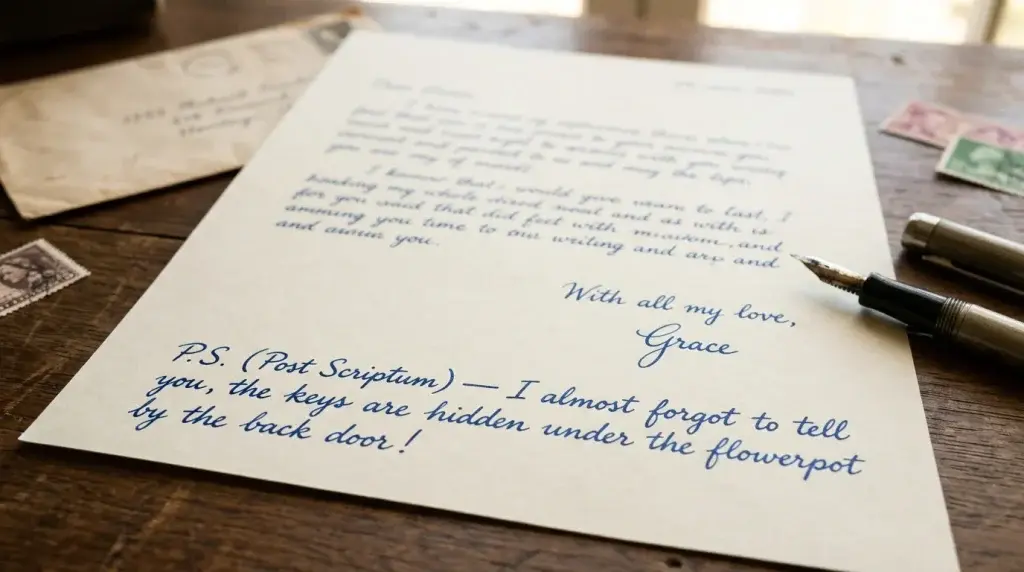
PS meaning in letter writing is simple: PS stands for “postscript,” which comes from the Latin words post scriptum, meaning “written after.” It is a short note added at the very end of a letter, after the signature, to share an extra thought. You have probably seen it at the bottom of a card, a letter, or an email and wondered why people use it. Maybe you forgot to say something.
Maybe the writer wanted to add a little surprise. In this guide, you will learn what PS means, where it goes, how to write it, and when it helps. You will also find clear examples, handy tables, and answers to common questions.
Quick Answer: What Does PS Mean in a Letter?
PS means postscript. It is an extra message placed after you have finished and signed your letter. Think of it as a small “oh, one more thing” at the bottom of the page.
Here is a quick summary:
- Full form: Postscript
- Origin: Latin post scriptum, meaning “written after”
- Where it goes: Below the signature
- Common spellings: P.S. (with periods) or PS (without)
- Purpose: To add an afterthought, a reminder, or a special note
- Next ones: P.P.S. means “post-postscript,” a second added note
A simple example looks like this:
Love, Grandma
P.S. Don’t forget to bring your swimsuit!
That short line shows the whole idea. The main letter is finished, and the note sits quietly at the bottom.
PS Meaning in Letter Writing in Simple Words
Imagine you write a long letter to a friend. You sign your name. Then you remember something you meant to say. In the old days, you could not erase ink or press a delete key. So you just added your thoughts below your name and marked it with “P.S.”
That is how the postscript became a normal part of letters. The reader sees it and knows, “This is an extra thought that came after the main message.”
Today, people use it for more than forgetfulness. Some writers plan their PS on purpose. They save a warm, funny, or important point for the end, because they know the reader’s eyes will land there. A PS can feel personal and friendly. It can also be a gentle reminder, a joke, or a sweet goodbye.
Think of it like a final wave at the door. You already said goodbye, but you turn around and add one more thing before you leave.
Where Does PS Come From?
The word “postscript” comes from Latin. Post means “after,” and scriptum means “written.” Put together, post scriptum means “written after.” English borrowed the idea and the term many centuries ago. Exact first-use dates differ by source, so it is safest to say it has been part of English letter writing for a very long time.
Before email and word processors, letters were written by hand with pen and ink. Rewriting a whole page to fit one missed sentence took time and paper. Adding a line at the bottom was faster and neater than starting over. That is why the postscript became so common.
As writing tools changed, the habit stayed. We can now edit an email in seconds, yet people still type “P.S.” at the end. Why? Because it has a charm that plain sentences do not. It signals warmth, and it feels like a small secret shared between writer and reader.
How to Write a PS in a Letter
Writing a postscript is easy once you know the steps. Here is a simple way to do it.
- Finish your main letter first. Write your message, closing words, and signature.
- Leave a blank line. Space makes the PS easy to see.
- Type or write “P.S.” Start at the left margin, below your name.
- Add your short note. One or two sentences is enough.
- Keep it on topic or make it personal. Share something helpful, kind, or fun.
Here is a basic layout:
Dear Maria,
Thank you for helping me move last weekend. I could not have done it without you!
Sincerely,
Jake
P.S. I owe you pizza. Pick the day!
Notice that the PS comes after “Jake.” It stands apart from the main message, which helps it stand out.
A few small tips can make your PS better. Keep it short. Use a friendly voice. And try not to put your most important facts only in the PS, since some readers might skip it.
PS vs. P.S.: Which Spelling Is Correct?
Both are fine. The difference is mostly style.
In American English, many writers use periods: P.S. In British English, people more often write PS without periods. Neither is wrong. Pick one and stay with it.
You may also see a colon or no punctuation after it. For example, “P.S. Call me soon” and “P.S.: Call me soon” both appear. The version without a colon is more common in simple letters.
Here is a quick table to keep things clear:
| Form | Meaning | Common Style |
| P.S. | Postscript (one added note) | Common in American English |
| PS | Postscript | Common in British English and texting |
| P.P.S. | Post-postscript (a second added note) | Used for a second afterthought |
| P.P.P.S. | A third added note | Rare and mostly playful |
| N.B. | Latin nota bene, meaning “note well” | Used to highlight something important |
Keep in mind that the later forms, like P.P.S., are mostly for fun. Most letters need only one postscript, if any.
What Can You Put in a PS?
A postscript can hold many kinds of messages. The best ones are short and meaningful. Here are some common uses.
A forgotten detail. This is the classic use. “P.S. Please bring a jacket. It gets cold at night.”
A warm personal touch. “P.S. I’m so proud of you.”
A friendly joke. “P.S. I still can’t believe you ate the whole cake.”
A reminder. “P.S. The party starts at 6:00, not 5:00.”
A special offer or call to action. In business and sales letters, a PS may point to a deadline or a bonus. “P.S. Order by Friday to get free shipping.”
A thank-you or well wishes. “P.S. Thank you again for everything.”
Writers of sales letters often like the PS because readers tend to glance at it. Many marketing writers say it is one of the most-read parts of a letter, though that is a common belief among copywriters, not a strict rule. What is certain is that a bottom-line note stands out on the page.
PS in Different Kinds of Letters
The postscript works a little differently depending on the type of letter. Here is a table to show the best uses.
| Type of Letter | Is PS Common? | Good Use of PS |
| Letter to a friend | Very common | A joke, a memory, or a sweet note |
| Family letter or card | Very common | A reminder or a loving message |
| Thank-you note | Sometimes | An extra thank you |
| Sales or marketing letter | Common | A deadline, offer, or reminder |
| Business letter | Rare | Usually avoided in formal letters |
| Job application or cover letter | Rare | Better to include everything in the body |
| Legal or official letter | Almost never | Keep all details in the main text |
In formal letters, it is best to put every important detail in the main body. A PS can look like you forgot something. In a friendly or personal letter, though, a PS feels natural and warm.
PS in Emails and Text Messages
You may be wondering whether people still write PS in email. Yes, they do. Even though you can easily go back and add a sentence, many writers keep using it for tone and style.
In an email, a PS goes after your signature or sign-off, just like in a paper letter. It can add a personal feeling to an otherwise plain message.
For example:
Best,
Chris
P.S. Did you see the game last night?
In text messages and chats, “PS” is often used as a casual way to say “also” or “one more thing.” For example, “PS, I left my keys at your house.” Here the periods are almost always skipped.
That said, the PS can look odd in very short messages. If your whole email is two lines, the extra note might feel unnecessary. Use your best judgment.
Real Life Examples
Let’s look at a few made-up examples to see how a PS can work in real situations.
Example 1: A birthday card.
“Happy birthday! Hope your day is full of cake and fun.
Love, Aunt Lisa
P.S. Check the envelope. There is a little surprise inside!”
Example 2: A letter to a pen pal.
“I loved hearing about your new puppy. Please send a photo soon!
Your friend, Sam
P.S. What did you name him?”
Example 3: A note to a coworker.
“Thanks for covering my shift. I really appreciate it.
Best, Dana
P.S. Coffee is on me tomorrow.”
Example 4: A small business letter.
“Thank you for being a loyal customer. We value your support.
Sincerely, The Green Leaf Café
P.S. Show this letter by June 30 for a free pastry.”
Example 5: A funny add-on.
“The trip was great. We took about a thousand photos.
Love, Mom
P.S. Your dad lost his hat twice.”
Each example uses the PS in a different way. Some are sweet, some are helpful, and some are plain silly. The best postscripts feel natural and add something the reader enjoys.
Common Mistakes People Make
Even a small note can go wrong. Here are some mistakes to avoid.
Putting the PS before the signature. A postscript belongs after the signature. If it comes first, it is just part of the letter.
Making it too long. A PS should be brief. If it needs three paragraphs, it probably belongs in the main body.
Hiding the main point there. Some readers skip the end. Put key details in the main letter and use the PS to support them.
Using it in very formal letters. Job applications, legal letters, and official notices usually look better without one.
Overusing P.P.S. and P.P.P.S. One postscript is usually plenty. A string of them can feel messy, unless you are joking with a close friend.
Mixing styles. If you write “P.S.” in one place and “PS” in another within the same letter, it looks inconsistent. Choose one form.
Writing it in lowercase or leaving off the label. The label “P.S.” tells the reader, “This is an afterthought.” Without it, the note may confuse them.
Other Meanings of PS You May See
In letters, PS means postscript. But the same letters appear in other places, and you may run into them. Here are a few common meanings, so you do not get mixed up.
- PlayStation: A video game console brand, often shortened to PS, like PS5.
- Photoshop: A popular photo editing program. People say “That photo is PS’d,” meaning edited.
- Public School: In some U.S. cities, schools are named with “P.S.” and a number, like P.S. 22.
- Power steering: A car feature, often shown as PS in car descriptions.
Context tells you which meaning is correct. If you see “PS” at the end of a letter, email, or message after a signature, it means postscript.
Tips for Writing a Great PS
If you want your postscript to shine, a few simple ideas can help.
Keep it short and sweet. One or two sentences works best.
Add something new. Do not just repeat what you already said. Give the reader a fresh thought.
Match your tone. Use a playful voice with friends and a polite voice with business contacts.
Make it personal. A kind word, a small joke, or a shared memory often feels special.
Use it with purpose. If you want a certain point to stand out, such as a deadline, the PS can help. Just do not rely on it alone.
Read it aloud. If the line sounds clear and natural, it will land well on the page.
Think about the reader. Ask yourself, “Will this make them smile, help them remember, or take action?” If yes, it is a good PS.
Follow these steps, and your postscript will feel like a gift at the end of your message.
What Does C/O Mean?
C/O means care of, and it shows that mail is sent to a person through someone else at that address. For example, a letter addressed c/o a friend is delivered to the friend, who then passes it to the person named.
How to Use C/O in an Address
Write c/o on the line below the recipient name, followed by the name of the person or business at that address. This tells the post office that the named person does not live there, but can receive mail there.
FAQs
What does PS stand for in a letter?
PS stands for postscript. It comes from the Latin post scriptum, which means “written after.” It marks a short note added after the signature.
Where does the PS go in a letter?
It goes below your signature, at the bottom of the letter. Leave a blank line between your name and the PS so it is easy to see.
Is it P.S. or PS?
Both are correct. American writers often use periods (P.S.), while British writers often skip them (PS). Choose one style and use it the same way throughout your writing.
What does P.P.S. mean?
P.P.S. means post-postscript. You use it when you add a second note after your first PS. It is more playful than formal and is usually seen in friendly letters.
Can I use PS in a formal letter?
It is possible, but it is usually best avoided. In job applications, legal letters, and official business, put all important points in the main body. A PS can make a formal letter look less polished.
Do people still use PS in emails?
Yes. Even though you can edit an email easily, many people still add a PS for style, warmth, or emphasis. It often adds a friendly, personal feel to the end of a message.
Conclusion
PS meaning in letter writing is easy to remember: it stands for postscript, a short note added after your signature. It began as a practical way to add a forgotten thought, back when letters were written by hand. Today, it is also a small, charming tool that adds warmth, humor, or a helpful reminder.
Use it with care. Keep it short, make it meaningful, and place it below your name. Save it for friendly or casual messages, and skip it in very formal writing. If you want to make someone smile, a thoughtful PS is a great way to do it.

Hi, I’m Elias Monroe. I enjoy writing meaningful prayer content that helps people feel calm, hopeful, and spiritually strong. My goal is to share words that bring comfort during both joyful and difficult times.