You see it carved on a mountain stone, printed on a prayer flag, or stamped on a bracelet: Om Mani Padme Hum. Few phrases travel as widely, from Himalayan monasteries to phone screens around the world. Yet the six syllables rarely come with an explanation.
The answer has layers. Translators render the mantra in different ways, and teachers explain it through compassion, wisdom, and practice rather than a single sentence. Understanding it starts with seeing it as both a phrase and a practice. Even so, a clear starting point exists.
In this guide, you’ll learn the meaning of each syllable, where the mantra comes from, how to pronounce it, and how to chant it with respect. Along the way, we’ll also look at why scholars and practitioners read it differently.
Quick answer: Om Mani Padme Hum is the six-syllable mantra of Avalokiteshvara, the bodhisattva of compassion. It is often translated as “the jewel in the lotus,” and it points to compassion and wisdom working together.
Let’s begin with a quick snapshot of the meaning.
Quick Meaning Snapshot
| Syllable | Common translation | Common association |
| Om | Sacred opening sound | Body, speech, and mind |
| Mani | Jewel | Compassion and the wish to help others |
| Padme | In the lotus | Wisdom, purity, and awakening |
| Hum | Closing seed syllable | Unity and the heart of the practice |
Interpretations differ between teachers and lineages. Still, this table gives a reliable starting point for the sections ahead.
Word-by-Word Breakdown
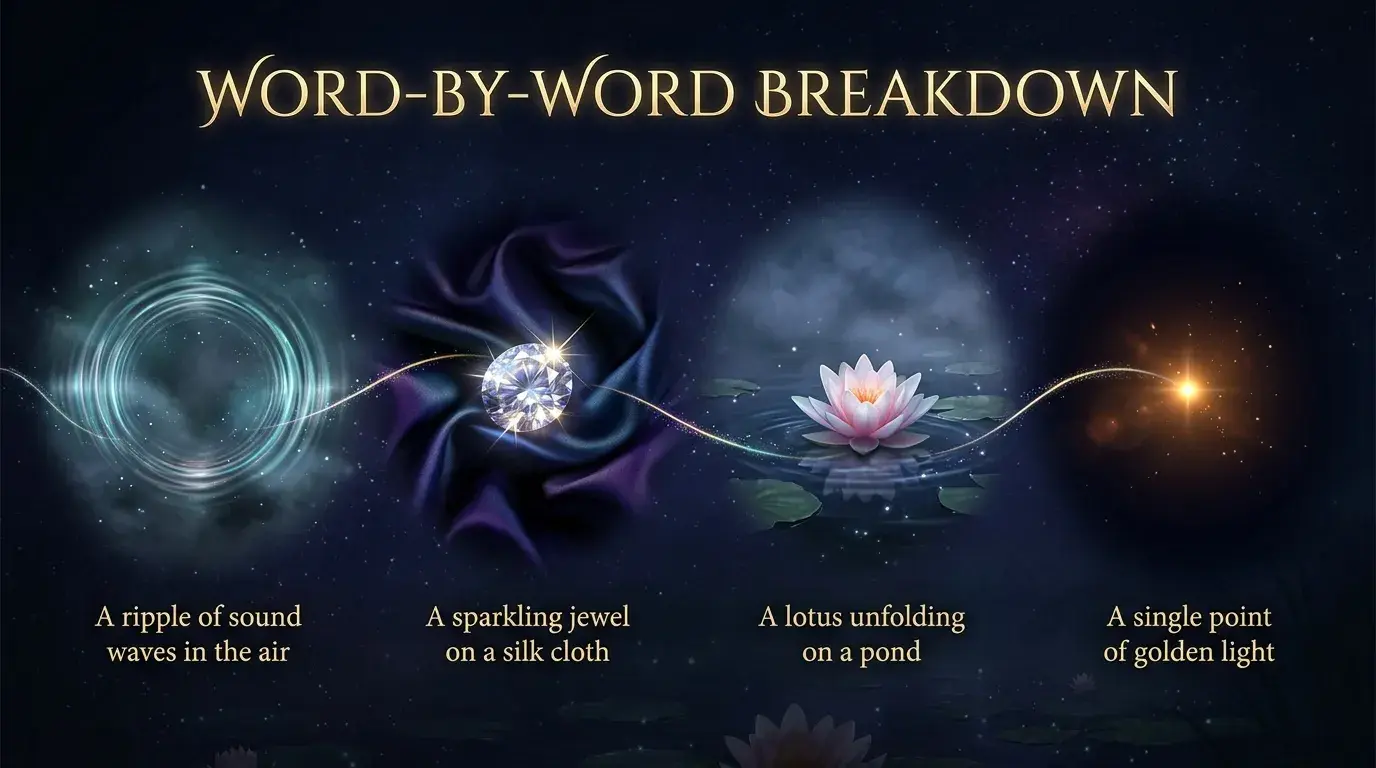
Each syllable carries its own layer of meaning. Reading them one at a time makes the whole mantra easier to grasp.
Om
Om is a sacred sound that opens many mantras in Indian religions. Buddhist teachers often link it to the body, speech, and mind of an awakened being. Some also describe it as a call that opens the heart before the rest of the mantra begins.
Mani
Mani means “jewel.” In Buddhist writing, it often points to a wish-fulfilling gem. Teachers in the Tibetan tradition commonly connect the jewel to compassion and to the wish to free all beings from suffering.
Padme
Padme comes from padma, the Sanskrit word for lotus. The lotus grows in muddy water yet rises clean and bright. For that reason, Buddhists see it as a symbol of purity and awakening, and teachers often link it to wisdom.
The ending -e is a grammatical form, and scholars debate its exact role. That debate gets its own section below.
Hum
Hum is a seed syllable that closes the mantra. Many teachers link it to the essence of the awakened mind and to the union of compassion and wisdom. Others see it as a seal that gathers the whole mantra into one point.
Putting it together
Joined together, the words are most often rendered as “the jewel in the lotus.” A more literal English version reads “praise to the jewel in the lotus.” Other scholars read the middle words as a name, which we explore later.
No single English line captures everything. For this reason, many practitioners treat the translation as a doorway and the chanting as the path.
The Deeper Meaning
Beyond translation, the mantra carries teachings that Buddhists have explored for centuries. The ideas below come from common Tibetan Buddhist explanations. Details vary by teacher and lineage.
Compassion and wisdom as one path
In Mahayana Buddhism, compassion and wisdom are often called the two wings of a bird. A bird needs both to fly. Compassion without wisdom can lose its way, while wisdom without compassion can turn cold.
The mantra holds the two together. The jewel points to compassion, and the lotus points to wisdom.
Purifying body, speech, and mind
Many teachers say the mantra helps transform ordinary body, speech, and mind into their awakened forms. The practice works step by step. Over time, the chanter aims to grow kinder in action, in words, and in thought.
The six syllables and the six perfections
One common teaching links each syllable to a Mahayana perfection:
- Om: generosity
- Ma: ethics
- Ni: patience
- Pad: diligence
- Me: concentration
- Hum: wisdom
The six syllables and the six realms
Another scheme links each syllable to one of the six realms of rebirth, from the realm of the gods with Om to the hell realm with Hum. Chanting is said to help free beings in each realm. Commentaries differ in the details, so treat any single chart as one tradition’s view.
The lotus and the jewel in Buddhist art
Buddhist art often shows the lotus as a seat or a held flower. The jewel stands for something priceless inside every being. Together, they remind viewers that clarity can grow even in difficult conditions.
Dalai Lama teachings
The Dalai Lama often teaches the mantra as a short summary of the path. In his explanations, compassion and wisdom work together, and practice matters more than a perfect translation. For his exact words, read his published teachings directly.
Who Is Avalokiteshvara?
Avalokiteshvara is the bodhisattva of compassion in Mahayana Buddhism. A bodhisattva is a being who aims to awaken for the sake of all others. This figure is loved across Asia, and each culture has its own name for the bodhisattva.
- Avalokiteshvara: the Sanskrit name
- Chenrezig: the Tibetan name
- Guanyin: the Chinese name
- Kannon: the Japanese name
Traditional images show a calm figure with a gentle face. Some images show four arms, and others show a thousand arms and many eyes, which symbolize the reach of compassion.
In Tibetan Buddhism, the Dalai Lamas are traditionally regarded as emanations of Avalokiteshvara. This belief helps explain why the mantra holds such a central place in Tibetan life.
The figure’s appearance also changed across cultures. In China, for example, Guanyin is often shown in a female form.
Origin and History
The mantra has a long and well-documented story. Still, scholars hold different views on some details.
Early textual roots
The mantra first appears in the Karandavyuha Sutra, a Mahayana text that scholars often date to about the fourth or fifth century CE. The sutra calls it the six-syllable mantra and the innermost heart of Avalokiteshvara. It praises the mantra as a path to liberation.
Spread across Asia
From its Indian roots, the mantra traveled through Nepal, Tibet, Mongolia, and China. Each region adapted the sounds to its own language. As a result, you will see spellings such as “Om Mani Peme Hung” and “Om mani badme khum.”
Role in Tibetan culture
In Tibet, the mantra became part of daily life. People carve it into rocks, paint it on hills, and print it on prayer flags. Scrolls of the mantra also fill prayer wheels. Tibetan practice draws on later works such as the Mani Kambum, a text often dated to the eleventh century.
Why it became so popular
The mantra is short and rhythmic, so anyone can learn it quickly. Its message of compassion also speaks to people far beyond monastery walls.
Modern spread
Today, the mantra appears in meditation apps, books, music, and jewelry. This visibility brings new interest in the practice. It also brings a need for care and context, as the later sections explain.
Translation Debates
Surprisingly, the meaning of the middle words is still discussed by scholars. Two main readings stand out.
“Jewel in the lotus”
This is the popular reading. Scholar Alexander Studholme reads manipadme as a compound in the locative case, meaning “in the jewel-lotus.” A variation reads it as “in the lotus made of jewels.” This view fits the common image of a precious gem resting inside a flower.
The vocative reading
Scholar Donald Lopez argues for a different grammar. Citing Tibetan grammatical sources, he suggests that manipadme is a form of address, a call to a bodhisattva named Manipadma, or “Jewel-Lotus.” Tibetan writers also support this reading, including a ninth-century grammatical treatise and a seventeenth-century work from the circle of the fifth Dalai Lama.
In this view, the mantra means something like “O you who hold the jewel and the lotus.”
Why Sanskrit grammar creates debate
Sanskrit endings can signal several cases. The ending -e can mark a locative or a vocative, depending on the word. As a result, both readings are grammatically possible, and scholars weigh the evidence differently.
Why practitioners may not mind
For many practitioners, the mantra works as a practice rather than a sentence to parse. Chanting, visualizing, and reflecting on compassion matter most. A literal translation helps, but it does not replace the experience.
How to explain this respectfully
When you share the meaning, present the popular reading first and then mention the scholarly debate. This approach respects both the tradition and the research. It also helps readers avoid claiming one final answer.
How the Mantra Is Used
People use Om Mani Padme Hum in many ways, from quiet personal practice to community rituals.
Chanting aloud and silently
Practitioners chant the mantra out loud, whisper it, or repeat it silently. Each method has its own feel. Aloud chanting can steady the mind, while silent repetition suits busy places.
Mala beads
A traditional mala has 108 beads. Chanters move one bead at a time to keep count. A simple counter also works if you prefer it.
Prayer wheels
Prayer wheels contain scrolls printed with the mantra many times over. Turning the wheel clockwise is a traditional way to honor its blessings. Large wheels stand at temples, while small handheld ones are common at home.
Mani stones and mani walls
Carvers inscribe the mantra on flat stones and leave them along paths. Over time, these stones form long walls. Travelers walk past them on the left in a traditional show of respect.
Prayer flags
Colorful flags carry printed mantras and hang in high places. According to tradition, the wind spreads the blessings to all who pass. Flags fade and fray, which reflects the Buddhist view of impermanence.
Daily and ritual practice
Monasteries recite the mantra in morning sessions, group retreats, and ceremonies. Lay practitioners often chant during walks, commutes, or quiet evenings.
How to Pronounce Om Mani Padme Hum
Pronunciation changes with language and region. Sanskrit, Tibetan, and other traditions each have a typical sound.
| Tradition | Common rendering | Rough sound |
| Sanskrit | Om Mani Padme Hum | om MAH-nee PAHD-meh hoom |
| Tibetan | Om Mani Peme Hung | om MAH-nee PEH-meh hoong |
| Mongolian | Om mani badme khum | om MAH-nee BAHD-meh khoom |
| Mandarin Chinese | Ōng mā nī bēi mēi hōng | ong mah nee bay may hong |
These guides are approximate. For accurate sounds, listen to a Tibetan teacher or a trusted recording. Some practitioners also add a seventh sound, hrih, but that is a separate variation.
Sincerity matters more than perfect pronunciation. Start with the version you hear most often, and refine it over time.
How to Chant It Step by Step
A simple routine can help you begin. Adjust it to suit your own tradition and teacher.
Set a calm space
Find a quiet corner and sit comfortably. A cushion or a chair works equally well. Turn off notifications so the space feels still.
Set an intention
Begin with a brief intention, such as wishing kindness for yourself and others. This links the practice to its heart. Keep the thought gentle and sincere.
Start slowly
Breathe naturally and let the rhythm follow your breath. Chant at an unhurried pace. Speed adds nothing, while steadiness helps the mind settle.
Use beads or a counter
Begin with a small number, such as 21 repetitions. Increase the count over time if it feels natural. Many practitioners work toward 108.
End with dedication
When you finish, sit for a moment in silence. Then dedicate the benefit to all beings, with a simple wish for their happiness.
A sample five-minute routine
- Minute 1: settle your posture and breathe
- Minute 2: set your intention
- Minutes 3 and 4: chant slowly, aloud or silently
- Minute 5: rest in silence and dedicate the practice
Benefits People Report
Practitioners describe a range of benefits. Most fall into two groups.
Traditional benefits
In Buddhist teaching, chanting purifies negative states and grows compassion. The practice also builds a habit of kindness. The Karandavyuha Sutra itself praises the mantra as deeply beneficial.
Commonly reported personal benefits
Many people report calm, better focus, and steadier emotions. Others value the rhythm as a daily anchor. These are personal experiences, so results differ from person to person.
A note on research
Studies on meditation and repeated mantra practice exist, and some show benefits for stress. Findings vary, though, and no study can promise a result for you. This article is not medical advice. If you face health concerns, please speak with a qualified professional.
Realistic expectations
The practice builds slowly. Small, steady sessions matter more than long, rare ones. Over time, you may notice changes in how you respond to others.
Common Misconceptions
A few myths surround the mantra. Clearing them up helps you approach it with respect.
- “It’s just a pretty phrase.” In reality, it is a sacred mantra with deep roots in Mahayana Buddhism.
- “It’s a magic spell for wishes.” Buddhist teachers describe it as a practice for compassion and wisdom, not a tool for granting desires.
- “It’s the same as the Hindu Om.” Om is sacred in several Indian traditions. The full mantra, however, belongs to Buddhism and Avalokiteshvara.
- “You must chant it perfectly.” Sincerity and steady effort matter more than flawless sound.
- “It only belongs to monks.” Lay practitioners chant it every day across Asia and beyond.
Using the Mantra Respectfully
Because the mantra is sacred, a little care goes a long way.
On jewelry, clothing, and tattoos
Many people wear the mantra for personal inspiration. Before you do, learn what it means and why it matters. Choose placement with care, since some traditions advise against putting sacred words on the lower body or on shoes.
Learn from a teacher or trusted source
Some traditions suggest receiving a transmission from a qualified teacher. Others welcome anyone to recite it. If you feel drawn to deeper practice, find a teacher or a Buddhist center you trust.
Avoid commercial misuse and false claims
Be cautious about products that promise wealth, love, or cures through the mantra. Such claims distort the teaching. Genuine practice focuses on compassion and wisdom.
Place mantra items with care
In many traditions, people keep sacred items off the floor and out of unclean places. Store prayer beads, books, and prints in a clean, raised spot. This small habit shows respect.
Om Mani Padme Hum in Pop Culture and Daily Life

The mantra now appears far from its origins. You will find it in meditation music, apps, books, and films. Home decor, bracelets, and gift items also carry it.
This wide reach can spark real curiosity. It can also flatten the meaning into a trend. Context and respect keep the mantra tied to its purpose, which is compassion in daily life.
Frequently Asked Questions
What does Om Mani Padme Hum mean in English?
It is often translated as “the jewel in the lotus.” Teachers read it as compassion and wisdom working together.
Is Om Mani Padme Hum Buddhist or Hindu?
It is a Buddhist mantra linked to Avalokiteshvara. The opening sound Om is sacred in several Indian traditions.
Who is the mantra for?
It is the mantra of Avalokiteshvara, the bodhisattva of compassion. Practitioners chant it to grow compassion and wisdom.
What does “jewel in the lotus” mean?
The jewel stands for compassion, and the lotus stands for wisdom and purity. Together, they show a precious quality resting inside a pure flower.
How many times should you chant it?
No single number is required. Many practitioners use 108 repetitions, while beginners often start with 21.
Can anyone chant Om Mani Padme Hum?
Many Tibetan teachers welcome all people to recite it. Some traditions suggest receiving a transmission from a qualified teacher.
What does Om Mani Padme Hum mean on a bracelet or tattoo?
It often serves as a reminder of compassion and wisdom. Learn the meaning first, and wear it with respect.
What is the Tibetan pronunciation?
Tibetans commonly say “Om Mani Peme Hung.” Listen to a Tibetan teacher for the best guide.
What are the six syllables linked to?
One common teaching links them to the six perfections, and another to the six realms. Details differ by lineage.
Does it have to be chanted in Sanskrit?
No. Practitioners chant it in Sanskrit, Tibetan, and other regional forms. What matters is a sincere and steady intention.
Conclusion
Om Mani Padme Hum is a six-syllable mantra of compassion and wisdom. It is often rendered as “the jewel in the lotus,” though scholars also offer other readings. Each syllable adds a layer, from the sacred opening to the closing seed sound.
Meaning is a doorway, and practice is the path. Learning the origin, the symbolism, and the pronunciation helps you walk through that doorway with care.
If the mantra speaks to you, begin gently. Chant a few minutes a day, learn from trusted teachers, and keep the spirit of kindness at the center. Share this guide with someone who is curious, and explore our other mantra and meditation guides.

Hi, I’m Elias Monroe. I enjoy writing meaningful prayer content that helps people feel calm, hopeful, and spiritually strong. My goal is to share words that bring comfort during both joyful and difficult times.