Tongue and cheek meaning, in plain words: people usually mean “tongue in cheek,” a phrase for saying something in a joking way, not seriously. The “and” version is a common slip, but the idea behind it is easy to understand.
Maybe you saw the phrase in a text, a review, or a TV show and wondered if the speaker was kidding. That is a smart question, because this kind of humor can be hard to spot. The tone is playful, the face is often straight, and the words are not meant to be taken at face value.
In this guide, you will learn what the phrase means, how to write it the right way, and where it likely came from. You will also see real examples, common mistakes, and simple tips for telling when someone is joking.
Quick Answer: Tongue and Cheek Meaning
When someone says “tongue and cheek,” they almost always mean “tongue in cheek.” It describes a statement or action that is meant as a joke, often with a straight face. The speaker does not mean it literally.
Here is a simple example. A friend burns the toast and says, “I’m a world-class chef.” She is not bragging. She is making a playful joke about her own mistake. That is tongue-in-cheek humor.
You can think of the phrase as a wink in words. The speaker is saying, “Don’t take me seriously, I’m having fun.” The person listening is supposed to catch the joke without a big explanation.
Is It “Tongue and Cheek” or “Tongue in Cheek”?
This is the question behind many searches. The correct idiom is “tongue in cheek.” The phrase “tongue and cheek” is a common mistake. It sounds close, so people mix it up, especially when they only hear the phrase and never see it written.
The mistake makes some sense. Your tongue and your cheek are both parts of your mouth, so “and” feels natural. But the real image is of a tongue pushed into the cheek. That is why the word “in” matters. The table below shows the common forms.
| Phrase | Correct? | Notes |
| Tongue in cheek | Yes | The standard idiom |
| Tongue-in-cheek | Yes | Use hyphens before a noun, like “a tongue-in-cheek joke” |
| Tongue and cheek | No | A common error, but the meaning people intend is the same |
| Tongue in check | No | A spelling slip, since “check” is a different word |
| Tongue in the cheek | No | Not the standard form |
If you are writing for school, work, or a website, use “tongue in cheek.” If you are just talking, no one will be confused. Most listeners will still know what you mean.
What Does Tongue in Cheek Really Mean?
At its core, “tongue in cheek” means “said in fun.” It covers jokes, playful remarks, and humor that should not be taken seriously. The tone is light, and the point is usually to amuse, tease, or poke gentle fun at something.
The humor often depends on a gap between what is said and what is meant. A speaker may sound serious while saying something that is clearly silly. The listener smiles because they notice the gap. That small moment of “I get it” is what makes this style work.
It also helps to know what the phrase does not mean. It does not mean the speaker is lying, and it does not usually mean they are being cruel. The goal is playfulness. Of course, a joke can still miss the mark, and we will talk about that later.
You can use the phrase for people and for things. A person can speak tongue in cheek. A video, a book title, a product name, or an ad can also be tongue in cheek. In each case, the creator wants you to smile and not take every word as fact.
Where Does the Phrase Come From?
The picture behind the idiom is simple. When someone pushes their tongue into their cheek, the cheek bulges out. Some word historians say this was once a way to show scorn, or to hide a laugh while pretending to be serious.
Over time, the idea changed. A hidden smirk turned into a general sense of “I’m not being serious.” By the 1900s, the phrase was a common way to describe playful, ironic humor. Today, almost no one thinks about the bulging cheek when they say it.
I should be honest here. Word experts do not fully agree on the exact first use or the exact path the phrase took. Some sources mention writers from the 1700s and early 1800s. Because the details are debated, it is safer not to claim one exact date. What we can say for sure is that the idiom has been around for a long time and the meaning has stayed fairly steady.
How to Use Tongue in Cheek in a Sentence
The phrase works in a few ways. It can describe a noun, like “a tongue-in-cheek remark.” It can also describe how something was said, like “She said it tongue in cheek.”
Grammar is simple once you know one rule. Put hyphens between the words when the phrase comes before a noun. That gives you “a tongue-in-cheek video” or “tongue-in-cheek humor.” When the phrase comes after the verb, you can skip the hyphens. That gives you “He wrote it tongue in cheek.”
You may also see the longer form “with tongue firmly in cheek.” This adds a little extra emphasis. It tells the reader, “Yes, this is a joke, and I know it.”
Here are some easy sentence examples:
- “The ad is tongue in cheek, so don’t take it seriously.”
- “He offered a tongue-in-cheek apology for eating the last cookie.”
- “I said it tongue in cheek, but she thought I was serious.”
- “The book’s title is a tongue-in-cheek joke.”
The phrase does not change in past or future tense. It stays the same no matter when the joke happened.
Real Life Examples of Tongue-in-Cheek Humor
Seeing the phrase in daily life makes it much clearer. Here are a few settings where you may notice it.
At home, a parent might look at a messy room and say, “Wow, what a clean space.” Everyone knows the room is a disaster. The playful tone makes it a tongue-in-cheek comment. Among friends, someone might call a small hill “a mountain climb” while huffing after a short walk. That is the same kind of fun.
In media, plenty of products are tongue in cheek. A funny company slogan, a joke product on a store shelf, or a movie trailer that pokes fun at its own genre can all fit. Newspapers and websites sometimes run playful “news” stories to make readers laugh. Those pieces rely on the reader catching the joke.
At work, you might see a tongue-in-cheek email subject like “Urgent: The Cake Is Gone.” No one thinks it is an emergency. The joke lightens the mood. In every case, the shared understanding is what matters. Both sides need to know it is a joke.
Tongue in Cheek vs. Sarcasm, Irony, Satire, and Deadpan
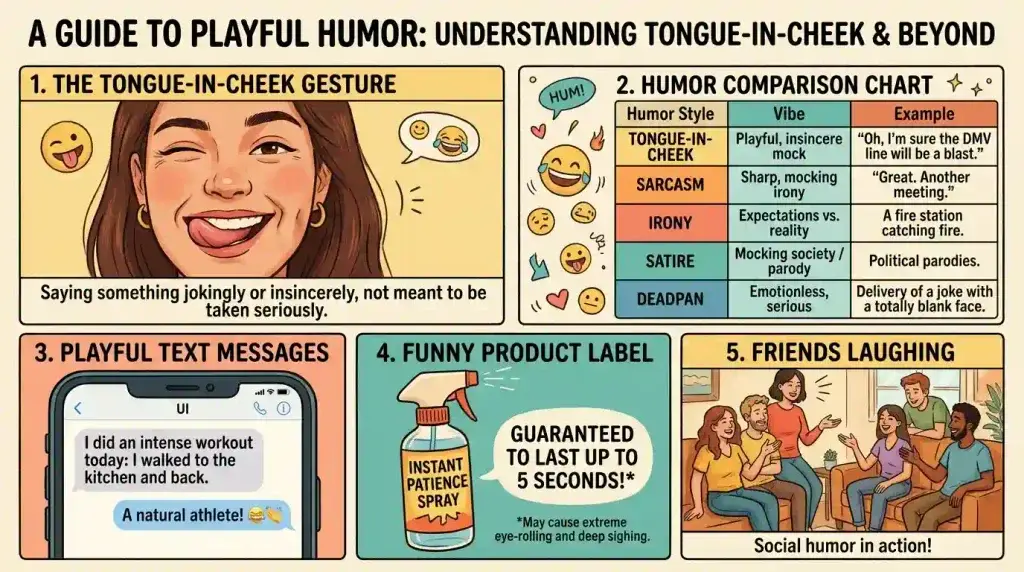
Many readers mix up tongue in cheek with other kinds of humor. They overlap, but they are not the same. This table gives a quick guide.
| Term | Simple Meaning | Tone | Example |
| Tongue in cheek | Said as a playful joke | Light and friendly | “I’m a genius,” says the person who lost their keys |
| Sarcasm | Saying the opposite to mock or sting | Often sharp or bitter | “Great job,” after someone drops a tray |
| Irony | A gap between what is expected and what happens | Can be funny or sad | A fire station burns down |
| Satire | Humor used to criticize people or ideas | Often pointed | A fake news story that mocks politicians |
| Deadpan | Joking with a flat, serious face | Dry and calm | Saying something silly without smiling |
The big difference is tone. Tongue in cheek tends to be friendly. Sarcasm often has an edge. Satire usually has a message. Deadpan is a style of delivery, and you can use it to be tongue in cheek.
These styles can also blend. A sentence can be sarcastic and playful at once. A satire piece can be tongue in cheek. Do not worry if the lines feel blurry. What matters most is knowing that the speaker is not being fully serious.
Common Mistakes People Make
A few mistakes come up again and again. Knowing them will help you use the phrase with more confidence.
The first mistake is the spelling mix-up we talked about. “Tongue and cheek” and “tongue in check” are both wrong. The second mistake is using the phrase to mean “serious.” The idiom means the opposite. If a statement is tongue in cheek, it is not meant to be taken at face value.
The third mistake is treating tongue in cheek as the same as sarcasm. Sarcasm can hurt. Tongue-in-cheek humor is usually lighter. The fourth mistake is skipping the hyphens before a noun. Writing “a tongue in cheek joke” is a small slip, and “a tongue-in-cheek joke” is the cleaner form.
Another common problem is using the phrase on a joke that nobody caught. If your audience missed the humor, calling it “tongue in cheek” later may sound like an excuse. A final mistake is overusing the phrase. If every post says “tongue in cheek,” it loses its charm. A good joke does not always need a label.
How to Tell If Someone Is Being Tongue in Cheek
Spoken words can be tricky, and written words are harder still. Without a voice or a face, a joke can look serious. Here are some clues that help.
First, listen for exaggeration. A person who says they “waited a million years” is probably not being literal. Second, watch for a gap between the words and the situation. Praise for a clearly bad result is a big hint. Third, look at tone. A grin, a pause, or a lifted eyebrow can show the speaker is playing.
In writing, look for clues like emojis, odd capital letters, or a silly turn of phrase. A line like “Obviously, I am the best cook in the universe” feels playful because it is so big. Context also matters. If a friend known for jokes says something odd, take it lightly.
When you are not sure, there is a simple fix. Ask, “Are you kidding?” That quick question can prevent a lot of confusion. It is better to ask than to guess wrong and hurt someone’s feelings.
Is It the Same in British and American English?
Mostly, yes. The phrase “tongue in cheek” is used in both American and British English with the same basic meaning. You will hear it in the US, the UK, and many other English-speaking places.
The bigger difference is in style. British humor is often described as dry and understated, and many people link it with deadpan delivery. American humor can be louder and more direct. Both can be tongue in cheek, though. The phrase describes the playful spirit, not a certain accent.
Because I did not find a firm rule that separates the two on this phrase, the safest advice is simple. Use “tongue in cheek” and you will be understood nearly anywhere English is spoken.
Tips for Writing Tongue-in-Cheek Content Without Confusion
If you write blogs, ads, emails, or posts, tongue-in-cheek humor can make your work more fun. It can also backfire. Here are some practical tips.
Know your audience. A joke that works with close friends may confuse strangers. Make the humor clear enough that most readers will catch it. A small signal, like a silly detail or a playful word, can help.
Keep it kind. Poking fun at yourself is usually safe. Poking fun at others can hurt, especially if the topic is sensitive. If a joke could be read as an insult, think twice.
Be careful with serious topics. Health, money, and loss are areas where jokes can land badly. If readers might act on what you say, a plain tone is usually better.
Do not rely on the label alone. Writing “just kidding” after a harsh line does not fix it. Instead, build the joke so the playful tone is clear from the start.
Finally, read your work out loud. If it sounds playful to your ear, it likely will to your reader.
Current Usage and Trends
Today, “tongue in cheek” is still a very common phrase. You will find it in reviews, news stories, social media posts, and everyday talk. People use it to describe jokes, ads, memes, and even whole shows.
Online, the phrase often shows up when people want to explain a post. A writer might add “this is tongue in cheek” so readers do not get upset. Others use it to describe a funny product or a playful style.
The spelling mix-up also remains common in search results and online comments. Many people type “tongue and cheek” because it sounds right. That is not a big problem, and it explains why so many readers look for the meaning this way. I did not find exact numbers on how often each version is used, so I will not guess.
FAQs
What does “tongue and cheek” mean?
People who say this usually mean “tongue in cheek.” It describes something said as a joke, often with a straight face, and not meant to be taken seriously.
Is it “tongue in cheek” or “tongue and cheek”?
The correct phrase is “tongue in cheek.” “Tongue and cheek” is a common mistake, but most listeners will still understand it.
Is tongue in cheek the same as sarcasm?
No. They overlap, but sarcasm often has a sharp or mocking edge. Tongue-in-cheek humor is usually lighter and more playful.
Should I use hyphens in tongue-in-cheek?
Use hyphens when the phrase comes before a noun, such as “a tongue-in-cheek joke.” After a verb, you can leave them out, as in “She said it tongue in cheek.”
Where does the phrase come from?
It likely comes from the image of a tongue pushed into the cheek, once linked to scorn or a hidden laugh. The exact first use is debated, so no single date is certain.
Can writing be tongue in cheek?
Yes. Books, ads, articles, and posts can all be tongue in cheek. Just make sure the playful tone is clear so readers do not take the words literally.
Conclusion
The tongue and cheek meaning is easy to hold onto once you know the trick. The phrase people want is “tongue in cheek,” and it describes something said in fun, not in earnest. The speaker is winking with words, and the listener is invited to smile.
We also looked at how the phrase differs from sarcasm, irony, satire, and deadpan. Tongue in cheek is usually the lightest and friendliest of the group. It shows up in jokes, ads, books, and daily talk, and it has been around for a long time.
Here is one practical tip. When you use the phrase, write it as “tongue in cheek,” and add hyphens before a noun. When you read it, look for exaggeration and a playful tone. And when you are not sure, a simple “Are you kidding?” can save the day.

Hello, I’m Clara Whitmore. I write daily prayers, devotionals, and faith-based reflections for readers seeking peace and encouragement. I believe prayer has the power to heal hearts and renew faith.