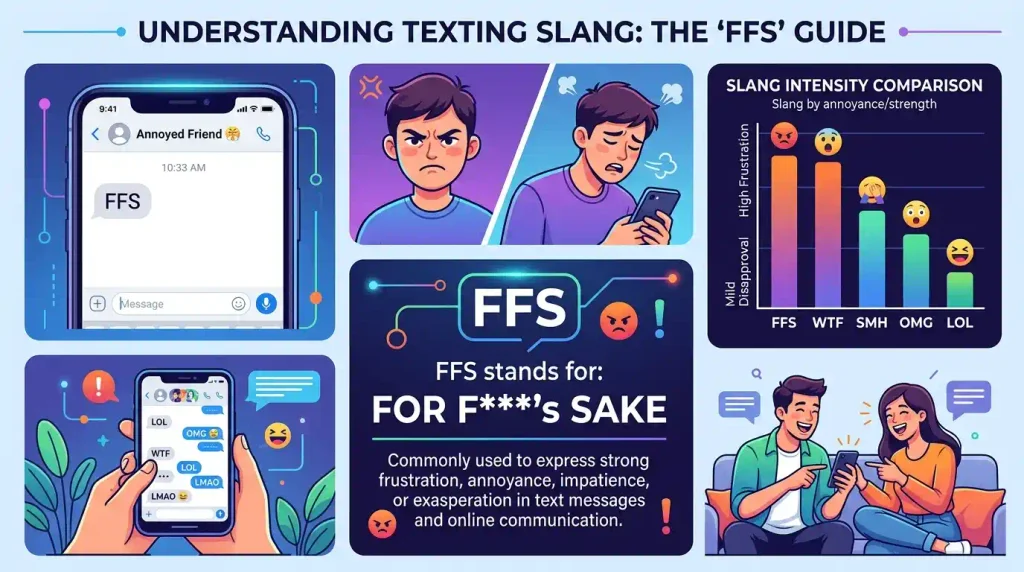
You are scrolling through your messages when a friend sends one word: “FFS.” Is it a joke? Millions of people have asked the same thing. In short, the ffs meaning in text is “for f***’s sake,” a rude but common way to show anger, stress, or annoyance. People type it when something goes wrong or someone does something silly.
It can sound harsh, so tone and timing matter a lot. In this guide, you will learn what FFS stands for, how people use it, and where it likely came from. You will see real examples, helpful tables, common mistakes, and other meanings too. By the end, you will know exactly how to read FFS and when to use it or skip it.
Quick Answer: What Does FFS Mean in Text?
FFS means “for f***’s sake.” People send it to show that they are frustrated, tired, or fed up. It works like a loud sigh in written form.
Think of the phrase “for goodness’ sake.” Now make it stronger and ruder. That is FFS. It does not always mean the writer is truly angry. Sometimes it is just a dramatic way to react to something small, like a dead phone battery or a slow website.
Here are the key points:
- Full form: For f***’s sake
- Feeling: Annoyance, anger, or stress
- Tone: Informal and rude
- Best used with: Close friends and family who are okay with strong language
The word is not polite. If you would not say the full phrase out loud in a room, think twice before texting the short version.
What Does FFS Stand For and How Strong Is It?
FFS is an abbreviation, which means it is a short form of a longer phrase. The letters stand for “for f***’s sake.” The phrase has a curse word in it, so the shortened version carries the same rude feeling, even though the bad word is hidden.
Many people think FFS is milder than the full phrase because you do not see the curse word. That is only partly true. Most readers know what the letters mean, so the message still lands hard.
The strength of FFS depends on who sends it and why. Between two close friends, it might be a playful groan. From a boss to a worker, it could feel like an attack. The same three letters can be funny or hurtful, depending on the setting.
Here is how the strength changes with the situation:
| Situation | How FFS Feels | Example |
| Joking with a close friend | Light and playful | “FFS, I left my keys inside again” |
| Complaining about a bad day | Mild to medium annoyance | “FFS, the train is late again” |
| Arguing with someone | Sharp and angry | “FFS, I already told you twice” |
| Texting a boss or teacher | Rude and risky | Not a good idea |
How to Use FFS in a Text Message
There are no strict grammar rules for slang, but people follow some habits. Learning these habits will help you sound natural.
First, FFS is usually written in capital letters, like “FFS.” Lowercase “ffs” is also common, and it often looks more relaxed. Capitals can feel like shouting, which adds more anger.
Second, FFS can stand on its own. A single “FFS” is a full message. It says, “I cannot believe this.”
Third, you can add it to the start or end of a sentence. For example, “FFS, why is this so hard?” or “Why is this so hard, FFS?” Both are fine. Most people add a comma to separate it from the rest of the sentence, though many skip punctuation in fast texts.
Fourth, you can stretch it out for drama. Some people write “FFSSSS” or “ffs!!!” to show extra frustration. Others add an emoji, like a face palm or an angry face, to make the mood clear.
Finally, FFS works best when the reader can guess the reason. If your message says only “FFS” and nothing else, the other person may be confused. A short follow-up, such as “my laptop just died,” helps everyone understand.
Real Life Examples of FFS in Texts
Seeing FFS in real situations makes it easier to understand. Below are made-up examples that show how people use it every day.
Imagine you are waiting for a package. It was supposed to arrive on Monday. On Friday, the tracking page still says “in transit.” You might text a friend: “FFS, my package still isn’t here.”
Maybe you are trying to fix a computer. Every time you click a button, the screen freezes. You could write: “Frozen again. FFS.”
Here is another one. A group chat is planning a trip. Someone changes the plan for the fifth time. A friend might reply: “FFS, can we just pick a date?”
Sometimes people use FFS to poke fun at themselves. If you spill coffee on your shirt right before a meeting, you might text: “Just spilled coffee on myself. FFS.”
The table below shows common messages and the feelings behind them:
| Text Message | What the Writer Really Feels |
| “FFS, it’s raining again” | Tired of bad weather |
| “FFS, answer your phone” | Impatient and worried |
| “FFS, that’s so unfair” | Upset about something wrong |
| “Lost my wallet. FFS.” | Stressed and annoyed at self |
| “FFS, it was only one job” | Frustrated with someone’s mistake |
Notice how each example has a clear reason. That makes FFS easier to read and less likely to be taken the wrong way.
Where Did FFS Come From?
The full phrase “for f***’s sake” has been part of spoken English for a long time. People have used similar phrases like “for God’s sake” and “for heaven’s sake” for many years to show frustration. The stronger version is a rude twist on those older sayings.
The short form FFS grew as people began typing on chat rooms, online forums, and later on phones. Typing long phrases takes time, so users made short forms. Think of LOL, BRB, and OMG. FFS joined that list.
Here is the honest part: no one can point to the exact day or place where FFS was first typed. Slang often spreads from many people at once, and no one keeps a perfect record. So this article will not guess. What we can say is that the short form became common as texting and social media grew, and it is now widely understood, especially among younger adults.
British vs American English: Does It Change Anything?
FFS is used in both places, but it tends to feel a little more at home in British English. Many people in the UK use strong words casually, and FFS often sounds like a normal reaction there.
In the United States, FFS is well known, but some people see it as stronger or ruder. Americans may also pick other short forms, such as WTF or SMH, more often. That said, plenty of Americans use FFS every day, especially online.
Both groups spell it the same way. The main difference is comfort level. A British friend may send FFS without thinking twice. An American relative may raise an eyebrow. When you text someone from a different country, it helps to know their style first.
Common Mistakes People Make with FFS
Even simple slang can cause trouble. Here are the mistakes that show up most often.
The biggest mistake is using FFS with the wrong person. Sending it to a teacher, manager, client, or grandparent can seem disrespectful. Even if you meant it as a joke, they may not read it that way.
Another mistake is aiming it at a person by accident. Saying “FFS, this printer” is about the printer. Saying “FFS, you” points the anger at someone. That can start a fight fast. Try to aim FFS at a situation, not a human being.
Some people also think FFS is always angry. In truth, it can be a joke, a sigh, or a moan. If you assume the worst, you might argue over nothing. Look at the rest of the message and the emojis for clues.
A fourth mistake is overuse. If every text has FFS in it, the word loses power, and readers may think you are always upset. Save it for moments when it fits.
Last, people sometimes mix up FFS with other slang. FFS does not mean “for fun’s sake” or “for fantastic sake,” even though jokers sometimes make up those versions. The standard meaning is the rude one.
Other Meanings of FFS
The letters FFS can stand for other things outside of texting. Context helps you tell them apart.
| Meaning | Where You Might See It |
| For f***’s sake | Texts, chats, social media |
| Fee-for-service | Healthcare and business payments |
| FFS (band) | A music group made of Franz Ferdinand and Sparks |
In healthcare, “fee-for-service” means a doctor or clinic gets paid for each service they provide, rather than one flat amount. You may read this in news stories about medical costs.
If you see FFS in a work email about billing, it probably means fee-for-service. If you see it in a friend’s angry text, it means the rude phrase. The setting tells you which one to pick.
Safer Alternatives to FFS
Sometimes you want to show frustration without using strong language. The good news is that plenty of options exist.
If you want the same feeling but softer, try “for goodness’ sake” or “for heaven’s sake.” These sound a bit old-fashioned, but they are polite and clear. You can also use “seriously?” or “come on!” to show you are annoyed.
Other short forms can work too. “SMH” means “shaking my head,” and it shows disappointment without any bad words. “Ugh” is another simple way to show you are fed up. In a work chat, you might write, “That is frustrating,” which is direct and professional.
Here is a quick comparison to help you choose:
| Slang or Phrase | Strength | Good For |
| FFS | Strong and rude | Close friends only |
| WTF | Strong and rude | Shock and confusion |
| SMH | Mild | Disappointment |
| “Ugh” | Mild | Everyday annoyance |
| “For goodness’ sake” | Very mild | Polite frustration |
Picking the right one keeps your message clear and keeps you out of trouble.
Tips for Using FFS the Smart Way
Use these simple tips to make sure your texts land the way you want.
Know your reader. Ask yourself, “Would this person laugh or feel hurt?” If you are not sure, leave FFS out.
Add context. A short reason after FFS, like “FFS, my bus left early,” tells the reader what is wrong. Without a reason, people may guess, and guesses are often wrong.
Watch your tone. Text does not show your face or voice. A smiley or laughing emoji can tell the reader you are joking. A plain FFS with no extras can seem cold or angry.
Keep it out of work and school. Messages can be saved, shared, or copied. Rude words can come back to hurt you later. When in doubt, choose a clean phrase.
Do not use it in the heat of an argument. Anger and fast typing are a bad mix. Take a breath, then decide if FFS helps or makes things worse.
Finally, if someone sends you FFS, do not panic. Read the whole message, look at the mood, and ask if you are unsure. A quick “Everything okay?” can clear things up.
FAQs About FFS Meaning in Text
What does FFS mean in a text message?
FFS means “for f***’s sake.” People use it to show frustration, anger, or annoyance about something that just happened.
Is FFS a bad word?
The letters are not a curse word by themselves, but they stand for a rude phrase. Most people treat FFS as a strong, informal language.
Is it okay to send FFS to my boss or teacher?
It is best not to. Because FFS is rude, it can seem disrespectful in school or work settings. Choose a polite phrase like “that is frustrating” instead.
Does FFS always mean someone is angry?
No. Sometimes it is a joke or a dramatic sigh between friends. Look at the rest of the message, the emojis, and the situation to understand the mood.
What is a polite way to say FFS?
You can say “for goodness’ sake,” “seriously?” or “come on.” In a text, “ugh” or “SMH” also works to show you are annoyed without strong words.
Is FFS the same as WTF?
They are not the same. FFS shows frustration or being fed up. WTF, which stands for “what the f***,” usually shows shock or confusion. Both are rude, so use care with each.
Conclusion
Now you know the ffs meaning in text. It stands for “for f***’s sake,” and it shows frustration, anger, or plain annoyance. It can be playful between close friends, but it can also sound harsh or rude. The tone you choose, the person you text, and the reason behind the message all change how it feels.
The best plan is simple. Use FFS only with people who are comfortable with strong language, and add a little context so your meaning is clear. Keep it away from work, school, and older relatives. When you are unsure, pick a softer phrase like “ugh” or “for goodness’ sake.”
Slang changes fast, but good communication stays the same. Think about your reader, and your message will almost always land well.
Discover More Article

Hi, I’m Rebecca Hayes. I write faith-filled articles, healing prayers, and daily devotionals to encourage people in every season of life. My passion is helping readers find peace, hope, and strength through prayer.