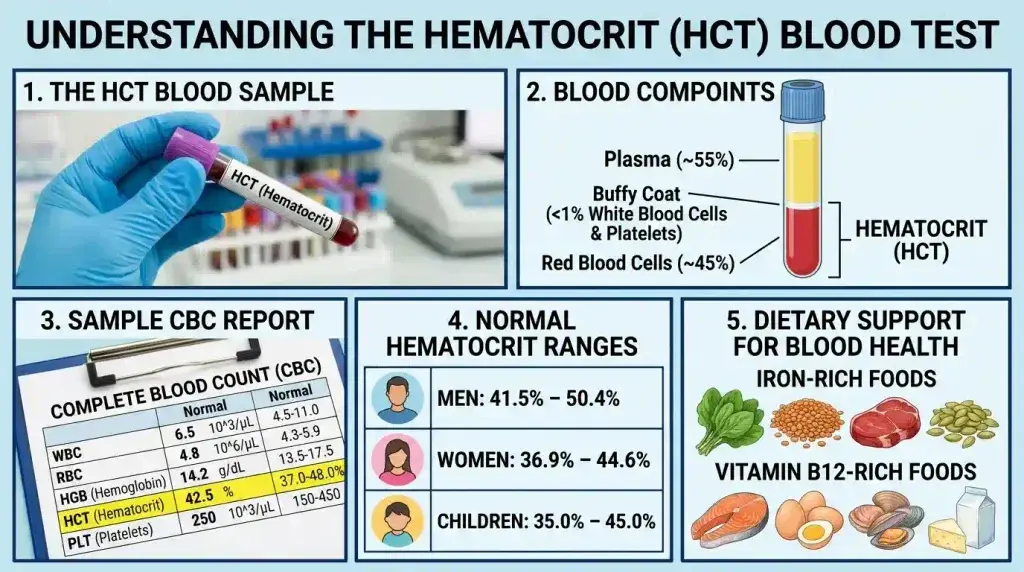
HCT meaning in blood test results is simple: HCT stands for hematocrit, which is the percentage of your blood made up of red blood cells. Doctors use it to check for problems like anemia, dehydration, and other health conditions. If you got your lab results and saw “HCT” with a number next to it, you are not alone in wondering what it means.
Many people feel worried when a number is marked high or low. This guide explains what HCT is, what normal ranges look like, what can make the number go up or down, and what to do next. You will also find helpful tables and answers to common questions.
Quick Answer: What Does HCT Mean in a Blood Test?
HCT means hematocrit. It measures how much of your blood is made up of red blood cells, shown as a percentage. For example, an HCT of 42% means that 42 out of every 100 parts of your blood are red blood cells. The rest is mostly plasma, the liquid part of blood.
Here is a short summary:
- Full name: Hematocrit (also spelled haematocrit in British English)
- What it measures: The share of your blood that is red blood cells
- Shown as: A percentage
- Found on: A complete blood count (CBC) test
- Also called: Packed cell volume (PCV)
- Why it matters: It helps doctors check for anemia, dehydration, and other problems
HCT Meaning in Blood Test Results in Simple Words
Think of a glass of fruit punch with fruit chunks floating in it. The liquid is like plasma. The chunks are like blood cells. If you let the glass sit, the chunks would settle at the bottom. Hematocrit tells you how much of the glass is chunks and how much is liquid.
Your blood has several parts. Red blood cells carry oxygen from your lungs to the rest of your body. White blood cells fight germs. Platelets help your blood clot. Plasma is the yellowish liquid that carries all of these around. Red blood cells make up the biggest share of the solid part, which is why hematocrit focuses on them.
Why does this matter? Oxygen is like fuel for your body. If you do not have enough red blood cells, you may feel tired, weak, or short of breath. If you have too many, your blood can get thick, which may make it harder for blood to flow. Hematocrit gives your doctor a quick way to see which way things are leaning.
HCT is one number on a bigger report. It is almost never used alone. Doctors look at it along with other numbers to get the full story.
How Is Hematocrit Measured?
Hematocrit is usually part of a test called a complete blood count, or CBC. This is one of the most common blood tests in the world. A nurse or lab worker takes a small amount of blood, usually from a vein in your arm. The process takes only a few minutes.
In the lab, the blood is checked in one of two main ways. In the older, manual method, the blood is spun very fast in a tiny tube. The red cells sink to the bottom, and the lab worker measures how much of the tube they fill. Today, most labs use automated machines that count and size the cells and then calculate the hematocrit number.
You can also get a quick finger-prick test in some clinics, or when a person donates blood. These checks are fast, but doctors may order a full lab test if the result needs a closer look.
Do you need to fast before the test? Usually, no. A CBC alone does not require fasting. But if your doctor ordered other tests on the same blood sample, such as blood sugar or cholesterol, you may be told to skip food for several hours. It is always best to follow the directions you were given.
Normal HCT Ranges
Normal hematocrit levels depend on age, sex, and sometimes the lab itself. The numbers below are typical ranges often seen for adults and children. Each lab sets its own reference range, so always check the range printed on your own report.
| Group | Typical HCT Range |
| Adult men | About 41% to 50% |
| Adult women | About 36% to 44% |
| Newborns | About 48% to 69% |
| Infants (around 1 year) | About 33% to 39% |
| Children (ages 1 to 12) | About 35% to 45% |
These are general guides, and different sources list slightly different numbers. That is normal. Medical labs use their own equipment and groups of healthy people to set their ranges. The range on your report is the one your doctor will use.
Why do men usually have a higher number than women? Men often have more red blood cells, partly due to hormones. Women may also lose blood each month during periods, which can lower their numbers a bit. Pregnancy also changes the picture, and that is covered below.
What Does a Low HCT Mean?
A low hematocrit means your blood has fewer red blood cells than expected. Doctors often link it to anemia, but there are other possible causes too.
Some common reasons for a low HCT include:
- Iron deficiency: Your body needs iron to make red blood cells. Not enough iron is one of the most common causes of anemia.
- Lack of vitamins: Low vitamin B12 or folate can also slow red cell production.
- Blood loss: This can come from heavy periods, an injury, surgery, or bleeding inside the body, such as in the stomach.
- Chronic disease: Long-term conditions like kidney disease or some inflammatory illnesses can lower red cell counts.
- Bone marrow problems: Bone marrow is where blood cells are made. If it is not working well, the numbers can drop.
- Pregnancy: Blood plasma grows during pregnancy, which can make the hematocrit look lower. This is often normal, but a doctor should still check it.
- Overhydration: Too much fluid in the body can dilute the blood.
What might you feel? Some people with a low HCT feel tired, look pale, get dizzy, have cold hands, or notice a fast heartbeat. Others feel nothing at all, especially if the drop is small or slow. That is one reason routine blood tests are so useful.
What Does a High HCT Mean?
A high hematocrit means there is a larger share of red blood cells in your blood than expected. Sometimes the cause is simple, and sometimes it needs more checking.
Common reasons for a high HCT include:
- Dehydration: When you lose water and do not drink enough, your plasma shrinks. The red cells then take up a bigger share, so the number goes up even though you did not make more cells.
- Living at high altitude: Thin air has less oxygen, so the body makes more red cells to adapt.
- Smoking: Smoke lowers the oxygen in your blood, and the body may respond by making more red cells.
- Lung or heart disease: Conditions that lower oxygen levels can push the body to make extra red cells.
- Sleep apnea: Repeated drops in oxygen during sleep may raise red cell levels.
- Polycythemia vera: This is a rare blood disorder in which the bone marrow makes too many red cells.
- Certain medicines or supplements: Some treatments, such as testosterone therapy, can raise hematocrit. Other drugs may do the same.
- Intense athletic training: Some athletes have slightly higher numbers, but misuse of banned substances can also raise them.
A high HCT can make blood thicker, which may raise the risk of clots in some people. That is why doctors take a persistent high number seriously. But one high reading, especially if you were dehydrated, does not always mean something is wrong.
HCT vs. Hemoglobin vs. Hematocrit Terms
When you read your CBC, you will see several terms that look alike. This table helps you tell them apart.
| Term | What It Means | What It Measures |
| HCT (Hematocrit) | Percent of blood made of red blood cells | A percentage |
| HGB or Hb (Hemoglobin) | The protein in red cells that carries oxygen | Grams per deciliter (g/dL) |
| RBC (Red Blood Cell count) | Number of red blood cells | Millions of cells per microliter |
| MCV | Average size of your red blood cells | Femtoliters (fL) |
| MCH | Average amount of hemoglobin in each red cell | Picograms (pg) |
| MCHC | How concentrated hemoglobin is in red cells | Grams per deciliter (g/dL) |
| PCV | Packed cell volume, another name for HCT | A percentage |
A handy tip: hematocrit is usually about three times your hemoglobin number. For example, if hemoglobin is 14 g/dL, hematocrit is often near 42%. This is just a rough rule, and it is not exact for everyone. Doctors use the full set of numbers to understand what is going on.
Why Doctors Order an HCT Test
Doctors check hematocrit for many reasons. Often it is simply part of a regular checkup. Other times, there is a clear reason.
Your doctor may order a CBC with HCT if you feel very tired, look pale, bruise easily, or have shortness of breath. It may also be used before surgery, during pregnancy, or while you take certain medicines. People with long-term conditions, such as kidney disease, often have it checked regularly. Doctors may also use it to see how well a treatment is working, for example, after treatment for anemia.
It is also helpful as a screening tool. A person may feel fine and still have a number that is a little off. Catching that early gives the doctor time to find the cause and help.
Can Everyday Factors Change Your HCT?
Yes. Your number can shift based on things you might not expect. Knowing this can keep you from panicking over a single result.
Hydration is one big factor. If you did not drink much before your test, your result may look higher. If you drank a lot, it may look lower.
Body position can matter too. Standing up for a long time versus lying down can slightly change the reading, because fluid moves around in the body.
Altitude is another factor. People who live in mountain towns often have higher numbers than people near sea level.
Smoking, certain medicines, pregnancy, and even the time of day may also play a part. Because of all of this, doctors often repeat a test before drawing firm conclusions. One reading is a snapshot, not a full movie.
Real Life Examples
Real stories make numbers easier to understand. Here are a few short, made-up examples to show how HCT might be used.
Example 1: Feeling tired. Maria is 32 and has felt worn out for weeks. Her CBC shows an HCT of 33%, which is below the typical range for women. Her doctor checks her iron and finds it is low. After iron treatment and diet changes, her energy slowly returns.
Example 2: A dry day. Tom, 45, has a blood test after a long hike and very little water. His HCT is slightly high. His doctor suggests drinking plenty of fluids and repeating the test. The second result is normal.
Example 3: Pregnancy. Aisha is in her second trimester. Her HCT is a little lower than before she became pregnant. Her doctor explains that extra fluid in her blood can cause this and keeps watching her levels to be safe.
Example 4: A long-term smoker. Jim, 58, smokes daily, and his HCT is on the high side. His doctor talks with him about smoking, checks his oxygen levels, and orders more tests.
These are only examples. They are not medical advice, and every person is different.
What to Do If Your HCT Is Outside the Normal Range
First, take a breath. A number outside the range does not always mean something serious. Many causes are simple and fixable.
Here are some practical steps:
- Look at the range on your report. Labs differ, and your result may be only slightly off.
- Think about the day of the test. Were you dehydrated, sick, or in a new place with a higher altitude?
- Write down your symptoms. Tiredness, dizziness, headaches, and shortness of breath are all worth mentioning.
- List your medicines and supplements. Some can affect your blood.
- Talk to your doctor. They can look at your whole report, your history, and your other results.
- Ask about a follow-up test. A repeat test often gives a clearer picture.
Avoid trying to treat yourself based only on a number. For example, taking iron pills when you do not need them can be harmful. Always check with a healthcare professional first.
If you ever have severe symptoms, such as chest pain, trouble breathing, fainting, or heavy bleeding, seek emergency care right away.
Ways to Support Healthy Blood
Some habits help keep your blood in good shape. They will not replace medical care, but they can support it.
Eat a balanced diet with iron-rich foods like beans, lean meat, spinach, and fortified cereals. Pair them with vitamin C foods, such as oranges or peppers, which help your body take in iron. Make sure you also get enough vitamin B12 and folate, found in eggs, dairy, leafy greens, and many fortified foods.
Drink enough water during the day, especially if you are active or the weather is hot. Avoid smoking. Get regular checkups, especially if you have a family history of blood problems.
If you follow a vegetarian or vegan diet, ask your doctor if you need a B12 supplement. And if you take any supplements, share them with your care team.
FAQs
What does HCT stand for in a blood test?
HCT stands for hematocrit. It shows the percentage of your blood that is made of red blood cells.
What is a normal HCT level?
For adult men, it is often around 41% to 50%. For adult women, it is often around 36% to 44%. Ranges vary by lab, so check your own report.
Is a low HCT dangerous?
Not always. A slightly low number may come from mild iron deficiency or pregnancy. A very low number can be serious and needs a doctor’s care.
Can dehydration raise my HCT?
Yes. When your body has less water, the blood plasma shrinks, so red cells make up a larger percent of your blood. Drinking fluids often brings the number back down.
Is HCT the same as hemoglobin?
No. Hematocrit measures the percent of red cells in your blood. Hemoglobin measures the oxygen-carrying protein inside those cells. They are related, but they are not the same.
Should I worry if only my HCT is abnormal?
Not right away. One number can shift for simple reasons. Your doctor will look at your full blood count and your symptoms before deciding if anything more is needed.
Conclusion
HCT meaning in blood test reports comes down to one idea: it tells you what percent of your blood is red blood cells. That number helps doctors spot problems like anemia, dehydration, and other conditions that affect how your blood carries oxygen.
A single result is only one piece of the puzzle. Your age, sex, water intake, altitude, medicines, and health history can all change it. A number outside the normal range is a reason to ask questions, not a reason to panic.
If your report shows a low or high HCT, bring it to your doctor, share your symptoms, and ask if a repeat test makes sense. Stay hydrated, eat well, and keep up with regular checkups. Your doctor is the best guide for what your numbers truly mean for you.

Hi, I’m Rebecca Hayes. I write faith-filled articles, healing prayers, and daily devotionals to encourage people in every season of life. My passion is helping readers find peace, hope, and strength through prayer.