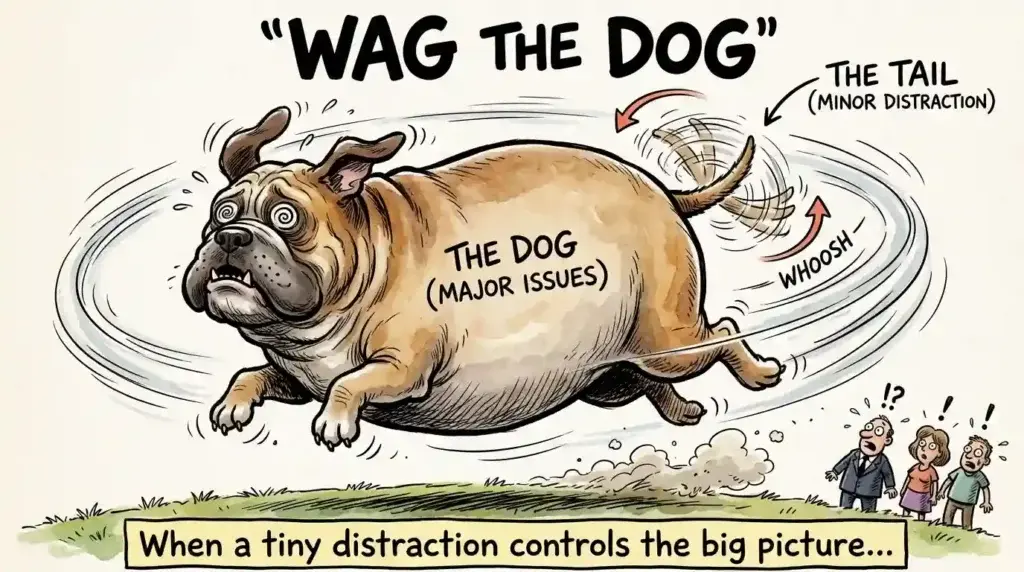
Wag the dog meaning is simple: it describes a situation where something small and unimportant ends up controlling something big and important. People most often use it when a leader creates a distraction, like a crisis or a conflict, to pull attention away from a bigger problem. Have you ever heard a news anchor say, “This feels like wag the dog”?
It can sound confusing at first. A tail cannot really move a dog, so why would anyone say that? In this guide, you will learn what the phrase means, where it came from, how to use it in a sentence, and why it became linked to politics.
You will also find clear examples, helpful tables, and answers to common questions.
Quick Answer: What Does Wag the Dog Mean?
To wag the dog means to let a small part control the whole. Normally, a dog wags its tail. In this phrase, the tail wags the dog instead, which is backward and odd. That is the point.
Here is a quick summary:
- Basic meaning: A minor thing controls a major thing
- Common political meaning: Creating a distraction to hide a bigger problem
- Tone: Usually critical or suspicious
- Part of speech: A verb phrase (to wag the dog), also used as a noun phrase or adjective
- Similar ideas: the tail wagging the dog, smokescreen, diversion, red herring
You might read a sentence like this: “Critics said the sudden announcement was meant to wag the dog and shift attention from the budget fight.” That sentence shows how the phrase is often used today.
Wag the Dog Meaning in Simple Words
Picture a big, strong dog and a tiny tail. The dog is in charge. The tail follows along. Now flip it. Imagine the tail is so powerful that it swings the whole dog around. That picture feels wrong, and that feeling is exactly why the saying works.
The phrase has two common meanings, and it helps to know both.
The first meaning is the general one. It describes any case where a small, less important thing controls a larger, more important thing. For example, a tiny department inside a huge company might end up making the rules for everyone. People might say, “That’s the tail wagging the dog.”
The second meaning is the political one, and it is the one most people search for. It describes a leader or group who starts a distraction, often a war, a scandal story, or a dramatic event, to make people stop talking about something else. The big thing (the real problem) is the dog. The distraction is the tail. By waving the tail, the person hopes the public looks the other way.
You may also hear the phrase used in everyday life, not only in government. A person might say that a small complaint wagged the dog in a meeting, taking over the whole discussion. In that case, no one is plotting anything. It just means a small issue grabbed too much control.
Where Did the Phrase Come From?
The saying is older than most people think. The idea of a tail wagging a dog shows up in print in the 1800s, often in a joke or a riddle. One widely told version goes like this: “Why does a dog wag its tail? Because the dog is smarter than the tail. If the tail were smarter, it would wag the dog.” The exact first use and the original author are hard to prove, since many old jokes were passed around without clear credit.
The phrase became far more famous in the late 1990s because of a movie. Wag the Dog came out in 1997. It was a comedy directed by Barry Levinson, with Robert De Niro and Dustin Hoffman. The story is about a president who is caught in a scandal just days before an election. To hide it, his team hires a Hollywood producer to invent a fake war. The public watches the fake war on TV and forgets about the scandal.
The film was based on a novel called American Hero by Larry Beinhart, published in 1993. The book also dealt with the idea of a staged war to help a leader.
Now here is a point many people like to mention. The movie came out in December 1997. Not long after, in 1998, real news stories about a U.S. president and a scandal appeared, and the country also took military action overseas.
Some people at the time pointed to the film and asked if the two things were connected. Officials denied it, and no one has proven any link. So it is fair to say that the movie shaped how people talked about those events, but it does not show that the claims were true.
How to Use Wag the Dog in a Sentence
Using the phrase is easier than it sounds. You can use it in a few different ways.
As a verb phrase, you can say someone is trying to “wag the dog.” For example:
- “Some people think the report was released to wag the dog.”
- “He was accused of trying to wag the dog during the campaign.”
As a noun phrase or adjective, you can talk about a “wag the dog situation” or “wag the dog politics.” For example:
- “It sounds like a classic wag the dog move.”
- “Many voters worry about wag the dog tactics before elections.”
In the older and simpler meaning, people say “the tail wagging the dog.” This form is common in business and daily life:
- “Our smallest client is making all the rules. It’s the tail wagging the dog.”
- “One rude comment took over the whole meeting. That’s the tail wagging the dog.”
Here are a few grammar tips to keep in mind:
- The usual form is “wag the dog.” You do not need to add “tail” when using the political meaning.
- When you use the longer form, say “the tail wagging the dog,” not “the dog wagging the tail.” That would just be what a dog normally does.
- You can change the verb tense. For example: “wagged the dog,” “is wagging the dog,” or “will wag the dog.”
- Use the movie title in italics: Wag the Dog.
Two Meanings Compared
Because the phrase has more than one use, readers sometimes mix them up. This table makes the difference clear.
| Version | Simple Meaning | Where You Hear It | Example |
| The tail wagging the dog | A small thing controls a big thing | Business, sports, daily life | “One tiny rule is running the whole school.” |
| Wag the dog (political) | Creating a distraction to hide a bigger issue | News, politics, debates | “The sudden crisis looked like an attempt to wag the dog.” |
| Wag the Dog (the movie) | A 1997 comedy about a fake war used to hide a scandal | Film talk, pop culture | “Have you seen the movie Wag the Dog?” |
As you can see, the core picture stays the same. A small force pulls a larger one. What changes is the setting and the purpose.
Is It Always About Politics?
No, it is not. Many people think the phrase belongs only to news and elections, but that is only one use.
Everyday English, the phrase can describe any situation where the balance of power feels upside down. In a family, a small child might decide where everyone eats dinner because no one wants to hear them cry.It simply points out that the order of control seems wrong.
The political meaning, however, carries more weight. When someone says a leader is “wagging the dog,” they are making a serious claim. They are saying the leader is acting in bad faith. That is a big accusation, and it usually needs strong proof. Without it, the phrase is more of an opinion than a fact.
This is why careful writers and reporters often add words like “critics said” or “opponents claimed.” It shows that the claim comes from someone’s view, not from proven truth.
Real Life Examples
Let’s look at a few easy examples so the meaning feels natural.
At school. Imagine a student club with only five members. Yet they decide the lunch menu for the whole school because no one else votes. A student might say, “That’s the tail wagging the dog.” The small group has more power than it should.
At work. A company has a huge sales team, but one small tech group keeps blocking every new idea with strict rules. People in the break room might joke that the tail is wagging the dog.
In a family. A family trip is planned around one picky eater’s food needs. Everyone else gives up their choices. It is a mild, funny use of the phrase.
In news and politics. A leader faces a tough question about a failing plan. Suddenly, a loud dispute with another country fills the news. Some commentators say the dispute was created or made larger to distract the public. They call it a wag the dog move. Others say it was a real event and a real response. This is why the phrase often sparks debate. Whether it fits depends on proof, and proof is often hard to find.
In movies and books. Fans of the film often use the title as a shortcut. When they see a staged event on TV, they might say, “It’s like Wag the Dog.” This is a casual way to say something feels fake or planned.
In each example, you can feel the upside-down order. Something small or secondary takes the lead.
Wag the Dog vs. Similar Phrases
Several other phrases sound close to this one. Here is how they differ.
| Phrase | Meaning | How It Differs |
| Red herring | Something that pulls attention from the real issue | Focuses on a false clue, not on control |
| Smokescreen | Something used to hide what is really happening | Very close to the political meaning |
| Diversion | An act that turns attention away | A more neutral and general word |
| Distraction | Anything that pulls focus | Can be accidental, not planned |
| Tail wagging the dog | A small part controlling the whole | The original and broader idea |
| Scapegoat | Someone blamed for others’ mistakes | About blame, not distraction |
| Spin | Presenting facts in a favorable way | About wording and image, not creating events |
A quick tip can help here. If someone creates a big event on purpose to hide a problem, “wag the dog” fits well. If someone just tells a story in a flattering way, “spin” is a better word. And if a small group holds too much power, use “the tail wagging the dog.”
Common Mistakes People Make
Even a short phrase can be tricky. Here are some mistakes to watch for.
The first mistake is thinking it always means a fake war. The movie used a fake war, but the phrase can describe any distraction, large or small.
The second mistake is reversing the picture. Some people say “the dog wagging the tail.” That is not the saying. The point is that the tail is doing something unnatural.
Third, some people use it as a proven fact. Saying “He wagged the dog” sounds like a sure thing. In truth, it is usually an accusation or opinion. If you want to stay fair, say “critics say” or “it looked like.”
Fourth, some mix it up with “wagging a finger.” That phrase means scolding someone. It has nothing to do with this saying.
Last, people sometimes forget the older meaning. Not every use is about politics. A small business complaint can be a perfect, harmless example.
Wag the Dog in Pop Culture and Today
The movie made the phrase a household expression, and it has stayed popular. Whenever a major news event happens at an awkward time for a leader, someone online will bring it up.
You can find the phrase in newspaper columns, talk shows, podcasts, and social media. It has also shown up in discussions about how the media shapes what people think. After all, the movie was not only about politics. It was also about how easily TV, music, and clever stories can shape what people believe.
In recent years, the phrase has taken on a new flavor. People now talk about online rumors, viral posts, and fake news. Some say that today’s fast media makes wag the dog tricks easier, since a loud story can bury a quieter one in a few hours. Others say people are more alert than ever, and that fact-checkers and independent reporters make such tricks harder.
Both views exist, and there is no simple answer. What is clear is that the phrase gives people an easy way to talk about a very old worry: Are we looking where we should be looking?
Why the Phrase Matters
At its heart, the saying is about attention and control. It teaches us to ask a few helpful questions when big news hits.
- Who benefits if I focus on this story?
- What else is happening that I might be missing?
- Is there proof for what is being claimed?
- Am I hearing more than one point of view?
Asking these questions does not make you a cynic. It makes you a careful reader. You can enjoy the news without believing every claim, and you can doubt a claim without assuming the worst.
It is also fair to remember the other side. Not every crisis is staged. Real wars, real storms, and real emergencies happen. Calling every big event a wag the dog story would be unfair and could even hide real problems. Balance is the best approach.
Tips for Using the Phrase the Right Way
If you want to use the phrase in speaking or writing, a few habits will help.
First, be clear about which meaning you intend. If you are talking about a small group holding too much power, you may want to say “the tail wagging the dog.” If you are talking about a distraction, “wag the dog” works well.
Second, be careful with accusations. Saying a leader is wagging the dog is a strong claim. Back it up with facts, or soften it with words like “some believe.”
Third, keep your audience in mind. In a casual chat, the phrase is easy to follow. In a school essay or news article, you may want to add a short explanation the first time you use it.
Finally, avoid overusing it. A phrase that appears in every sentence loses its punch.
FAQs
What is the short meaning of wag the dog?
It means a small or unimportant thing controls something bigger. In politics, it usually means creating a distraction to hide a more serious problem.
Where does the phrase wag the dog come from?
The idea of a tail wagging a dog goes back to the 1800s, though the first user is not clear. The phrase became very famous because of the 1997 movie Wag the Dog, which was based on the 1993 novel American Hero.
Is wag the dog always a negative phrase?
Mostly, yes. It points out something that seems backward or unfair. The political version often carries suspicion or blame.
What is the movie Wag the Dog about?
It is a comedy about a president caught in a scandal before an election. His team invents a fake war to pull the public’s attention away.
What is the difference between wagging the dog and tail wagging the dog?
“The tail wagging the dog” is the older, broader idea of a small thing controlling a big thing. “Wag the dog” is the shorter version, now often used for political distractions.
Can a real event be called wag the dog?
People may call it that if they believe it was used as a distraction. However, calling something wag the dog is an opinion unless there is clear proof. Many real events are simply real.
Conclusion
Wag the dog meaning is easy to remember once you picture it. A tiny tail should never swing a whole dog, yet in this phrase, it does. That odd picture describes situations where something small controls something big, and it also describes distractions meant to hide real problems.
The saying has been around for many years, but the 1997 movie brought it into everyday talk. Today, you will hear it in news, politics, and casual chat. Still, it is wise to use it with care. It often carries an accusation, and accusations need support.
Here is a simple rule to take with you: when big news pops up, pause and ask what else might be going on. Stay curious, check more than one source, and use the phrase thoughtfully when the situation truly fits.

Hi, I’m Elias Monroe. I enjoy writing meaningful prayer content that helps people feel calm, hopeful, and spiritually strong. My goal is to share words that bring comfort during both joyful and difficult times.