
Spoiler warning: this article discusses the Nika reveal, Gear 5 and the Joy Boy connection from later parts of One Piece.
Few names in anime are as instantly recognizable as Luffy. Millions of fans know the straw hat, the stretchy grin, and the dream of becoming Pirate King, but many have never stopped to ask what the name actually means.
So, what is the Luffy meaning in English? The short answer is that “Luffy” is not an everyday English word. It is a coined character name created by One Piece author Eiichiro Oda, so its meaning comes less from a dictionary and more from the story, the wordplay around it, and the ideas the character stands for.
In this guide, we will break down the name’s origin, explain what “Monkey D.” signifies, decode his famous titles like Straw Hat and Gomu Gomu, and explore the symbolism behind the world’s most famous rubber pirate.
We will also clear up common myths, compare how the name appears in different languages and versions, and answer the questions fans search for most.
Who Is Luffy?
Quick facts
- Full name: Monkey D. Luffy
- Japanese spelling: モンキー・D・ルフィ (Monkī D. Rufi)
- Creator: Eiichiro Oda
- Series: One Piece (manga serialized since 1997)
- Birthday: May 5
- Dream: To become the Pirate King
- Devil Fruit: Gomu Gomu no Mi (later revealed as Hito Hito no Mi, Model: Nika)
- Japanese voice actor: Mayumi Tanaka
Monkey D. Luffy is the main character of One Piece, the best-selling manga series created by Eiichiro Oda. He is the captain of the Straw Hat Pirates, a cheerful, fearless young man who sets out to sea with one goal: to find the legendary treasure known as the One Piece and become the Pirate King.
Luffy’s journey begins in childhood. After accidentally eating the Gomu Gomu no Mi, a Devil Fruit, his body becomes rubber, which lets him stretch, bounce, and absorb blows that would hurt anyone else. Around the same time, the pirate Shanks gives him his signature straw hat, entrusting it to him with a promise that Luffy will return it once he has become a great pirate.
What makes Luffy memorable is not just his power but his personality: simple, loyal, and fiercely devoted to freedom. He does not fight for fame or wealth. He fights to protect his friends and to live exactly as he pleases. That is why his name carries so much weight with fans. As we will see, much of its meaning comes from who he is and what he stands for, rather than from any definition on a page.
Understanding the character first makes the rest of the discussion easier. When people ask what “Luffy” means, they are often really asking what Luffy represents, and the answer to that question runs through every section below.
What Does “Luffy” Mean in English?

The direct answer is that “Luffy” has no literal meaning in English. It is not a dictionary word, a common given name, or a translation of a Japanese term. It is a name Eiichiro Oda created for his hero, which is why its meaning is found in the character himself rather than in a definition.
How the name is spelled and pronounced
In Japanese, the name is written ルフィ and romanized as Rufi. The English spelling “Luffy” comes from how the sounds are adapted:
- L vs. R: Japanese does not distinguish between the English “L” and “R” sounds, so ル can be rendered as either. That is why some translations use “Ruffy” (the German release is a well-known example).
- The “fi” sound: This is a less common sound in traditional Japanese, which gives the name a playful, slightly foreign feel.
- Pronunciation: English speakers usually say “LUFF-ee,” while the Japanese pronunciation is closer to “RUH-fee.”
These small differences are normal whenever a Japanese name is moved into English. They do not change who the character is, but they do explain why you will see the name written in more than one way.
What we know vs. what fans speculate
| Claim | Status |
| “Luffy” is a coined name, not an English word | Widely accepted |
| The name means “rubber” | False, the rubber link comes from his Devil Fruit |
| The name was chosen for its sound and feel | Plausible, but check Oda’s own words |
| The name is derived from a specific word or person | Unverified, treat as theory unless an official source says so |
A note on origin theories
You will find many claims online about where the name comes from. Without a confirmed statement from Oda, such as an interview or an SBS column in the volumes, these remain fan theories, and it is best to label them that way. Fan wikis and social media posts often repeat unsourced claims until they sound like fact, so treat anything without a primary source with caution.
The practical takeaway
Because the name has no built-in definition, its “meaning” comes from what Luffy represents: freedom, loyalty, and an unbreakable dream. That is the thread we will follow through the rest of the article.
Breaking Down “Monkey D. Luffy”
Luffy’s full name has three parts, and each one adds a layer of meaning.
“Monkey”: the family name
Luffy’s surname comes from his family line. His grandfather is Vice Admiral Monkey D. Garp, and his father is Monkey D. Dragon, the leader of the Revolutionary Army. In Japanese, the word is モンキー, simply the English word “monkey” written in katakana.
The choice fits the character. Luffy is playful, agile, and curious, and his stretchy movements often look like a monkey swinging through trees. Oda has not framed it as a deep symbol, so it is safest to describe this as a natural fit rather than a confirmed intention.
“D.”: the biggest mystery
The middle initial is one of the best-known mysteries in One Piece. Several characters carry it, including Gol D. Roger, Portgas D. Ace, and Marshall D. Teach. The story refers to it as the Will of D., and it is tied to ideas like destiny, rebellion, and an “enemy of the gods.”
What the series has told us so far:
- The “D.” is deliberately hidden, and the World Government treats it as dangerous.
- Characters who carry it often have a strong impact on history.
- The letter has not been fully explained in the story.
So if someone asks what the D. stands for, the honest answer is that the series has not confirmed it. Any specific word you see online is a fan theory.
“Luffy”: the given name
As covered above, “Luffy” is a coined name with no literal meaning. Paired with “Monkey D.,” it creates a memorable mix: a simple, friendly given name attached to a family name loaded with mystery. That contrast suits a character who looks goofy but carries enormous significance in the story.
Luffy’s family at a glance
| Person | Relationship | Notes |
| Monkey D. Garp | Grandfather | Marine hero |
| Monkey D. Dragon | Father | Revolutionary Army leader |
| Portgas D. Ace | Sworn brother | Brothers by sharing a cup |
| Sabo | Sworn brother | Revolutionary Army chief of staff |
Note that Ace carries his “D.” through his own family line, so he and Luffy are brothers by bond rather than by blood.
Luffy’s Titles and Nicknames
Luffy has collected many names over the course of the series. Some are official titles, some are nicknames, and some are reveals tied to major story events. Here is what each one means in English.
Straw Hat
The nickname comes from the worn straw hat Luffy always wears. Shanks gave it to him in childhood, and Luffy promised to return it once he became a great pirate. The hat is also why his crew is called the Straw Hat Pirates, and it is the symbol on their flag. In the story, the media and the Marines adopted “Straw Hat Luffy” as his public name, so it works as both a nickname and a brand.
Gomu Gomu no Mi
The Japanese word gomu (ゴム) means “rubber,” borrowed from the Dutch gom. English translations often render the fruit as the Gum-Gum Fruit or the Rubber-Rubber Fruit, depending on the release. The word mi (実) means “fruit,” so the name literally reads “Rubber-Rubber Fruit.”
Later in the story, the fruit’s true identity is revealed to be the Hito Hito no Mi, Model: Nika, a Mythical Zoan fruit. Hito means “human,” so the name points to a human-type fruit with a mythical form.
Sun God Nika and Joy Boy
Nika is a legendary figure described as a warrior of liberation who brought laughter and joy. Luffy’s awakened form, known as Gear 5, reflects this: it is playful, cartoonish, and built around freedom and fun. Joy Boy is a historical figure whose connection to Nika and to Luffy is still being unfolded in the story, so treat any claim beyond what the series has shown as theory.
Pirate King
This is Luffy’s dream rather than a current title. In the world of One Piece, the Pirate King is the person who finds the One Piece treasure and is recognized as the freest person on the seas. Gol D. Roger held the title before him. For Luffy, it means freedom, not power or wealth.
Yonko (Emperor)
Yonko (四皇) means “Four Emperors” and refers to the four most powerful pirates at sea. Luffy’s status among them was established in the later part of the story. Because the roster can change as the story moves forward, check the latest chapters if you want to describe it in detail.
Bounty
Luffy’s wanted poster has grown over the series, and the amount is often cited by fans as a measure of his rise. Because the figure changes, confirm the latest number from the manga or an official source before quoting it.
Quick glossary
| Term | Japanese | English meaning |
| Straw Hat | 麦わら (Mugiwara) | Straw hat |
| Gomu Gomu no Mi | ゴムゴムの実 | Rubber-Rubber Fruit / Gum-Gum Fruit |
| Hito Hito no Mi, Model: Nika | ヒトヒトの実 幻獣種 モデル ニカ | Human-Human Fruit, Mythical Zoan, Model: Nika |
| Yonko | 四皇 | Four Emperors |
| Pirate King | 海賊王 (Kaizokuō) | King of the Pirates |
Symbolism: What Luffy Represents
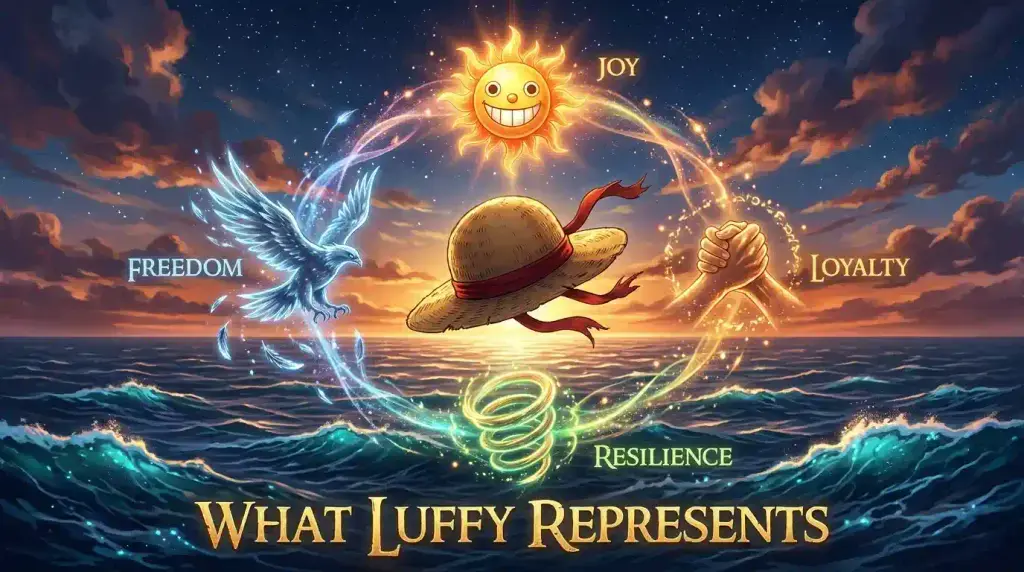
Because “Luffy” has no dictionary meaning, the character himself becomes the definition. Fans and critics often point to a handful of themes that shape how the name is understood.
Freedom
Freedom is the idea most closely tied to Luffy. His dream of becoming Pirate King is not about ruling others or collecting treasure. It is about being the freest person on the seas, answering to no one. He consistently chooses personal choice over rules, rank, or reputation, and this is what draws so many allies to him.
Loyalty and friendship
Luffy builds his crew on trust rather than orders. He recruits people because he connects with them, and he is willing to take on enormous enemies to protect them. The Straw Hat Pirates work as a found family, and Luffy’s loyalty to them is the emotional core of the series.
The rubber body as a metaphor
His Devil Fruit gives him a body that stretches and absorbs impact. Many readers see this as a symbol of flexibility and resilience: a character who bends under pressure but does not break. This is an interpretation rather than something Oda has stated, so it is best understood as a popular reading.
Rebellion against authority
Luffy repeatedly stands against powerful institutions, including the World Government and the Celestial Dragons. He does not fight out of a political agenda. He acts when he sees someone being treated unjustly, which makes his rebellion feel personal and instinctive rather than ideological.
Joy and laughter
Luffy’s most recent reveals tie him to the Sun God Nika, a figure associated with joy and liberation. Gear 5 reflects this with its cartoon-like, playful style. In this reading, laughter itself becomes an act of defiance against oppression.
The Will of D.
The “D.” links Luffy to a larger story about destiny and resistance to the powers that rule the world. Since the series has not fully explained it, any firm conclusion about what it says about Luffy remains a theory.
Putting it together
Taken together, “Luffy” works as a symbol of freedom, loyalty, resilience, and joy. That is the closest thing to a true “meaning” the name has, and it is why the character resonates with readers around the world.
Luffy in Different Languages and Versions
Because One Piece has been released in dozens of countries, Luffy’s name and the way it is presented can change depending on the language and the version you are watching or reading.
Japanese vs. English pronunciation
In Japanese, the name is ルフィ (Rufi), pronounced roughly “RUH-fee.” English speakers usually say “LUFF-ee.” Both are accepted, and neither is wrong. The difference comes from how Japanese sounds map onto English ones. When fans debate how to say it, the usual answer is to use whichever version matches the language you are speaking.
Spelling variations around the world
Some regional releases adapt the spelling to fit local pronunciation:
- English releases: “Luffy” is the standard spelling in official manga and anime releases.
- German release: The name has appeared as “Ruffy,” reflecting the R sound in the Japanese original.
- Other languages: Several releases use their own adaptation, so check any specific language before you quote it.
Voice actors
Voice casting also shapes how the name sounds to audiences:
- Japanese: Mayumi Tanaka has voiced Luffy since the anime began.
- English: Luffy has been voiced by different actors across the 4Kids dub and the later Funimation and Crunchyroll dubs.
- Other dubs: Many languages have their own Luffy voice, and fans often compare them online.
Localization differences
Localization is how a series is adapted for a new audience, and it affects names and titles:
- 4Kids era: The early English adaptation of the anime changed some names, jokes, and plot details. Luffy’s name stayed the same, but the tone and presentation of the series differed from the original.
- Later English releases: Newer dubs and subtitles are generally closer to the Japanese original, including how titles like “Straw Hat” are handled.
- Manga translations: Official English releases can differ in how they translate terms such as the Devil Fruit names, so the same fruit may appear as “Gum-Gum” in one release and “Rubber-Rubber” in another.
Why this matters for the name’s meaning
Since “Luffy” is a coined name, it travels across languages without needing a translation. That is part of why it is so recognizable worldwide. The spelling and pronunciation change slightly, but the character stays the same.
Luffy’s Name Across the Franchise
Luffy appears far beyond the original manga and anime, and his name is handled consistently wherever he shows up.
Movies
One Piece has had many theatrical films, and Luffy leads all of them. His full name, Monkey D. Luffy, and the “Straw Hat Luffy” nickname are used the same way as in the main series. Film posters and marketing often lean on the straw hat silhouette, which shows how the nickname has become part of his visual identity.
Video games
Luffy is a playable character in a long list of One Piece games, as well as crossover titles that feature characters from multiple series. In these games, you will often see his name alongside the form or “Gear” he is using, so the name works as a label for a whole set of abilities rather than just a person.
Spin-offs and side stories
Luffy also appears in specials, side manga, and novelizations. Across these, his name and titles stay the same, though spelling can follow the regional release.
Merchandise and name styling
Figures, clothing, and collectibles use “Luffy” or “Monkey D. Luffy” depending on the product. A few patterns are common:
- Short form: “Luffy” alone is the most common branding, since it is short and easy to recognize.
- Full form: “Monkey D. Luffy” appears on premium collectibles and official artwork.
- Katakana: Japanese products use ルフィ, often stylized in bold lettering.
- Straw hat icon: The hat often stands in for the name entirely.
The live-action Netflix adaptation
The Netflix series adapted the story with live actors and kept the character’s name unchanged, so viewers hear “Monkey D. Luffy” just as they would in the anime. It is a good example of how a coined name travels across formats without needing adjustment.
Why this matters
Because “Luffy” is a coined name rather than a translated one, it can stay identical across films, games, merchandise, and live-action. That consistency is part of what makes it a strong brand name as well as a character name.
Common Misconceptions
Because “Luffy” has no official dictionary meaning, a lot of half-true claims circulate online. Here are the most common ones, and what the evidence supports.
“Luffy means ‘rubber'”
This is probably the most frequent mix-up. The rubber link comes from his Devil Fruit, the Gomu Gomu no Mi, where gomu means “rubber.” It does not come from his name.
“The D. stands for a specific word”
You will see many confident answers online. None of them is confirmed. The series has hinted at the importance of the Will of D. but has not explained the letter itself.
“Luffy is a real name”
Not in the traditional sense. It is not a standard given name in English or Japanese, and it was created for the character. Some people may use it as a nickname or a name inspired by the series, but there is no established meaning or history that connects it to anything outside the story.
“Monkey is just a joke surname”
It is easy to assume the surname is purely comedic. In the story, however, it is the family name shared by Garp and Dragon, two major figures, which gives it more weight than a throwaway gag. Whether Oda intended a deeper meaning is not confirmed, so it is best described as a fitting choice rather than a proven symbol.
“Gear 5 is just a power-up”
Many casual viewers see Gear 5 as only a stronger form. In the story, it is tied to the Sun God Nika, joy, and liberation, so it carries thematic meaning beyond raw strength.
“Straw Hat Luffy is his real title”
“Straw Hat” is a nickname used by the public and the Marines, not a rank or an official title. His official standing in the world is separate, such as his bounty or his Yonko status.
How to avoid spreading myths
- Check claims against the manga, official databooks, or Oda’s SBS columns.
- Label anything unconfirmed as a “theory” or “fan interpretation.”
- Be cautious with fan wikis and social media posts, which often repeat unsourced claims.
Fun Facts and Trivia

Beyond the name itself, there are plenty of small details about Luffy that fans love to share.
Character profile details
- Birthday: May 5, which is Children’s Day in Japan. Many fans like to note how well that fits a character who is so childlike and carefree.
- Favorite food: Meat. Luffy’s appetite is a running gag, and food is often what sets off his funniest scenes.
- Dream: To become the Pirate King, a goal he has stated from the very first chapter.
- Weakness: Like all Devil Fruit users, he cannot swim, and seawater drains his strength.
Debut details
Luffy appears in the very first chapter of the manga, which began serialization in 1997, and he is introduced as a young boy with a dream. In the anime, he appears from the first episode.
Things fans often miss about his design
- The scar under his left eye: It comes from a childhood moment in which he proved his courage to Shanks, a scene that is central to his origin.
- The straw hat: It is one of the most recognizable silhouettes in anime, and it works as a symbol of his promise to Shanks.
- The simple outfit: His clothes are intentionally plain, which keeps the focus on his personality and his stretchy movements.
Interesting trivia about the name
- Short and easy: The name is only two syllables, which makes it simple to remember and pronounce in many languages.
- Same name, many scripts: It appears in katakana in Japan, Latin letters in English, and other scripts elsewhere, yet stays instantly recognizable.
- Hat as a name substitute: On merchandise and fan art, the straw hat alone often stands in for the character.
Frequently Asked Questions
What does Luffy mean in English?
“Luffy” has no literal meaning in English. Its meaning comes from the character: freedom, loyalty, resilience, and joy.
Is Luffy a real name?
Not in the traditional sense. It was created for the One Piece protagonist and is not a standard given name in English or Japanese. Some fans use it as a nickname, but it has no established history outside the series.
What does the “D.” in Monkey D. Luffy stand for?
The series has not confirmed what the “D.” stands for. It is tied to the mysterious Will of D., which hints at destiny and rebellion. Any specific word you see online is a fan theory, not an official answer.
Why is Luffy called Straw Hat?
He wears a straw hat given to him in childhood by Shanks, with a promise to return it once he becomes a great pirate. The Marines and the public adopted “Straw Hat Luffy” as his nickname, and it gave his crew its name.
How do you pronounce Luffy?
In English, it is usually “LUFF-ee.” In Japanese, ルフィ (Rufi) sounds closer to “RUH-fee.”
What is Luffy’s full name in Japanese?
It is モンキー・D・ルフィ, romanized as Monkī D. Rufi. “Monkey” is written in katakana, and “D.” stays as the Latin letter.
What is Luffy’s real power called?
His power began as the Gomu Gomu no Mi, the “Rubber-Rubber Fruit” or “Gum-Gum Fruit.” It was later revealed to be the Hito Hito no Mi, Model: Nika.
Does Luffy mean rubber?
No. The rubber link comes from his Devil Fruit, where gomu means “rubber.” The name “Luffy” itself has no such meaning.
Conclusion
So, what is the Luffy meaning in English? The honest answer is that “Luffy” is a coined name with no literal translation. Eiichiro Oda created it for his hero, which means its meaning is not found in a dictionary.
We looked at how the name works as a whole: “Monkey D.” ties Luffy to a mysterious family line and the unresolved Will of D., while titles like Straw Hat and Gomu Gomu reflect his promise to Shanks and his rubber powers. Behind all of it, the character stands for freedom, loyalty, resilience, and joy, and that is the closest thing to a true definition the name has.

Hi, I’m Rida, the writer behind this site about word meanings.
I explain words in simple English with clear definitions, synonyms, and real examples.
My goal is to help learners and curious readers pick the right word with confidence.
Every article is checked against trusted dictionaries so you can learn with trust.