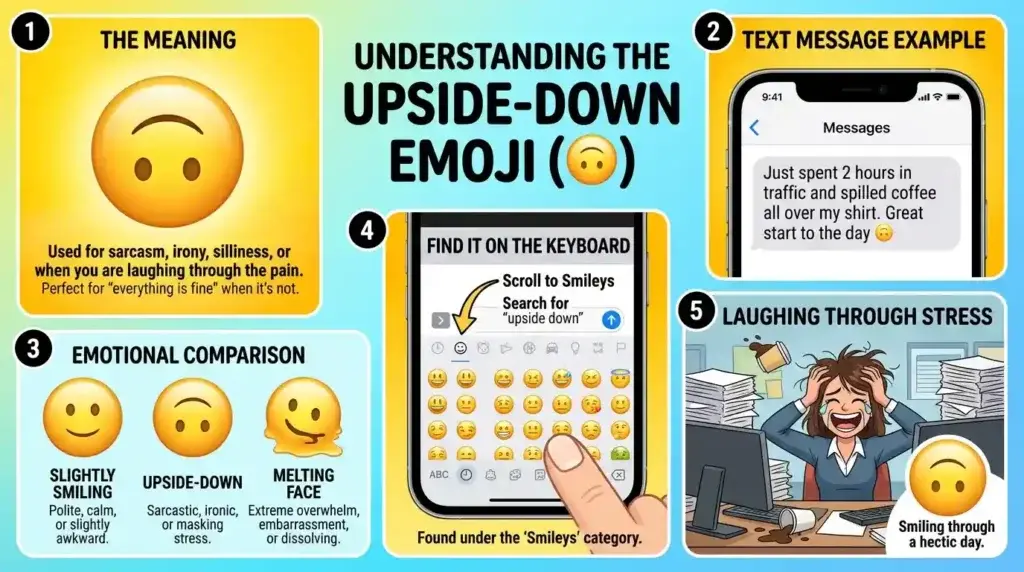
The upside down emoji meaning is simple: 🙃 shows sarcasm, silliness, or a smile that is not fully real. Someone might send it as a joke. Or they might send it when they feel stressed but want to act calm.
Have you ever gotten this little face in a message and wondered what the sender meant? You are not alone. Millions of people use it every day, and it can mean very different things. The right meaning depends on who sends it, what they wrote, and how well you know them.
In this guide, you will learn what the face means, where it came from, and how it looks on different phones. You will also see real examples, common mistakes, and answers to popular questions.
Quick Answer: What Does the Upside Down Emoji Mean?
The upside down emoji is a smiling face turned 180 degrees. Its official name is “Upside-Down Face.” Most people use it to show sarcasm, a joke, silliness, or a mix of feelings that do not match.
Think of it as a wink with extra attitude. A normal smile says, “I am happy.” The upside down smile says, “I am happy, but not really,” or “I am joking, so don’t take me seriously.”
Here are the three most common meanings:
- Sarcasm or irony. The words say one thing, but the face says the opposite.
- Playfulness or silliness. The sender is being goofy and lighthearted.
- Hidden stress or awkwardness. The sender is trying to stay calm when things feel messy.
Because one small face can carry all three meanings, the text around it is your best clue.
The Many Meanings of the Upside Down Face
Let’s look closer at each meaning, because the emoji is a bit like a chameleon. It changes color depending on where it sits.
Sarcasm and irony. This is the most popular use. Sarcasm means saying something you do not mean, usually to be funny or to show you are annoyed. Irony is when the real result is the opposite of what you expected. If your friend texts, “Great, my phone broke again 🙃,” they are not happy. The face adds a dry, funny edge to a bad moment.
Joking and teasing. Sometimes the face is just friendly. If you tell a friend, “I ate the whole pizza by myself 🙃,” you are joking and a little silly. The upside down look tells the reader, “Don’t take this too seriously.”
Hiding stress. Many people use it for the feeling of “everything is fine” when it is clearly not fine. Picture a person with a big smile while ten things go wrong around them. That is the mood. Someone with a full inbox, a late project, and a broken car might send 🙃 as a way to laugh at the chaos.
Feeling awkward or embarrassed. If you say something silly in a group chat, you might add 🙃 to show you know it was a little weird. It works like a shrug with a smile.
Passive-aggressive feelings. Passive-aggressive means showing anger in a quiet, indirect way. A message like “Thanks for letting me know so early 🙃” may show that the sender is upset. Be careful with this use, because it can hurt feelings.
Feeling upside down inside. Some people use the emoji to say their life, mood, or day feels turned around. It can mean “I feel off today” or “my plans got flipped.”
Upside Down Emoji Meaning in Text Messages
Text messages have no tone of voice. You cannot hear a sigh or see an eye roll. That is why people lean on emojis, and the upside down face is a handy tool for tone.
Here is how the meaning can change with the words around it.
| Message | Likely Meaning |
| “Can’t wait for Monday 🙃” | Sarcasm. The sender does not enjoy Mondays. |
| “I locked my keys in the car again 🙃” | Embarrassed and laughing at themselves. |
| “Sure, take your time. I’ll just wait here 🙃” | Passive-aggressive. The sender is annoyed. |
| “Just ordered three desserts 🙃” | Playful and silly. |
| “Everything is totally fine 🙃” | Hidden stress. Things may not be fine. |
| “Nice job breaking my favorite mug 🙃” | Teasing or mild anger, depending on the friendship. |
You should also think about the sender. A close friend who jokes a lot probably means it playfully. A coworker who rarely uses emojis may be sending a quiet warning. Knowing the person helps you read the message correctly.
Real Life Examples of the Upside Down Emoji
Examples make the meaning clear, so here are a few everyday moments.
At school. A student writes in a group chat, “Test tomorrow and I haven’t studied 🙃.” This shows worry mixed with a laugh. The student feels stressed but is trying to joke about it.
At work. A teammate writes, “Another meeting that could have been an email 🙃.” This is sarcasm. They are mildly annoyed but keeping things light.
With family. A parent texts, “The dog ate my shoe again 🙃.” This is a tired, funny shrug. The parent is not truly angry. They are just showing that life is messy.
With friends. Someone writes, “I said ‘you too’ when the waiter said enjoy your meal 🙃.” This is embarrassment turned into a joke.
On a bad day. A person posts, “Lost my wallet, missed my bus, and it’s raining 🙃.” This is the classic “everything is going wrong” use. The emoji says, “I can only laugh at this point.”
In each case, the sender wants to share a feeling without being too heavy. The face lets them be honest and funny at the same time. That is a big part of why people love it.
Upside Down Emoji Meaning on Social Media
On social media, the face often takes on a slightly different flavor. People post short, quick thoughts, so a single emoji can do a lot of work.
On platforms like Instagram, TikTok, and X, 🙃 often shows up in captions about funny struggles. Think of posts about Monday mornings, long lines, or messy weeks. Many people also use it in comments to show playful sarcasm, like replying to a funny video with “Me every day 🙃.”
It also appears in memes. A common meme idea shows a calm, smiling person while something silly or sad happens in the background. The upside down face fits that joke well because it looks cheerful but a little “off.”
Brands and creators sometimes use it too, usually to sound relaxed and human. A company might post, “Our website was down for an hour 🙃 We’re back!” That shows they can laugh at their own mistake. Still, brands should use it with care, since sarcasm can sound rude if the situation is serious.
One more tip: on social media, people read your emoji quickly and may not think hard about your tone. If you want to be clear, add a few words that explain how you feel.
Upside Down Emoji vs. Similar Emojis
Several emojis look or feel close to 🙃. Mixing them up can change your message, so this table shows how they compare.
| Emoji | Name | Main Feeling | Best Used For |
| 🙃 | Upside-Down Face | Sarcasm, silliness, hidden stress | Jokes and “everything is fine” moments |
| 🙂 | Slightly Smiling Face | Calm, polite, or mild | Friendly but simple replies |
| 😉 | Winking Face | Flirting or sharing a secret joke | Playful hints |
| 😅 | Grinning Face with Sweat | Relief or nervous laughter | “Phew, that was close” moments |
| 😬 | Grimacing Face | Awkward or uneasy | Cringe moments |
| 🫠 | Melting Face | Feeling overwhelmed or fading away | Heat, stress, or embarrassment |
| 😒 | Unamused Face | Annoyed or unimpressed | Clear irritation |
The big difference is tone. The slightly smiling face 🙂 can also seem sarcastic in some chats, but it is usually softer. The melting face 🫠 shows stronger feelings, like being completely worn out. The unamused face 😒 is plainly annoyed, while 🙃 hides the annoyance behind a joke.
If you want to be playful, 🙃 works well. If you want to be clear and kind, a regular smile may be safer.
How the Upside Down Emoji Looks on Different Devices
Emojis look a little different on each phone or app. The Unicode group sets the name and code for each emoji, but each company draws its own version. So the upside down face on an iPhone does not look exactly like the one on an Android phone.
In general, all versions show a round face, usually yellow, turned upside down with a smile. The smile may look like a frown at first glance because the face is flipped. That odd look is part of the fun.
Small differences can include the shape of the eyes, the size of the smile, and the color shade. Some versions look cheerful and bright. Others look a bit more cheeky or tired.
These design changes can slightly shift the mood. A very wide, bright smile can read as more playful. A smaller, flatter smile can read as more sarcastic. Most people do not notice these tiny details, but it is good to know that your friend may see a slightly different face than the one you sent.
If a message is very important, do not rely only on an emoji. Words are always clearer.
Origin and History of the Upside Down Emoji
The upside down face is a fairly young emoji. It was added to the Unicode system, which is the global list that lets phones show the same symbols, in the mid-2010s. It began showing up on many phones and apps around 2015.
Its official code is U+1F643, and its short name in many apps is “:upside_down_face:”. It came into the world next to its calm cousin, the slightly smiling face 🙂.
I could not find reliable, public details about exactly who first suggested the design or why, so I won’t guess. What we do know is how people used it after it arrived. Within a short time, users picked it up as a way to show sarcasm and silly stress, even though the name only describes how the face looks.
That is how many emojis work. The name describes the picture, but the crowd decides the meaning. The upside down face is a good example of people shaping a symbol to fit feelings that words do not capture well.
How to Type the Upside Down Emoji
You can find the emoji on almost any device. Here are the quickest ways.
| Device | How to Add 🙃 |
| iPhone or iPad | Tap the emoji key on the keyboard, then search “upside down” or look in the smiley section. |
| Android (Gboard) | Tap the emoji icon, then type “upside down” in the search bar. |
| Windows | Press the Windows key and the period key together, then search for “upside down.” |
| Mac | Press Control, Command, and Space together, then search for the face. |
| Any web page | Copy and paste the emoji from a trusted emoji site or another message. |
If you build web pages, the HTML code is 🙃. Most people will never need this, but it is handy to know.
If the emoji does not show up, your device may be old. Updating the system or the app often fixes this. An older phone might show an empty box instead of the face, which can be confusing for the reader.
Common Mistakes When Using the Upside Down Emoji
Because the emoji has many meanings, people often misuse it. Here are the most common mistakes.
Using it in a serious moment. If someone shares bad news, replying with 🙃 can look cold or rude. Even if you meant it as a gentle joke, the reader may feel brushed off.
Using it with someone who does not know your style. Sarcasm is hard to read from a stranger. A new coworker, a teacher, or a boss may not know you are joking. They might think you are upset or disrespectful.
Thinking it always means “silly.” Some people use it only for fun, so they are surprised when others read it as angry. Remember that many readers see it as passive-aggressive.
Mixing it up with a regular smile. The upside down face and the slightly smiling face are not the same. Sending 🙃 when you mean “thank you” can accidentally sound sarcastic.
Using too many at once. A row of 🙃🙃🙃🙃 can feel like a lot. It may read as stronger sarcasm or even panic.
Forgetting culture and age. Different groups use emojis in different ways. Younger people may see 🙃 as a funny stress sign, while some older readers may see it as a mistake, like a smile that got flipped by accident.
A simple fix for most of these is to add a few clear words. “That meeting was long 🙃 but I learned a lot” feels much safer than the emoji alone.
Tips for Using the Upside Down Emoji the Right Way
You can use 🙃 well if you follow a few friendly habits.
Know your audience. Use it with people who understand your humor. Close friends and family are usually safe. For work chats, think twice.
Match the mood. The emoji works best for light problems, like a spilled drink or a long line. Skip it when someone is hurting.
Add context. A short sentence helps the reader understand your tone. “Today is a mess 🙃 but I’m okay” is clear and kind.
Keep it to one. One emoji is usually enough. More than one can change the tone in a way you did not plan.
Read your message again. Ask yourself, “Could this sound rude?” If the answer is yes, change the words or pick a softer emoji.
Use it to share, not to hide. The emoji can be a fun way to say you are stressed. But if you truly feel overwhelmed, it is better to tell someone you trust in plain words. Humor is great, but it should not replace real talk when you need help.
Be careful with sarcasm in writing. Spoken sarcasm uses voice and face. Written sarcasm has none of that. If a person could be hurt, skip the sarcasm.
Current Usage and Trends
Today, the upside down face is one of the most recognized “mood” emojis. It sits in the same family as other expressive faces that show mixed feelings, such as the melting face and the face with a hand over the mouth.
Its most common modern use is a funny way of saying “I am coping.” People use it for work stress, school stress, and everyday bad luck. It also shows up in jokes about waiting, traffic, and technology that does not work.
I do not have solid public numbers on exactly how often it is used, so I will not claim any. But it is easy to see how common it is by scrolling through comments, captions, and group chats.
One lasting trend is that people now treat emojis as tone markers. In the past, a writer might add “just kidding” or “lol.” Now a single face can do that job. The upside down emoji helps people say, “Please read this with a grin and a shrug.”
FAQs
1. What does the upside down emoji mean in a text?
It usually means sarcasm, a joke, or silly stress. The words around it tell you which meaning fits best.
2. Is the upside down emoji rude?
It can be, but not always. Between friends, it is often playful. At work or with someone upset, it may sound sarcastic or cold, so use it with care.
3. What does 🙃 mean from a girl or a guy?
The meaning does not change by gender. It depends on the person’s style and the topic. Look at the message and your history with the sender.
4. Is the upside down face the same as the smiley face?
No. The smiley face usually shows simple happiness. The upside down face adds sarcasm, humor, or mixed feelings.
5. Does the upside down emoji mean someone is flirting?
Not usually. Flirting is more often shown by the winking face 😉. The upside down face is more about jokes, sarcasm, and stress, though a playful tone could be part of a friendly chat.
6. Why did the upside down emoji show up as a box on my phone?
Your device may not support newer emojis, or the app may be out of date. Updating your phone or app usually fixes it.
Conclusion
The upside down emoji meaning comes down to one idea: a smile with a twist. Most of the time, 🙃 shows sarcasm, silliness, or the feeling of laughing at a rough moment. It can be warm and funny, or it can sound sharp, depending on the words around it and the person who sends it.
Now you know how to read it and how to use it. Remember that tone is easy to lose in a text. If you want to be clear, add a few simple words. If someone is going through a hard time, choose a kinder emoji or a real message of care.
The best advice is to think about your reader before you hit send. A tiny face can make a message funnier, or it can cause a big misunderstanding. Use it with a smile, and use it with thought.

Hi, I’m Rebecca Hayes. I write faith-filled articles, healing prayers, and daily devotionals to encourage people in every season of life. My passion is helping readers find peace, hope, and strength through prayer.