You sit down at a school meeting and someone says, “We think an IEP might help.” Everyone nods, and you quietly wonder what it means.
IEP stands for Individualized Education Program. It is a written, legally binding plan describing the specialized instruction, supports, and services a student with a disability receives at school.
School conversations are full of acronyms like IEP, FAPE, LRE, and 504. This guide explains them in plain language: what an IEP includes, who qualifies, who is on the team, how the process works, and what rights families have.
IEP Meaning: The Basics

Each word matters. Individualized means the plan is built around one student’s strengths and needs. Education covers academic and functional skills such as communication, behavior, and daily living. Program means a set of services and goals the school commits to deliver.
In everyday terms, an IEP is a roadmap for the extra help a student gets, how progress is measured, and who is responsible. Legally, it is a written statement developed, reviewed, and revised under the Individuals with Disabilities Education Act (IDEA), so schools must follow it. It is also an ongoing process: evaluate, write the plan, deliver services, track progress, and update at least yearly.
The IEP traces back to the Education for All Disabled Children Act of 1975, renamed IDEA in 1990. In some countries the term means Individual Education Plan, with a similar idea but different legal force.
The Law Behind the IEP
IDEA is the U.S. federal special education law. Part B covers ages 3 to 21 and requires IEPs. Part C covers birth to age 2 and uses an Individualized Family Service Plan (IFSP).
Six principles shape every IEP:
- Free Appropriate Public Education (FAPE): special education and related services at no cost to families.
- Least Restrictive Environment (LRE): learning alongside peers without disabilities as much as appropriate.
- Appropriate evaluation: fair, thorough evaluation before services and periodically after.
- Parent and student participation: families are equal team members.
- Procedural safeguards: legal rights to consent, records, and dispute resolution.
- Individualized planning: services based on the student’s specific needs.
Good to know: FAPE means an appropriate education, not the best possible one. In Endrew F. v. Douglas County School District (2017), the Supreme Court held that an IEP must be reasonably calculated to enable progress appropriate in light of the child’s circumstances, with appropriately ambitious goals.
Federal, state, and local roles are layered: the U.S. Department of Education sets baseline rules, state agencies monitor compliance and handle complaints, and districts evaluate students and deliver services. Timelines and terms vary by state, so check your state department of education.
Who Qualifies for an IEP?

A student qualifies only if both are true: (1) they have a qualifying disability, and (2) the disability affects their education so they need specially designed instruction. A diagnosis alone is not enough.
Federal law recognizes 13 categories: specific learning disability (such as dyslexia), autism, speech or language impairment, other health impairment (such as ADHD, epilepsy, or diabetes), emotional disturbance (such as anxiety or depression), intellectual disability, hearing impairment, deafness, visual impairment, orthopedic impairment, traumatic brain injury, deaf-blindness, and multiple disabilities. Many states also allow developmental delay for children roughly ages 3 to 9.
Common fits: dyslexia usually falls under specific learning disability; ADHD often under other health impairment; Down syndrome under intellectual disability or multiple disabilities. The team decides based on the evaluation, not the diagnosis name alone.
- Gifted students: Giftedness alone does not qualify, but twice-exceptional (2e) students, who are gifted and have a disability, can.
- Charter schools are public, so IEP rights are the same. Private school students can be evaluated, but districts are generally not required to provide full IEP services. Homeschool rules vary by state.
- Good grades don’t rule out an IEP, a doctor’s diagnosis doesn’t guarantee one, and mild or moderate disabilities qualify if they affect learning.
What’s Inside an IEP?
Federal law requires certain components:
- Student information and parent concerns. Parents can put their priorities in writing.
- Present Levels of Academic Achievement and Functional Performance (PLAAFP). The foundation: where the student is now, based on test scores, work samples, and observations. Example: “Maya reads at a second-grade level in fourth grade and struggles with multisyllabic words.”
- Measurable annual goals. Specific and SMART. Weak: “Maya will improve her reading.” Strong: “By year end, Maya will read fourth-grade passages at 90 words per minute with 95% accuracy, measured monthly.”
- Special education and related services. Specially designed instruction plus speech therapy, occupational therapy, physical therapy, counseling, transportation, and similar services.
- Supplementary aids and services. An aide, assistive technology, a co-teacher, or preferential seating.
- Accommodations and modifications. Accommodations change how a student learns or shows learning (extra time, text-to-speech) while keeping grade-level expectations. Modifications change what is expected (shorter or simpler work) and can affect the path to a standard diploma, so ask how they affect long-term goals.
- General education participation and LRE justification. Any removal from the general classroom must be explained.
- Statewide and district assessments. With or without accommodations; a few students with the most significant cognitive disabilities take an alternate assessment.
- Service details. Start and end dates, frequency, duration, and location. Vague wording like “as needed” is hard to enforce.
- Progress monitoring and reporting. How and how often progress is measured and shared.
- Transition plan. Beginning by age 16 (earlier in some states).
- Extended School Year (ESY) services for students who lose skills over breaks.
- Behavior Intervention Plan (BIP), based on a Functional Behavioral Assessment (FBA), when behavior interferes with learning.
The IEP Team: Who’s Who
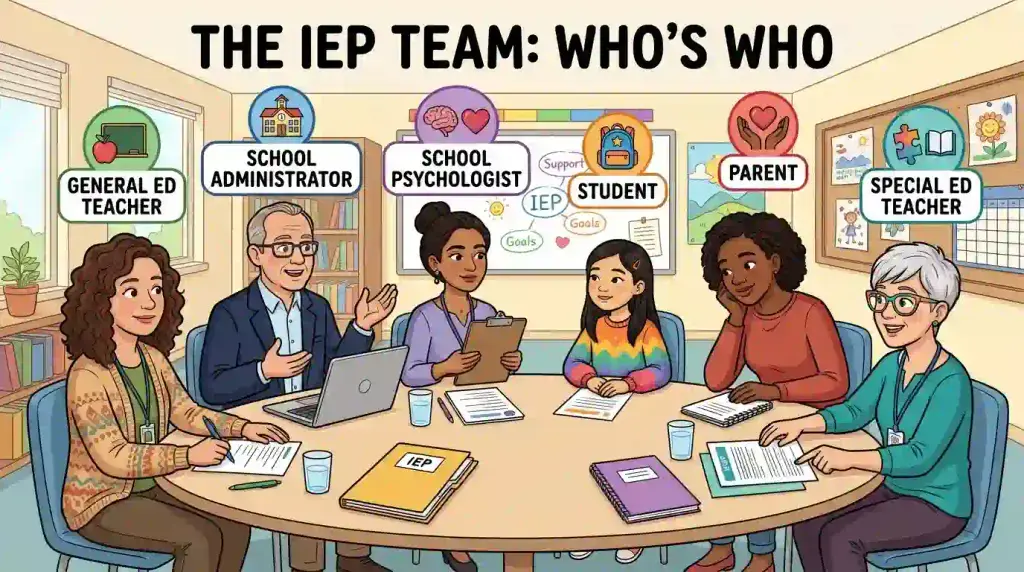
Federal law requires a team, and families are full members. Required members are:
- The parent or guardian, who has the right to take part in every decision.
- At least one general education teacher, who explains classroom expectations.
- At least one special education teacher, often the case manager and main contact.
- A district representative (LEA), qualified to supervise special education and able to commit district resources.
- Someone who can interpret evaluation results, often a school psychologist.
- The student, when appropriate, and always invited once transition planning begins.
Either side may add people with special knowledge: therapists, outside professionals, advocates, interpreters (which the school must provide if needed), or a supportive friend. Parents may bring anyone they choose. A required member can be excused only if the parent and school agree in writing and the member submits written input.
The goal is consensus. The school cannot simply outvote a parent, and a parent cannot simply override the school’s professional judgment. If agreement fails, parents can ask for more data, a follow-up meeting, Prior Written Notice, or formal dispute resolution.
The IEP Process, Step by Step
The steps below reflect federal rules; states may set different timelines.
- Identification and referral. Under Child Find, districts must identify children who may need services, including private-school, homeschooled, and preschool-age children. A parent, teacher, or professional can refer. Request in writing: it creates a record and often starts the legal clock.
- Consent for evaluation. The school must give written notice and get informed parental consent.
- Evaluation. Generally within 60 days of consent. It must be comprehensive, non-discriminatory, and use multiple sources. Schools must consider private evaluations parents share.
- Eligibility determination. The team decides whether the student has a qualifying disability and needs specially designed instruction. If not eligible, the school must explain in writing, and parents can seek an independent evaluation. A 504 plan may still apply.
- Developing the IEP. The meeting must occur within 30 days of the eligibility decision. You don’t have to sign on the spot.
- Consent and implementation. Written consent is required before first services. Parents can revoke consent, which ends special education services.
- Progress monitoring. Reported as often as report cards. The team can meet early if progress stalls.
- Annual review. At least once a year.
- Re-evaluation. At least every three years, unless parent and school agree it isn’t needed.
What Happens at an IEP Meeting?

Meetings typically run 30 to 90 minutes: introductions, purpose, parent concerns and student strengths, review of evaluations, goals, services and placement, then a summary of next steps.
To prepare as a parent: request the draft IEP and evaluations several days early, write a parent concerns letter, bring private evaluations and work samples, pick your top two or three priorities, and consider bringing support.
To prepare as a teacher: bring current data, use plain language, open with strengths, and be ready to explain how each support will work in practice.
Useful questions: How will progress be measured and reported? What does this service look like in a typical day? Who implements each accommodation? How much time will my child spend in general education? What happens if my child isn’t progressing?
If tension rises, stay focused on data, ask for the reasoning behind recommendations, request that concerns be recorded, ask for a break, and don’t sign under pressure. Afterward, review the final IEP against what was discussed, send corrections in writing, and follow up in a few weeks to confirm services have started.
Resolving disagreements, from least to most formal: informal conversation, IEP facilitation (availability varies), mediation (free and confidential), a state complaint (generally investigated within 60 days), and a due process hearing before an impartial hearing officer. Parents generally have two years to file for due process, though some states differ.
Parent and Student Rights (Procedural Safeguards)
Schools must give parents a written notice of procedural safeguards at least once a year and at key moments such as referral and complaints. Core rights include:
- Notice: Prior Written Notice before the school proposes or refuses changes to identification, evaluation, placement, or services.
- Consent: before the initial evaluation and first services; consent can be withdrawn.
- Records: inspect all education records, with a response no later than 45 days after the request.
- Participation: meetings at a mutually agreed time and place, with an interpreter if needed.
- Confidentiality: the school generally needs consent to share identifying information.
- Meetings and changes: request an IEP meeting, re-evaluation, or revision at any time.
- Independent Educational Evaluation (IEE): if you disagree with the school’s evaluation, you can request one at public expense. The district must pay or file for due process to defend its own evaluation.
Stay-put: while a dispute is pending, the student generally stays in their current placement.
Discipline: a removal of more than 10 school days in a year requires continued educational services. A removal that changes placement triggers a Manifestation Determination Review within 10 school days, asking whether the behavior was caused by the disability or by the school’s failure to implement the IEP.
Age of majority: in most states, rights transfer to the student at 18, with notice at least a year earlier.
Help is available from your state department of education, your state’s Parent Training and Information (PTI) Center (parentcenterhub.org), Protection and Advocacy agencies, and local advocates or attorneys.
Transition Planning: Preparing for Life After School
Transition services must be in the first IEP in effect when the student turns 16 (many states start at 14). The plan includes measurable postsecondary goals in education and training, employment, and, when appropriate, independent living. Example: “After graduation, Jordan will enroll in a community college automotive program and work part-time at a repair shop.”
Transition services can include career exploration, community experiences, job shadowing, travel training, and daily living skills, along with a list of courses of study. With consent, the school should invite agencies such as Vocational Rehabilitation. The student must be invited to any meeting where transition is discussed, and self-advocacy skills are worth building early.
At graduation or aging out, the school must provide a Summary of Performance, useful for colleges and employers.
Diploma matters: a regular diploma generally ends IDEA services. A certificate of completion often does not count as a regular diploma, so services may continue until the end of the school year in which the student turns 21 (or the state limit). Some states offer alternate diplomas. Decide with full information, since credentials affect college, financial aid, military service, and jobs.
After high school, IDEA no longer applies. Colleges and employers follow the ADA and Section 504, which provide accommodations but not specialized instruction, and the student must request them. Adult services may have waiting lists, so apply early.
IEP vs. 504 Plan (and Other Plans)
A 504 plan comes from Section 504 of the Rehabilitation Act of 1973, a civil rights law. In short, an IEP provides specialized instruction, while a 504 plan removes barriers through accommodations.
| IEP | 504 Plan | |
| Law | IDEA | Section 504 |
| Purpose | Specially designed instruction and services | Equal access through accommodations |
| Who qualifies | One of 13 categories plus need for specialized instruction | Impairment that substantially limits a major life activity (broader) |
| Written goals | Required | Not required |
| Review | At least yearly; re-evaluation every 3 years | Periodic, commonly yearly |
| Protections | Detailed procedural safeguards | Fewer, but notice, records, and hearing rights exist |
A student might get a 504 plan for diabetes care, ADHD that is managed with extra time, severe allergies, or injury recovery. Generally a student does not have both, since an IEP already carries 504 protections, though a district may use a 504 plan for a need outside the IEP. Neither is “better”; they fit different needs, and a student can move between them.
Related plans: the IFSP (birth to age 2), the Individual Health Plan for medical needs, the BIP for behavior, and RTI/MTSS frameworks that provide early help. RTI or MTSS cannot be used to delay or deny a parent’s request for an evaluation.
Types of IEP Support in Practice
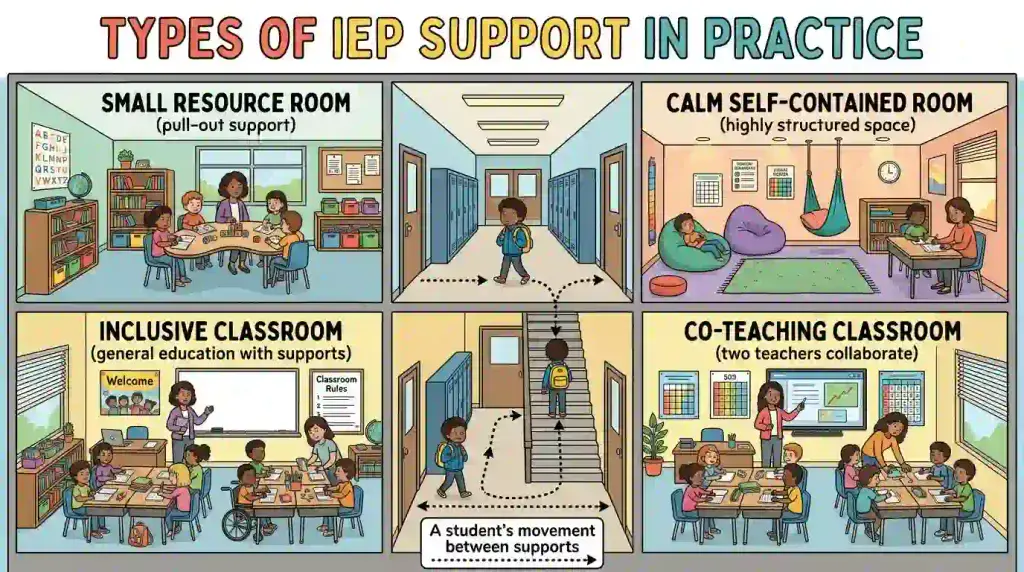
Because of LRE, schools offer a continuum of placements, from most to least inclusive:
- General education with supports: the whole day in a regular classroom with aides, technology, or visiting specialists.
- Co-teaching: general and special educators share a classroom.
- Resource room or pull-out: small-group work for specific skills.
- Self-contained classroom: most or all of the day with a special education teacher, often with time alongside peers.
- Specialized schools: such as schools for the deaf or blind.
- Home, hospital, or residential settings.
More restrictive does not mean more help. Placement is a team decision based on the IEP, not the other way around, and the IEP must explain any removal from general education. Related services can be push-in (provider comes to the classroom) or pull-out (student leaves for sessions). For example, Maya, a fourth grader with a reading disability, spends about 80 percent of her day with typical peers, with a small-group reading block in the resource room and text-to-speech in science. Placement can change as needs change.
Common Myths About IEPs
- “An IEP means special education classes all day.” An IEP describes needed support, not a room. Many students spend most or all of the day in general education.
- “It follows my child forever and hurts college chances.” It is reviewed yearly, can end, and is not on transcripts or sent to colleges. Students can share documentation with a college disability office if they choose.
- “Only for severe disabilities.” It covers mild to significant needs if education is affected.
- “The school decides everything.” Parents are equal members with consent and dispute rights.
- “Good grades mean no IEP.” Eligibility looks at overall educational impact, not grades alone.
- “It’s a stigmatizing label.” IEPs are confidential, and many children feel relief at finally getting help.
- “Once signed, it can’t change.” You can request a meeting any time.
- “The school must give anything I ask.” Schools must provide an appropriate education, so data helps your case.
- “Teachers don’t have to follow it.” An IEP is legally binding on everyone who implements it.
- “A teacher’s recommendation guarantees an IEP.” Evaluation and eligibility decide.
Benefits and Challenges of an IEP
Benefits: individualized support, legal accountability, measurable goals, access to related services families might otherwise pay for, home-school collaboration, transition planning, discipline protections, and growth in self-advocacy.
Challenges: evaluation and service delays, inconsistent day-to-day implementation, stigma worries, limited resources, disagreements over goals, heavy jargon, and uneven quality across districts.
If the IEP isn’t being followed, compare the plan with what your child actually experiences, write to the case manager citing the specific item, request service logs, question for compensatory services for missed sessions, and escalate to mediation, a state complaint, or due process if needed.
The goals feel too low or vague, ask what data provides them, request specific and appropriately ambitious goals, and offer your own observations or outside evaluations.
If services were cut, ask for the data and Prior Written Notice, and remember stay-put may save current services during a battle .
IEPs Beyond the U.S.
IDEA is a U.S. law, so “IEP” rights are specific to the U.S. Other countries use their own systems.
- England: SEN Support in schools, and the legally binding Education, Health and Care Plan (EHCP) for complex needs (ages 0 to 25), the closest equivalent to an IEP. Scotland, Wales, and Northern Ireland have their own systems.
- Canada: Provincially run, with IEPs widely used by that name. Ontario also uses the Identification, Placement and Review Committee (IPRC).
- Australia: “Reasonable adjustments” under the Disability Standards for Education, with schools using Individual Education or Learning Plans. NCCD is a data collection, not a plan.
- Elsewhere: Ireland, New Zealand, and India commonly use individual education plans, with varying legal strength.
Legal force, funding, eligibility, parent rights, and terminology all differ. A U.S. IEP is not legally binding abroad, though records still help a new school. When moving, ask the local education authority which documents it accepts.
Tips for Parents, Educators, and Students
Parents: keep an IEP binder, write a concerns letter before each meeting, communicate in writing, learn key vocabulary, track progress at home, build a relationship with the case manager, take your time before signing, and connect with a PTI Center or parent group.
Teachers: read every IEP early, implement accommodations consistently, collect data, collaborate across roles, communicate regularly with families, use plain language, start with strengths, and protect confidentiality.
Students: learn your own needs, attend your meetings, practice asking for accommodations politely, set personal goals, and keep track of what works.
Year-round rhythm: confirm teachers have the IEP at the start of the year, check in after the first month, compare each progress report with goals, request an early meeting if progress is slow, and prepare a concerns letter before the annual review.
Resources and Tools

- Federal and national: U.S. Department of Education IDEA site (sites.ed.gov/idea), Center for Parent Information and Resources (parentcenterhub.org), National Center for Learning Disabilities (ncld.org), Understood.org, Wrightslaw, COPAA.
- State and local: your state department of education, your PTI Center, your Protection and Advocacy agency, and your district’s special education director.
- International: GOV.UK SEND pages and IPSEA (England), provincial ministries (Canada), the Department of Education’s Disability Standards pages (Australia), NCSE (Ireland).
- Lead magnet idea: a free “IEP Meeting Prep Kit” with a checklist, concerns letter, communication log, and question list.
- Who pays for IEP services? The school, at no cost to families, as part of FAPE.
- Is an IEP confidential? Yes, under FERPA and IDEA. Only staff with a legitimate educational reason can see it unless a parent consents.
Glossary of Common IEP Acronyms
| Acronym | Meaning |
| IEP | Individualized Education Program |
| IDEA | Individuals with Disabilities Education Act |
| FAPE | Free Appropriate Public Education |
| LRE | Least Restrictive Environment |
| PLAAFP | Present Levels of Academic Achievement and Functional Performance |
| LEA | Local Education Agency (the district or its representative) |
| PWN | Prior Written Notice |
| IEE | Independent Educational Evaluation |
| FBA / BIP | Functional Behavioral Assessment / Behavior Intervention Plan |
| MDR | Manifestation Determination Review |
| ESY | Extended School Year |
| SDI | Specially Designed Instruction |
| SLP / OT / PT | Speech-Language Pathologist / Occupational Therapy / Physical Therapy |
| IFSP | Individualized Family Service Plan |
| RTI / MTSS | Response to Intervention / Multi-Tiered System of Supports |
| SOP | Summary of Performance |
| 2e | Twice-Exceptional |
| ARD / CSE | IEP team names in Texas / New York |
| EHCP / SENCo | England’s Education, Health and Care Plan / Special Educational Needs Coordinator |
FAQS
What does IEP stand for in school? Individualized Education Program, a written, legally binding plan for a student with a disability. In some countries it means Individual Education Plan.
Does an IEP go on a permanent record? It is part of confidential education records but is not on a diploma or transcript and isn’t sent to colleges or employers. Parents can review records, and retention follows state and district rules.
Can an IEP be denied? A student can be found not eligible. The school must explain in writing, and parents can seek an independent evaluation, mediation, a state complaint, or due process. A 504 plan may still be an option.
How long does it take to get an IEP? Generally 60 days to evaluate after consent plus 30 days to hold the IEP meeting if eligible, so about 90 days, with many states faster.
Can a parent request an evaluation? Yes, any time and for any reason, ideally in writing. The school must agree and seek consent, or refuse in writing.
Does an IEP carry over to college? No. IDEA covers K-12 only, but students can request accommodations under the ADA and Section 504 through the college disability office.
Can a child have both an IEP and a 504 plan? Generally no, since the IEP covers needed accommodations, with rare exceptions for needs outside the IEP.
Can an IEP end? Yes: when the student no longer qualifies, graduates with a regular diploma, ages out (typically 21 or 22), or parents revoke consent in writing. The school must give written notice first.
Can parents refuse an IEP? Yes. Consent is required for first services, and it can be withdrawn later, which ends services.
Conclusion
IEP stands for Individualized Education Program, a legally binding plan that makes sure a student with a disability gets the instruction, supports, and services they need to learn and grow in school. You’ve seen where it comes from, who qualifies, what it contains, who is on the team, how the process works, what rights families have, and how it differs from a 504 plan.
An IEP is a support tool, not a label. It does not define a child or follow them forever. The strongest plans come from teamwork: parents share what they know, teachers share what they see, and students speak up about their needs. Ask questions, keep good records, and remember you can request a meeting or an evaluation at any time.

Hi, I’m Rida, the writer behind this site about word meanings.
I explain words in simple English with clear definitions, synonyms, and real examples.
My goal is to help learners and curious readers pick the right word with confidence.
Every article is checked against trusted dictionaries so you can learn with trust.