
On the Ides of March, 44 BC, Julius Caesar walked into a meeting of the Roman Senate, surrounded by men he thought he knew. Moments later, daggers flashed. Among the attackers stood a familiar face: Marcus Junius Brutus, a man Caesar had trusted, promoted, and perhaps even loved like a son.
“Et tu, Brute?” is Latin for “And you, Brutus?” It expresses shock and heartbreak at being betrayed by someone you trusted, and today it is used for any act of treachery from a close friend or ally.
But did Caesar really say it? Why “Brute” instead of “Brutus”? And how did a line from a 400-year-old play become one of the most quoted phrases in the English language?
In this guide, you’ll learn the exact meaning, grammar, pronunciation, history, and modern usage of “Et tu, Brute?”, plus the myths that have grown up around it.
Et Tu, Brute? at a Glance
| Phrase | Et tu, Brute? |
| Language | Latin |
| Literal meaning | “And you, Brutus?” (also read as “You too, Brutus?”) |
| Figurative meaning | Shock and hurt at being betrayed by a trusted friend or ally |
| Made famous by | William Shakespeare, Julius Caesar (c. 1599), Act 3, Scene 1 |
| Spoken by | Julius Caesar, in the play |
| Spoken to | Marcus Junius Brutus, one of the assassins |
| Historical accuracy | Unlikely to be Caesar’s real last words; ancient sources do not record the Latin phrase |
| Pronunciation | et too BROO-tay (English) or et too BROO-teh (Classical Latin) |
| Common variants | Et tu Brute, Et tu Brutus (the latter is not correct Latin) |
| Used today to express | Betrayal, disloyalty, or mock outrage at a friend’s “treachery” |
What Does “Et Tu, Brute?” Mean?

The simplest answer: “Et tu, Brute?” means “And you, Brutus?” or, more loosely, “You too, Brutus?” It is what you say when someone you trusted turns out to be among your enemies.
Word-by-word translation
- Et means “and,” but here it carries the sense of “also” or “even.” It signals surprise that this person, of all people, is part of the attack.
- Tu means “you” (singular, informal). Using the familiar form rather than a formal one hints at closeness between the two men.
- Brute is the form of the name Brutus used when speaking directly to him.
Put together, the phrase is a question, but not a real one. Nobody asking “Et tu, Brute?” wants an answer. It is a cry of disbelief.
Why “Brute” and not “Brutus”?
Latin uses a special form called the vocative case for addressing someone directly. For second-declension nouns ending in -us, the vocative ending changes to -e. So Brutus becomes Brute when Caesar speaks to him. Another familiar example: Marcus becomes Marce in direct address.
That is why a Latin speaker would say Et tu, Brute? and not Et tu, Brutus? The second version appears often in English writing, but it is not correct Latin.
Literal vs. figurative meaning
Literally, the phrase is a question addressed to one man at one moment in history.
Figuratively, it has become shorthand for betrayal by a close friend or ally. The sting comes from the relationship: an enemy’s attack is expected, but a friend’s is devastating. That is why the phrase works for everything from political defections to a roommate eating your leftovers.
Common spellings and variants
- Et tu, Brute? (standard, with comma)
- Et tu Brute (no comma, very common)
- Et tu, Brutus? (incorrect in Latin, but widely used)
- Et tu, Brutè (occasionally seen with an accent mark, which is not needed)
How to Pronounce “Et Tu, Brute?”

There are two main ways to say it: the reconstructed Classical Latin pronunciation, and the way most English speakers say it today.
Classical Latin
et too BROO-teh
- Et rhymes with “bet.”
- Tu is pronounced “too.”
- Brute has two syllables: a long “oo” in the first, and a final -e pronounced “eh,” as in “bet.”
Common English pronunciation
et too BROO-tay or et too BROO-tee
English speakers tend to anglicize the ending, so Brute is often said like “Brutay” or even “Brootee.” You will hear the first version most often in theater, film, and classrooms. The -tee ending is common in casual speech.
Why the variation?
Latin has not been a native spoken language for centuries, so there is no single “correct” pronunciation. Scholars reconstruct the Classical version from ancient writings, while English speakers have adapted the sounds over time. Shakespeare’s actors would have used yet another pronunciation, shaped by the English of the 1590s.
The takeaway: any of these versions will be understood. Pick one and say it with feeling.
The Historical Background

To understand why “Et tu, Brute?” carries so much weight, you need to know what was happening in Rome when Caesar died.
Rome in crisis
By the 40s BC, the Roman Republic was exhausted. Decades of political violence, rivalry between powerful generals, and civil war had weakened the institutions that had governed Rome for nearly 500 years. Caesar emerged as the winner of that struggle. After crossing the Rubicon in 49 BC and defeating his rival Pompey, he returned to Rome with unmatched military power and popularity.
The Senate showered him with honors. He was made dictator, a legal office meant to be temporary, and in early 44 BC he was named dictator perpetuo, or “dictator for life.” To many senators, this looked like the end of the Republic. Rome had expelled its kings centuries earlier, and the idea of one man holding permanent power was deeply threatening. Rumors that Caesar wanted to be crowned king only fueled the fear.
The conspiracy
Out of that fear grew a plot. Ancient sources put the number of conspirators at around 60, drawn from many backgrounds. Some were old enemies of Caesar. Others, remarkably, were men he had pardoned or promoted. The two leading figures were Gaius Cassius Longinus, a skilled military commander who bore Caesar a grudge, and Marcus Junius Brutus, a respected senator known for his republican principles.
Brutus was the conspiracy’s moral center. His family claimed descent from Lucius Junius Brutus, the legendary founder of the Republic who drove out Rome’s last king. Friends and critics alike pressed Brutus to live up to that heritage, and he came to see killing Caesar as a duty to Rome rather than a personal betrayal.
The assassination
The plotters chose the Ides of March (March 15), 44 BC, when the Senate was scheduled to meet. The venue was a hall attached to the Theatre of Pompey, since Caesar’s usual meeting place was unavailable. According to ancient accounts, the conspirators crowded around Caesar under the pretense of presenting a petition, then drew concealed daggers.
Suetonius reports that Caesar received about 23 wounds, though he notes that only one was fatal. Plutarch adds that when Caesar saw Brutus among his attackers, he stopped resisting and pulled his toga over his face. Caesar fell at the foot of a statue of Pompey, his old rival.
The conspirators had hoped to restore the Republic. Instead, the murder triggered another round of civil war, and within two decades Rome had an emperor.
Who Was Brutus, and Why Did His Betrayal Cut Deepest?
Of all the conspirators, Brutus was the one Caesar had the least reason to expect. Understanding why requires a look at who Brutus was and what he and Caesar meant to each other.
Background and family
Marcus Junius Brutus was born around 85 BC into one of Rome’s most distinguished families. His father’s side claimed descent from Lucius Junius Brutus, the founder of the Republic. His mother, Servilia, belonged to the powerful Servilii Caepiones and was the half-sister of Cato the Younger, the most famous defender of republican principles in Rome.
Brutus grew up steeped in philosophy, rhetoric, and republican ideals. He was admired for his integrity and seriousness, which made him a natural symbol for anyone who feared one-man rule.
From enemy to favorite
When civil war broke out, Brutus did something that surprised many: he sided with Pompey, the man who had killed his father. His loyalty was to the Republic, and Pompey, however flawed, represented the Senate’s cause. After Pompey’s defeat at Pharsalus in 48 BC, Caesar not only pardoned Brutus but welcomed him into his circle.
The rise that followed was swift. Caesar appointed Brutus governor of Cisalpine Gaul and later made him a city praetor, one of the highest magistracies, for 44 BC. He also marked Brutus for a future consulship. By any measure, Brutus was among Caesar’s most favored men.
The Servilia connection
Caesar’s affection for Brutus was widely linked to his long relationship with Servilia. Ancient writers say the two were lovers for years, and that Caesar once gave her a lavish gift, a pearl worth a fortune. That personal bond helps explain why Caesar treated her son with such warmth.
Was Brutus Caesar’s son?
Myth check: Probably not. Caesar was only about 15 years older than Brutus, which makes biological fatherhood unlikely. Still, the rumor was common in antiquity and fed the drama of later retellings. Even without a blood tie, Caesar clearly treated Brutus like family.
What happened to Brutus
After the assassination, Brutus and Cassius fled Rome and raised armies in the east. In 42 BC, they faced Mark Antony and Octavian (Caesar’s heir) at the Battle of Philippi. Brutus’s forces were defeated, and he died by suicide rather than be captured.
Why it hurt so much
Brutus’s betrayal stung because it was personal as well as political. Caesar had forgiven him, honored him, and trusted him. For Brutus, however, loyalty to the Republic outweighed loyalty to a friend. That tension is why the story still resonates: it asks whether one can betray a person in order to be faithful to a principle.
Did Caesar Really Say “Et Tu, Brute?”

The short answer: almost certainly not, at least not in Latin. No ancient historian records Caesar uttering those exact words. The famous line is largely a gift from later writers, and especially from Shakespeare.
What the ancient sources say
Three main ancient accounts describe Caesar’s final moments, and they do not agree.
- Suetonius (Life of Julius Caesar, written about 120 AD) says Caesar did not speak at all, groaning only at the first blow. He then adds that some people reported Caesar said, in Greek, “You too, child?” as Brutus approached.
- Cassius Dio (writing in the early 200s AD) gives the Greek phrase kai su, teknon?, meaning “You too, child?” Notice that this is not “Brutus” but “child,” a term that is affectionate, and perhaps loaded with meaning.
- Plutarch (writing around 100 AD) has Caesar say nothing. Instead, he stops fighting once he sees Brutus among his attackers and covers his face with his toga.
So the evidence is thin and conflicting. Suetonius himself seems unsure, and all of these authors wrote more than a century after the event, working from earlier accounts that have since been lost.
Why Greek?
If Caesar said anything, Greek is plausible. Educated Romans of his class spoke it fluently, and it was often used for emotionally charged or intimate remarks. That is one reason the Greek version has been taken seriously by some historians, even though it cannot be confirmed.
Before Shakespeare
The Latin phrase did not spring fully formed from Shakespeare’s pen. Versions of it appear in the late 1500s in plays about Caesar, including Richard Edes’s Latin play Caesar Interfectus (1582) and The True Tragedy of Richard Duke of York (1595), which uses the line in a different context. These suggest the phrase was already circulating in Elizabethan theater.
Shakespeare’s role
Shakespeare did not invent the Latin line, but he made it immortal. When he placed “Et tu, Brute? Then fall, Caesar” in Julius Caesar (c. 1599), it reached audiences far wider than any earlier version. The play’s popularity, along with centuries of school study, locked the Latin phrase into the English language.
The bottom line
“Et tu, Brute?” is best understood as dramatic tradition rather than documented history. Caesar may have said something, he may have said nothing, and the words we remember belong more to the stage than to the Senate floor.
Shakespeare’s Julius Caesar
Shakespeare’s Julius Caesar is not really a play about Caesar. He dies at the midpoint, and the rest of the drama follows the people who killed him. Yet the assassination scene, and one line within it, has become the play’s most famous moment.
Where the line appears
“Et tu, Brute?” comes in Act 3, Scene 1, the assassination scene. The conspirators gather around Caesar on the pretense of petitioning him, and Casca strikes first. Caesar fights back against the others, but when Brutus draws his dagger, he speaks his last words in the play:
“Et tu, Brute? Then fall, Caesar.”
The line is brief, but it carries the emotional weight of the whole scene.
The dramatic function of the line
Shakespeare uses the moment to show that Brutus’s blow wounds Caesar more than all the others. Up to that point, Caesar resists. After seeing Brutus, he yields. “Then fall, Caesar” is both a statement of defeat and an act of surrender: if even Brutus is against him, there is nothing left to fight for.
This echoes Plutarch’s account, in which Caesar stops resisting upon seeing Brutus. Shakespeare read Plutarch closely (he drew on Thomas North’s English translation of Plutarch’s Lives) and turned a silent gesture into a line of dialogue.
The brevity is the point. A longer speech would dilute the shock. Two Latin words and a name say everything an audience needs to know about the relationship and the betrayal.
Themes the scene explores
- Friendship vs. duty: Brutus must choose between a personal bond and a political principle.
- Honor and ambition: The conspirators claim noble motives, while Caesar’s critics accuse him of ambition.
- Betrayal: The scene shows betrayal in its most intimate form, a friend striking the blow.
- Appearance vs. reality: Men who seem to be petitioners are actually assassins.
Other famous lines from the play
- “Beware the Ides of March.” The Soothsayer’s warning to Caesar in Act 1, Scene 2.
- “The most unkindest cut of all.” Antony’s description of Brutus’s stab in Act 3, Scene 2, in his funeral speech.
- “Friends, Romans, countrymen, lend me your ears.” The opening of that same speech.
- “Cry ‘Havoc!’ and let slip the dogs of war.” Antony’s prophecy of the chaos to follow, in Act 3, Scene 1.
Why it works on stage
The line succeeds because of timing and contrast. The scene builds with crowded, violent action, then narrows to a single exchange between two men. Actors often pause before Caesar speaks, letting the audience feel the shock. Then the line lands quietly, almost like a sigh, and the scene ends not with a shout but with a surrender.
Why the Phrase Endures: Cultural Impact
More than four centuries after Shakespeare, “Et tu, Brute?” is still one of the most recognizable lines in the English language. Its staying power comes from a few things working together.
Betrayal is universal
Almost everyone has felt the particular pain of being let down by someone close. The phrase captures that feeling in a few words, and it works across cultures and generations because the emotion behind it never changes. An enemy’s attack hurts, but a friend’s attack changes how you see the world.
Brutus as a symbol
Brutus has meant different things to different eras. Dante, writing in the early 1300s, placed him in the lowest circle of Hell in the Inferno, where he is chewed in one of the three mouths of Satan, alongside Judas Iscariot and Cassius. For Dante, betraying a benefactor was among the worst sins imaginable.
Later readers saw him differently. During the Renaissance and the age of revolutions, Brutus became a symbol of resistance to tyranny. Thinkers and political figures invoked his name to argue that liberty can justify drastic action. That legacy remains tangled, since the same tyrannicide rhetoric has been borrowed by very different people, including assassins, for very different ends.
Shakespeare himself leaves the question open. In the play, even Antony calls Brutus “the noblest Roman of them all,” while still condemning the murder. That ambiguity is part of why audiences keep returning to the story.
A phrase that works in politics
Because the line is so compact, it has become a favorite of political commentary. Headlines use it when a party member votes against leadership, when an ally abandons a cause, or when a trusted adviser goes public with criticism. It signals both drama and a hint of irony, letting writers frame a modern dispute as an ancient tragedy.
Flexible tone
Part of its longevity is that it can be deadly serious or completely playful. The same phrase fits a historical lecture, a courtroom drama, and a joke about someone stealing the last slice of pizza. That range keeps it fresh and gives it new life in each generation, including in memes and social media.
A shared cultural shorthand
Finally, the phrase has become a kind of shorthand that needs no explanation. Even people who have never read Julius Caesar understand what is meant. Few quotations achieve that level of recognition, and fewer still manage it in a dead language.
Modern Usage
“Et tu, Brute?” has moved well beyond the classroom and the stage. Today it shows up in group chats, newsrooms, and boardrooms, usually with a wink.
In everyday life
Most modern uses are lighthearted. The phrase works best when a small betrayal gets treated like a historic one:
- A friend orders the dessert you said you were both skipping.
- A coworker takes the last coffee pod, or the credit for your idea.
- A sibling spoils the season finale.
- Your dog sits on the neighbor’s lap instead of yours.
The humor comes from the gap between the trivial offense and the grand language. Dropping a Latin line over a stolen french fry is part of the joke.
In politics and media
Journalists and commentators use the phrase when allies turn on one another: a party member votes against leadership, a longtime supporter endorses the opposition, or a close adviser criticizes a former boss in public. In these cases it signals that the betrayal came from inside the circle, which is what makes it newsworthy.
In pop culture
The line appears across books, films, television, comics, and music, usually as a quick way to signal a betrayal or to poke fun at one. It is also a staple of internet culture, where it turns up in memes, captions, and reaction posts.
How to use it correctly
Do:
- Use it when someone close to you does something disloyal, real or exaggerated.
- Keep the Latin form Brute when quoting it directly.
- Adapt the name for humor: “Et tu, Karen?” is widely understood.
Don’t:
- Use it for annoyances from strangers, since the point is a trusted relationship.
- Use it in a truly painful situation without considering tone. Humor can undercut real hurt.
- Write “Et tu, Brutus?” if you want to be precise, because the Latin vocative is Brute.
Example sentences
- Casual: “You voted for pineapple on the pizza? Et tu, Brute?”
- Humorous: “I trusted you with the Wi-Fi password, and you gave it to my brother. Et tu, Brute?”
- Professional: “When the finance team opposed the budget we had drafted together, it felt like an ‘Et tu, Brute?’ moment.”
- Political: “The senator’s decision to back the rival bill drew cries of ‘Et tu, Brute?’ from his own caucus.”
- Literary: “Her best friend’s testimony was the real blow, a modern ‘Et tu, Brute?’ in the courtroom.”
- Self-aware: “I know I’m being dramatic, but ‘Et tu, Brute?’ is the only fair response.”
Similar Phrases and Idioms
“Et tu, Brute?” is one of many expressions English uses to describe betrayal. Each has its own origin and flavor, so the right choice depends on the tone you want.
| Phrase | Origin | Meaning | Nuance |
| Stabbed in the back | Everyday English; the image of an attack from behind | Betrayed secretly by someone you trusted | Common and neutral; works in casual and serious contexts |
| Judas / Judas kiss | The Bible: Judas Iscariot betrays Jesus with a kiss | A traitor, or a betrayal disguised as affection | Heavier and more religious; implies deceit and bad faith |
| The most unkindest cut of all | Shakespeare, Julius Caesar, Act 3, Scene 2 | The worst wound is the one dealt by a loved one | Literary and dramatic; often used with irony |
| Snake in the grass | Virgil’s Eclogues | A treacherous person who hides their true nature | Focuses on the hidden threat, not the moment of betrayal |
| A Brutus | Marcus Junius Brutus | A traitor, especially a friend who turns on you | Shorthand for the betrayer rather than the act |
| Beware the Ides of March | Shakespeare, Julius Caesar, Act 1, Scene 2 | A warning that danger is coming | A caution, not a reaction to betrayal |
| Et tu, Brute? | Latin line popularized by Shakespeare | Shock at betrayal by a close friend | Ironic and theatrical; best for mock outrage |
How to choose
- Use “stabbed in the back” when you want a plain, widely understood description.
- Use “Judas” when the betrayal feels deliberate and deceitful, and you are comfortable with a strong, religious comparison.
- Use “Et tu, Brute?” when you want drama, humor, or a literary wink.
- Use “snake in the grass” when someone has been hiding bad intentions all along.
Equivalents in other languages
Many languages have a similar idea. French speakers say coup de poignard dans le dos (“a stab in the back”), and Spanish speakers use puñalada trapera (“treacherous stab”). The Latin line itself is understood well beyond English-speaking countries.
Common Misconceptions
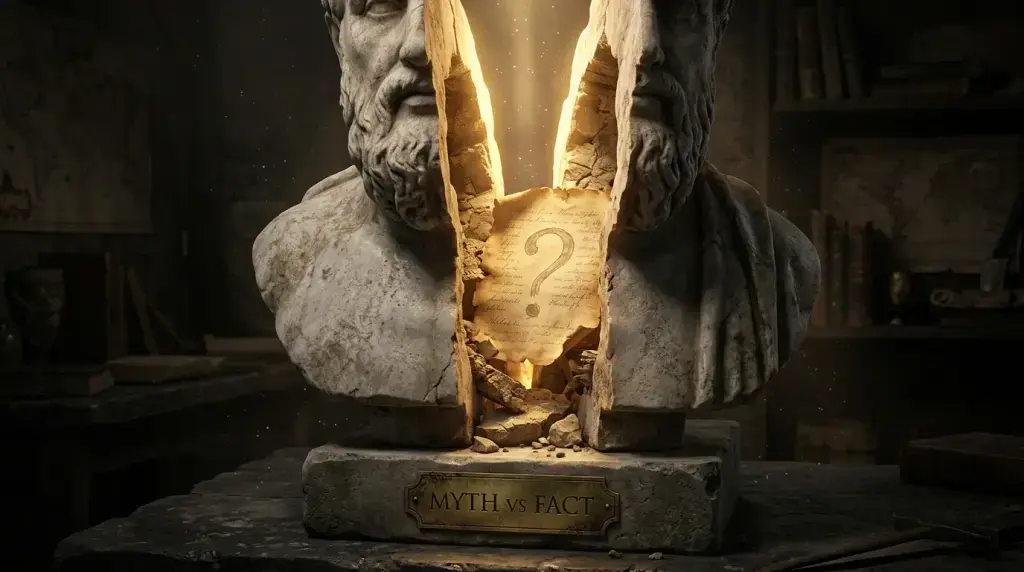
A phrase this famous naturally collects myths. Here are the most common ones, and what the evidence says.
Myth 1: Caesar definitely said “Et tu, Brute?” in Latin. False. No ancient source records these words. Suetonius says Caesar may have said nothing, or may have spoken Greek. The Latin line comes from Elizabethan theater, and Shakespeare made it permanent.
Myth 2: Brutus was Caesar’s son. Unproven, and unlikely. Caesar was only about 15 years older, so biological fatherhood is a stretch. The rumor grew from Caesar’s affair with Servilia and his obvious fondness for Brutus. The Greek “child” in the reported last words may simply be affectionate rather than evidence of a blood tie.
Myth 3: Brutus was a pure villain. It depends on who is telling the story. Dante condemned him to the lowest circle of Hell, while others have celebrated him as a defender of liberty. Shakespeare keeps both views alive by letting Antony call him “the noblest Roman of them all.”
Myth 4: The phrase comes from the Bible or Greek mythology. False. It is a Latin phrase tied to Roman history and popularized by an English playwright. It is sometimes confused with the story of Judas, which has a similar theme of betrayal, but the two are unrelated in origin.
Myth 5: “Et tu, Brutus?” is the correct form. Not in Latin. The vocative case turns Brutus into Brute when addressing someone directly.
FAQS
What does “Et tu, Brute?” mean in English?
It means “And you, Brutus?” or “You too, Brutus?” It expresses shock and hurt at discovering that a trusted friend has joined the people betraying you.
Who said “Et tu, Brute?”
In Shakespeare’s Julius Caesar (c. 1599), the line is spoken by Julius Caesar to Marcus Junius Brutus during the assassination in Act 3, Scene 1. There is no reliable ancient evidence that the real Caesar said it.
Is it “Brute” or “Brutus”?
In Latin, it is Brute. The vocative case, used for addressing someone directly, changes -us endings to -e. “Et tu, Brutus?” is common in English but is not correct Latin.
What language is “Et tu, Brute?”
Latin. Shakespeare’s play is in English, but he kept this line in Latin, which gave it extra weight and made it memorable.
What were Caesar’s actual last words?
Nobody knows for certain. Suetonius says Caesar may have said nothing, though some reported he said “You too, child?” in Greek. Plutarch describes him falling silent and covering his face. The surviving accounts were written well after the event and disagree with one another.
Why did Brutus betray Caesar?
Brutus feared that Caesar’s growing power, especially after being named dictator for life, would end the Roman Republic. His family tradition of opposing kings and the pressure of fellow senators pushed him to act, and he saw the murder as a duty to Rome rather than a personal betrayal.
What is the meaning of “Then fall, Caesar”?
It is Caesar’s response to seeing Brutus among his attackers. It signals surrender: if even Brutus has turned against him, he stops resisting and accepts his death.
How do you pronounce “Et tu, Brute?”
In Classical Latin, et too BROO-teh. Most English speakers say et too BROO-tay or BROO-tee. Any of these will be understood.
Conclusion
“Et tu, Brute?” means “And you, Brutus?”, a cry of shock at being betrayed by someone you trusted.
Its story is part history, part theater, and part myth.
Caesar almost certainly never said it in Latin, and the ancient sources do not agree on what, if anything, he said.
The words we remember came to us through Elizabethan playwrights, and Shakespeare gave them their lasting power.
Brutus himself was far more complicated than the label of “traitor” suggests.
To some he was a villain, and to others a defender of liberty who put principle above friendship.
That tension is exactly why the scene still grips us.
The phrase also survives because it packs a universal feeling into just a few words.
It works as tragedy in a theater and as a joke over a stolen slice of pizza.

Hi, I’m Rebecca Hayes. I write faith-filled articles, healing prayers, and daily devotionals to encourage people in every season of life. My passion is helping readers find peace, hope, and strength through prayer.