Dismissed with prejudice meaning is simple: the judge has ended the case for good, and the person who filed it cannot bring the same claim again. It is a final decision. You may have read the phrase in a news story, seen it in a court paper, or heard it from a lawyer, and wondered what the word “prejudice” has to do with anything.
Here it has nothing to do with bias. In this guide, you will learn what the phrase means, how it differs from “without prejudice,” and why courts use it. You will also see real-style examples, helpful tables, and answers to common questions. This article is general information, not legal advice.
Quick Answer: What Does “Dismissed With Prejudice” Mean?
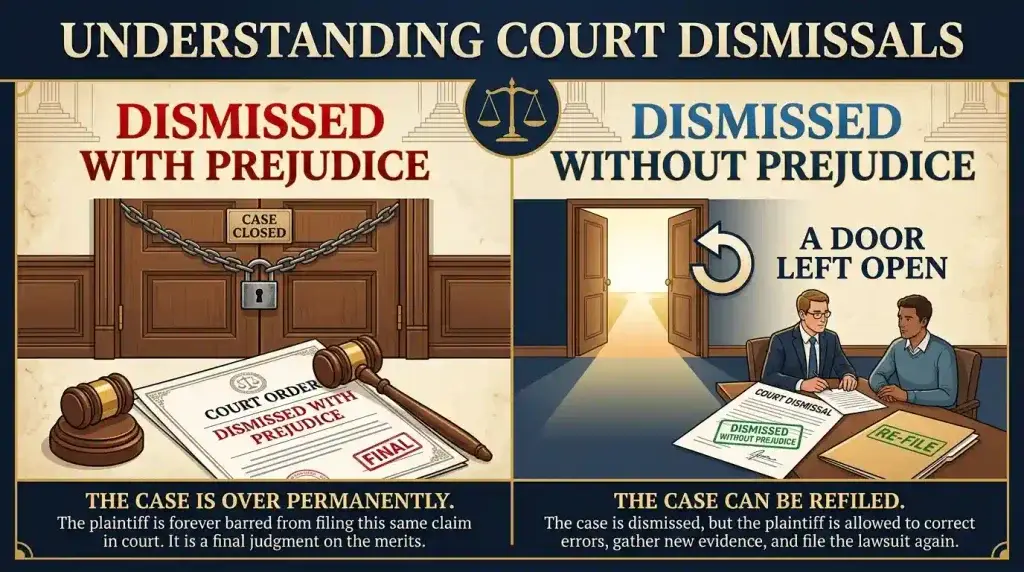
When a case is dismissed with prejudice, the court closes it permanently. The plaintiff, the person who started the lawsuit, cannot file the same claim against the same person again.
Here is a quick summary:
- Meaning: The case is over, and it cannot be refiled
- Effect: It usually counts as a final decision on the claim
- Opposite: Dismissed without prejudice, which allows a new filing
- Common reasons: A settlement, a serious rule violation, or a claim that can never succeed
- Can it be appealed? Often yes, but only in limited ways and within strict deadlines
A short example: “The judge dismissed the lawsuit with prejudice, so the company cannot sue again over the same issue.”
What “Prejudice” Means in Legal Language
Most people hear “prejudice” and think of unfair bias against a group. In everyday speech, that is the usual meaning. In law, the word has an older meaning that is more technical.
The word comes from the Latin praejudicium, which means a “prior judgment.” In court language, “prejudice” refers to harm or loss of legal rights. So “with prejudice” means the dismissal comes with a loss of the right to try again. “Without prejudice” means no rights are lost, so the person may try again.
This is why the phrase sounds odd to new readers. It is not saying the judge was unfair. It is saying that the decision has a lasting effect on the person’s ability to bring the claim.
Keeping this in mind makes the rest of the topic much easier. Think of “with prejudice” as “with a permanent effect.”
Dismissed With Prejudice Meaning in Simple Words
Imagine you borrowed a game from a friend, and your friend says, “I’m done lending you games. This is the last time.” That is a lot like a dismissal with prejudice. The door is shut.
Now imagine your friend says, “Not today, but ask me again next week.” That is more like a dismissal without prejudice. The door is closed for now, but it is not locked.
In a real court, the situation is a bit more formal. A lawsuit starts when a plaintiff files a complaint. The other side, the defendant, may answer or ask the court to dismiss the case. A judge can also dismiss a case on their own for certain reasons. If the judge says “with prejudice,” the plaintiff loses the chance to bring the same claim again in that court or in any other court.
The idea protects people from being sued again and again over the same thing. It also helps courts finish cases instead of letting them drag on forever.
With Prejudice vs. Without Prejudice
This is the comparison most readers want. Here is a table that shows the key differences.
| Feature | With Prejudice | Without Prejudice |
| Can the case be refiled? | No | Yes, often with a deadline |
| Is it final? | Yes | Not always |
| Effect on the plaintiff | Loses the right to sue again on that claim | Keeps the right to try again |
| Common reason | Settlement, serious misconduct, or a claim that cannot work | Fixable mistakes or missing paperwork |
| Effect on the defendant | Protected from the same claim | May face the claim again |
| Typical feeling | Closed door | Door left open |
One important point: “without prejudice” does not mean the plaintiff can wait forever. Time limits called statutes of limitations set deadlines for filing claims. If the deadline passes, a refiled case may be too late, even though the first dismissal was “without prejudice.”
Why Do Courts Dismiss Cases With Prejudice?
Courts do not use this step lightly. It ends someone’s chance to be heard, so judges usually have strong reasons. Here are the most common ones.
A settlement. Many cases end when the two sides agree on a deal. As part of the deal, the plaintiff often agrees to dismiss the case with prejudice. This protects the defendant from another lawsuit over the same matter. It is one of the most common reasons you will see the phrase.
The claim cannot succeed. Sometimes a judge decides that even if everything the plaintiff said were true, the law would not give them a win. If the problem cannot be fixed, the judge may dismiss with prejudice.
Repeated failures to fix mistakes. A court may give a plaintiff several chances to correct a weak complaint. If the plaintiff keeps failing, the judge may finally close the case for good.
Serious rule violations. If a party ignores court orders, hides important evidence, or acts in bad faith, the judge can dismiss as a penalty. Courts treat this as a serious step.
Failure to pursue the case. If a plaintiff does not show up, does not file papers, or lets the case sit, a judge may dismiss it. The judge decides whether to do so with or without prejudice, based on the situation.
The case was already decided. If a claim was already decided in an earlier case, courts may dismiss a repeat case with prejudice. This idea is called res judicata, a Latin phrase meaning “a matter already judged.”
What Happens After a Dismissal With Prejudice?
The effects are important. Here is what usually follows.
First, the case ends in that court. No trial will happen, and no further hearings will be scheduled on that claim.
Second, the plaintiff cannot file the same claim again. If they try, the defendant can ask the court to throw it out because of the earlier dismissal.
Third, the decision usually counts as a final judgment on the claim. In many courts, that means the claim is considered settled by law, even if no trial took place.
Fourth, the defendant is generally protected from another lawsuit over the same events and claims. This gives peace of mind and helps them move on.
Fifth, the plaintiff may still have limited options. For example, they may be able to appeal the decision to a higher court. Appeals have strict deadlines, often measured in weeks, and they must show that the judge made a legal mistake. In some cases, a party may also ask the same judge to reconsider, but courts grant these requests only for specific reasons.
Because the rules differ by court and by state, a person facing this situation should talk to a licensed attorney in their area.
Does It Mean the Plaintiff Lost on the Merits?
This question confuses many people, so let’s go slowly.
“On the merits” means a decision based on the actual facts and law of the case, not just on paperwork or timing. A case dismissed with prejudice is often treated as if it were decided on the merits, even when no trial happened. In federal courts in the United States, for example, many involuntary dismissals work this way unless the judge says otherwise. Some types of dismissals, such as those for lack of jurisdiction or the wrong location, are not treated that way.
Why does this matter? Because a decision on the merits blocks the plaintiff from trying again. It is a legal effect, not a statement about who was right or wrong in real life.
For instance, if a settlement ends the case, the dismissal with prejudice does not mean a judge decided the defendant did nothing wrong. It simply means both sides agreed to close the matter. News writers sometimes make this mistake. A dismissal with prejudice does not always prove innocence or guilt.
Dismissal With Prejudice in Criminal Cases
The phrase appears in criminal cases too, though the rules and reasons can look different.
If a criminal charge is dismissed with prejudice, the government generally cannot bring the same charge against that person again. That is a big deal for the person who was charged.
Judges may take this step in several situations. For example, they might do it when the government violated a person’s rights, when key evidence was handled improperly, or when a case was delayed too long in a way that broke speedy trial rules. Prosecutors may also dismiss charges, and whether it is with or without prejudice depends on the court and the details.
This idea is related to, but not the same as, “double jeopardy.” Double jeopardy is a constitutional protection that, in general, stops a person from being tried twice for the same offense after certain steps in a case. Whether double jeopardy applies depends on how far the first case went. A dismissal with prejudice is a different tool, but the two can overlap.
Because criminal rules are complex and vary by state and by federal courts, anyone facing criminal charges should speak with a defense lawyer.
Real Life Examples
Here are several made-up examples that show how the phrase may appear.
A settled injury case. Sara sues a store after slipping on a wet floor. The store’s insurance company offers her money, and she accepts. As part of the deal, the case is dismissed with prejudice. Sara cannot sue the store again for that same fall.
A weak complaint. A man sues his neighbor for a claim that the law does not recognize. The judge lets him fix the complaint twice, but the problem remains. The judge dismisses the case with prejudice because the claim cannot work.
A broken court order. A company refuses to hand over documents the judge ordered it to share. After several warnings, the judge dismisses the company’s lawsuit with prejudice as a penalty.
A missed paperwork step. A person files a case but forgets a required form. The judge dismisses it without prejudice, so the person can fix the paperwork and try again, as long as the deadline has not passed.
A criminal case. A court finds that police broke important rules when collecting evidence. The judge dismisses the charges with prejudice, and the government cannot refile them.
A business dispute. Two companies end a long fight over a contract. They sign an agreement and tell the court to dismiss the case with prejudice, so neither can sue the other again over that contract.
Each example shows a different route to the same result: the case is closed for good.
Common Mistakes People Make
Legal language can be confusing. Here are mistakes to watch for.
Thinking “prejudice” means bias. In this phrase, it means loss of legal rights, not unfair treatment.
Believing it always means the defendant is innocent. A dismissal with prejudice only means the case cannot be refiled. It does not always say who was right.
Thinking “without prejudice” means a free do-over. Deadlines still apply. If time runs out, the plaintiff may lose the chance to refile.
Assuming every dismissal is the same. Some are with prejudice, some are without, and the judge or the court rules decide which applies.
Believing there is no way to challenge it. Appeals and other requests are sometimes possible, but they are limited and have strict time limits.
Forgetting that settlements often include it. Many people are surprised to learn that a “dismissed with prejudice” label can mean the two sides reached a private agreement.
Treating online summaries as legal advice. Court rules change and differ by place. Only a lawyer who knows your case can give advice.
Tips If You See This Phrase in Your Own Case
If you receive a court paper that says “dismissed with prejudice,” a few steps may help. These are general ideas, not legal advice.
Read the order carefully. Look at the exact words and the date. The details matter.
Check for deadlines. Appeals and other requests usually have short time limits, so act quickly.
Talk to a lawyer. If you cannot afford one, many areas offer legal aid, bar association referral services, or court self-help centers.
Keep your papers. Save every document, email, and notice connected to the case.
Ask questions. If you do not understand the order, ask your lawyer or the court clerk’s office. Clerks cannot give legal advice, but they can often explain procedures.
Think about next steps. Depending on your situation, there may be other options, such as a different kind of claim, an appeal, or a settlement discussion.
Stay calm. A dismissal may feel heavy, but understanding it is the first step toward deciding what to do next.
FAQs
What does dismissed with prejudice mean in simple words?
It means the court ended the case for good. The person who filed it cannot bring the same claim again.
What is the difference between dismissed with prejudice and without prejudice?
With prejudice, the case is closed permanently. Without prejudice, the person may usually file again, as long as deadlines have not passed.
Can a case dismissed with prejudice be refiled?
In general, no. If someone tries, the other side can ask the court to throw it out. In rare situations, a party may appeal or ask the court to reconsider, but the options are limited.
Does dismissed with prejudice mean the defendant is innocent?
Not always. It means the claim cannot be brought again. In a settlement, for example, the case may end with no ruling about who was right.
Is it good or bad to have a case dismissed with prejudice?
It depends on which side you are on. For a defendant, it is usually good news because the claim is over. For a plaintiff, it can be a serious loss because the door is closed.
Do I need a lawyer if my case is dismissed with prejudice?
It is wise to talk to one. Deadlines are short, and the rules vary by court and state. A licensed attorney can explain your options for your specific situation.
Conclusion
Dismissed with prejudice meaning comes down to this: the court has closed the case permanently, and the same claim cannot be filed again. The word “prejudice” here does not mean bias. It points to the loss of legal rights, which is why the phrase carries so much weight.
Courts use it for settlements, repeated mistakes, rule violations, and claims that can never succeed. It differs from “without prejudice,” which leaves the door open to try again. Remember that the label does not always say who was right, and it does not always mean a trial took place.
If you ever see this phrase in your own case, read the order carefully, watch the deadlines, and speak with a licensed lawyer. Clear information and quick action can help you decide what to do next.

Hi, I’m Rida, the writer behind this site about word meanings.
I explain words in simple English with clear definitions, synonyms, and real examples.
My goal is to help learners and curious readers pick the right word with confidence.
Every article is checked against trusted dictionaries so you can learn with trust.