Have you ever seen the term “line of credit” and wondered what it actually means? You are not alone. Many people hear this phrase at the bank or online and feel a little confused. In simple words, a line of credit is a type of loan that gives you access to money up to a set limit. You can borrow, pay back, and borrow again, kind of like a reusable pool of cash.
This article will explain the line of credit meaning in plain English, show you how it works, and help you decide if it fits your money needs.
Quick Answer
A line of credit is a flexible loan that lets you borrow money up to a certain limit, pay it back, and borrow again as needed. You only pay interest on the amount you actually use, not the full limit. It works a bit like a credit card, but often with lower interest rates and larger amounts available.
Meaning or Definition
Let’s break down the line of credit meaning in the simplest way possible.
A line of credit is an agreement between you and a lender, usually a bank or credit union. The lender says, “We will let you borrow up to this amount of money whenever you need it.” You do not get all the money at once. Instead, you draw out only what you need, when you need it.
Here is a simple example. Say a bank gives you a line of credit of $10,000. You do not have to take all $10,000 right away. Maybe you only need $2,000 this month for a home repair. You take that $2,000, and you only pay interest on that amount. Next month, you might not need any money at all, so you pay nothing extra. Then later, you might need $3,000 more, so you draw that out too.
This is very different from a normal loan. With a normal loan, like a car loan, the bank gives you the full amount right away. Then you pay it back in fixed monthly payments over a set time. A line of credit does not work that way. It stays open, and you can use it again and again, as long as you pay back what you owe.
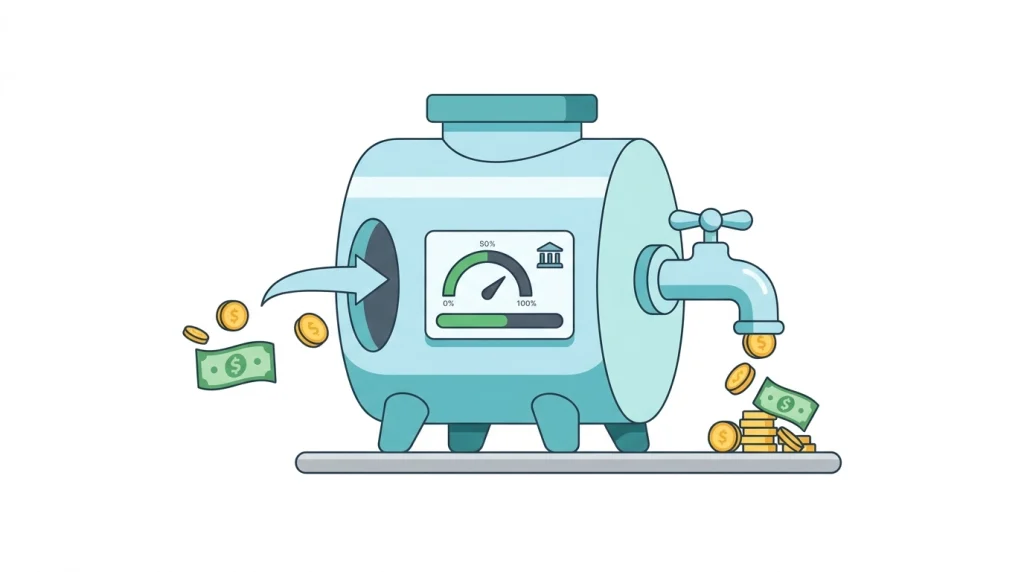
Think of it like a water tank with a tap. The tank holds a certain amount of water, which is your credit limit. You can turn the tap on to get water whenever you need it. You do not have to use the whole tank at once. And once you use some water, the tank slowly refills as you pay your bill.
There are two main types of lines of credit that people commonly use.
A personal line of credit is unsecured, meaning you do not need to put up any property as security. Banks look at your credit score and income to decide if you qualify.
A home equity line of credit, often called a HELOC, is secured by your house. Because your home backs the loan, banks often offer lower interest rates. But there is more risk too, since you could lose your home if you fail to pay.
Businesses also use lines of credit. A business line of credit helps companies manage cash flow, pay for supplies, or cover slow sales months without needing a full loan each time.
How a Line of Credit Works
Now that you know the meaning, let’s look at how the process actually works step by step.
First, you apply with a lender. They check your credit history, your income, and sometimes your assets. Based on this, they approve you for a certain credit limit.
Second, once approved, you can draw money whenever you need it. This is called “drawing” from your line of credit. You might do this through checks, a card, or an online transfer, depending on the lender.
Third, you pay interest only on the money you borrow. If your limit is $15,000 but you only use $4,000, you pay interest on that $4,000 alone. This is one of the biggest benefits compared to a regular loan.
Fourth, you make payments, usually monthly. Some lines of credit only require you to pay the interest each month. Others ask for a small piece of the amount you borrowed too.
Fifth, as you pay back the money, your available credit goes back up. So if you had $4,000 out and you pay back $1,000, you now have $11,000 available to use again, out of your original $15,000 limit.
This cycle can continue for years, based on your agreement with the lender. Some lines of credit have a set time, called a “draw period,” after which you cannot borrow anymore and must only repay what you owe.
Line of Credit vs Loan: What’s the Difference
Many people confuse a line of credit with a regular loan. They sound similar, but they work in very different ways.
| Feature | Line of Credit | Regular Loan |
| How you get the money | Draw as needed, up to a limit | Full amount given at once |
| Interest charged on | Only the amount you use | The full loan amount |
| Repayment | Flexible, based on usage | Fixed monthly payments |
| Reusable | Yes, can borrow again after repaying | No, once paid off, it’s closed |
| Best for | Ongoing or unpredictable expenses | One-time large purchases |
As you can see, a line of credit gives you more flexibility. A loan gives you more certainty, since you know exactly what you owe and when it ends. Neither one is better in every case. It depends on your situation and what you need the money for.
Real-Life Examples
Seeing real examples can help the line of credit meaning feel less abstract. Here are a few common situations where people use one.
Sarah owns a small flower shop. Some months, sales are strong. Other months, especially in winter, sales drop. She uses a business line of credit to cover rent and supplier costs during the slow months. Then she pays it back when sales pick up again in spring.
Mike and his wife want to slowly remodel their kitchen over the next two years. Instead of taking out one big loan, they use a home equity line of credit. They draw money for each phase of the project, like cabinets first, then countertops later, and only pay interest on what they have used so far.
Jenny keeps a personal line of credit open just for emergencies. Her car needed a $900 repair last year. She drew from her line of credit, fixed her car quickly, and paid the balance off over the next few months.
These examples show how a line of credit fits situations where costs are ongoing or unpredictable, rather than a single fixed expense.
Common Mistakes People Make
Even though the idea is simple, people often make mistakes when they use a line of credit. Knowing these can help you avoid trouble.
One common mistake is treating it like free money. Just because credit is available does not mean it is wise to use all of it. Borrowing more than you need can lead to debt that is hard to pay off.
Another mistake is ignoring the interest rate. Lines of credit often have variable interest rates, meaning the rate can go up or down over time. If rates rise, your monthly payment could grow, even if you did not borrow any new money.
Some people forget about fees. Certain lenders charge an annual fee just to keep the line of credit open, even if you never use it. Always check the fine print before signing.
A big mistake with a HELOC is forgetting that your home is the collateral. If you cannot make payments, the bank has the legal right to take steps toward foreclosure. This is a serious risk that people sometimes overlook when they focus only on the low interest rate.
Lastly, some people let the draw period end without a plan. Once the draw period is over, many lines of credit switch to a repayment-only phase, and monthly payments can suddenly increase. Knowing this ahead of time helps you avoid surprises.
Tips for Using a Line of Credit Wisely
If you decide a line of credit fits your needs, here are some practical tips to use it the smart way.
Borrow only what you truly need. Just because you are approved for $20,000 does not mean you should use all of it. Keep your usage close to what solves your actual problem.
Pay more than the minimum when you can. Many lines of credit only require interest payments each month. Paying extra toward the principal helps you avoid long-term debt.
Watch your credit utilization. Using a large chunk of your available credit can lower your credit score. Try to keep your usage under 30 percent of your total limit when possible.
Compare offers from different lenders. Interest rates, fees, and terms can vary a lot. A little research before choosing a lender can save you real money over time.
Keep a small emergency reserve elsewhere. Do not rely on a line of credit as your only safety net, since interest rates can change and access to credit can shift if your financial situation changes.
Read the agreement fully before signing. Look for details about the draw period, repayment period, fees, and what happens if you miss a payment.
Current Usage and Trends
Lines of credit remain popular tools for both individuals and businesses because of their flexibility. Many banks and online lenders now offer digital applications, letting people apply and get approved within a single day. Home equity lines of credit have also grown in popularity as home values rise, giving homeowners more equity to borrow against. Small businesses continue to rely on business lines of credit to manage cash flow gaps, especially in industries with seasonal demand. As financial technology grows, more lenders are offering flexible, app-based access to lines of credit, making them easier to manage than ever before.
FAQs
What does line of credit mean in simple words?
A line of credit means a lender gives you access to a set amount of money that you can borrow, repay, and borrow again, only paying interest on what you actually use.
Is a line of credit the same as a credit card?
They are similar, but not exactly the same. A credit card is one type of revolving credit, while lines of credit often offer higher limits, lower interest rates, and sometimes different repayment terms.
Can a line of credit hurt my credit score?
Yes, if you use too much of your available credit or miss payments, it can lower your credit score. Using it responsibly and paying on time can actually help your score over time.
What happens if I do not use my line of credit?
In most cases, nothing bad happens, though some lenders may charge a small annual fee just to keep the account open, even without use.
Do I need collateral for a line of credit?
It depends on the type. A personal line of credit is usually unsecured, needing no collateral. A home equity line of credit uses your house as collateral.
How is interest calculated on a line of credit?
Interest is calculated only on the amount of money you have drawn out, not on your full credit limit. If you borrow $2,000 out of a $10,000 limit, interest applies only to that $2,000.
Conclusion
Understanding the line of credit meaning does not have to be complicated. At its core, it is a flexible way to borrow money, letting you draw funds when needed and pay interest only on what you use.
If it is a personal line of credit for emergencies, a home equity line of credit for renovations, or a business line of credit for cash flow, the idea stays the same: flexible access to funds without borrowing more than necessary. Before opening one, compare lenders, read the terms closely, and borrow responsibly.
Used wisely, a line of credit can be a smart financial tool that helps you handle life’s unexpected costs with more confidence.
Discover More Article

Hello, I’m Clara Whitmore. I write daily prayers, devotionals, and faith-based reflections for readers seeking peace and encouragement. I believe prayer has the power to heal hearts and renew faith.