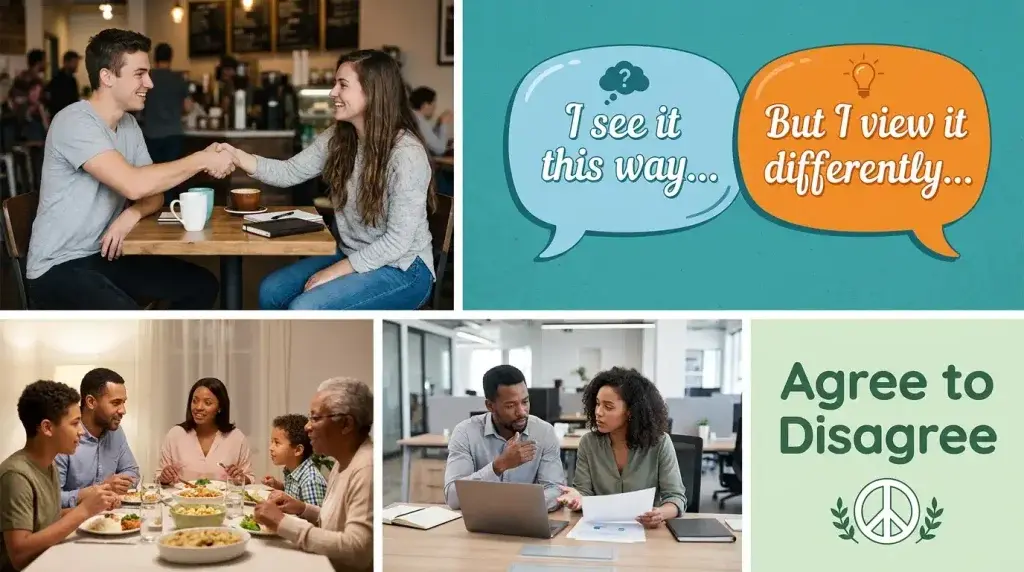
Agree to disagree means that two people accept they hold different opinions and stop arguing about it. Nobody wins, and nobody has to give in. That is the agree to disagree meaning in one line. You have probably heard it at a dinner table, in a group chat, or at work.
People search for it because the phrase can sound calm, but it can also sound cold, depending on how it is said. In this guide, you will learn what it means, where it came from, and how to use it well.
You will also see examples, common mistakes, and simple ways to say it kindly. By the end, you will know when this phrase helps a talk and when it does not.
Quick Answer: Agree to Disagree Meaning in Simple Words
To agree to disagree is to say, “We see this differently, and that is okay.” Both people keep their own view. They stop trying to change each other’s mind.
Think of two friends who love different sports teams. They can talk about the game all day and never switch sides. At some point, they laugh and say, “Let’s agree to disagree.” The friendship stays strong, and the argument ends.
The phrase sounds odd at first, because it seems to say two opposite things. The “agree” part is not about the topic. It is about the fight. The two people agree on one small thing: they will stop pushing. The “disagree” part is about the topic itself, where they still do not match.
What the Phrase Really Means
Every good debate has a moment when it stops helping. Each side has shared its reasons. Each side has listened, or at least heard. Now the talk starts to go in circles. Voices get louder. Feelings get hurt. That is the moment this phrase was made for.
When you say it, you are saying three things at once. First, “I hear you.” Second, “I still think differently.” Third, “I care about us more than I care about winning.” That last part matters most. A good use of the phrase protects the bond between two people.
The phrase is also a kind of peace treaty. Nobody signs a paper, but both people know the deal. The topic is closed for now. You will not keep bringing it up, and you will not treat the other person badly because of it.
How to Use “Agree to Disagree” in a Sentence
The phrase is a verb group. You can use it in a few simple ways. Most often, you will hear “agree to disagree” after words like “let’s,” “we can,” “we should,” or “I guess we’ll have to.” It works in the present, the past, and the future.
Here is a table that shows the common patterns with plain examples.
| Pattern | Example Sentence | When You Might Say It |
| Let’s agree to disagree | “Let’s agree to disagree about pineapple on pizza.” | To end a light debate with a smile |
| We agreed to disagree | “We agreed to disagree and had cake.” | To tell a story about a past talk |
| We can agree to disagree | “We can agree to disagree on the movie.” | To offer a calm way out |
| I guess we’ll agree to disagree | “I guess we’ll agree to disagree on that.” | To close a talk when you feel a bit tired |
| Agree to disagree on [topic] | “They agree to disagree on politics.” | To describe a rule between two people |
Notice that the word “on” or “about” often comes after the phrase. It points to the topic. You can also leave it out when everyone knows what you mean. “Let’s just agree to disagree” is a full sentence on its own.
The phrase also works as a noun idea. People say, “That was a real agree-to-disagree moment.” This use is casual, and you will mostly see it in speech or online posts.
Where the Phrase Came From
The idea of ending a quarrel while keeping your own view is very old. The exact words are a different story. Many language writers trace the phrase to the 1700s, and it is often linked to the early Methodist preacher John Wesley. Wesley and his friend George Whitefield held different beliefs on some religious points, yet they stayed on good terms. Some sources say Wesley used similar wording in his writing.
Still, the record is not perfectly clear. Some writers say the phrase was already common before Wesley. Others say Wesley used a close version rather than these exact words. Because of this, it is safest to say the phrase has roots in 18th-century English and has been popular ever since, without pointing to one single first user.
What we can say for sure is that the phrase has lasted for hundreds of years. That tells us something. People have always needed a gentle way to end a fight that cannot be won. The words may change, but the need stays the same.
When It Is Smart to Agree to Disagree
This phrase works best in some places. It is a great tool when the topic is about taste, belief, or values. These are areas where there is often no single correct answer.
Take food, music, and hobbies. If you love spicy soup and your cousin hates it, no fact will settle the matter. Talking for an hour will not change your tongue. Here, agreeing to disagree is the wise choice.
It also fits deep beliefs, such as faith or how to raise children. These views come from a lifetime of experience. A single talk rarely changes them. Pushing harder often makes people dig in deeper. It is better to respect the difference and enjoy the rest of your time together.
The phrase helps when the talk has become heated, too. If both people are upset, nothing good will come from going on. Stepping back can save the moment. You can even come back to the topic later, when everyone feels calm.
It is also useful when the stakes are low and the relationship is important. Winning a small point is not worth losing a friend. A good rule is this: if the topic will not matter next month, but the person will, choose the person.
When It Is Not the Right Move
The phrase is helpful, but it is not a magic fix. Sometimes it is the wrong thing to say.
If the disagreement is about a fact that can be checked, this phrase can be unfair. Say you and a coworker argue about the date of a meeting. One of you is right, and a quick look at the calendar will show it. Saying “let’s agree to disagree” here just delays the answer. Look it up instead.
The phrase is also a poor fit when safety is on the line. If someone plans to do something dangerous, you should not let it go. The same goes for cases of harm, cruelty, or unfair treatment. Staying silent in the name of peace can hurt real people.
Be careful at work, too. If a team needs to choose one plan, someone must decide. Agreeing to disagree can leave the group stuck. In that case, the leader may need to make the call, and everyone can share their concerns first.
Finally, watch out for using the phrase as a weapon. Some people say it to shut down a talk they are losing. Others say it to avoid hearing something hard. If you say it just to escape, the other person will feel brushed off. That can hurt trust.
How to Say It Kindly
Tone matters as much as the words. The same phrase can sound warm or cold. A calm voice, a small smile, and a gentle pace help a lot.
Start by showing that you listened. You might say, “I can see why you feel that way.” This small step tells the other person they were heard. People relax when they feel understood, even if you do not agree.
Next, name the difference in a simple way. For example, “I think we see this differently.” Try to avoid words that blame, like “you always” or “you never.” Talk about your own view instead of attacking theirs.
Then offer the phrase as a shared choice, not a rule you are forcing. “Maybe we can agree to disagree on this one?” ends with a question, which feels softer. It invites the other person to say yes.
Last, shift to something you both enjoy. Ask about their weekend. Pass the salt. Turn the talk to a topic where you match. This small move tells them the bond is safe.
If the other person is not ready to stop, do not push. You can say, “I’d like to take a break from this topic.” Give them time. People often need a moment before they can let go.
Agree to Disagree vs. Similar Phrases
English has many ways to end a debate. They are close, but not the same. This table shows how they differ.
| Phrase | Meaning | Tone | Best Use |
| Agree to disagree | Accept different views and stop arguing | Calm, fair | Friends, family, taste and belief topics |
| Let it go | Stop worrying about the issue | Sometimes sharp | When a small matter keeps coming back |
| Drop it | Stop talking about it now | Can sound rude | When one person is upset |
| Fair enough | I accept your point | Light, friendly | Quick, easy talks |
| Beg to differ | I do not agree with you | Polite, a bit formal | When you want to state your view politely |
| Meet in the middle | Both sides give a little | Team-like | Plans, deals, and shared choices |
| Pick your battles | Save your energy for big issues | Wise, serious | Advice about what to argue over |
The big difference is that “agree to disagree” keeps both views alive. “Drop it” and “let it go” often ask one person to give up. “Meet in the middle” changes both views. This phrase leaves them exactly where they were, and that is why people find it so fair.
Common Mistakes to Avoid
Even a simple phrase can go wrong. Here are the mistakes people make most often.
The first mistake is using it too early. If you say it in the first minute, the other person may feel ignored. Give the talk some room. Let each person share their thoughts first.
The second mistake is saying it in an angry tone. If your voice is sharp, the words will sound like an insult. The phrase needs a calm voice to work.
Third, some people say it and then keep arguing. That makes the phrase meaningless. If you say it, you need to stop. Bringing up the topic again a minute later breaks the deal.
Fourth, people use it for facts. As we noted, it is better to check a fact than to pretend it is just an opinion. Using the phrase here can make you look like you are avoiding the truth.
Fifth, be careful with spelling and word use. It is “agree to disagree,” not “agree on disagree” or “agree to disagreeing.” Also, remember that “agree to disagree” is an informal phrase, though it is fine in most settings. In a very formal letter, you might choose “we hold differing views” instead.
Last, don’t treat it as a way to win. Saying it with a smug look, as if you have proven your point, will spoil the peace. The goal is respect, not victory.
Real Life Examples
Seeing the phrase in action can make it clearer. Here are a few short scenes.
At home, two brothers argue about which video game is best. After ten minutes, one laughs and says, “We are never going to agree. Let’s agree to disagree and just play.” They pick a game and start playing. The peace holds.
At a family dinner, an uncle and a niece disagree about a hot news topic. The niece sees the mood getting tense. She says, “Uncle, I respect your view. I see it differently, so maybe we can agree to disagree and enjoy the meal.” He nods, and the table relaxes.
At work, two teammates disagree on how to design a poster. One likes bold colors, and the other likes soft ones. They ask their manager to choose. Later, one says, “I still like mine, but I am fine with the decision. We can agree to disagree.” Here the phrase works after the choice is made.
Between friends, someone might say, “I’ll never like that band, and you’ll never stop loving them. I think we have to agree to disagree.” Both friends smile. It is a small joke that shows they know each other well.
Notice what each example shares. There is respect, a calm tone, and a clear step back. None of these scenes ends with a winner, and that is fine.
Agree to Disagree at Work, at Home, and Online
The phrase changes a little depending on where you are.
At home, it protects close bonds. Family members will see each other for years, so peace matters. Short and warm is best. A hug or a joke after the phrase helps a lot.
At work, the phrase needs more care. You want to look professional and open to ideas. You might say, “I understand your view, and we may see it differently. Let’s take it to the team lead.” That keeps things fair. It also makes sure the real issue gets solved.
Online, things get tricky. Without a face or a voice, words can sound harsher than you mean. People often use the phrase in comments to end a long thread. Adding a kind note, like “Thanks for sharing your side,” makes it feel less cold. If the talk has turned mean, it is fine to leave the thread. You do not owe anyone an endless debate.
With friends, the phrase is often playful. You can use humor to keep it light. The trust between you gives you more freedom.
Current use of the phrase also shows how people talk today. In a time when public debates can feel loud and divided, many people use it as a way to keep the peace with neighbors, classmates, and relatives. It is a small habit that keeps people talking.
Tips for Using the Phrase Well
A few simple habits will help you use the phrase with skill.
Listen first. You cannot agree to disagree well if you have not truly heard the other side. Try to repeat their point in your own words. This shows care and often lowers the heat.
Pick your moment. Wait until each person has had a fair turn. Use the phrase when the talk is going in circles, not at the start.
Watch your tone and face. A gentle voice and an open look show you mean it kindly. Crossed arms and rolled eyes send a different message.
Keep your word. Once you have said it, let the topic rest. If you need to bring it up again, ask first: “Can we talk about this again later?”
Know the topic. Use the phrase for opinions and values. For facts, check the facts. For safety, speak up.
Practice on small things. Try it first on light topics, like snacks or shows. The skill will feel more natural when the big topics come up.
Finally, remember that disagreeing is not bad. Good friends do it all the time. What matters is how you treat each other while you do.
FAQs
What is the meaning of “agree to disagree”?
It means both people accept that they hold different views and stop arguing about it. Each person keeps their own opinion. The goal is to keep the peace and respect each other.
Is “agree to disagree” rude?
Not by itself. It can be polite and fair when said in a calm, kind tone. It can sound rude if you use it to shut someone down or to avoid a fair talk. Your tone and timing make the difference.
Where did the phrase “agree to disagree” come from?
Many writers link it to 18th-century England, and it is often tied to the preacher John Wesley. The exact first use is not fully clear, so sources do not all agree. It has been in common use for a very long time.
Can I use “agree to disagree” at work?
Yes, but use it with care. It works well for matters of taste or style. For team choices, make sure someone decides, so work can move forward. You can also say, “We see this differently,” which sounds a bit more formal.
What is a good reply when someone says “let’s agree to disagree”?
You can say, “Sounds good, thanks for hearing me out,” or “Fair enough, I respect that.” If you are not ready to stop, you can say, “Okay, can we come back to this later?” A kind reply keeps the peace.
What can I say instead of “agree to disagree”?
You can try “We see this differently,” “I respect your view,” “Let’s leave it there for now,” or “I beg to differ.” Each has a slightly different feel. Choose the one that fits the person and the place.
Conclusion
The agree to disagree meaning is simple. Two people accept that they hold different views and choose peace over a fight. It does not say who is right. It says the bond matters more than the win.
Used well, the phrase can save friendships, calm family dinners, and keep teams working together. Used poorly, it can feel like a door slammed shut. The difference comes down to timing, tone, and honest listening.
So here is a practical tip. Next time a talk starts going in circles, pause and take a breath. Say what you heard, share your view once, and then offer the phrase with a smile. Move on to something you both enjoy.
If the topic involves facts or safety, look deeper before you let it go. Otherwise, feel free to agree to disagree and keep the peace.

Hi, I’m Sarah Mitchell. I love writing faith-based content that brings peace, hope, and encouragement to everyday life. Through prayers and devotionals, my goal is to help readers feel closer to God and stronger in faith.