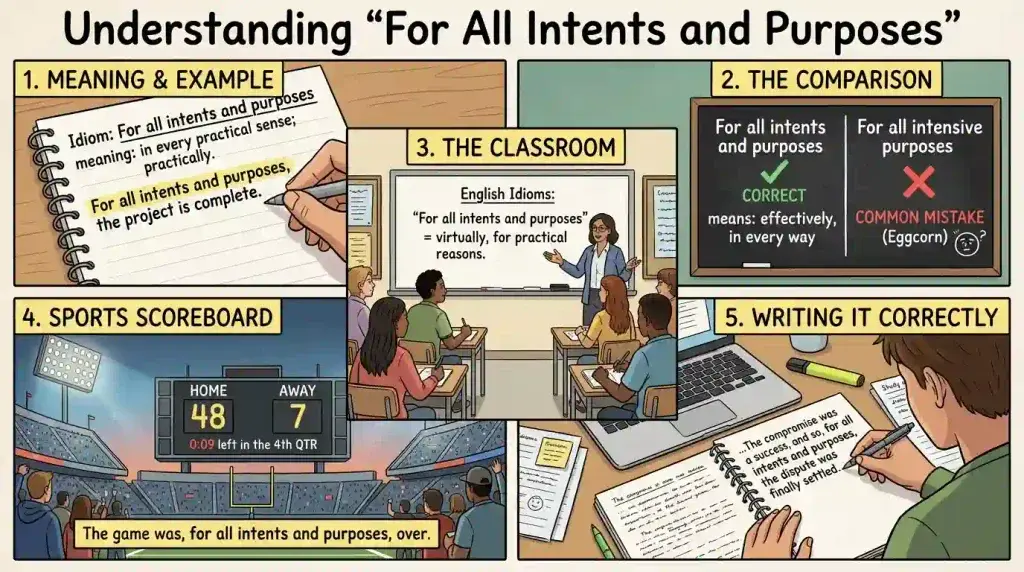
The meaning is easy to learn: it means “in almost every way that matters” or “practically speaking.” People use it when something is not exactly true on paper, but it is true enough in real life. For example, “The game is over for all intents and purposes.”
You have likely heard this phrase in school, at work, or on the news. It sounds a bit formal, and many people feel unsure about it. Some even write it the wrong way without noticing.
In this guide, you will learn what the phrase means, how to use it, and how to spell it correctly. You will also see real examples, common mistakes, similar phrases, and answers to popular questions.
Quick Answer: What Does For All Intents and Purposes Mean?
“For all intents and purposes” means “in every way that counts” or “practically.” It is used when one thing is so close to another that the small difference does not matter.
Here are the key facts in short form:
- It means “practically” or “essentially.” The result is nearly the same.
- It is an idiom. The words together mean something different from each word alone.
- It is written as “intents and purposes.” Not “intensive purposes.”
- It works in casual and formal writing. It fits most settings.
For example, “The store is closed for all intents and purposes” means it may not be officially shut, but you cannot buy anything there.
The Meaning Behind the Phrase
Let’s break the phrase into parts. That makes it easier to see why it works.
An “intent” is a goal or plan, something you mean to do. A “purpose” is the reason you do something. Put them together, and you get an old-fashioned way of saying “any goal or reason you might have.”
So “for all intents and purposes” says, “No matter what you meant to do, or why you wanted to do it, this is true.” In plain words: it is true enough for any practical use.
This is why the phrase fits so well when something is almost, but not fully, the same. A broken phone that turns on for one second a day is “dead for all intents and purposes.” It is not technically gone, but it is useless.
It is an idiom, which means the words together carry a meaning that is bigger than the parts. You do not need to think about each word. Just remember the idea: “close enough to count.”
Where Does the Phrase Come From?
Many people like to know how a phrase began. This one has a long history, and it comes from a legal background.
The phrase appears in old English law. A 1500s English law used the wording “to all intents, constructions, and purposes,” and similar wording showed up in legal writing from that time. In the law, it meant that something should be treated as true in every way and for every reason.
Over time, regular speakers picked up the shortened version. It moved from courtrooms and law books into everyday talk, and now it is used in many settings.
I could not confirm every detail of how the wording changed over the years, so I will keep this simple. What is clear is that the phrase has deep roots in legal language, and that explains why it still sounds a little formal today.
How to Use For All Intents and Purposes in a Sentence
The phrase is flexible. It is called an adverbial phrase, which means it adds extra information to a sentence, much like “basically” or “practically.”
You can place it in three spots.
At the start of a sentence. For example: “For all intents and purposes, the project is finished.” A comma usually follows the phrase here.
In the middle of a sentence. For example: “The project is, for all intents and purposes, finished.” Commas go on both sides.
At the end of a sentence. For example: “The project is finished for all intents and purposes.” No comma is needed, though some writers add one.
Here are more examples:
- “For all intents and purposes, she runs the company.”
- “The two cars are, for all intents and purposes, the same.”
- “He has quit for all intents and purposes.”
- “For all intents and purposes, winter has arrived.”
A simple test helps. Try replacing the phrase with “practically” or “basically.” If the sentence still makes sense, you are using it right.
The Most Common Mistake: Intensive Purposes
This is the biggest slip-up with the phrase, so it deserves its own section.
Many people say or write “for all intensive purposes.” It is a very common error. It happens because “intents and” and “intensive” sound almost the same when spoken fast. Our ears hear one thing, and our brains fill in a word that seems to fit.
The correct form is “for all intents and purposes.” The word is “intents,” and it has “and” after it. There is no word “intensive” in the real phrase.
| Version | Correct? | Why |
| For all intents and purposes | Yes | This is the standard form |
| For all intensive purposes | No | A mix-up of sound |
| For all intents and purpose | No | “Purposes” should be plural |
| For all intents or purposes | Rare | Not the standard wording |
This kind of mistake has a name: an eggcorn. An eggcorn is a mistaken word or phrase that still seems to make sense. Many people make this slip because “intensive purposes” sounds like it could mean “very serious reasons.” But that is not the original idea.
If you are writing, double-check the spelling. If you are speaking, take a moment to say “intents and purposes” clearly.
Real Life Examples of For All Intents and Purposes
Examples make the phrase feel natural. Here are everyday moments where it fits.
At school. A teacher might say, “For all intents and purposes, the class is over.” The bell has not rung, but everyone has packed up.
At work. A manager might say, “For all intents and purposes, the deal is done.” The papers are not signed, but both sides agree.
In sports. A reporter might write, “For all intents and purposes, the game was over by halftime.” One team is far ahead, and a comeback is unlikely.
At home. A parent might say, “For all intents and purposes, the kitchen is closed.” Dinner is done, and no one is cooking anymore.
In politics and news. A writer might say, “For all intents and purposes, he is the leader of the group.” He may not have the official title, but he makes the decisions.
With technology. A friend might say, “My old laptop is, for all intents and purposes, dead.” It still turns on, but it is far too slow to use.
In every case, the phrase points to a gap between what is official and what is real. It says the real situation matters most.
For All Intents and Purposes vs. Similar Phrases
English has many ways to say “practically.” Some are close to this phrase, and some are a little different. This table shows how they compare.
| Phrase | Meaning | Tone |
| For all intents and purposes | In every way that matters | Slightly formal |
| Practically | Almost, in real life | Neutral |
| Basically | In the main points | Casual |
| Essentially | At the core | Neutral to formal |
| In effect | In the way it works | Formal |
| To all intents | An older, shorter form | Formal, rare |
| Virtually | Almost completely | Neutral |
The main difference is tone. “Basically” is casual. “In effect” is more formal. “For all intents and purposes” sits in the middle, with a touch of formality that adds weight to a sentence.
If you want a short, simple word, “practically” or “basically” works well. If you want the sentence to feel a little stronger or more official, the longer phrase is a good pick.
Is This Phrase Formal or Informal?
The phrase sits in the middle. It is not slang, and it is not stiff. You can use it in school essays, work emails, news stories, speeches, and casual chats.
Because it comes from legal language, it has a slightly serious sound. That is why it often shows up in writing about law, business, politics, and sports. But people also use it in everyday talk, so it does not feel out of place at the dinner table.
In very short messages, like texts, a single word such as “basically” may feel more natural. In longer writing, the phrase adds a smooth, confident rhythm.
One more point: the phrase is long. Using it too often can make your writing feel heavy. Save it for moments when it truly adds clarity.
British vs. American English
The phrase is understood and used in both American and British English. Its meaning is the same in both places.
The main difference is in how people use it in daily life. Some say it is a bit more common in formal writing in British English, but I could not find reliable data to prove this, so I will not claim it. What we can say is that both groups use it the same way and spell it the same way.
You will also see the older legal form “to all intents and purposes” in British writing. Some writers still use this version. Both “for” and “to” are accepted, but “for all intents and purposes” is the most common today, especially in American English.
If you are writing for a US audience, stick with “for all intents and purposes.”
Common Mistakes When Using For All Intents and Purposes
Beyond “intensive purposes,” there are a few other slip-ups to avoid.
Using it when something is fully true. The phrase works best when something is almost true. If the project is truly finished, just say “the project is finished.”
Forgetting commas. At the start of a sentence, add a comma after the phrase. In the middle, use commas on both sides.
Overusing it. Using the phrase again and again can sound heavy. Mix it up with simpler words.
Writing “purpose” instead of “purposes.” The word “purposes” should be plural.
Using it to mean “on purpose.” The phrase does not mean “deliberately.” It means “practically.”
Adding extra words. Some people say “for all intents and purposes, essentially.” That repeats the same idea twice. Pick one.
Using it in the wrong tone. In a quick, casual text, the phrase may feel too long. A simpler word might fit better.
A good habit is to read the sentence out loud. If it sounds smooth and clear, you are probably using it well.
Tips for Using the Phrase Well
Here are some friendly tips to help you use it with confidence.
Use it for “almost true” situations. The phrase shines when there is a small gap between official and real.
Try the swap test. Replace it with “practically.” If the meaning stays the same, you are on the right track.
Watch your spelling. Remember it is “intents and purposes.” One memory trick: think of “intents” like “intentions,” and “purposes” like “reasons.”
Place it where it flows. Try it at the start, middle, or end of a sentence, and choose the version that sounds best.
Keep it fresh. Do not use it more than once or twice in a single piece of writing.
Think about your reader. For young readers or English learners, a simple word like “basically” may be easier to understand.
Proofread. Because “intensive purposes” is such a common slip, double-check your writing before you hit send.
Current Usage and Trends
Today, the phrase is still very common in speech and writing. You will hear it on the news, in meetings, in classrooms, and in casual conversations.
I do not have reliable public numbers on how often people use it, so I will not make any claims. But it is easy to spot in headlines, essays, and online posts.
One trend is that the mistaken version, “intensive purposes,” appears often in casual writing and online comments. Language experts note this kind of error is common with spoken phrases, since people often learn them by ear first. This is normal, and it does not mean the writer is careless.
Another trend is that many people now shorten or replace the phrase with simpler words in fast chats. Still, the full phrase remains a favorite for adding a clear, steady tone.
FAQs
1. What is the meaning of for all intents and purposes?
It means “in almost every way that matters” or “practically.” It is used when something is not fully true on paper, but is true in real life.
2. Is it “intents and purposes” or “intensive purposes”?
The correct phrase is “intents and purposes.” “Intensive purposes” is a common mistake caused by how the words sound when spoken quickly.
3. Where does the phrase come from?
It comes from old English legal writing, where similar wording was used to say that something should be treated as true in every way. Over time, it moved into everyday speech.
4. Do I need a comma with this phrase?
Yes, in most cases. Use a comma after it at the start of a sentence, and commas on both sides in the middle. At the end, a comma is optional.
5. What is another way to say for all intents and purposes?
You can say “practically,” “basically,” “essentially,” “in effect,” or “virtually.”
6. Is for all intents and purposes formal or casual?
It is somewhere in between. You can use it in essays, emails, and everyday talk. In very short texts, a simpler word may feel more natural.
Conclusion
For all intents and purposes meaning comes down to one clear idea: “practically speaking.” It tells your reader that something is close enough to the truth for it to count in real life, even if it is not perfect on paper. The phrase has old legal roots, but it fits easily into everyday English.
Now you know how to use it, where to place it in a sentence, and how to avoid the famous mistake of “intensive purposes.” You also know which similar phrases can stand in when you want a simpler tone.

Hi, I’m Rida, the writer behind this site about word meanings.
I explain words in simple English with clear definitions, synonyms, and real examples.
My goal is to help learners and curious readers pick the right word with confidence.
Every article is checked against trusted dictionaries so you can learn with trust.