The ex dividend date meaning is simple: it is the first day a stock trades without its next dividend attached. If you buy the stock on or after that day, you do not get the upcoming payment. If you own it before that day, you do.
Why do people search for this? Many new investors hear about dividends and then get confused by all the dates. One wrong move, and they may miss a payment they expected. That can feel frustrating.
In this guide, you will learn what the date means, how it fits with other dividend dates, and how it affects the stock price. You will also see real examples, common mistakes, and answers to popular questions. This is general education, not financial advice.
Quick Answer: What Does Ex Dividend Date Mean?
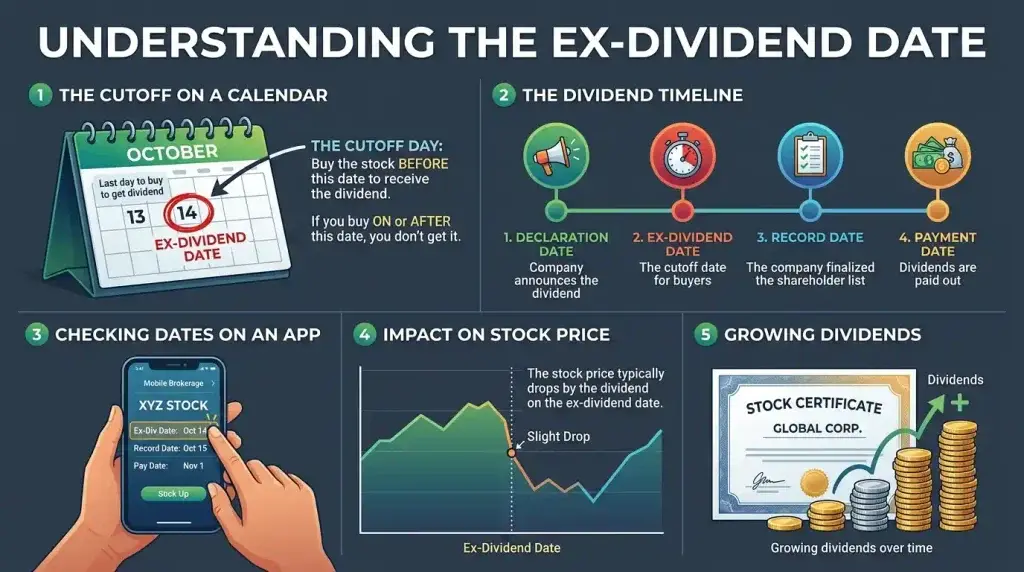
The ex dividend date, sometimes called the “ex-date,” is the cutoff day for a dividend. To get the next dividend, you must own the stock before this day starts. If you buy on the ex-date or later, the payment goes to the seller instead.
Here are the key facts:
- Buy before the ex-date and you get the dividend.
- Buy on or after the ex-date and you do not.
- The stock price often drops by about the dividend amount on that day.
- Selling on or after the ex-date still lets you keep the dividend, if you owned the stock before it.
What Is a Dividend?
Before the date makes sense, it helps to know what a dividend is. A dividend is a share of a company’s profit that it pays to its owners. If you own stock, you own a small piece of the company. When the company chooses to share some profit, you get paid.
Dividends are usually paid in cash. Some companies pay them every three months. Others pay once or twice a year, and some pay none at all. Newer or fast-growing companies often keep their money to grow the business, while older, steady companies often pay regular dividends.
A company is never forced to pay a dividend. The board of directors decides each time. That is why dividends can go up, go down, or stop. They are never promised forever.
The Four Key Dividend Dates
The ex-dividend date is only one of four dates. Knowing all four helps you see the full picture.
| Date | What It Means |
| Declaration date | The company announces the dividend, its size, and the other dates |
| Ex-dividend date | The cutoff. Buy before this day to get the payment |
| Record date | The day the company checks its list of owners |
| Payment date | The day the money lands in your account |
The order is usually declaration, then ex-dividend, then record, then payment. The ex-dividend date and record date are close together, but they are not the same.
The record date is when the company looks at its books to see who owns the stock. The ex-dividend date exists because buying a stock takes a short time to finalize. The ex-date is set so that the books will be correct by the record date.
Why the Ex-Dividend Date Exists
You may wonder why we need this extra date at all. The reason is settlement. Settlement is the short time it takes for a stock trade to be officially completed and recorded.
In the United States, most stock trades now settle one business day after the trade. This is called T+1, and it began in May 2024. Before that, it took two business days. Because of this change, the ex-dividend date now usually falls on the same day as the record date.
Here is a simple way to think about it. If you want your name on the owner list by the record date, you must buy early enough for the trade to finish. The ex-dividend date is the first day you would be too late.
Because rules can change, it is smart to check the dates listed by your broker or the company itself.
How the Ex-Dividend Date Works: A Simple Example
Examples make this much clearer. Let’s use a made-up company called Sunny Foods.
Sunny Foods announces a dividend of $0.50 per share. The ex-dividend date is Thursday, and the payment date is the following month.
| If You Buy | Do You Get the Dividend? |
| Tuesday | Yes |
| Wednesday | Yes |
| Thursday (ex-date) | No |
| Friday | No |
Now say you own 100 shares and bought on Wednesday. You would receive $0.50 times 100, which equals $50 on the payment date.
Now say your friend buys 100 shares on Thursday. The ex-date has arrived, so your friend does not get the $50. Instead, the person who sold the shares keeps it.
What if you owned the shares and sold them on Thursday? You would still get the $50, because you owned the stock before the ex-date. Selling on the ex-date or later does not cancel your payment.
What Happens to the Stock Price on the Ex-Dividend Date?
This part surprises many people. On the ex-dividend date, the stock price often drops by roughly the amount of the dividend.
Why? Think of it like this. Before the ex-date, the stock price includes the value of the coming dividend. After the ex-date, new buyers will not get that money, so the stock is worth a little less.
For example, if Sunny Foods trades at $50 and pays a $0.50 dividend, the price might open near $49.50 on the ex-date. That is a rough guide, not a rule. Prices also move because of news, the market, and many other things, so the real drop can be different.
This leads to an important point. Buying a stock just to grab a dividend does not create free money. You get the dividend, but the price often drops by a similar amount. In many cases, you end up in about the same place, and you may owe taxes on the dividend.
Can You Make Money by Buying Right Before the Ex-Date?
Some people try a trick called “dividend capture.” They buy a stock just before the ex-date, collect the dividend, and then sell. It sounds smart, but it is harder than it looks.
First, the stock price usually falls on the ex-date, which can cancel out the dividend. Second, trading costs and taxes can eat into any gain. Third, a stock can also fall for other reasons while you hold it, so you could lose money.
Many experts say long-term investors should focus on the quality of the company and the overall plan, not on timing one payment. A dividend is a nice bonus, but it should not be the only reason to buy.
If you are curious about this strategy, it is wise to learn the risks first. Talking with a licensed financial professional can help you decide what fits your goals.
Ex-Dividend Date and Taxes
Dividends are usually taxable in the United States. The tax rules can be a little tricky, and they depend on how long you held the stock.
Some dividends are called “qualified.” These may be taxed at lower rates, but you generally must hold the stock for a set number of days around the ex-dividend date. Other dividends are “ordinary” and may be taxed at your regular income rate.
I will not list exact holding periods or tax rates here, because rules can change and each person’s situation is different. The best place to check is the Internal Revenue Service website or a tax professional.
One more tip: your broker will send you a tax form each year that shows the dividends you received. Keep it with your tax records.
Ex-Dividend Date vs. Record Date vs. Payment Date
These three dates are often mixed up. Here is a clear side-by-side look.
| Date | Who It Is For | Main Purpose |
| Ex-dividend date | Buyers | Shows who gets the dividend |
| Record date | The company | Checks the owner list |
| Payment date | Owners | The day the money arrives |
The easiest rule to remember: the ex-dividend date is the one you, as a buyer, care about most. The record date is mostly for the company’s paperwork. The payment date is when you finally see the cash.
Think of a concert. The ex-dividend date is the last moment to buy a ticket. The record date is when the staff checks the guest list. The payment date is when the show begins and you enjoy it.
Real Life Examples of the Ex-Dividend Date
Here are a few everyday situations.
The new investor. Maya buys a stock on the ex-dividend date, hoping to get the payment. She does not, because the cutoff has passed. She learns to check the ex-date before buying.
The long-term holder. Carlos has owned his shares for years. The ex-date comes and goes, and he does nothing. A few weeks later, the dividend appears in his account.
The seller. Priya sells her shares on the ex-date. She still gets the dividend because she owned the stock before the cutoff.
The reinvestor. Sam uses a dividend reinvestment plan, often called a DRIP. His dividend buys more shares automatically, so his holding grows over time.
The retiree. Linda relies on dividends as part of her income. She tracks ex-dates and payment dates so she knows when to expect money.
How to Find an Ex-Dividend Date
You do not have to guess. Here are common places to find the date.
| Where to Look | What You Will Find |
| Company investor relations page | The official dividend announcement |
| Your brokerage app | Dividend dates for stocks you own |
| Financial news sites | Calendars of upcoming ex-dates |
| Stock exchange websites | Official notices and data |
Start with the company’s website, since it is the most direct source. Brokerage apps often show the dates right on the stock page. Be careful with random websites, because dates can be wrong or out of date.
A good habit is to check the date again before you buy. Companies can change their plans, and a quick look can save you from a surprise.
Special Cases: Big Dividends and Stock Dividends
Most ex-dividend dates follow the simple rules above. But a few special cases work a little differently.
For very large dividends, stock exchanges may set a different ex-date. This helps keep the market fair when a payment is a big part of the stock’s price. The details are technical, so check the company’s announcement.
Stock dividends are another case. Instead of cash, a company gives extra shares. The ex-date rules can differ here, and the price effect is not the same. Stock splits also have their own dates.
If you run into one of these cases, read the company’s notice carefully. Your broker’s help page can also explain how it applies to you.
Common Mistakes About the Ex-Dividend Date
New investors often trip over the same few points.
Buying on the ex-date and expecting the dividend. You need to buy before it.
Mixing up the ex-date and the payment date. The payment arrives later, often weeks after.
Thinking the dividend is free money. The price usually drops to match it.
Assuming the dividend is guaranteed. Companies can change or cancel dividends.
Ignoring taxes. Dividends can raise your tax bill.
Chasing high yields without checking the company. A very high dividend can be a warning sign. Sometimes it means the stock price has fallen or the payout may not last.
Trusting old dates. Always confirm the current date with a reliable source.
Tips for Using Ex-Dividend Dates Wisely
Here are some friendly ideas, based on general good habits.
Focus on the company, not just the date. A strong business matters more than one payment.
Use a calendar. Mark the ex-date and payment date for stocks you own.
Think long term. Dividends can add up over many years, especially if you reinvest them.
Check your broker’s rules. Settlement and cutoff details can vary slightly.
Learn the tax basics. A little knowledge now can prevent a surprise later.
Ask a professional. A licensed financial advisor or tax expert can help with personal decisions.
Remember, I am not a financial advisor, and this article is for learning only.
FAQs
1. What does ex dividend date mean in simple words?
It is the first day a stock trades without its next dividend. Buy before it to get the payment.
2. Do I get the dividend if I buy on the ex-dividend date?
No. You must buy before the ex-date. If you buy on that day or later, the seller gets the dividend.
3. Can I sell on the ex-dividend date and still get the dividend?
Yes, if you owned the stock before the ex-date. Selling on or after that day does not cancel your payment.
4. Why does the stock price drop on the ex-dividend date?
New buyers will not receive the coming dividend, so the stock is worth a little less. The drop is often close to the dividend amount, but it can vary.
5. Is the ex-dividend date the same as the record date?
They are different, but they are close. In the US, with one-day settlement, they are usually on the same day. Check the company’s notice to be sure.
6. Is it smart to buy right before the ex-dividend date?
Usually not just for the dividend. The price often drops, and taxes and trading costs can reduce any gain. Look at the whole company first.
Conclusion
The ex dividend date meaning comes down to one clear rule: to get the next dividend, you must buy the stock before that date. If you buy on or after it, the payment goes to the seller. The stock price often dips on that day, so grabbing a dividend is not free money.
Now you know how the ex-date fits with the declaration, record, and payment dates. You also know how to find it, how taxes may apply, and which mistakes to avoid.
The best advice is to keep things simple. Check the date from a trusted source, think about the company and not just the payout, and plan for the long run. When in doubt, a licensed financial professional can guide you based on your own goals.

Hi, I’m Sarah Mitchell. I love writing faith-based content that brings peace, hope, and encouragement to everyday life. Through prayers and devotionals, my goal is to help readers feel closer to God and stronger in faith.