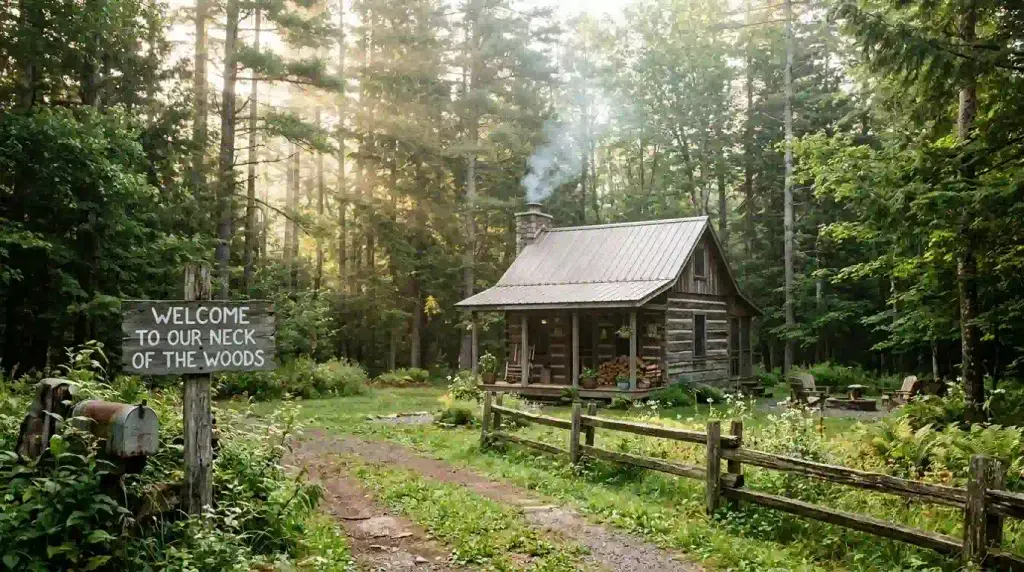
Have you ever heard someone ask, “What brings you to this neck of the woods?” It sounds a little funny at first. There is no neck, and there may not even be any woods. The neck of the woods meaning is simple: it refers to a certain area, region, or neighborhood, usually one that is familiar to the speaker.
People use it in friendly talk, in stories, and in news reports. Many readers search for it because the words do not match the meaning. In this guide, you will learn what the phrase means, how to use it, where it likely came from, and which mistakes to avoid. You will also find easy examples, helpful tables, and clear answers to common questions. Let’s get started.
Neck of the Woods Meaning:
“Neck of the woods” means a particular area or neighborhood. Most of the time, it points to the place where a person lives or knows well. If someone says, “I’m from your neck of the woods,” they mean they come from the same area as you, or one very close by.
The phrase is casual and friendly. It is often used when people meet and talk about where they live or where they have been. You can use it for a small town, a city block, a region, or even a whole state. The size is flexible, and that is part of why people like it.
What Does “Neck of the Woods” Really Mean?
Let’s look at the words one by one. A “neck” can mean a narrow strip of land that connects two bigger areas, like the neck of a bottle. The “woods” are a wooded place. So the phrase paints a picture of a small, narrow patch of land within a larger forest.
Over time, people stopped thinking about the picture. Today, the phrase simply means “area” or “region.” It does not matter if the place is a busy city or a wide desert. A person from downtown Chicago can say, “Nice weather in our neck of the woods.” Nobody expects to see trees.
The phrase also carries a warm feeling. It suggests closeness, as if the area is a home base. When you say “my neck of the woods,” you are saying, “the place I know and call mine.” When you say “your neck of the woods,” you are showing interest in where the other person lives.
It also often works as a gentle way to talk about a place without being exact. If you say, “I grew up in a small neck of the woods in Ohio,” you give a general idea without naming a street or town. That makes it handy in casual talk.
How to Use Neck of the Woods in a Sentence
This phrase is easy to use once you know the common patterns. It usually appears with a possessive word, such as “my,” “your,” “our,” or “this.” It often follows a preposition, like “in” or “from.”
Here is a table with common patterns and examples.
| Pattern | Example Sentence | What It Means |
| in my neck of the woods | “It’s rainy in my neck of the woods.” | In the area where I live |
| in your neck of the woods | “I’ll be in your neck of the woods next week.” | I’m visiting your area |
| from this neck of the woods | “Are you from this neck of the woods?” | Are you from around here? |
| in our neck of the woods | “Pizza is a big deal in our neck of the woods.” | In our local area |
| out this way / in that neck of the woods | “Is the new mall in that neck of the woods?” | Is it in that general area? |
A few grammar notes can help. The phrase works as a noun phrase. It tells us about a place, so it often pairs with words like “in,” “from,” or “around.”
In very formal writing, such as a legal paper, a plain word like “region” or “area” may sound better.
Finally, remember that the phrase is a set expression. Keep the words in the same order. Saying “woods of the neck” or “neck of the forest” would confuse people.
Real Life Examples of Neck of the Woods
Examples make a phrase easier to remember. Here are common situations where people use it.
| Situation | Example | Hidden Message |
| Meeting someone new | “Where are you from?” “Just up north, your neck of the woods!” | We live close to each other |
| Planning a visit | “Let me know if you’re ever in my neck of the woods.” | Come visit me |
| Talking about weather | “It’s freezing in our neck of the woods.” | It’s cold where we live |
| Local news | “A new park is opening in this neck of the woods.” | A new park is coming to this area |
| Asking about travel | “What brings you to this neck of the woods?” | Why are you visiting here? |
Now let’s look at a few short stories.
Ana moved from Texas to Florida for a new job. At a barbecue, she met a man named Carlos and learned that he used to live in Dallas. “Wow, you’re from my neck of the woods,” she said with a big smile. They talked about their favorite tacos for an hour.
Mr. Brown runs a small hardware store in a quiet town. When a stranger walks in, he often asks, “What brings you to our neck of the woods?” He is not being nosy. He is simply being friendly.
A weather reporter says, “Snow is expected in our neck of the woods tonight.” Everyone watching understands that she means the local area.
These stories show how flexible the phrase is. It can be used for meeting people, making plans, sharing news, or just making small talk.
Where Does Neck of the Woods Come From?
The history of this phrase is interesting, but we should be careful here. Many websites tell neat stories with exact dates, and not all of them are reliable.
What most dictionaries and language sources agree on is that the phrase is American. It is generally thought to have started in the early 1800s, when settlers in North America were moving into forests and clearing land. In that setting, a “neck” could mean a narrow stretch of land, and a “neck of the woods” could mean a small settlement in the forest. The phrase appears in American writing from that period, and its use grew over time.
At first, it likely described a specific wooded area where people lived. Later, the meaning widened. By the time the phrase became common across the country, it was being used for any local area, wooded or not.
What we cannot say for sure is who first used it. No single person is known to have invented it, and the exact first appearance is hard to pin down. If you see a source with a very exact name and date, treat it with care. A safer way to say it is that the phrase grew out of early American life and spread through everyday speech.
For deeper research, trusted sources like Merriam-Webster and the Oxford English Dictionary can show early examples and how the meaning has changed.
Is Neck of the Woods British or American?
This is one of the most common questions about the phrase. The short answer is that it began in America, but it is now understood in many English-speaking countries.
In the United States, people use it often in everyday talk. In places like the United Kingdom, Canada, and Australia, many people also know it and use it, though it may sound a bit more American to some ears. The meaning stays the same everywhere.
There is no spelling difference, and the grammar rules are the same. If you are writing for an American audience, you can use the phrase freely. If you are writing for a worldwide audience, it is still safe, but adding a short hint, like “in my area,” can help English learners.
Be careful with claims that one country uses it far more than another. Without strong data, it is better to say that it started in America and is now widely understood.
Similar Phrases and Words
Sometimes you want a fresh way to say the same thing, or you want to avoid repeating yourself. This table shows other options and when each one fits best.
| Phrase | Example | Best Used When |
| around here | “Is there a bank around here?” | Talking about the nearby area |
| in the area | “Do you live in the area?” | A simple, neutral tone |
| in these parts | “Folks in these parts love football.” | A folksy, old-fashioned feel |
| neighborhood | “It’s a quiet neighborhood.” | A small local area |
| region | “This region gets lots of snow.” | A larger or more formal area |
| back home | “Back home, we eat late.” | Talking about where you grew up |
Each phrase has its own flavor. “In these parts” sounds like something from an old Western movie. “Region” sounds more formal. “Neck of the woods” sits in the middle. It feels warm and casual, but still clear.
Using a mix of these phrases keeps your writing fresh. Still, “neck of the woods” has a cozy charm that plain words often lack.
Common Mistakes to Avoid
Even simple phrases can cause trouble. Here are mistakes that show up most often.
The first mistake is thinking the phrase must refer to a forest. It does not. A city, a suburb, or a farm town can all be a “neck of the woods.” The picture of woods is just part of the history.
The second mistake is using it in very formal writing. In a business report, a school paper, or a legal document, it may sound too casual. A word like “region” or “area” is a better fit there.
The third mistake is changing the words. People sometimes say “neck of the wood” or “neck in the woods.” The correct form is “neck of the woods,” with “woods” in plural form.
The fourth mistake is using it for something that is not a place. You would not say, “That idea is in my neck of the woods,” unless you are making a joke or using it in a creative way. It works best for places.
The fifth mistake is stretching it too far. Using it five times in one paragraph can sound odd. Mix in other phrases to keep things smooth.
Last, avoid using it in a way that might confuse people who are still learning English. If you are speaking with a new learner, a quick line like “That means my area” can make everything clear.
How People Use Neck of the Woods Today
Today, the phrase still shows up in many places. Knowing these uses can help you spot it and use it well.
In conversation, it is a classic icebreaker. “What brings you to our neck of the woods?” is a friendly way to start a chat with a visitor. It signals curiosity without being pushy.
In local news, reporters use it to talk about nearby events. A story might say that a new restaurant is opening “in this neck of the woods.” It gives a friendly, local feel.
In travel writing, it often appears in headlines and guides. Writers might say, “Looking for great hiking in the Pacific Northwest? Here’s what’s happening in this neck of the woods.”
In business, small shops and service companies like the phrase. A plumber might say, “Proudly serving your neck of the woods.” It makes the business sound close and trustworthy.
On social media, people use it in captions and posts. “Fall colors are finally here in my neck of the woods” is a typical post under a pretty photo. It lets friends see a small piece of the poster’s world.
The phrase has also taken on a new role in the age of remote work. People who work from different cities may ask each other, “How’s the weather in your neck of the woods?” It is a warm way to connect with someone far away.
Tips for Using Neck of the Woods Naturally
If you want to sound like a native speaker, a few simple habits can help.
Use it in friendly settings. It shines in chats, emails to friends, and local stories. It may feel out of place in a stiff, formal letter.
Pair it with a possessive word. “My neck of the woods,” “your neck of the woods,” and “our neck of the woods” all sound natural. Using it without one often feels incomplete.
Add a small detail. “It’s been super hot in my neck of the woods, almost 100 degrees” gives the listener something to picture.
Do not overuse it. A single use in a conversation is plenty. Using it again and again can sound forced.
Match it to your reader. If your audience includes English learners, add a short note. A friendly line like “In my area, I mean” can clear things up.
Finally, trust your ear. Read your sentence out loud. If it sounds like something a friendly neighbor would say, you are probably using it well.
FAQs
What does the simple neck of the woods mean?
It means a particular area, region, or neighborhood. It is often used for the place where someone lives or knows well.
Is “neck of the woods” an idiom?
Yes. An idiom is a phrase whose meaning is different from its separate words. Here, “neck” and “woods” together simply mean a local area.
Where did “neck of the woods” come from?
It is generally believed to be an American phrase from the early 1800s, when settlers lived in small clearings in forests. The exact first use is hard to prove.
Does “neck of the woods” have to mean a forest area?
No. Today it can mean any area, such as a city, town, or neighborhood. The woods part is mostly historical.
Can I use “neck of the woods” in formal writing?
It is better in casual or friendly writing. For formal papers or reports, a word like “region” or “area” usually works better.
What is a good reply when someone asks, “What brings you to this neck of the woods?”
You can simply say why you are visiting. For example, “I’m here for work,” or “I’m visiting family.” It is a friendly question, not a serious one.
Conclusion:
The neck of the woods meaning is easy to remember once you see the big picture. It means a certain area or neighborhood, most often one that is familiar to the speaker. The phrase is friendly, casual, and flexible, which is why people use it in chats, news stories, and social media posts.
We also learned that it is generally thought to be an American phrase from the early 1800s, though the exact first use is hard to prove. It does not need to describe a forest, and it fits best in relaxed settings. Keep the words in the correct order, avoid using it too often, and choose plainer words for formal writing.
Now it is your turn. The next time you meet someone new, try asking, “What brings you to this neck of the woods?” Say it with a smile, and you will sound friendly and natural.

Hi, I’m Elias Monroe. I enjoy writing meaningful prayer content that helps people feel calm, hopeful, and spiritually strong. My goal is to share words that bring comfort during both joyful and difficult times.