
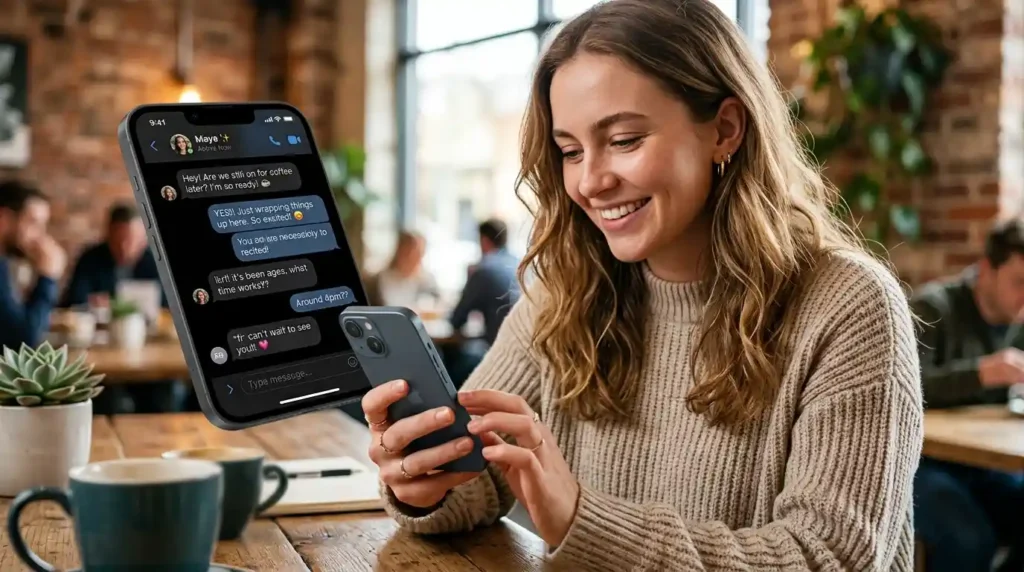
If you are wondering about fr meaning in text, the most common answer is “for real.” People use “fr” in texts, chats, comments, and social media to show agreement, honesty, seriousness, or emphasis. For example, if someone says, “This movie is amazing,” replying “fr” means “For real, I agree.”
Have you ever opened a text message and seen someone write “fr” and wondered what those two letters mean? You are not alone. Short forms like “fr,” “fr fr,” “lol,” and “idk” are now a normal part of casual online communication.
The fr meaning in text is usually “for real.” Depending on the conversation, it can mean “I agree,” “seriously,” “honestly,” or “really?” It is a quick way to show that someone agrees with a statement or truly means what they are saying.
You may see “fr” in text messages, TikTok comments, Instagram DMs, Snapchat chats, gaming conversations, and group messages. It is short, easy to type, and works in many casual situations.
In this guide, you will learn what “fr” means, how people use it, what “fr fr” means, how to reply, when to use it, and when it is better to avoid it.
Quick Answer: What Does FR Mean in Text?
The most common fr meaning in text is “for real.” It is an informal internet abbreviation used to show agreement, sincerity, seriousness, or emphasis.
For example:
| Text | Meaning |
| “That song is so good fr.” | That song is really good. |
| “Fr!” | I agree! |
| “You did all that in one day? Fr?” | Really? / Are you serious? |
| “I’m tired fr.” | I am genuinely tired. |
| “Fr fr.” | For real, seriously. |
The exact meaning depends on where “fr” appears and what the other person is talking about. A simple “fr” as a reply usually shows agreement. At the end of a sentence, it often adds emphasis. When followed by a question mark, “fr?” can mean “Really?” or “Are you serious?” (Slang.net)
What Does FR Stand For?
In most casual online conversations, FR stands for “for real.” The letters come directly from the first letters of “for” and “real.”
“For real” is an informal English phrase that can show that something is true, genuine, or serious. The shortened version, “fr,” carries a similar idea but is much faster to type.
For example, imagine your friend says:
“I have been studying for six hours today.”
You could reply:
“fr”
Here, “fr” can mean, “For real,” or “I understand and agree.”
It can also be added to the end of your own message:
“That was the funniest movie fr.”
In this example, “fr” adds emphasis. The writer is saying that they genuinely think the movie was funny.
Social media glossaries describe “FR” as a casual expression of agreement, confirmation, or sincerity.
How Is FR Used in Text Messages?
The word “fr” can do several jobs in a conversation. Although the basic meaning stays connected to “for real,” its tone changes with context.
One common use is agreement. If a friend makes a statement that you strongly agree with, you can simply reply “fr.”
For example:
Person 1: “Mondays are so hard.”
Person 2: “Fr.”
Here, “fr” means “I agree” or “That is so true.”
Another use is emphasis. A person may put “fr” at the end of a sentence to make it clear that they genuinely mean what they said.
For example:
“I could sleep all day fr.”
The writer is not necessarily asking a question. Instead, “fr” adds a feeling of honesty or emphasis.
A third use is questioning or disbelief.
For example:
“He bought a new car yesterday.”
“Fr?”
In this situation, “fr?” can mean “Really?” or “Are you serious?”
Therefore, you should not translate “fr” in exactly the same way every time. Look at the sentence and the conversation around it.
FR Meaning When Someone Sends Just “FR”
When someone sends only “fr” as a complete message, it usually means “I agree” or “For real.”
For example:
You: “This weather is way too hot.”
Friend: “fr”
Your friend is agreeing with you.
Another example:
You: “That exam was difficult.”
Friend: “FR 😭”
The person strongly agrees and may also be adding emotion through the emoji.
A one-word “fr” reply is especially useful when someone wants to respond quickly. It can save time while still showing that they understand or agree.
The tone can be friendly, serious, funny, or emotional depending on the conversation.
FR Meaning at the End of a Sentence
Another very common use is placing “fr” at the end of a sentence.
For example:
“I need a vacation fr.”
This means:
“I really need a vacation.”
Here, “fr” works like an emphasis marker. It tells the reader that the person genuinely means the statement.
More examples include:
“That food was amazing fr.”
“I am exhausted fr.”
“You are one of the nicest people I know fr.”
“This game is difficult fr.”
In each example, “fr” adds a sense of sincerity.
This usage is common in informal digital conversations because it lets people add emphasis without writing a longer phrase. (SocialCRM.org)
What Does FR Mean With a Question Mark?
When you see “fr?”, the meaning changes slightly.
“Fr?” can mean:
“Really?”
“Are you serious?”
“Is that actually true?”
For example:
“I met my favorite singer yesterday.”
“fr?”
The second person is asking whether the statement is really true.
Another example:
“I finished the whole project in two hours.”
“Fr?”
Again, the person is surprised and wants confirmation.
So punctuation matters. “fr” and “fr?” can have different meanings even though they use the same two letters.
| Expression | Common meaning |
| fr | I agree / for real |
| FR | For real, with stronger visual emphasis |
| fr? | Really? / Are you serious? |
| fr fr | For real, seriously |
| frfr | For real for real |
The exact tone still depends on the people and the conversation.
What Does FR FR Mean?
“FR FR” or “frfr” means “for real, for real.”
It is used to make the statement stronger. If “fr” means “for real,” then repeating it adds extra emphasis.
For example:
“That was the best birthday ever fr fr.”
This means:
“That was genuinely the best birthday ever.”
Another example:
“I’m not joking fr fr.”
Here, the person is strongly saying that they are serious.
“FR FR” became especially visible in online slang and social media culture. Sources tracking internet slang describe it as a repeated form of “for real” used for stronger emphasis.
It is still informal, so it is mainly suitable for casual conversations.
Real-Life Examples of FR in Texting
Understanding examples is one of the easiest ways to learn slang. Here are several situations where you may see “fr.”
Example 1: Agreeing
“This week went by so fast.”
“fr.”
Here, the second person agrees.
Example 2: Showing honesty
“I’m really nervous about tomorrow fr.”
The writer is emphasizing that the feeling is genuine.
Example 3: Showing surprise
“She got the job!”
“fr?”
Here, “fr?” means “Really?”
Example 4: Agreeing strongly
“That was the funniest video.”
“FR 😂”
The person strongly agrees and adds a laughing emoji.
Example 5: Adding emphasis
“You have to try this restaurant fr.”
Here, the person is strongly recommending it.
Example 6: Emotional agreement
“Sometimes I just want to sleep for a whole day.”
“fr 😭”
The reply shows agreement and emotion.
These examples show why context is important when understanding online slang.
FR on TikTok, Instagram, Snapchat, and Other Apps
You can find fr across many forms of online communication. It appears in comments, private messages, captions, group chats, gaming conversations, and casual posts.
At TikTok, someone may comment “fr” under a video when they strongly agree with the creator.
On Instagram, a person might use “fr” in a DM or comment to support a friend’s opinion.
On Snapchat, it can be used as a quick reply.
In gaming chats, players may use it to agree with another player’s comment.
In a group chat, “fr” can be a very short way to show that several people share the same feeling.
The platform does not usually change the basic meaning. Instead, the surrounding message helps determine the exact tone.
How to Reply When Someone Says FR
If someone sends you “fr,” you usually do not need a complicated response. The best reply depends on what you want to say.
If you agree, you can respond with:
“Exactly!”
“For real!”
“I know, right?”
“Same!”
“Seriously!”
You can also continue the conversation:
“Fr! I was thinking the same thing.”
Or:
“Fr 😂 That was wild.”
If someone writes “fr?”, they are probably asking for confirmation. In that case, answer the question clearly.
For example:
Friend: “You actually met her?”
You: “Yes, fr!”
Or:
Friend: “You finished the book already?”
You: “Yep, fr.”
Understanding whether “fr” is an agreement or a question will help you choose the right response.
Common Mistakes When Using FR
Although “fr” is easy to understand, people can still use it in ways that sound awkward.
The first mistake is using it in formal writing. A business email, school assignment, job application, or formal report usually needs standard English.
Instead of:
“This plan is great fr.”
Use:
“I genuinely think this plan is excellent.”
Another mistake is using “fr” with someone who may not understand internet slang. Older relatives, teachers, clients, or professional contacts may not know what it means.
A third mistake is assuming that “fr” always means exactly the same thing. Context matters. “Fr” may show agreement, while “fr?” may ask for confirmation.
A fourth mistake is overusing slang. If every sentence contains “fr,” the writing may become difficult to read or may sound forced.
| Situation | Use “fr”? | Better choice |
| Texting a close friend | Yes | “fr” |
| TikTok comment | Yes | “fr!” |
| Casual group chat | Usually | “fr 😂” |
| Message to a teacher | Usually no | “I agree.” |
| Job application | No | Standard English |
| Business email | No | “I agree.” |
| Academic essay | No | Formal wording |
Is FR Formal or Informal?
FR is informal slang.
It belongs mainly to casual digital communication. You can use it with friends, online communities, and people who already understand internet slang.
However, it is usually not suitable for professional or academic writing.
Imagine that you are emailing a manager:
“I agree with this plan fr.”
That message may sound too casual.
A better version would be:
“I agree with this plan.”
Or:
“I strongly agree with this approach.”
The important point is that “fr” is not wrong. It simply belongs to a different style of communication.
FR vs. Other Similar Text Abbreviations
There are several online expressions that can have meanings close to “fr.”
FR means “for real.”
FR FR means “for real, for real,” adding stronger emphasis.
ONG commonly means “on God” and can be used to stress sincerity.
TBH means “to be honest.”
IMO means “in my opinion.”
NGL means “not gonna lie.”
These abbreviations are not exact replacements for one another. Their meaning and tone can differ.
For example:
“That movie was amazing fr.”
This emphasizes agreement or sincerity.
“TBH, I did not like the movie.”
This introduces an honest opinion.
“NGL, that movie surprised me.”
This signals that the person is about to share a candid thought.
Knowing these differences can make online conversations easier to understand.
The Difference Between FR and FRFR
The difference is mostly about strength.
“Fr” is a short way to say “for real.”
“Fr fr” repeats the phrase to make it stronger.
For example:
“I’m tired fr.”
This means:
“I am genuinely tired.”
But:
“I’m tired fr fr.”
sounds more intense. It can mean:
“I am seriously, genuinely tired.”
The repeated form is often used for humor, emphasis, or emotional expression. Internet slang sources describe “fr fr” as an intensified form of “for real.”
Is FR the Same as “Really”?
Sometimes, yes, but not always.
Depending on the context, “fr” can be understood as “really,” “seriously,” or “I agree.”
For example:
“That was hard fr.”
could mean:
“That was really hard.”
But:
“Fr!”
as a reply to someone’s opinion usually means:
“I agree!”
And:
“Fr?”
can mean:
“Really?”
This is why direct word-for-word translation does not always work with slang.
Origin and History of “For Real” and FR
The phrase “for real” existed long before modern texting and social media. The exact origin of the internet abbreviation “fr” is difficult to assign to one person or one platform.
Online slang references document “fr” as an abbreviation used in internet communication for “for real,” with records of the abbreviation appearing in online slang communities in the early 2000s.
The phrase became increasingly visible in online culture during the 2010s and 2020s. It also became strongly associated with younger internet users and social media communication.
However, it is better not to claim that one person invented “fr.” Internet slang often develops gradually as people shorten common phrases to communicate faster.
Today, “fr” is widely recognized in casual online conversations.
Current Usage of FR in 2026
As of 2026, “fr” continues to appear in informal online communication, including social media comments, direct messages, group chats, and gaming communities. Recent slang references describe it as a common shorthand for agreement, sincerity, and emphasis.
One reason it remains useful is its flexibility. A person can use two letters instead of typing “for real,” “I agree,” or “seriously,” depending on the context.
For example:
“That test was hard fr.”
Or:
“Fr, I completely agree.”
Or simply:
“Fr.”
The expression also fits the fast style of social media. People often use short comments and reactions, so abbreviations like “fr” can communicate a feeling quickly.
Still, slang changes over time. The meaning of a short form can vary between online communities, age groups, and platforms. Context should always guide your interpretation.
When Should You Use FR?
Use fr when you are having a casual conversation and the other person understands internet slang.
It works well in:
Text messages
Group chats
Social media comments
Casual DMs
Gaming chats
Friendly conversations
It may be less suitable when the situation requires clear, formal English.
If you are unsure, write the full phrase instead. “For real” is clearer and still sounds natural in casual English.
For example:
“I agree with you, for real.”
This can work when you want to sound casual but do not want to rely on abbreviations.
When Should You Avoid FR?
Avoid “fr” when you are writing something formal or important.
This includes job applications, business letters, professional emails, academic assignments, official documents, and formal customer communication.
Instead of:
“Your idea is great fr.”
You could write:
“Your idea is excellent.”
Instead of:
“I agree fr.”
Write:
“I completely agree.”
The goal is not to avoid slang forever. It is simply to match your language to the situation and the person reading your message.
Frequently Asked Questions About FR Meaning in Text
What does FR mean in text?
FR usually means “for real.” In casual texting, it can show agreement, sincerity, seriousness, or emphasis.
What does FR mean on social media?
On social media, FR usually means “for real.” People often use it to agree with a post, confirm a feeling, or emphasize that they genuinely mean something.
What does FR mean from a girl or boy?
The basic meaning does not normally change based on whether the sender is a girl or boy. “Fr” usually means “for real.” The tone depends more on the conversation and context.
What does FR FR mean?
FR FR means “for real, for real.” It is an intensified version of “fr” and is often used to show stronger agreement or sincerity.
Does FR mean “really”?
It can. In some conversations, “fr?” can mean “really?” or “are you serious?” However, “fr” can also mean “I agree” or “for real,” so context matters.
Is FR appropriate in formal writing?
Usually, no. FR is casual internet slang. For professional, academic, or formal writing, it is better to write “for real,” “I agree,” “seriously,” or another complete expression that fits the situation.
Conclusion
The most common fr meaning in text is “for real.” It is a short, informal expression used to show agreement, sincerity, seriousness, or emphasis. A simple “fr” can mean “I agree,” while “fr?” can mean “Really?” or “Are you serious?” Adding “fr” to the end of a sentence can also make the statement feel more genuine.
You will often see the abbreviation in texts, social media comments, DMs, group chats, and gaming conversations. “Fr fr” simply adds extra emphasis.
The key is context. If you are chatting with friends, “fr” can be a natural and quick response. However, for school, work, or other formal situations, complete words are usually a better choice.

Hi, I’m Elias Monroe. I enjoy writing meaningful prayer content that helps people feel calm, hopeful, and spiritually strong. My goal is to share words that bring comfort during both joyful and difficult times.




1 thought on “What Does “FR” Mean in Chat and Social Media?<p class="post-updated-date">🕓 <span class="updated-label">Last updated on</span> <time datetime="2026-09-22T15:07:28+00:00">September 22, 2026</time></p><script type="application/ld+json"> { "@context": "https://schema.org", "@type": "BlogPosting", "mainEntityOfPage": { "@type": "WebPage", "@id": "https://prayyeralert.com/fr-meaning-in-text/" }, "datePublished": "2026-09-21T16:47:14+00:00", "dateModified": "2026-09-22T15:07:28+00:00" } </script>”