The hit the hay meaning is simple: it means to go to bed and get some sleep. If someone says, “I’m going to hit the hay,” they are heading off to bed. You may have heard this phrase in a movie, at a family dinner, or from a tired friend after a long day. Maybe you wondered if it had anything to do with real hay. Many people search for this phrase because idioms can be confusing, especially for new English learners.
The good news is that this one is easy once you see how it works. In this guide, you will learn what it means, how to use it, and where it may have come from. You will also see how it compares to other bedtime phrases, along with real examples and common mistakes to avoid.
Quick Answer: Hit the Hay Meaning in Plain Words
“Hit the hay” means “go to bed.” That is all. When a person says it, they usually plan to sleep soon, or they are about to lie down for the night. It is a casual, friendly way to say, “I’m tired, so I’m going to sleep now.”
The phrase is an idiom. An idiom is a group of words that means something different from the words alone. Nobody is really hitting anything. And in most cases, nobody is lying on real hay, either.
You can use the phrase at the end of a long day, after a late movie, or when you are just worn out. It works well with friends, family, and coworkers you know. It is not rude. It is just relaxed and a little playful. If you remember one thing, remember this: “hit the hay” equals “go to bed.”
What Does Each Word in the Phrase Mean?
Looking at the words one by one can help you see why the idiom feels so natural. Let us break it down.
The word “hit” does not mean to strike something here. In this phrase, it means to reach or go to a place. You may know the same use in other common phrases. People “hit the road” when they start a trip. They “hit the gym” when they go work out. They “hit the books” when they sit down to study. In each case, “hit” means to arrive at something and get started.
The word “hay” is dried grass. Farmers cut it, dry it, and feed it to horses, cows, and other animals. Long ago, people also used hay and straw to stuff beds. A bed made of hay was soft enough to sleep on, even if it was a bit scratchy.
Put the two ideas together and you get “go to the bed.” The phrase turns that plain idea into something short, bouncy, and fun to say. That is why people still like it today, even though almost nobody sleeps on a hay bed anymore.
How to Use “Hit the Hay” in a Sentence
Using this idiom is easy because it works like a regular action phrase. You can change the verb to fit the time. Here is how it looks in different forms.
In the present, you might say, “I hit the hay around ten every night.” For the future, you could say, “We should hit the hay soon.” In the past, you would say, “She hit the hay early last night.” You can also use it with “going to,” as in “I’m going to hit the hay.”
The phrase most often appears with a person as the subject. It is a verb phrase, so it needs someone doing the action. You can say, “He hit the hay,” but you would not say, “The night hit the hay.”
Word order matters too. Always keep the words in the same order: hit, then the, then hay. Saying “hit hay” or “hit the bed” does not carry the same idiom meaning. People will probably still understand you, but it will sound odd.
You can add time words to make the meaning clearer. For example, “I’m going to hit the hay early tonight” tells the listener when and why. Short extra details like that make the idiom feel natural in conversation.
Real Life Examples of “Hit the Hay”
Seeing an idiom in real situations helps it stick. Here are everyday moments where people might use this phrase, and what each one means in plain English.
| Situation | Example Sentence | Plain English Meaning |
| After a long workday | “I’m exhausted. I’m going to hit the hay.” | I’m very tired, so I’m going to bed. |
| At a family party | “Kids, it’s late. Time to hit the hay.” | It’s late, so go to bed. |
| Before an early trip | “We leave at 5 a.m., so let’s hit the hay now.” | We need sleep before our early start. |
| After a movie night | “That was fun, but I’m ready to hit the hay.” | I enjoyed it, but I want to sleep now. |
| Talking about a routine | “He usually hits the hay by nine.” | He normally goes to bed at nine. |
| Teasing a friend | “Did you finally hit the hay last night?” | Did you finally get some sleep? |
Notice that every example is about sleep or bedtime. The tone is light. Nobody sounds angry or formal. That is the sweet spot for this idiom.
Here are a few more sentences you might hear. “Big day tomorrow, so I’ll hit the hay early.” “My dad always hits the hay right after the evening news.” “After camping all day, we were ready to hit the hay.” Each one paints a simple picture of someone ready to rest.
Where Did “Hit the Hay” Come From?
The exact first use of this phrase is hard to pin down, so it is best to be honest about that. Still, language experts and dictionaries agree on the general story, and it makes good sense.
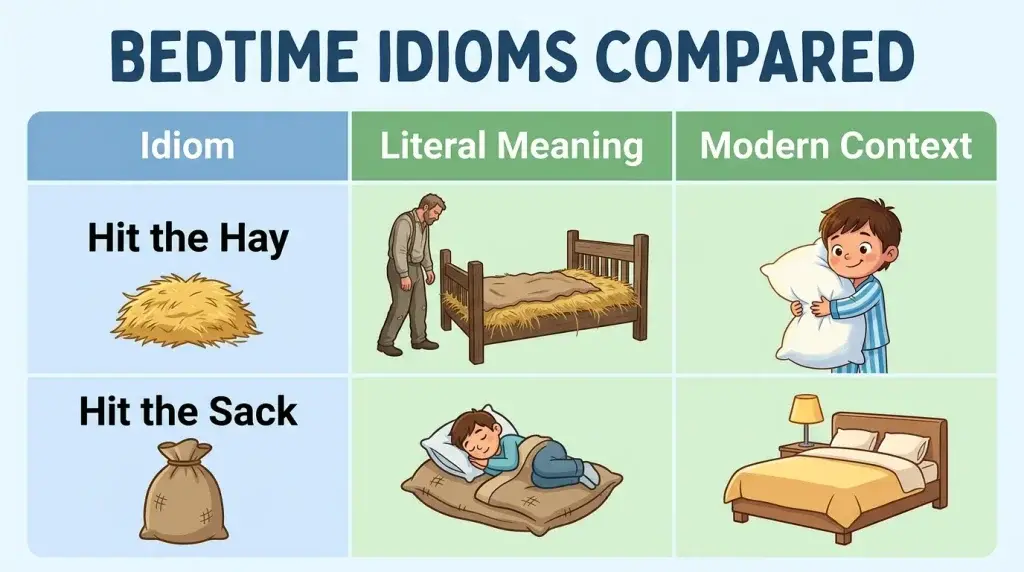
For a long time, many beds were not like the soft mattresses we have now. Ordinary people often filled cloth bags with hay or straw and used them as mattresses. Farm workers, travelers, and soldiers slept on these simple beds. When you lay down on one, you were, in a way, “hitting the hay.”
The phrase is usually linked to American English from the early 1900s. It appears in print around that time, and it spread through newspapers, books, and everyday speech. A close cousin, “hit the sack,” comes from a similar idea. A “sack” was a bag stuffed with hay or straw that served as a bed.
You may read websites that give exact dates or tell dramatic stories about one person who first said it. Be careful with those claims. The truth is that idioms usually grow slowly through everyday talk, and nobody records the very first speaker. What we can say with confidence is that the phrase fits the old habit of sleeping on hay-filled beds, and it has stayed popular long after that habit faded.
Hit the Hay vs. Other Bedtime Idioms
English has many fun ways to say “go to bed.” Some are casual, some are old-fashioned, and some sound a bit formal. Knowing the differences helps you pick the right one.
| Phrase | Meaning | Tone | Example |
| Hit the hay | Go to bed | Casual, playful | “I’m going to hit the hay.” |
| Hit the sack | Go to bed | Casual, very common | “Let’s hit the sack early.” |
| Turn in | Go to bed | Calm, slightly old-fashioned | “I think I’ll turn in now.” |
| Call it a night | Stop what you’re doing for the day | Neutral | “Let’s call it a night.” |
| Get some shut-eye | Get some sleep | Friendly | “I need to get some shut-eye.” |
| Crash | Fall asleep quickly from tiredness | Very casual | “I’m going to crash.” |
| Retire for the night | Go to bed | Formal | “He retired for the night.” |
Here is a helpful tip. “Hit the hay” and “hit the sack” are nearly twins. You can swap one for the other in most sentences. “Call it a night” is a little different. It means you are done with your activity, but it does not always mean you are going straight to bed.
“Crash” often means you are so tired that you fall asleep right away. “Retire for the night” is the most formal choice and would sound a bit stiff in a normal chat. Choose the phrase that matches your mood and your listener.
Is “Hit the Hay” American or British English?
Many people ask whether this idiom is American or British. The answer is that it is mostly known as an American English phrase, and it grew out of early American speech.
That said, people in the United Kingdom, Canada, Australia, and other English-speaking places often understand it. Movies, TV shows, and music have spread American idioms all over the world. So a British speaker will probably know what you mean if you say, “I’m off to hit the hay.”
Still, British speakers may choose other phrases more often in daily life. You might hear “I’m off to bed,” “I’m turning in,” or “I’m going up the wooden hill” in some older or playful settings. These are fine choices, and none is better than the others. They are just different flavors of the same idea.
If you are writing for a US audience, “hit the hay” is a great pick. If you are writing for a worldwide audience, it is still safe, but a short note or clear context can help new learners. For example, you could write, “I’m going to hit the hay, which means I’m going to bed.”
Common Mistakes to Avoid
Even a simple idiom can trip people up. Here are the mistakes you will see most often, and how to fix them.
The first mistake is taking the phrase too literally. Some learners think it means a person is actually lying in a pile of hay or working on a farm. Unless the speaker is on a farm, it simply means going to bed.
The second mistake is changing the words. Saying “hit a hay,” “hit the haystack,” or “hit hay” changes the phrase, and listeners may feel confused. Keep it as “hit the hay.”
The third mistake is using it in very formal writing. You would not usually put it in a business report, a legal paper, or a school essay about a serious topic. It is a casual phrase, so save it for friendly talk, stories, and relaxed writing.
The fourth mistake is using it when someone is not going to sleep. If you say, “I’m going to hit the hay,” people expect you to go to bed soon. If you plan to stay up and watch TV for three more hours, the phrase may feel misleading.
The last mistake is mixing it up with similar phrases like “hit the road” or “hit the books.” These use the same word “hit” but mean something else. “Hit the road” means to leave. “Hit the books” means to study. Only “hit the hay” is about sleep.
When Should You Use This Idiom?
Tone matters in every language. This idiom is friendly and light, so it fits best in relaxed settings.
Use it when you talk with friends, family, neighbors, or coworkers you know well. It is great at sleepovers, on camping trips, and during late-night chats. It also works well in stories, blog posts, social media captions, and casual emails.
Skip it in very serious or formal moments. If you are writing to a judge, a new boss, or a customer who needs a polite message, choose a plainer phrase such as “I am going to bed” or “I will be offline for the night.”
You can also use it to be kind and a little funny. Telling a sleepy child, “Okay, buddy, time to hit the hay,” feels warmer than, “Go to bed right now.” The idiom adds a smile to a simple order. That is one reason parents and grandparents have used it for so long.
Current Usage and Trends
Even though hay beds are mostly a thing of the past, people still say this phrase every day. You can hear it in TV shows, read it in books, and see it in social media posts. It shows up in captions like “Long day. Time to hit the hay,” often paired with a sleepy photo or a cozy bed.
It has also found a home in the world of sleep and wellness. Writers who talk about healthy sleep habits sometimes use it as a friendly, easy way to talk about bedtime. It sounds less strict than “enforce a bedtime” and more fun than “retire for the evening.”
Teachers of English as a second language like this idiom too. It is short, clear, and tied to a daily activity every learner understands. That makes it a good first idiom to teach.
One note of honesty is needed here. There is no exact number that tells us how often people use this phrase compared with others, so it is best not to claim it is “the most popular” bedtime idiom. What we can say is that it remains widely known, easy to understand, and still in regular use across the United States and beyond.
Tips to Remember and Use the Idiom
Learning an idiom is easier when you attach it to a picture or a habit. Here are some simple ideas that work well.
Try picturing a cozy farm bed made of soft hay. When you think “hit the hay,” imagine that bed and yourself lying down. That image links the words to the meaning right away.
Next, connect the phrase to your own nightly routine. Each night, when you brush your teeth, say to yourself, “Time to hit the hay.” After a week, the phrase will feel natural.
You can also practice with a friend. Take turns using the phrase in short sentences about your day. For example, “I worked late, so I’m going to hit the hay.” Speaking the idiom out loud helps it move from your head to your daily speech.
Another smart tip is to learn it alongside its cousins. When you study “hit the hay,” also learn “hit the sack” and “turn in.” Grouping similar phrases helps your brain store them together and pick the best one later.
Finally, listen for it. Notice how actors, hosts, and friends use it in real life. Pay attention to their tone. Hearing the idiom in real settings is one of the best ways to understand when it feels right.
FAQs About the Hit the Hay Meaning
What does “hit the hay” mean?
It means to go to bed or go to sleep. A person who says it is usually tired and ready to rest. It is a casual, friendly phrase used in everyday talk.
Is “hit the hay” an idiom?
Yes. An idiom is a phrase whose meaning is different from its separate words. Here, no one is really hitting hay. The words together simply mean “go to bed.”
Where does “hit the hay” come from?
It most likely comes from the old habit of sleeping on beds stuffed with hay or straw. The phrase is linked to early 1900s American English. The exact first speaker is unknown, so be careful with any website that claims to know.
Is “hit the hay” the same as “hit the sack”?
They mean almost the same thing, and you can usually swap them. Both come from beds made of hay or straw. “Hit the sack” is also very common, while “hit the hay” can feel a touch more playful.
Is “hit the hay” formal or informal?
It is informal. It fits chats with friends and family, stories, and relaxed writing. In formal settings, choose simpler phrases like “go to bed” or “get some rest.”
Can I use “hit the hay” in the past tense?
Yes. You can say, “I hit the hay at ten last night.” Just change the verb to fit the time, and keep the words “the hay” the same.
Conclusion
Now you know the full hit the hay meaning. It simply means to go to bed and get some sleep. The phrase is casual, friendly, and easy to use. It probably grew from the days when beds were stuffed with hay, though nobody can say exactly who said it first. You also learned how to use it in a sentence, how it compares to phrases like “hit the sack” and “turn in,” and which mistakes to avoid. Keep the words in order, use it in relaxed settings, and save it to talk about sleep. Next time you feel tired after a long day, give it a try. Say it with a smile, close your eyes, and enjoy a good night’s rest. Practice it a few times, and it will soon feel like your own.

Hi, I’m Elias Monroe. I enjoy writing meaningful prayer content that helps people feel calm, hopeful, and spiritually strong. My goal is to share words that bring comfort during both joyful and difficult times.