Picture a student the week before finals. The phone is off, the snacks are closed, and the books are open. A friend asks, “Want to hang out?” The student sighs and says, “Can’t. Nose to the grindstone this week.”
That short phrase packs a lot of meaning. The nose to the grindstone meaning is easy to explain: it means to work very hard and stay focused on a task, often for a long time. It does not mean anything painful, even though the picture sounds a bit rough.
People search for this phrase when they hear it at work, at school, or in a movie. They want to know what it says and how to use it. In this guide, you will learn the meaning, the possible origin, the correct grammar, and plenty of examples you can use right away.
Quick Answer: Nose to the Grindstone Meaning
To keep your nose to the grindstone means to work hard and steadily without getting distracted. It is often used when a job is long, tough, or important. The person is giving full effort and not slacking off.
Here is a fast snapshot:
| Question | Short Answer |
| What type of phrase is it? | An idiom |
| What does it mean? | Working hard with steady focus |
| Is it literal? | No, nobody is touching a real grindstone |
| Is the tone positive or negative? | Usually neutral or positive, sometimes a bit tired |
| Where is it used? | Work, school, sports, and everyday life |
What the Idiom Really Means
An idiom is a phrase where the real meaning is different from the exact words. Nobody has to press their nose on a stone wheel. The phrase paints a picture so you can feel the idea.
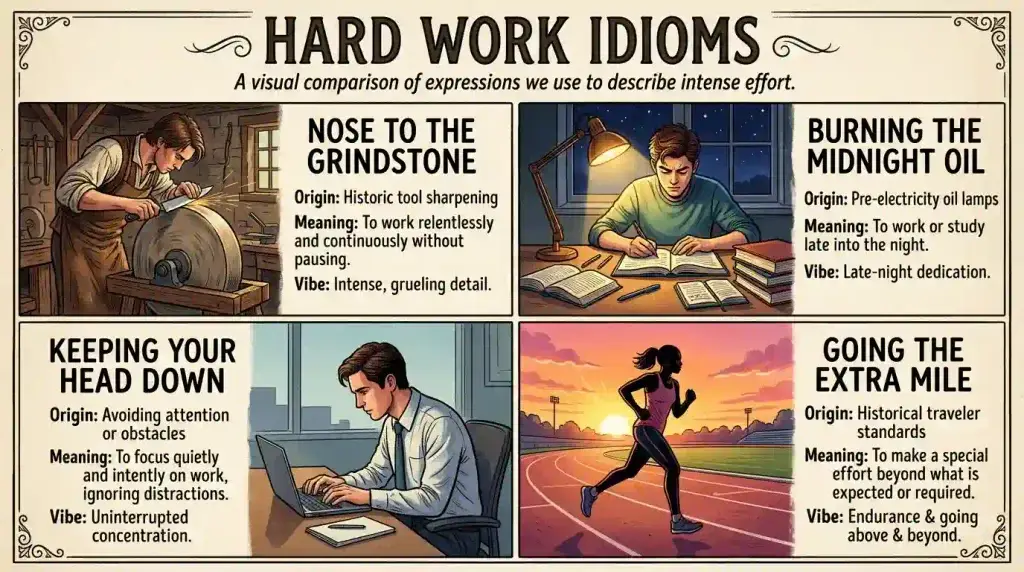
Think of the picture for a moment. A person leans in so close that their nose is near the tool. They cannot look around the room. They cannot check the clock or watch the window. All they can do is stay put and keep working.
That is the heart of the phrase. It is about focus and effort that do not stop. The person is not messing around. They have a goal, and they are putting in the hours to reach it.
The phrase can sound a little serious, though. Often there is a hint that the work is tiring or dull. Someone who says “I’ve had my nose to the grindstone all month” may be proud of the effort. They may also be hinting that they need a break soon.
Where Does the Phrase Come From?
Now for the fun part. What is a grindstone, and why is a nose near it?
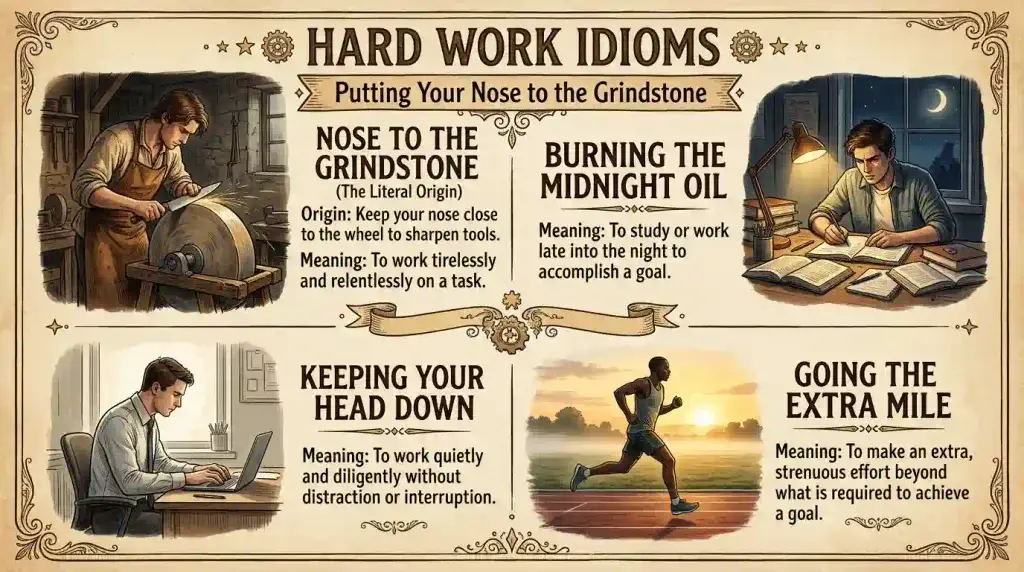
A grindstone is a round stone wheel. People used it to sharpen knives, axes, and other tools. It also served to grind grain in some mills. Workers would turn the wheel and press the metal against it. The job took patience and a steady hand.
The most common explanation is that the phrase comes from this kind of work. A person sharpening a blade had to lean in close to watch what they were doing. Their face would be near the spinning stone. Staying in that spot for long meant hard, steady labor.
Here is where honesty matters. Many websites tell a very detailed story about the phrase, and some of those stories are not well proven. We can say that the phrase has been used in English for several centuries. Dictionaries often trace written examples back to the 1500s. But the exact first user and the true story behind the image are not fully certain. So the safest thing to say is this: the picture most likely comes from grinding and sharpening work, but the exact origin is not known for sure.
| What We Know | What We Do Not Know for Sure |
| A grindstone is a stone wheel for sharpening or grinding | Who said the phrase first |
| The idiom has been in English for a long time | The exact date it began |
| The idea links to close, steady work | Which of the popular origin stories is true |
How to Use the Phrase in a Sentence
Good news: this idiom is easy to use. It usually follows a verb like “keep,” “have,” or “put.” You can also use it with “back to,” as in “back to the grindstone.”
Here are some common ways to say it:
| Sentence | What It Shows |
| “I kept my nose to the grindstone and finished the report.” | Steady effort led to a result |
| “She has her nose to the grindstone this month.” | Someone busy and focused |
| “If we keep our noses to the grindstone, we can win.” | A team call for hard work |
| “He put his nose to the grindstone after the holidays.” | Getting serious after a break |
| “Time to get back to the grindstone.” | Returning to work |
Notice that “nose” changes to “noses” when you talk about more than one person. You say “we kept our noses to the grindstone,” not “our nose.” This is a small detail, but it makes your writing sound polished.
Also note the words that come before it. You can say “keep,” “hold,” or “put” your nose to the grindstone. All three work. “Keep” is the most common of the three.
Grammar Notes and Correct Usage
A few quick tips will help you use the idiom well.
First, the word is “grindstone,” one word. Some people write “grind stone,” but dictionaries list it as a single word.
Second, you do not need to say “the nose.” It is always a person’s own nose, so use “my,” “your,” “his,” “her,” “our,” or “their.”
Third, the phrase works best as a verb phrase. For example, “I’m keeping my nose to the grindstone.” You can also use it as a describing phrase, as in “He’s a nose-to-the-grindstone kind of guy.” When you use it that way before a noun, many writers add hyphens.
Fourth, think about your setting. In a casual email or chat, the idiom is fine. In a very formal report or a paper for readers who learn English as a second language, a plain phrase like “work hard” may be easier to understand.
Real Life Examples
Let’s look at how this idiom plays out in daily life. These examples are made up to show the idea.
At work. A small business owner is getting ready for the busiest season of the year. She tells her team, “We need to keep our noses to the grindstone until the holiday rush is over.” Everyone knows it means long hours and strong focus.
At school. A high school junior wants to raise his grades before college applications. He puts his phone away during homework and studies every night. His teacher says, “I can see you have your nose to the grindstone. It’s paying off.”
In sports. A runner trains every morning before sunrise. Her coach tells her, “Keep your nose to the grindstone, and race day will take care of itself.”
At home. A dad is finishing a big paint job on the garage. His kids ask to play. He says, “Not yet. Nose to the grindstone until this wall is done.”
In a career. A new employee spends his first year learning everything he can. He does not complain about the extra work. Later, he earns a promotion. His boss says, “He kept his nose to the grindstone, and it showed.”
In each case, the pattern is the same. The person has a goal, avoids distractions, and keeps going.
Is It a Compliment or a Complaint?
Here is something many guides skip. The same phrase can feel different depending on who says it and how.
When a boss says, “I like how you keep your nose to the grindstone,” it is a compliment. It praises your work ethic. The boss sees you as reliable and steady.
When you say it about yourself, the tone may be tired. “I’ve had my nose to the grindstone for weeks” can mean “I’m working hard, and I’m worn out.” It is a way to explain why you have been quiet or busy.
When someone says it about another person, it may be a bit of a warning. “He always has his nose to the grindstone” can mean he works hard. But it can also hint that he never takes time to relax or have fun.
So how do you know? Look at the words around it. Pay attention to tone of voice, too. Context will almost always tell you what the speaker feels.
Similar Phrases and Related Idioms
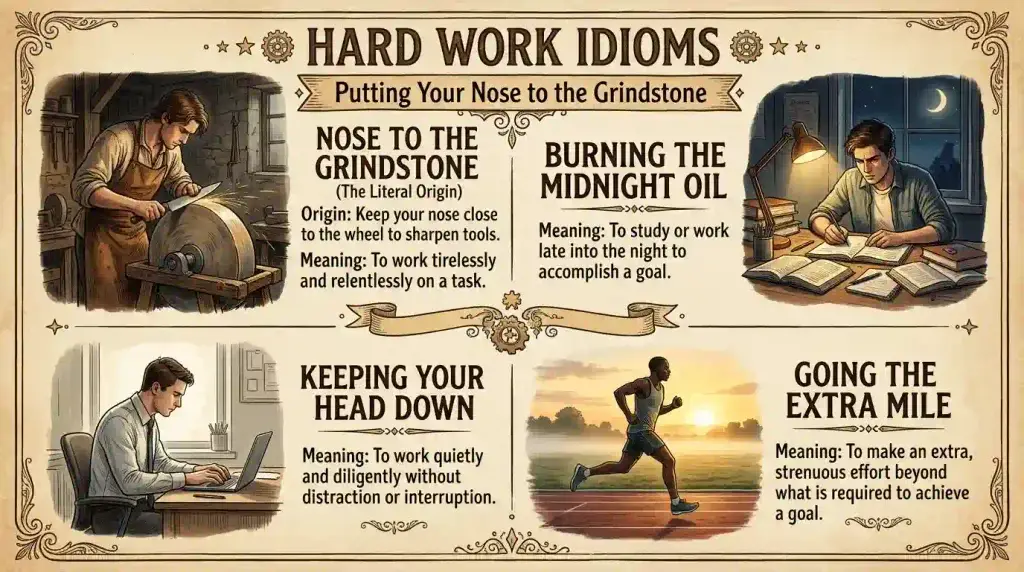
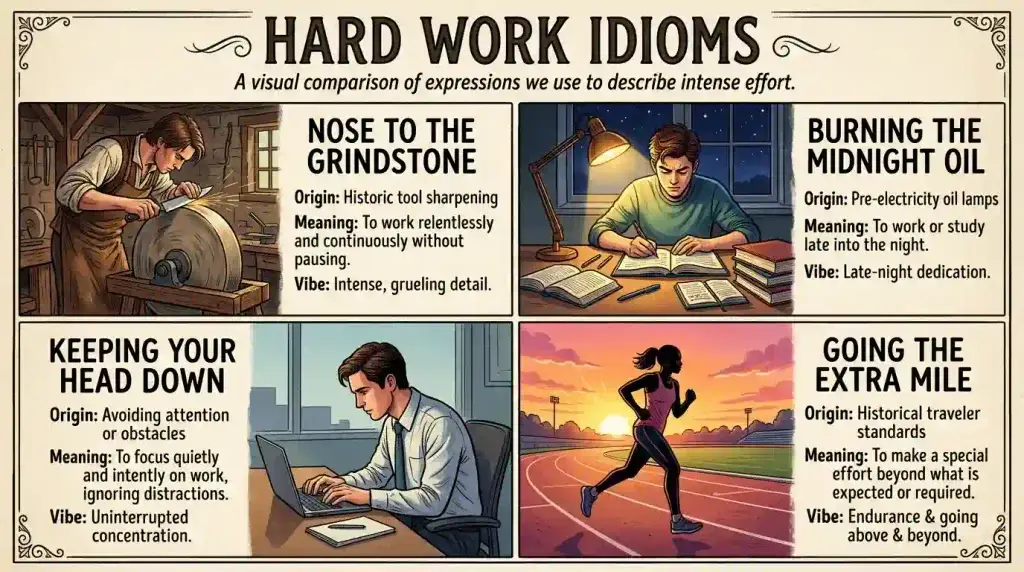
English has many ways to talk about hard work. Some are close to this idiom, and some are a bit different. Here is a simple chart.
| Phrase | Meaning | How It Differs |
| Buckle down | Start working seriously | Focuses on the start of the effort |
| Burn the midnight oil | Work late into the night | Focuses on late hours |
| Roll up your sleeves | Get ready to work hard | Focuses on getting started |
| Hit the books | Study hard | Used mostly for school |
| Work your fingers to the bone | Work extremely hard | Stronger and more tiring |
| Put your shoulder to the wheel | Push hard to finish a job | Very close; stresses teamwork or heavy effort |
Of these, “put your shoulder to the wheel” is the closest cousin. Both are about steady, tough effort. But “nose to the grindstone” puts more stress on focus and staying put.
You may also see the opposite idea in phrases like “slack off,” “goof off,” or “coast.” These describe people who are not working hard.
British vs. American English
Is the phrase different on each side of the ocean? Not much. Both American and British speakers know and use it. Dictionaries from both places list it with nearly the same meaning.
One small note: you may hear “back to the grindstone” slightly more in some places than others, but both are understood everywhere. So you can use this idiom with readers in the United States, the United Kingdom, Canada, and Australia without worry.
Common Mistakes With This Idiom
A few slips pop up now and then. Here is how to avoid them.
Do not say “nose to the grinder.” A grinder is a different tool, and it is also a type of sandwich in some parts of the United States. The idiom uses “grindstone.”
Do not say “nose on the grindstone.” The usual form is “nose to the grindstone.”
Do not write “nose to the grind stone” as two words. Use “grindstone.”
Do not mix it up with “nose to the ground.” That phrase is about tracking, like a hunting dog. People sometimes use it to mean focus, but it is a different image.
Do not take it as a bad word or a rude phrase. It is a friendly, common idiom.
Also, avoid overusing it. A single idiom is great. Three in one paragraph can sound heavy.
Tips for Keeping Your Nose to the Grindstone
The phrase is not only a saying. It also points to a real skill: staying focused when the job is hard. Here are some ideas that many people find helpful.
Pick one task at a time. It is hard to give full effort when you try to do five things at once.
Set a small goal for each work block. For example, “I will write one page in thirty minutes.” Clear goals keep you moving.
Remove distractions. Silence your phone, close extra tabs, and clear your desk. Small interruptions add up fast.
Take short breaks. This might sound odd for a hard-work idiom. But rest helps your brain stay sharp. Working nonstop can lead to tired, sloppy work.
Reward yourself. After a big push, do something you enjoy. A walk, a snack, or time with a friend can refill your energy.
Watch for burnout. Working hard is good, but working too hard for too long can hurt your health and mood. If you feel worn out all the time, talk to someone you trust or a health professional. Hard work works best when it is balanced with rest.
Current Usage and Trends
Today, this idiom shows up in many places. You will hear it in offices, classrooms, news stories, and speeches. People use it in emails, too, such as “I’ll have my nose to the grindstone this week, so I may reply slowly.”
It also shows up around talks of “hustle culture,” the idea that people should work nonstop to get ahead. Some people love that idea. Others think it leads to stress. The idiom itself is neutral, but it often appears in these debates.
With remote work, many people now say it about home offices. “Nose to the grindstone” can describe a long day at a laptop as much as a long day at a workbench.
Even though grindstones are rare in daily life now, the phrase has not faded. That shows how strong the picture is. We may not sharpen tools by hand anymore, but we all know what it feels like to lean in and get the job done.
FAQs About Nose to the Grindstone Meaning
What does nose to the grindstone mean?
It means to work hard and stay focused on a task without getting distracted. The person is giving steady effort, often for a long time or on a tough job.
Is nose to the grindstone an idiom?
Yes. It is an idiom, which means the words do not point to the real action. Nobody is truly pressing their nose on a stone wheel. It is a picture used to describe hard work.
Where does the phrase nose to the grindstone come from?
Most explanations link it to sharpening tools on a grindstone, where a worker had to lean in close. The phrase has been in English for centuries. But the exact first use is not known for sure.
Is nose to the grindstone a good or bad thing?
It is usually positive, since it praises hard work. But it can also hint that someone is tired or too busy. The tone depends on who says it and how.
What is another way to say nose to the grindstone?
You can say “work hard,” “buckle down,” “stay focused,” or “put your shoulder to the wheel.” Each has a slightly different feel, but all point to serious effort.
How do you use nose to the grindstone in a sentence?
You might say, “I kept my nose to the grindstone all week to finish the project.” You can change the pronoun to fit the person, such as “his,” “her,” “our,” or “their.”
Conclusion
The nose to the grindstone meaning is simple to remember. It describes working hard with steady focus, even when the job is long or tough. The picture of a worker leaning close to a spinning stone helps the phrase stick in your mind.
You now know how to use it, how to avoid common slips, and how it differs from similar idioms. You also learned that its exact origin is not fully proven, which is a good reminder to be careful with fun stories you read online.
Here is one last tip. Hard work matters, but so does rest. Keep your nose to the grindstone when it counts, then give yourself time to look up and breathe. That balance will take you further than effort alone.

Hi, I’m Sarah Mitchell. I love writing faith-based content that brings peace, hope, and encouragement to everyday life. Through prayers and devotionals, my goal is to help readers feel closer to God and stronger in faith.