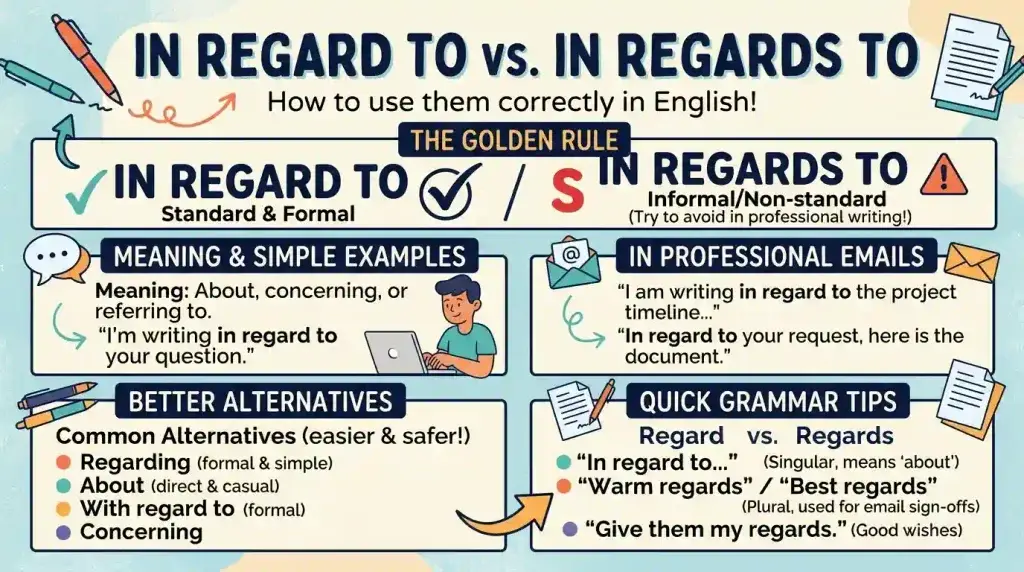
The phrase “in regards to” means “about,” “concerning,” or “related to” a particular subject. People use it in conversations, emails, and formal writing to explain what they are talking about. For example, “I am writing in regards to your application” means “I am writing about your application.”
Although many people use this phrase, it can be confusing because similar expressions, such as “in regard to,” “with regard to,” and “as regards,” also exist. Some are more common in formal writing, while others sound more natural in everyday English.
In this guide, you will learn the meaning of “in regards to,” how to use it correctly, and how it differs from similar phrases. You will also find simple examples, common mistakes, better alternatives, and answers to frequently asked questions. By the end, you will know which expression to choose when writing an email, speaking with someone, or creating professional content.
Quick Answer: What Does It Regards To Mean?
“In regards to” means about, concerning, or in connection with something. It introduces the subject of a sentence and helps explain what a person is discussing.
For example:
- “I have a question in regards to your services.” This means you have a question about the services.
- “She contacted me in regards to the meeting.” This means she contacted you about the meeting.
- “In regards to your request, we will respond tomorrow.” This means the response concerns your request.
The phrase is widely understood, but “in regard to” and “with regard to” are generally preferred in careful formal writing.
In Regards To Meaning in Simple English
It connects your words to a specific subject.
Think of it as another way of saying “about this topic.”
For example, imagine that you applied for a job and want to ask the company about your application. You might write:
“I am contacting you in regards to my job application.”
The meaning is clear: you are contacting the company about your application.
However, in careful writing, this sentence is better written as:
“I am contacting you regarding my job application.”
Both sentences communicate the same basic idea. The second version is shorter and more natural in professional communication.
According to the Cambridge English Dictionary, “in regard to” means “in relation to” someone or something. It is commonly used to introduce the subject of a message or conversation.
Cambridge English Dictionary
+1
Here are some simple meanings to remember:
| Expression | Simple meaning |
| In regards to | About something; a commonly used but less preferred form |
| In regard to | About or concerning something |
| With regard to | In connection with something |
| Regarding | About a particular subject |
| In relation to | Connected with something |
| Concerning | About something that may need attention |
The key is to choose the expression that makes your message clear without adding unnecessary words.
Is In Regards To Grammatically Correct?
This is one of the most common questions about the phrase.
The expression “in regards to” appears in everyday speech, online writing, and workplace communication. Most readers understand what it means. However, traditional grammar and formal writing guides generally recommend “in regard to,” without the letter s.
For example:
- Less preferred: “I have a question in regards to the new policy.”
- Preferred: “I have a question in regard to the new policy.”
- More natural: “I have a question about the new policy.”
The confusion comes from several similar expressions. “In regard to” and “with regard to” use the singular noun “regard.” Meanwhile, “as regards” is also an accepted expression, but it follows a different grammatical pattern.
Dictionary.com explains that the forms with an extra s have become increasingly common, even though the traditional forms remain preferred in careful writing.
Dictionary.com
+1
This means you do not need to worry if you hear someone say “in regards to.” The meaning is usually easy to understand. However, if you are writing a business email, school assignment, report, or website article, choosing a standard alternative is a safer option.
Here is a simple rule to follow:
Use “in regard to” or “with regard to” in formal writing. Use “about” or “regarding” when you want a clear, direct sentence.
In Regard To vs. In Regards To: What Is the Difference?
The difference is mainly about standard usage, not the basic meaning.
Both expressions are commonly used to introduce a subject. However, “in regard to” is the traditional standard form, while “in regards to” is often considered nonstandard in formal English.
Consider these examples:
“In regard to your order, we have confirmed the delivery date.”
“In regards to your order, we have confirmed the delivery date.”
Most readers will understand both sentences. However, an editor following traditional grammar rules will usually choose the first version.
The following table makes the distinction easier to understand.
| Feature | In regard to | In regards to |
| Meaning | About or concerning | About or concerning |
| Traditional standard usage | Preferred | Generally not preferred |
| Formal emails | Recommended | Better avoided |
| Academic writing | Recommended | Better avoided |
| Casual conversation | Understood | Commonly heard |
| Best alternative | Regarding or about | Regarding or about |
The extra s can be confusing because the word “regards” is correct in other situations.
For example, “Please give my regards to your family” is correct. In this sentence, “regards” means kind thoughts or good wishes.
It does not mean “about.”
Remember that distinction when choosing between these expressions. You can use “regards” to send good wishes, but “in regard to” is the safer form when introducing a topic.
In Regard To vs. With Regard To
“In regard to” and “with regard to” are both standard expressions. They have almost the same meaning and can often replace each other without changing the main idea.
For example:
- “In regard to your request, we need more information.”
- “With regard to your request, we need more information.”
Both sentences explain that the request is the subject of the message.
The choice often depends on the writer’s style and the flow of the sentence. “With regard to” may sound slightly more formal or traditional in some settings, but neither expression is automatically better in every situation.
The Cambridge English Dictionary lists “with regard to” as a related form of “in regard to.”
Cambridge English Dictionary
+1
Here are more examples:
| In regard to | With regard to |
| In regard to the meeting, we will arrive early. | With regard to the meeting, we will arrive early. |
| In regard to your complaint, we are investigating. | With regard to your complaint, we are investigating. |
| In regard to the project, I have an update. | With regard to the project, I have an update. |
Both versions are correct. Still, you can often make these sentences simpler.
Instead of saying, “With regard to the meeting, we will arrive early,” write, “We will arrive early for the meeting.”
The shorter sentence is easier to read and sounds more direct.
Best Synonyms for In Regards To
If you want your writing to sound natural, you do not need to use “in regards to” every time you discuss a subject.
The best choice depends on your sentence, audience, and purpose.
1. About
“About” is the simplest and most common alternative.
2. Regarding
“Regarding” is useful in professional messages and formal documents.
Example: “I am writing regarding your recent application.”
It is concise and clearly introduces the topic.
3. Concerning
“Concerning” can replace “in regard to” when you mean “about.”
Example: “We received an email concerning the schedule change.”
Be aware that “concerning” can also mean worrying or troubling when used as an adjective.
4. With respect to
This expression is often used in formal, academic, or technical writing.
Example: “With respect to your question, the answer depends on the situation.”
It can sound formal, so “about” may be a better choice for simple messages.
5. In relation to
Use this expression when you want to describe a connection between two things.
Example: “We discussed the costs in relation to the expected results.”
It may be more suitable than “about” when the relationship itself matters.
6. As for
“As for” helps introduce a new topic or return to a subject.
Example: “As for the delivery date, we expect it next week.”
It sounds natural in conversations and less formal writing.
7. On the subject of
This phrase clearly identifies the topic being discussed.
Example: “On the subject of school safety, the principal shared several ideas.”
It works well when moving from one topic to another.
Merriam-Webster lists words and expressions such as “about,” “concerning,” “regarding,” and “with regard to” among the alternatives related to “regarding.”
| Your purpose | Best alternative | Example |
| Everyday conversation | About | I called about the meeting. |
| Professional email | Regarding | I am writing regarding your order. |
| Formal discussion | With respect to | With respect to your proposal, we agree. |
| Explaining a connection | In relation to | This rule applies in relation to safety. |
| Introducing a new topic | As for | As for tomorrow, the plan is unchanged. |
| Discussing a specific issue | Concerning | We received a message concerning the delay. |
How to Use In Regard To in a Sentence
The phrase “in regard to” usually comes before the subject you want to discuss. That subject may be a person, object, event, question, request, or idea.
A simple pattern is:
In regard to + noun or noun phrase + main statement
For example:
“In regard to your question, the answer is yes.”
Here, “your question” is the subject, and the rest of the sentence provides the answer.
You can also place the phrase later in a sentence.
Example: “We have received several comments in regard to the new website.”
The sentence tells readers what the comments concern.
Here are practical examples from different situations.
At work: “I would like to speak with you in regard to the new project.”
At school: “The teacher sent a message in regard to tomorrow’s exam.”
In customer service: “We are contacting you in regard to your recent purchase.”
In a business report: “The team identified three concerns in regard to the proposed plan.”
All five sentences communicate a clear topic. However, each can often be improved by using a shorter expression.
For instance, “I have a question about our weekend plans” sounds more natural than “I have a question in regard to our weekend plans.”
When editing your writing, ask yourself whether the phrase adds useful meaning. If “about” communicates the same idea, the shorter option is usually a good choice.
Examples of In Regards To in Everyday Life
Understanding a phrase is easier when you see it used in situations you may experience yourself.
The examples below include the commonly used “in regards to” form alongside a recommended alternative.
Example 1: Job application
Common version: “I am writing in regards to the job opening.”
Preferred version: “I am writing regarding the job opening.”
Example 2: Customer support
Common version: “I contacted the company in regards to my refund.”
Preferred version: “I contacted the company about my refund.”
Example 3: School
Common version: “The teacher emailed us in regards to the homework.”
Preferred version: “The teacher emailed us about the homework.”
The email contains information about the assignment.
Example 4: Workplace meeting
Common version: “I have an update in regards to our meeting.”
Preferred version: “I have an update about our meeting.”
The speaker has new information related to the meeting.
Example 5: Online shopping
Common version: “I need help in regards to my order.”
Preferred version: “I need help with my order.”
The customer needs assistance with a purchase.
Example 6: Website management
Common version: “I have a question in regards to the website design.”
Preferred version: “I have a question about the website design.”
The writer wants to discuss the site’s appearance or layout.
Example 7: Scheduling
Common version: “She called me in regards to the appointment.”
Preferred version: “She called me about the appointment.”
The call was related to an upcoming appointment.
Example 8: A formal request
Common version: “In regards to your request, we need additional details.”
Preferred version: “Regarding your request, we need additional details.”
The recipient needs to provide more information.
These examples show that the intended meaning usually remains the same when you replace “in regards to” with “about,” “regarding,” or another suitable expression.
Common Mistakes to Avoid
Even experienced English speakers sometimes mix up expressions that sound alike. Learning a few simple rules can help you avoid these mistakes.
Mistake 1: Adding an unnecessary s
Less preferred: “In regards to your email, I have a question.”
Better: “In regard to your email, I have a question.”
You can also write, “I have a question about your email.”
Mistake 2: Mixing different expressions
Incorrect: “In regards with your application, we will respond soon.”
Better: “In regard to your application, we will respond soon.”
Do not mix “in regard to” with “with regard to” or add “with” in the wrong place.
Mistake 3: Using the phrase when a short word works better
Wordy: “I am contacting you in regard to the delivery.”
Clearer: “I am contacting you about the delivery.”
A shorter sentence often communicates the same idea more effectively.
Mistake 4: Confusing the phrase with sending good wishes
These sentences have different meanings:
- “I am writing in regard to your message.” This introduces a topic.
- “Please send my regards to your family.” This sends good wishes.
The word “regards” does not always mean the same thing. Its meaning depends on how it is used.
Mistake 5: Using it too often in one email
Consider this message:
“I am writing in regard to the report. In regard to the deadline, I have a question. In regard to the budget, I need more information.”
The repeated phrase makes the email sound stiff.
A better version is:
“I am writing about the report. I have a question about the deadline and need more information about the budget.”
The revised message is easier to read and sounds more natural.
Tips for Choosing the Right Expression
Choosing the right phrase does not need to be difficult. Follow these practical tips when writing emails, reports, articles, or everyday messages.
Choose simple English first. If you can use “about” without changing the meaning, it is often your best choice.
Use “regarding” for professional communication. It is a useful option when discussing an application, order, meeting, or business matter.
Choose “in regard to” for traditional formal usage. This is a standard expression when you need to introduce a topic.
Read the sentence aloud. If the wording sounds too long or unnatural, try rewriting it with fewer words.
Think about your audience. A message to a friend does not need the same level of formality as a business letter.
Avoid unnecessary repetition. Use different sentence structures when discussing several related topics.
For example, instead of writing, “In regard to the project, I have an update,” you can write, “I have an update about the project.”
Both sentences are understandable, but the second is shorter and more direct.
Finally, remember that formal language is not always better language. Good writing helps readers understand your message quickly.
FAQS
What does in regards to mean?
“In regards to” means “about,” “concerning,” or “related to.” For example, “I called in regards to your order” means “I called about your order.” The expression is common, but “in regard to” is preferred in traditional formal writing.
Is it in regards to correct English?
It is widely used and understood, particularly in everyday speech. However, many traditional grammar guides consider it nonstandard. For professional writing, use “in regard to,” “with regard to,” or “regarding.”
Should I write in regard to or in regards to?
Choose “in regard to” when you want to follow traditional standard usage. The word “regard” does not need an s in this expression. You can also use “regarding” or “about” to make your sentence shorter.
What is another word for in regards to?
Useful alternatives include “about,” “regarding,” “concerning,” “with regard to,” and “in relation to.” The best choice depends on your sentence. “About” is usually the simplest option, while “regarding” works well in professional communication.
Is with regards to also incorrect?
“With regards to” is common, but “with regard to” is the traditional standard form. Some dictionaries note that the version with an s has become more common over time. If you want to avoid criticism in formal writing, use “with regard to.”
Can I use it in regard to in a professional email?
Yes. “In regard to” is suitable for professional emails, reports, and formal letters. For example, “I am writing in regard to your recent application.” You can also write, “I am writing regarding your recent application,” which is shorter and natural.
Conclusion:
Understanding the meaning of “in regards to” can help you communicate more clearly in everyday conversations, professional emails, and formal writing. The phrase means “about,” “concerning,” or “related to” a subject. Although many people use it, “in regard to” and “with regard to” are safer choices for traditional formal English.
You can also use simple alternatives such as “about” and “regarding” to make your sentences shorter and easier to understand. For example, instead of writing, “I am contacting you in regards to your application,” you can write, “I am contacting you about your application.”
The best approach is to choose words that fit your audience and purpose. Keep your sentences clear, avoid unnecessary phrases, and focus on communicating your message naturally. These small improvements can make your English more effective and professional.

Hi, I’m Sarah Mitchell. I love writing faith-based content that brings peace, hope, and encouragement to everyday life. Through prayers and devotionals, my goal is to help readers feel closer to God and stronger in faith.