Maybe you think about sex more than your friends seem to. Maybe your partner wants it less than you do. Or maybe you have just heard the term “high sex drive” and want to know what it really means. You are not alone, and you are not strange for asking.
The high sex drive meaning is simple: it describes a stronger or more frequent desire for sex than is typical for that person. It is usually a normal part of being human, not a disease. In this guide, you will learn what libido is, what can raise it, how to tell healthy desire from a problem, and when to talk with a doctor. You will also find easy tables and clear answers.
High Sex Drive Meaning: The Quick Answer
A high sex drive, also called a high libido, means you feel sexual desire often or strongly. There is no single “normal” level, and a high libido is generally not a concern unless it causes distress or interferes with daily life.
In other words, having a strong sex drive is not wrong, unhealthy, or shameful by itself. It becomes a topic for a doctor only when it feels out of control, harms your relationships or work, or leads to risky choices.
This article gives general health information. It is not medical advice, and a doctor or counselor is the best person to ask about your own situation.
What Is Libido?
Let’s start with the basics. Libido is another word for sex drive. It describes your emotional and mental desire for sex.
Think of it like appetite. Some people get hungry often, and others only a few times a day. Neither is wrong. Desire for sex works in a similar way. It rises and falls, and it differs from person to person.
Libido is not only about the body. It also involves your thoughts, feelings, stress level, relationships, and sense of safety. That is why the same person can feel more desire in one season of life and less in another.
Libido is also separate from what you actually do. Some people with a strong drive choose to wait, be selective, or have no partner. Others with a lower drive may still enjoy intimacy. Desire is one thing. Behavior is another.
Is a High Sex Drive Normal?
For most people, yes. Sex drive lies on a spectrum from no desire to frequent desire, and what looks high to one person may look normal to another.
Another source puts it simply: every person has their own normal, healthy libido level. So there is no magic number of times per week that counts as “right.”
This matters because many people worry without a reason. They compare themselves to friends, movies, or things they read online. But those comparisons are often unfair. Nobody shares the full truth about their private life, and media often exaggerates.
A helpful question is not “Is my drive too high?” but “Is my drive causing problems for me?” If it feels manageable, fits your values, and does not hurt anyone, it is most likely just your normal.
High Sex Drive vs. Compulsive Sexual Behavior
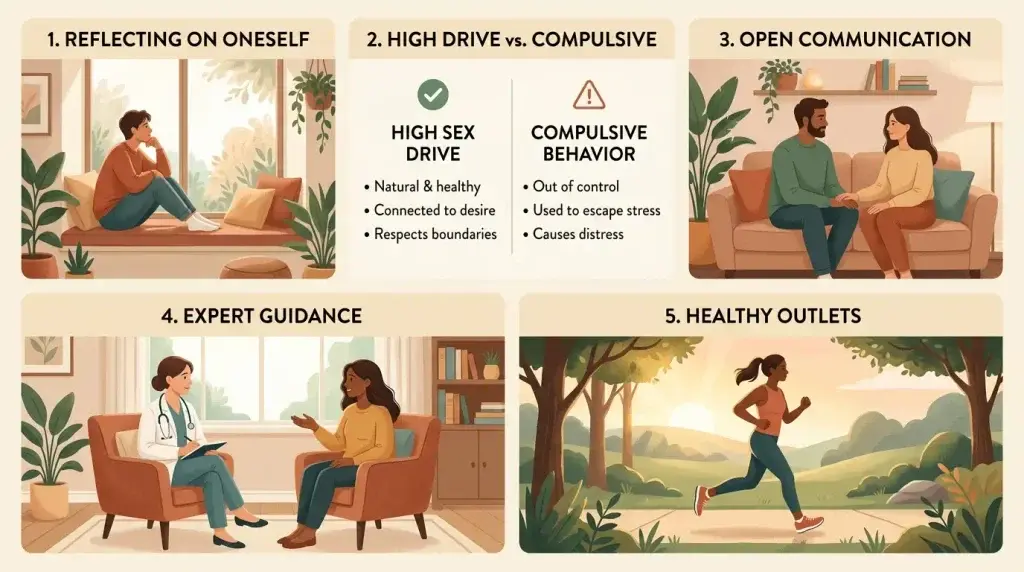
Here is the key difference that many people miss. A high sex drive is about how strong your desire is. Compulsive sexual behavior is about control and harm.
Compulsive behavior is less about libido itself and more about loss of control, repeating behavior despite harm, or using sex in a way that causes damage.
This table shows the difference.
| Feature | High Sex Drive | Compulsive Sexual Behavior |
| What it is | Strong or frequent desire | Hard-to-control urges and actions |
| Control | You can choose what to do | You feel you cannot stop, even when you want to |
| Effect on life | Usually none | Harms work, health, money, or relationships |
| Feelings afterward | Usually okay or happy | Often guilt, shame, or distress |
| Secrecy | Not needed | Often hidden from others |
| Needs treatment? | Usually not | Often helped by therapy or medical care |
A high libido can become a problem when it leads to sexual activity that feels out of control, which is sometimes called hypersexuality or compulsive sexual behavior.
The words used for this condition vary. Some doctors say “compulsive sexual behavior disorder.” Others use “hypersexuality.” You may also hear the popular term “sex addiction,” though experts debate that label. What matters most is the pattern: loss of control and harm, not the strength of desire alone.
What Causes a High Sex Drive?
Many things can raise or lower desire. This table shows the main ones.
| Factor | How It May Affect Desire |
| Hormones | Testosterone, estrogen, and progesterone all play a role |
| Age | Younger people often report higher desire |
| Menstrual cycle | Desire may rise around ovulation |
| Mood and stress | Feeling happy and relaxed can raise desire; stress can lower it |
| Relationship | A new or close relationship may increase desire |
| Sleep and energy | Good rest and health often support a steady libido |
| Medications | Some medicines raise or lower desire |
| Medical or mental health conditions | Some can cause sudden changes |
Testosterone, estrogen, and progesterone all affect desire, and normal ups and downs in these hormones can make libido rise. In women, higher estrogen around ovulation can increase sex drive, and younger people tend to have a higher sex drive than older people.
It is also normal for libido to change over time. Big life events, like a new baby, a new job, grief, or illness, can raise or lower it. Seeing a change does not mean something is wrong.
Hormones, Age and Gender Myths
Many people believe that men always have a higher sex drive than women. This is a common myth. Desire varies widely in every group.
Libido naturally varies widely among men, and some men have a high sex drive their whole lives without any concern. The same is true for women, nonbinary people, and everyone else. Hormones matter, but they are not the whole story.
Age plays a part too, but it is not a rule. Some older adults have a strong, healthy drive. Some younger adults have little. Culture, health, comfort, and past experiences all shape how desire feels.
Another myth is that a high drive means a person is untrustworthy or only cares about sex. That is not true. Desire is not the same as character. Someone can have a strong drive and be loving, loyal, and responsible.
It is kinder and more accurate to see sex drive as one trait among many, like energy level or sense of humor. It is part of who you are, and it does not define your worth.
Mental Health and Medications
Sometimes a sudden rise in desire is tied to something medical or emotional. Knowing this can help you take the right step.
One of the most medically important causes of hypersexual behavior is mania or hypomania, which can occur in bipolar disorder. In these states, a person may feel unusually energetic, need less sleep, talk fast, and take more risks. A big jump in sexual interest can be one sign among many.
Some dopamine agonist medicines used to treat Parkinson’s disease may cause compulsive sexual behavior. That is why anyone who starts a new medicine and notices a strong, unusual change in behavior should tell their doctor. Never stop a prescribed medicine on your own. Call the doctor or pharmacist first.
Stress, anxiety, trauma, and depression can also change desire in different ways. For some people, sex becomes a way to cope with hard feelings. That is not a moral failing. It is a clue that extra support may help.
If your sex drive changes suddenly and strongly, or feels out of character, it is a smart idea to talk with a healthcare provider.
Signs a High Sex Drive May Be a Problem
Most of the time, there is nothing to fix. But it is worth knowing the warning signs. This table can help you check in with yourself.
| Question to Ask | If the Answer Is Yes |
| Do I feel unable to control my urges, even when I want to? | Consider talking with a professional |
| Is my behavior hurting my work, school, or money? | Consider talking with a professional |
| Am I taking risks I regret, like unsafe sex? | Seek medical advice |
| Do I feel deep guilt or shame afterward? | A counselor can help |
| Am I hiding my behavior from people close to me? | Notice this sign and consider support |
| Did this change suddenly or feel unlike me? | See a doctor to check for causes |
Signs listed by health writers include being secretive about sexual behavior and feeling dependent on it. If you answer yes to questions like these, it may be time to see a doctor, who can check for physical or psychological causes.
One “yes” does not mean you have a disorder. These questions are a starting point, not a test. A doctor or therapist can look at the whole picture.
When Partners Have Different Levels of Desire
Many couples have different sex drives. It is one of the most common relationship challenges, and it does not mean the relationship is broken.
A difference in sex drive does not automatically mean the relationship is broken. The goal is not to match each other perfectly. It is to understand, respect, and find a middle path.
Here are some helpful ideas. Talk openly and kindly, at a calm time, not in the middle of a fight. Use “I” statements, like “I feel close to you when we spend time together,” instead of blame. Ask your partner what feels good and what feels like pressure.
Remember that closeness has many forms. Sometimes the partner with higher desire mainly wants closeness, and sex is the way they express it. Hugs, kind words, quality time, and shared fun can also build connection.
Most importantly, consent matters at every step. Nobody should feel pushed, guilted, or pressured. A partner can say no at any time, and a respectful partner listens. If talks keep getting stuck, a couples counselor or sex therapist can offer a safe space and tools.
Healthy Ways to Handle a High Sex Drive
If you have a strong drive and it feels fine, you do not need to change anything. If you want help managing it, here are some practical, healthy ideas.
Move your body. Exercise can improve mood, reduce stress, and give you a healthy outlet for energy.
Protect your sleep and food routines. Rest and steady meals support balanced mood and hormones.
Stay connected. Time with friends, family, hobbies, and community builds a full life, so desire does not feel like the only source of joy.
Practice mindfulness. Slow breathing, gentle stretching, and quiet time can help you notice urges without feeling pushed by them.
Set personal boundaries. Think about what fits your values. That might mean limiting certain websites or situations that leave you feeling worse afterward.
Choose safe, consensual choices. Use protection, get regular health checkups, and make decisions with respect for yourself and others.
Talk to someone. A trusted friend, counselor, or doctor can listen without judgment.
If your doctor does not suspect a physical cause, they may suggest sex therapy or counseling. Therapy is not a sign of weakness. It is a practical tool, like a coach for your mind.
When to See a Doctor
Seeing a doctor is smart if something feels off. This table sums up when to reach out.
| Situation | Suggested Step |
| Strong desire with no problems | No action needed |
| Desire that feels hard to control | Talk to a doctor or therapist |
| A sudden, big change that feels out of character | See a doctor soon |
| Mood swings, little sleep, racing thoughts | Seek medical help promptly |
| Risky behavior you cannot stop | Seek professional help |
| New medicine and new strong urges | Call your doctor or pharmacist |
| Pain, worry, or distress about sex | Talk to a healthcare provider |
Urgent evaluation is recommended if you notice severe mood swings, compulsive or risky sexual behavior, sudden personality changes, or nerve-related symptoms.
A doctor can run tests to see whether a high libido has a physical cause or a psychological one. Doctors hear about these topics all the time. You will not shock them, and they are there to help, not to judge.
If you are in immediate danger or feel you might hurt yourself or someone else, contact local emergency services right away.
Common Myths About High Sex Drive
Because the topic is private, many myths spread. Here are the most common ones.
The first myth is that a high sex drive is always a disorder. As we saw, it usually is not. Most men with a high sex drive do not have a hypersexuality disorder, and treating normal variation as a disease is a mistake.
The second myth is that you can measure “too much” with a number. There is no such number. There is no diagnostic test or doctor-approved online quiz that can tell you whether your libido is high.
The third myth is that a high drive means you are a bad person. Desire is not a moral issue. What you do with it, and how you treat others, is what counts.
The fourth myth is that a lower-drive partner is cold or broken. Lower desire is also normal and has many causes.
The fifth myth is that you must “fix” your partner or yourself. Often, understanding and communication are enough.
Last, avoid getting medical advice from random websites, forums, or social media. Use trusted health sources and talk with real professionals.
FAQs
What is the simple high sex drive meaning?
It means you feel sexual desire strongly or often compared to what is typical for you. It is usually a normal variation, not a disease.
Is a high sex drive normal?
Yes, in most cases. There is no single normal level. It becomes a concern only if it feels out of control or harms your life or relationships.
What causes a high sex drive?
Many things, including hormones, age, mood, relationships, and health. In some cases, medicines or conditions like mania can cause sudden increases.
What is the difference between a high sex drive and sex addiction?
A high sex drive is about strong desire. Compulsive sexual behavior, sometimes called sex addiction, is about feeling unable to control urges and causing harm. Experts debate the term “addiction.”
Can a high sex drive be lowered?
If it bothers you, healthy habits like exercise, sleep, stress care, and therapy can help. A doctor can also check for causes and discuss options. Do not change medicines without medical advice.
When should I see a doctor about my sex drive?
See a doctor if your drive changes suddenly, feels out of control, leads to risky behavior, or comes with mood changes or distress. Also check in if a new medicine changes your urges.
Conclusion:
The high sex drive meaning comes down to this: it describes strong or frequent sexual desire, and it is usually a normal part of life. There is no single right level, and every person has their own baseline. Hormones, age, mood, relationships, and health can all play a part.
We also learned that a high drive is different from compulsive sexual behavior, which involves loss of control and harm. Sudden or extreme changes, mood swings, risky behavior, or new medicines are good reasons to check in with a doctor.
So here is some practical advice. If your drive feels manageable and respectful of others, you can relax. If it causes distress, talk with a trusted professional without shame. Be kind to yourself, communicate openly with partners, and always put consent and safety first. Understanding your own body and mind is a healthy step.

Hello, I’m Clara Whitmore. I write daily prayers, devotionals, and faith-based reflections for readers seeking peace and encouragement. I believe prayer has the power to heal hearts and renew faith.