Blue dot fever meaning, in short: it is internet slang for a show with lots of unsold seats. The name comes from the blue dots that mark unsold seats on Ticketmaster’s website.
Scroll through social media in 2026 and you may have seen the phrase beside screenshots of empty arenas and canceled tours. It sounds like a sickness, but it is not one. People search for it because the term is new, catchy, and a little confusing.
In this guide, you will learn what the phrase means, where it started, and which tours people linked to it. You will also see why the debate is so heated, what Live Nation says, and how to use the term the right way.
Quick Answer: What Is the Blue Dot Fever Meaning?
Blue dot fever is a slang term for weak ticket sales at live events, mostly concerts. It became a viral way to describe several big 2026 tours that were scrapped or scaled back.
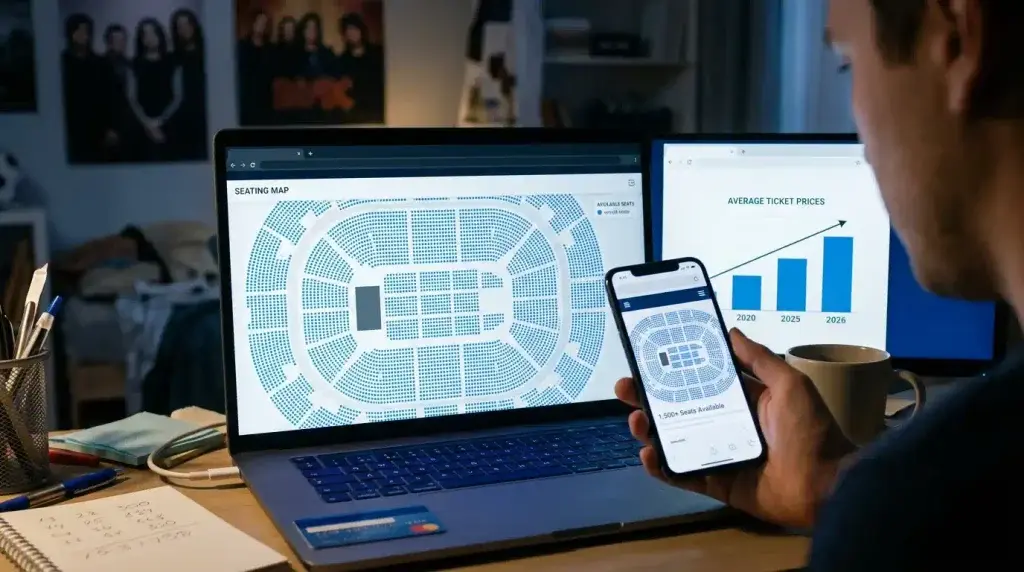
Here is a simple way to picture it. You open a ticket site and look at the seating map. If the map is covered in blue dots, many seats are still for sale. Too many blue dots can mean the show is not selling well.
The “fever” part is a joke. People say it as a dramatic way to describe an event that is underselling. Think of it like saying a tour “caught a cold.” No one is really sick. The phrase just paints a picture.
Why Is It Called “Blue Dot Fever”?
The name has two parts, and each one has a job. The first part, “blue dot,” points to what you see on screen. On many interactive venue maps, unsold seats show up as small blue circles or dots. When a whole section looks blue, the image sticks in your mind.
The second part, “fever,” makes it sound like something that spreads from person to person. That fits the way the story played out online. One canceled tour led to another, and each new case seemed to prove the point. Users began talking about it as if it were a contagious condition moving through live entertainment.
Notice that the phrase does not belong to one website. Ticket sites use different colors and styles. The blue dots are simply the image that caught on, and it stuck because it is easy to see and easy to share.
Where Did the Term Come From?
The phrase grew fast in spring 2026. According to one newsletter, a Page Six reporter named Ian Mohr was the first to label the trend “Blue Dot Fever,” citing industry sources. I could not confirm that claim with a second source, so treat it with some care.
What we can say is that the phrase took off in early May. Fortune ran a story on May 7, 2026, about a growing list of canceled tours and the “blue dot fever” label. Music-business sites like Hypebot also helped spread it. What started as industry whispers turned into a full viral phenomenon within about a month.
By summer, the phrase had left the music world. An art-industry newsletter in July called it internet slang and warned that art sellers should watch for the same trouble. That shows how quickly a joke can become a real talking point.
Which Artists Were Linked to Blue Dot Fever?
Several famous names ended up in the headlines. Meghan Trainor and Zayn gave up all of their US arena dates, while Post Malone and Jelly Roll shut down one-third of their shared stadium tour. The Pussycat Dolls also canceled many dates. Jennifer Lopez was also mentioned in some coverage, though she said she pulled out because she had too much going on, while Variety reported low sales at some venues.
Here is a quick summary of the most talked-about cases.
| Artist | What Happened | Did They Blame Sales? |
| Meghan Trainor | Dropped all US arena dates | No |
| Zayn | Dropped all US arena dates | No |
| Post Malone and Jelly Roll | Canceled about one-third of a joint stadium tour | No |
| Pussycat Dolls | Canceled large parts of a US tour | Yes, publicly |
This table is important for one reason. Only the Pussycat Dolls said out loud that poor sales caused the cancellations. The other links come from fans and writers who looked at seating maps and drew their own conclusions. Those guesses may be right, but they are still guesses.
Why Are Concert Tickets Not Selling?
No one reason explains everything. Still, writers keep pointing to money first. Fans face rising ticket prices and higher living costs, which makes them pickier about which shows to attend. Another outlet added that rising fuel costs, inflation, and unrest around the world have created a perfect storm for fans.
The price jump is easy to see in numbers. The average concert ticket costs $144 in 2026, up from $115 last year and $82 in 2020.
| Year | Average Concert Ticket Price |
| 2020 | $82 |
| 2025 | $115 |
| 2026 | $144 |
A ticket that costs this much is a bigger decision than it used to be. Many people now see a show only if it feels special. Add parking, food, and travel, and the night gets expensive fast.
Venue size matters too. One writer asked a pointed question: why did so many artists book tours in rooms that were too big in the first place? A star can sell out a theater and still struggle in an arena. Another analysis said that past ticket sales and other signs of fan demand ultimately decide which rooms an artist can realistically fill.
Streaming numbers can also mislead. A song played often on a workout playlist is not the same as a fan who will pay for a night out.
What Does Live Nation Say About Blue Dot Fever?
Live Nation, the parent company of Ticketmaster, pushed back hard. Its president and CFO, Joe Berchtold, said on May 14 that the phrase was catchy but “absolutely devoid of facts.” He also said such cancellations usually run about 1% to 2% in a normal year.
The company pointed to its money numbers. Live Nation said its first-quarter revenue rose 12% from a year earlier to $3.8 billion, and that it had sold 107 million tickets so far this year, up 11%. A company spokesperson added that fewer than 1% of the shows on its books had been canceled.
The company’s leaders also offered a different cause. CEO Michael Rapino called it a “scalper narrative,” and Berchtold said resellers were upset that artists were pricing tours better. Fans were not convinced. Some asked why tours were being canceled at all if this were only a scalper story.
Live Nation also faces legal trouble. On April 15, a jury found that Live Nation and Ticketmaster illegally monopolized parts of the US ticketing and amphitheater markets. That background may explain why some fans doubt the company’s side of the story.
Is Blue Dot Fever Real or Just Hype?
Honestly, it is a bit of both. Blue dot fever is real in the sense that some tours were canceled and many seats were empty. It is hype in the sense that the phrase made a few cases look like a full-blown industry crisis.
Industry voices still disagree. A Live Nation touring executive called the phrase “just hype” and said overall ticket sales were ahead of last year. Meanwhile, others see real warning signs. A Chartmetric report noted that Live Nation says cancellations are normal, but fans who bought tickets might disagree.
A fair reading goes like this. The unsold seats mostly involved artists who were not at the peak of their careers. That fits the idea that blue dots hit mid-level acts hardest. Superstars can still fill buildings, while many others must work harder for every seat.
I did not find any final proof that settles the debate. The numbers depend on who is counting, and each side has a reason to tell the story its own way.
How to Use Blue Dot Fever in a Sentence
You can use the phrase as a noun or as part of a joke. It works best when you are talking about ticket sales, tours, or events that look empty online.
Here are some easy examples:
- “That new tour looks like it has blue dot fever.”
- “The arena map was all blue dots, so I bought tickets late.”
- “Many fans blame high prices for blue dot fever.”
- “Her show sold out fast, so no blue dot fever there.”
Grammar is simple. People often say a tour “has” or “caught” blue dot fever. You can also say “blue dot fever hit” an artist. Lowercase is the normal style in everyday writing. In news stories, you will often see it in quotation marks the first time, then without them.
One more tip about tone: the phrase is a little mean. It points at flops. Use it with care when talking about a real person’s work.
Common Mistakes People Make
The first mistake is thinking it is a real illness. It is not. One writer joked that the good news is that Blue Dot Fever is not an actual illness.
The second mistake is thinking every blue dot means failure. A map is only a snapshot. Early on, nearly every seat is open. The third mistake is believing the phrase has one fixed definition. It started as music slang, but people now use it more widely.
The fourth mistake is mixing it up with other “blue dot” terms. Many things share the name, and the table below shows a few.
| Term | What It Means |
| Blue dot fever | Slang for unsold seats and weak event sales |
| Blue dot effect | Another name for prevalence-induced concept change, a psychological idea |
| Blue-dot task | A question put in a survey to spot people who are not paying attention |
These are all different ideas. If you search “blue dot” alone, you can land on any of them. Adding the word “fever” gets you to the concert story.
Real Life Examples of Blue Dot Fever
Blue dot fever shows up in three common ways. First, fans post screenshots of near-empty seating charts and add the phrase as a caption. These posts spread quickly, and each one adds to the story.
Second, reporters use it as a shortcut. Instead of a long sentence about weak sales, a headline can use the phrase and make readers curious. That is one reason the term got so much attention.
Third, other industries borrowed it. The art-world newsletter I mentioned earlier called it a warning for the art trade’s sell side, not just the music business. Any seller who prices too high or aims too big could face a similar problem.
Fans have also used the phrase to describe how they shop. Many now wait to see if prices drop, which makes sales look slower early on. That habit can make the problem look bigger than it is, or it can make it worse. It is hard to tell which.
How to Read a Seating Map Without Panic
If you are a fan, a map full of blue dots is not always bad news. It can mean you have more choices. It can also mean you can wait for a better price, though that is a gamble.
Here are a few simple tips. Check the map more than once, because one look is only one moment in time. Compare it with other shows on the same tour. Notice which sections are open, since a few empty rows in the back are not the same as a sea of blue. Finally, remember that sites use different colors and layouts, so not every map looks the same.
If you are an artist or a manager, the lesson is bigger. The seating chart is public, and everyone can see it. That makes empty seats hard to hide. It also means fans may judge a tour before it even starts.
Is Blue Dot Fever Still a Trend?
The phrase had its biggest moment in May, and it was still being discussed through the summer. I could not find fresh numbers for how often people use it right now, so it is hard to say if the buzz is rising or fading.
Even so, the phrase has done something important. It gave fans a simple label for a feeling many of them had. As one report noted, the blue dots are not just empty seats. They stand for bigger questions about price, access, and what people want from a night out.
Like most slang, it may fade. But you will probably still hear it whenever a big tour is canceled or a show looks empty online.
What Fans and Artists Can Learn From It
The most hopeful part of the story is that some artists seem to be doing fine. Olivia Dean, Pearl Jam, and Bad Bunny have enjoyed sold-out shows, partly because they did not inflate ticket prices. That points to one possible cure: fair pricing.
For fans, the lesson is to be careful and patient. Set a budget before you shop. Compare prices on more than one site. Think about if a smaller venue or a different date might be a better deal.
For artists, the lesson is to match the room to the demand. A full small room feels better than a half-empty arena. It also looks better online, where blue dots are easy to spot.
FAQs
What does blue dot fever mean?
It is slang for a show with many unsold seats, shown as blue dots on a ticket map. People use it to talk about weak sales and canceled tours.
Is blue dot fever a real disease?
No. It is a joke name. The word “fever” just makes the trend sound like something that spreads.
Who started the term blue dot fever?
One newsletter says Page Six reporter Ian Mohr was first to use it. I could not confirm that with a second source, so it is best to say the exact origin is not fully clear.
Which artists were linked to blue dot fever?
Meghan Trainor, Zayn, Post Malone, Jelly Roll, and the Pussycat Dolls were often named. Of these, only the Pussycat Dolls publicly blamed poor sales.
Does Live Nation agree that blue dot fever is real?
No. Its leaders say cancellations are at normal levels and that overall ticket sales are up. They also blame resellers for pushing the story.
Are blue dots always a bad sign?
Not at all. A seating map is a snapshot, and many events have open seats early on. Look at the whole picture before you decide.
Conclusion
The blue dot fever meaning is easy to remember. It is slang for a show with many unsold seats, named after the blue dots on a ticket map. The word “fever” is a joke, and the trend is not a real illness.
The debate is still open. Fans point to high prices and tight budgets. Live Nation points to strong overall sales and a normal rate of cancellations. Both sides have facts, and both have reasons to stress them.
Here is a practical tip. When you see a map full of blue dots, take a breath and look closer. Check the date, the venue, and the price before you decide what it means. And if you use the phrase, keep it light and fair to the artists involved.

Hi, I’m Elias Monroe. I enjoy writing meaningful prayer content that helps people feel calm, hopeful, and spiritually strong. My goal is to share words that bring comfort during both joyful and difficult times.