Have you ever heard someone say “an eye for an eye” and wondered what they meant? The eye for an eye meaning is simple: a person who harms someone should suffer the same harm in return. It is a rule about payback and fairness. People search for this phrase because it shows up in movies, news stories, and even family arguments.
But the story behind it is deeper than most people think. The words are thousands of years old, and they were first used to stop revenge, not to start it. In this guide, you will learn what the phrase means, where it came from, how to use it correctly, and why people still debate it today.
Quick Answer
“An eye for an eye” means that the punishment should match the crime. If someone hurts you, you may only hurt them back in the same way and to the same degree. The idea is equal payback, nothing more and nothing less.
In everyday American English, people use the phrase more loosely. They say it when someone takes revenge, or when a person treats others the way they were treated. The phrase can sound fair, or it can sound harsh. It all depends on who is speaking and how they say it.
Eye for an Eye Meaning in Simple Words
Let’s break it down. The word “eye” stands for any harm done to a person. The phrase says that if you take one eye, you pay with one eye. You do not pay with two eyes. You do not pay with your life. The payment equals the loss.
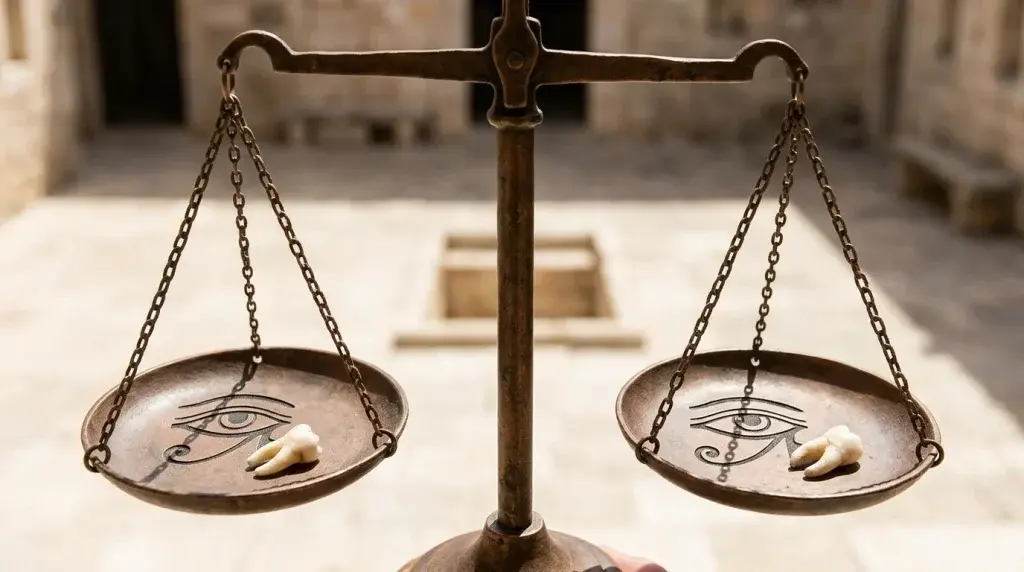
Think of it like a scale. On one side sits the harm done. On the other side sits the punishment. The two sides should weigh the same. If the punishment is heavier, the scale tips too far, and the rule is broken.
Here is a simple example. Imagine two kids on a playground. One kid knocks over the other kid’s block tower. Under the idea of “an eye for an eye,” the second kid could knock over the first kid’s tower. That is equal. But if the second kid broke the first kid’s toy, that would be too much.
Most people today do not take the phrase word for word. They use it as a short way to talk about revenge, fairness, or getting what you deserve. You might hear it in sentences like “That’s just an eye for an eye” or “I believe in an eye for an eye.”
Where Did the Phrase Come From?
The idea is very old. It did not start with one person or one book. Many ancient societies had rules that matched punishment to harm.
One of the oldest examples is the Code of Hammurabi. Hammurabi was a king of Babylon, a city in what is now Iraq. His laws were written down about 3,700 years ago, around 1754 BC. One law says that if a man destroys the eye of another man of the same rank, his own eye shall be destroyed. Other laws follow the same pattern for broken bones and teeth.
But here is a detail many people miss. The Code of Hammurabi did not treat everyone the same. If the person harmed was a lower-class worker or a slave, the punishment was often a fine instead of a body injury. So “equal payback” mostly applied between people of the same rank.
The Latin name for this idea is lex talionis, which means “the law of retaliation.” You may see this term in law books and history classes. It simply describes the rule of matching punishment to the harm done.
Why did ancient people need such a rule? Back then, there were often no police or courts the way we have them now. If someone hurt your family, you might take revenge on your own. Revenge often went too far. One hurt turned into two, then four, and whole families could end up fighting for years. A rule that said “only take what was taken from you” helped keep the peace.
Eye for an Eye in the Bible
Most English speakers know the phrase from the Bible. It appears in three places in the Old Testament.
In the book of Exodus, chapter 21, the law lists payments for injuries. It says “eye for eye, tooth for tooth, hand for hand, foot for foot.” In Leviticus, chapter 24, the same idea appears again, saying a person who injures a neighbor should receive the same injury. In Deuteronomy, chapter 19, the rule is used for people who lie in court. If a witness lies to hurt someone, the witness gets the punishment they wanted for the other person.
Notice how the rule was used. It was a guide for judges and courts. It was not permission for regular people to hit back whenever they felt angry.
Many Jewish teachers and scholars, over many centuries, explained that this rule meant money. In the Talmud, an ancient collection of Jewish teachings, rabbis wrote that a person who harms another must pay for the damage. This includes payment for pain, medical bills, lost work, and shame. So in Jewish tradition, the phrase is usually understood as fair payment, not literal body-for-body punishment.
Later, in the New Testament, Jesus brought the phrase up in the Sermon on the Mount. In Matthew, chapter 5, he said people had heard “an eye for an eye,” but he told them not to fight back against someone who hurts them. He gave the well-known example of turning the other cheek. For many Christians, this teaching changed how the phrase is viewed. It moved the focus from payback to forgiveness.
How Different Religions and Cultures View the Idea
The idea of matched punishment is not limited to one faith. Many cultures have thought about it.
In Islam, the Quran mentions a similar rule in Surah 5, verse 45. It describes life for life, eye for eye, and so on. The same passage also says that forgiving the person who did harm is a good act. In Islamic law, the family of a victim can often choose between asking for punishment, accepting payment, or forgiving. Details differ across countries and schools of thought.
Hindu and Buddhist teachings often stress non-violence and letting go of anger. The famous idea of “ahimsa,” which means not harming others, shaped leaders like Mahatma Gandhi. A saying often linked to Gandhi goes: “An eye for an eye makes the whole world blind.” Historians have not found solid proof that he said these exact words, so it is best to say the line is “often credited to him.” Still, the message is clear. If everyone takes revenge, everyone ends up hurt.
The table below gives a quick look at how the idea shows up in different places.
| Source | What It Says or Teaches | Main Focus |
| Code of Hammurabi | Matched harm between people of equal rank | Order and fairness |
| Old Testament | Punishment should match the injury | Justice in courts |
| Jewish tradition | Often understood as fair money payment | Repair and payment |
| New Testament (Matthew 5) | Do not fight back; turn the other cheek | Mercy and forgiveness |
| Quran | Matched punishment, but forgiveness is praised | Justice with mercy |
| Gandhi (attributed) | Revenge leaves everyone hurt | Non-violence |
As you can see, the same idea can lead to different lessons. Some stress fairness. Others stress forgiveness.
The Idea of Fair Punishment
Here is the part that surprises many readers. The rule was meant to limit harm, not to increase it.
Before rules like this, a person who was hurt might take much more than they lost. A stolen goat might lead to a burned house. A punch might lead to a killing. The rule of equal payback set a ceiling. It said, “You can go this far, but no farther.”
This idea is called proportionality. It means the punishment should fit the crime. Today, almost every legal system around the world uses this idea in some form. A person who steals a candy bar should not get the same punishment as a person who robs a bank. Judges look at how serious the harm was, and they try to choose a fair response.
So when people say “an eye for an eye” sounds cruel, they are partly right. But in its early form, it was a step toward fairness. It was better than endless revenge.
How to Use the Phrase Correctly
“An eye for an eye” is an idiom. An idiom is a group of words whose meaning is different from the meaning of each word alone. You do not need to be talking about real eyes at all.
The phrase works as a noun phrase. You can use it as the subject or the object of a sentence. For example, “An eye for an eye is not always the best way to solve a problem.” You can also use it with verbs like “believe in,” “follow,” or “live by.” For example, “He lives by an eye for an eye.”
The phrase is written with the articles “an” and “for an.” Keep them. Some people write it as “eye for eye,” but that version is mostly found in older translations of the Bible. In normal writing, use “an eye for an eye.”
You can also add the second half, “a tooth for a tooth.” The full phrase is sometimes used to add extra emphasis, but the short form is much more common.
Here are some sentences that show correct use.
| Sentence | What It Shows |
| “The old law was based on an eye for an eye.” | Talking about history |
| “She refused to take revenge, even though some friends said, ‘An eye for an eye.'” | Rejecting payback |
| “Some people support an eye for an eye in court cases.” | Talking about justice |
| “The two companies are stuck in an eye-for-an-eye fight.” | Describing an ongoing back-and-forth |
Notice the last example. When the phrase is used before a noun, as an adjective, writers often add hyphens: “an eye-for-an-eye approach.”
Real Life Examples
The phrase is easy to understand when you see it in everyday life.
Picture a workplace. One coworker takes credit for another coworker’s idea. The hurt coworker then tells the boss about a mistake the first coworker made. That is an eye for an eye. Each person gets back what they gave.
Here is another one. Two neighbors argue over a fence. One neighbor plays loud music late at night. The other neighbor then starts mowing the lawn at six in the morning. Each action pays back the other. Neither neighbor is happy, and the problem gets bigger.
Sports offer more examples. When a player hits an opponent hard, the other team’s player may try to hit back. Referees often step in because they know the cycle can grow out of control.
Even online, you can see this idea in action. Someone posts a rude comment, and another person answers with a rude comment of their own. Soon, everyone is trading insults.
In each case, the phrase explains the pattern: harm leads to harm. And in each case, you can also see why many wise people warn against it. Instead of fixing anything, it often keeps the fight alive.
Eye for an Eye in Modern Law and Debate
Today, courts do not take the phrase word for word. No legal system in the United States punishes someone by doing the same injury to them. Instead, judges use prison time, fines, community service, or other penalties.
Still, the old idea lives on in a softer form. It is called retributive justice. This view says people who do wrong deserve punishment, and the punishment should match the wrong. Another view is restorative justice, which focuses on repairing the harm and helping both sides heal. A third view focuses on deterrence, which means using punishment to keep others from committing crimes.
The phrase comes up often in the debate about the death penalty. Supporters sometimes say that a person who takes a life should lose their own, calling it a fair match. Opponents argue that the justice system can make mistakes and that punishment should not copy the crime. People on both sides care deeply about this topic, and good, thoughtful people disagree.
It also appears in talks about war and national defense, where leaders must decide how to respond to attacks. Some say a strong answer prevents future harm. Others say a balanced answer stops a cycle of revenge.
Because this topic is sensitive, it helps to remember that the phrase is a short way to point at a big idea. It cannot settle the debate on its own.
Common Mistakes to Avoid
Many people misuse or misunderstand the phrase. Here are the most common problems.
The first mistake is thinking the phrase means “double the payback.” It does not. The point is equal payback. Hitting back twice as hard goes against the original idea.
The second mistake is believing the phrase always meant real, physical punishment. As you read earlier, Jewish tradition has long taught that it meant payment. Many scholars agree that actual practice often involves fines.
The third mistake is saying Jesus created the phrase. He did not. He quoted an older teaching and then gave a different way to respond.
The fourth mistake is attaching the famous “makes the whole world blind” line to Gandhi as a proven fact. As noted, the link is common but not firmly proven.
The fifth mistake is spelling. Some people write “an eye for a eye.” The correct form is “an eye for an eye,” because “eye” starts with a vowel sound.
| Mistake | Better Version |
| “An eye for an eye” | “An eye for an eye” |
| “It means pay back double.” | “It means pay back equally.” |
| “It always meant body punishment.” | “It was often understood as payment.” |
| “Gandhi definitely said it.” | “It is often credited to Gandhi.” |
Similar Phrases You May Know
English has many sayings that carry a close meaning. Some are about revenge, and some are about fair trade.
| Phrase | Meaning | Tone |
| Tit for tat | Giving back the same kind of treatment you got | Neutral to negative |
| Fight fire with fire | Using the same method as your opponent | Mixed |
| Get even | Make things equal by paying someone back | Negative |
| Payback | Revenge for something done to you | Negative |
| What goes around comes around | Bad actions will return to the doer | Warning |
| Turn the other cheek | Do not fight back; forgive instead | Positive |
“Tit for tat” is the closest match in everyday talk. It is lighter and is often used for small back-and-forth fights. “An eye for an eye” sounds heavier and more serious. People often use it when the harm is large.
“Turn the other cheek” is its opposite. If “an eye for an eye” is payback, “turn the other cheek” is peace.
Tips for Using the Phrase in Your Own Writing
If you write essays, speeches, or articles, this phrase can add strong meaning. But it works best when used with care.
Start by thinking about your readers. The phrase sounds serious, so it fits topics like justice, fairness, and conflict. It may feel too heavy for a small, silly problem, unless you are joking.
Next, be clear about which meaning you want. Giving a short hint helps readers follow you.
You can also pair the phrase with a short example. For instance: “In an eye-for-an-eye world, a rude message gets a ruder one back.” The example does the explaining, and the phrase gives the punch.
Finally, avoid using it to insult a group of people or a religion. The phrase has deep roots in several faiths. A respectful tone keeps your writing trustworthy.
FAQs
1. What is the simple meaning of “an eye for an eye”?
It means that a person who causes harm should receive the same amount of harm back. The punishment should match the wrong, no more and no less.
2. Where does “an eye for an eye” come from?
The idea is very old. It appears in the Code of Hammurabi from ancient Babylon and in three books of the Old Testament: Exodus, Leviticus, and Deuteronomy. Other ancient cultures had similar rules.
3. Does “an eye for an eye” mean revenge?
Not exactly. In its early form, it was meant to limit revenge by keeping payback equal. Today, many people use it to describe revenge in general, but the original aim was fairness.
4. What did Jesus say about “an eye for an eye”?
In Matthew 5, Jesus mentioned the old saying and then taught people not to fight back against those who hurt them. He used the example of turning the other cheek, which many Christians see as a call to forgive.
5. Is “an eye for an eye” still used in law today?
Not word for word. Modern courts do not copy the harm to the offender. But the idea of matching punishment to the crime still shapes how many legal systems work.
6. Did Gandhi really say it makes the whole world blind?
The line is often credited to Gandhi, but experts have not found clear proof. It is safer to say it is “often attributed” to him. The message is that cycles of revenge leave everyone hurt.
Conclusion
The eye for an eye meaning is easy to say but rich to explore. At its core, it means that the punishment should match the harm. It began thousands of years ago as a way to stop endless revenge and bring order to communities. Over time, teachers, leaders, and everyday people have used the phrase in different ways. Some see it as fair, some see it as harsh, and many see both sides.
Today, you can use the phrase to talk about justice, payback, or fairness. Just remember the key points: equal does not mean double, and many traditions teach mercy alongside justice. When you write or speak about it, add a clear example and a respectful tone. That way, your readers will understand you and trust what you say.

Hi, I’m Rebecca Hayes. I write faith-filled articles, healing prayers, and daily devotionals to encourage people in every season of life. My passion is helping readers find peace, hope, and strength through prayer.