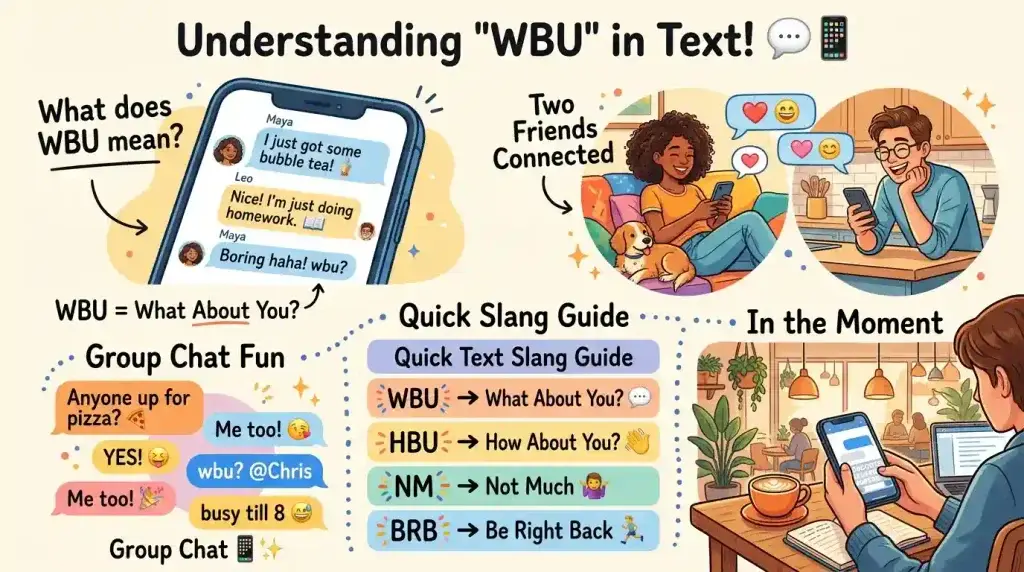
You are chatting with a friend when she sends a long message about her weekend. At the end, she adds two quick words: “wbu?” You stare at the screen for a second. What does that mean? The wbu meaning in text is simple: it stands for “what about you?”
People use it to turn a conversation back to the other person and keep it going. It shows up in texts, direct messages, and comment sections every day. Many readers search for it because it looks like a puzzle at first glance. In this guide, you will learn what it means, how to use it, how it differs from similar slang, and which mistakes to avoid. You will also find easy examples, helpful tables, and clear answers.
WBU Meaning in Text: The Quick Answer
WBU means “what about you?” It is a short, friendly way to ask someone to share their own answer after you have shared yours. For example, “I’m doing great today, wbu?” means “I’m doing great today. What about you?”
You can write it as “wbu,” “WBU,” or “Wbu.” All three are fine. Most people add a question mark at the end, but some skip it in fast texting.
It is casual slang, so it fits best in chats with friends, classmates, and people your own age. It keeps a conversation balanced, so one person is not doing all the talking.
What Does WBU Really Mean?
Let’s look at the phrase more closely. “What about you?” is a common question in spoken English. People ask it right after answering a question themselves. If someone asks, “What did you eat for lunch?” you might say, “Pizza. What about you?” The phrase hands the conversation back to the other person.
When people type, they like to save time and space. So “what about you” became “wbu,” using the first letter of each word. It is quick to type and easy to read once you know it.
WBU does more than ask a question. It also shows interest and care. When you add it to your message, you tell the other person, “I want to hear about you, too.” That is a small but kind signal in any chat.
It also keeps a chat from ending too soon. Imagine that a friend asks, “How was your day?” and you reply, “Good.” That reply is short and may leave your friend with nothing to say next. If you reply, “Good! Busy, but fun. Wbu?” you give your friend a way to keep talking.
In short, WBU does three jobs. It asks for the other person’s answer, shows that you care, and keeps the chat moving.
How to Use WBU in a Text
Using WBU is easy. You usually place it at the very end of your message, right after you share your own answer. Here is a table of common patterns.
| Pattern | Example | What It Means |
| answer + wbu | “I’m tired today, wbu?” | I’m tired. What about you? |
| answer + wbu? | “Pizza for dinner! Wbu?” | I’m having pizza. What about you? |
| short reply + wbu | “Good, wbu” | I’m good. What about you? |
| opinion + wbu | “I loved that movie, wbu?” | I loved it. What about you? |
| plan + wbu | “Heading to the mall later, wbu?” | I’m going to the mall. What about you? |
A few simple tips can help. First, always share your own answer before you use WBU. If you only type “wbu?” with nothing else, the other person may feel confused. Second, keep your message short and clear. WBU works best with quick, light chats. Third, match the mood. If you are texting a friend who seems sad, a gentle “wbu?” can show you care. But a joking tone may not fit.
Real Life Examples of WBU
Examples make slang easier to learn. Here are common moments where people use WBU.
| Situation | Example Text | Hidden Message |
| Greeting a friend | “Hey! I’m good, wbu?” | I’m fine. How are you? |
| Making plans | “I’m free Saturday, wbu?” | I’m free. Are you? |
| Talking about food | “I love tacos, wbu?” | I love tacos. What do you like? |
| Sharing music | “My favorite band is Coldplay, wbu?” | That’s mine. What’s yours? |
| Checking in | “Long day at work, wbu?” | My day was long. How was yours? |
Now let’s look at a few short stories.
Priya met a new classmate in an online group chat. She wrote, “I’m new here and kind of nervous. Wbu?” The classmate laughed and replied, “Same! Let’s be nervous together.” That small WBU opened the door to a new friendship.
Jake texted his cousin about the weekend. “I’m going to the lake with my dad,” he typed. “Wbu?” His cousin said she was heading to a soccer game, and they spent the next ten minutes sharing plans.
Maria was talking with her friend about favorite snacks. She wrote, “I can’t stop eating popcorn, wbu?” Her friend sent back three popcorn emojis and a funny story.
These stories show that WBU is useful in many moods. It can be shy, friendly, curious, or playful.
Where Does WBU Come From?
The honest answer is that nobody knows who first typed WBU. Slang like this tends to grow in everyday chats, and it is hard to trace a short abbreviation to one person or one date.
What we can say is that the full phrase “what about you” has been a normal part of English for a long time. The short form WBU grew along with texting, instant messaging, and social media, where people like to type quickly. Abbreviations like this became very common as phones and chat apps spread, and WBU is now widely understood among younger users.
It is also worth saying that some websites claim a specific start date or a famous inventor. Be careful with claims like that. A safer way to put it is that WBU grew naturally out of online talk and spread as more people used it.
For deeper research, trusted sources like Dictionary.com, Merriam-Webster, and Cambridge Dictionary can show how the abbreviation is defined and used.
WBU vs. HBU: What Is the Difference?
Many people also search for HBU, which is very close to WBU. Both are used to turn a question back to the other person. The difference is small.
WBU means “what about you?” and HBU means “how about you?” In most chats, they work the same way. You can swap one for the other, and nobody will mind.
| Slang | Full Form | Common Feel |
| WBU | What about you? | Casual, very common |
| HBU | How about you? | Casual, slightly softer |
| AYT | Are you there? | Checking if someone is online |
| IDK | I don’t know | Casual, uncertain |
| BRB | Be right back | Short break from a chat |
| TTYL | Talk to you later | Ending a chat |
| NM | Not much | Short reply to “what’s up?” |
A small tip may help here. “How about you” is often used when you are offering an idea. For example, “I’m going to the park. How about you come along?” “What about you” is more often used for simple questions, like “I’m fine, what about you?” But in texting, the two are used almost the same way.
You may also see WBU paired with NM. A friend might ask, “What’s up?” You can reply, “Nm, wbu?” That means, “Not much, what about you?” It is a classic quick exchange.
Is WBU Rude or Polite?
Is WBU polite? The answer is that it is usually friendly. Asking someone “what about you?” shows interest in their life. It says you care about the other person’s answer.
That said, tone matters. If you type “wbu” with no other words, it can feel a bit short. For example, if a friend writes a long, heartfelt message and you only reply, “ok wbu,” it may seem like you did not really read it. It helps to add a little more.
A good rule is to share your own thoughts first, then add WBU. That way, your message feels warm and complete. A friendly emoji can also help.
Also, think about who you are talking to. With close friends, WBU feels natural. With a teacher, boss, or someone you do not know well, it may feel too casual. In those cases, write out the full phrase: “What about you?” or “How about you?”
Common Mistakes to Avoid
Even short slang can trip people up. Here are the mistakes that show up most often.
The first mistake is using it in formal writing. In an email to a boss, a school paper, or a business letter, WBU looks out of place. Use the full phrase instead.
The second mistake is sending it without sharing anything first. If you only type “wbu?” the other person may not know what you are asking about. Share your answer, then add WBU.
The third mistake is mixing up the letters. Some people mix WBU with similar abbreviations like WYD (what are you doing?) or WYM (what do you mean?). Check the letters before you send.
The fourth mistake is overusing it. If every message you send ends with WBU, the chat can start to feel like a quiz. Mix it up with other questions, such as “How was your day?” or “Any plans?”
The fifth mistake is ignoring the answer. If you ask “wbu?” and your friend replies, be sure to read and respond. Asking and then going quiet can feel rude.
Last, avoid using it with people who may not know the slang. Older relatives or new English learners may need a quick explanation. A small note like “wbu means what about you” can help.
How People Use WBU Today
Today, WBU shows up in many places. Knowing where can help you spot it and use it well.
In text messages, it is one of the most common ways to return a question. Friends use it when talking about their day, their plans, their food, and their moods.
On social media, you may see it in direct messages and comment replies. People use it to keep a friendly back-and-forth going under a post.
In gaming chats, players use it for quick check-ins. Someone might type, “Ready to play, wbu?” and get a fast answer.
In dating apps and new friendships, it is a simple way to show interest. Asking “wbu?” After sharing a fact about yourself, tell the other person that you want to know more about them.
One small trend is worth noting. As people text more and talk less, short, friendly questions like WBU have become a common way to show kindness in a quick message. They save time while still keeping the chat warm.
Tips for Using WBU Naturally
If you want to use WBU like a pro, a few easy habits will help.
Share first, then ask. Give your own answer, then add WBU at the end.
Keep it friendly. A smile emoji or a kind word can make the question feel warm.
Use it with friends and peers. It fits best in casual chats, not in serious messages.
Do not overuse it. Using it once in a while keeps the chat fresh.
Follow up on the answer. When the other person replies, respond with interest. That keeps the chat real.
Match your reader. If you are texting someone who may not know the slang, write out “what about you?” the first time.
Finally, read your message before you send it. If it sounds like something you would say out loud to a friend, you are probably using it well.
FAQs
What is the simple wbu meaning in text?
It means “what about you?” People use it to ask someone to share their own answer after they have shared theirs.
Is WBU the same as HBU?
They are very close. WBU means “what about you?” and HBU means “how about you?” Most people use them in the same way.
Can I use WBU in a work email?
It is better to avoid it in formal or work emails. Write out “What about you?” or “How about you?” instead. In a casual chat with a close coworker, it may be fine.
Is WBU capitalized or lowercase?
Both are fine. Many people write it in lowercase, like “wbu,” because it feels relaxed. Uppercase “WBU” is also common.
How do I reply to WBU?
Just answer the question you were asked. If a friend says, “I’m good, wbu?” you can say, “I’m good too, just tired.” You can even send WBU back to keep the chat going.
Is WBU rude if I use it alone?
It is not rude, but it can feel short. It is friendlier to share your own answer first, then add WBU at the end.
Conclusion:
The wbu meaning in the text is easy to remember: it stands for “what about you?” People use it to hand a question back to the other person, show interest, and keep a chat flowing. It is casual, quick, and friendly, which is why it appears in so many texts and messages.
We also learned that it is close to HBU, that it works best with friends, and that the exact origin of the abbreviation is hard to trace. It is smart to keep it out of formal writing and to share your own answer before you use it.
So here is some practical advice. Use WBU when you want to show that you care about the other person’s side of the story. Add a little warmth, listen to the reply, and do not overdo it. Try it in your next chat with a friend, and see how naturally the conversation grows.

Hello, I’m Clara Whitmore. I write daily prayers, devotionals, and faith-based reflections for readers seeking peace and encouragement. I believe prayer has the power to heal hearts and renew faith.