The chalk it up meaning is simple. To “chalk it up” means to explain something by blaming it on a cause, or to count it as a certain kind of experience. You might hear, “Just chalk it up to bad luck.” People say it when they want to let a mistake go and move on. Many readers search for this phrase after hearing it in a movie, at work, or from a friend.
The words sound a bit odd, since chalk is something we use on sidewalks and chalkboards. So why does it show up in everyday talk? In this guide, you will learn what the phrase means, how to use it, where it came from, and which mistakes to avoid. You will also see real examples and get answers to six common questions.
Quick Answer: Chalk It Up Meaning
“Chalk it up” is an idiom. It means to credit something to a cause or to treat an event as a certain type of experience. If your team loses a game, you might say, “Let’s chalk it up to a bad day.”
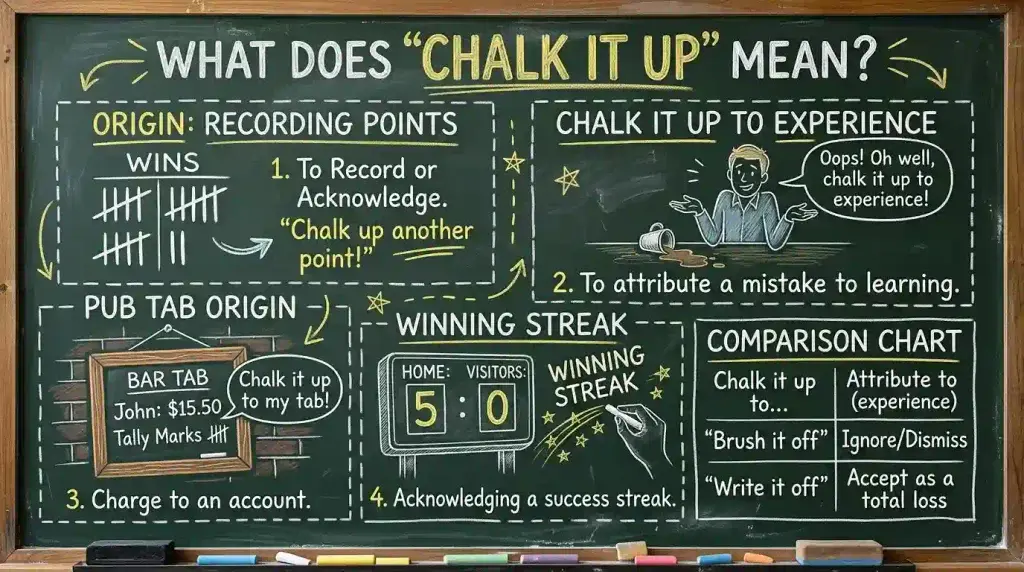
It also has a second use. Sometimes it means to add a point or a win to a score, as in “She chalked up her fifth win this season.” Both uses come from the same old habit of keeping score with chalk.
The Full Meaning of Chalk It Up
Let’s look at the phrase in more detail. An idiom is a group of words that means something different from the words alone. If you did not know the idiom, you might picture a person drawing on a wall. That is not the idea at all.
The most common meaning is “to blame or credit something to a cause.” The phrase usually comes with the word “to.” For example, “I chalk my success up to hard work.” Here, you are saying hard work is the reason for your success.
The second meaning is “to accept something as a lesson or an experience.” When you say, “Chalk it up to experience,” you mean, “That went badly, but I learned something, so let’s move on.” This version has a gentle, forgiving feel. It tells you not to be too hard on yourself.
The third meaning is “to score or earn.” A runner might chalk up a new record. A shop might chalk up big sales. Here, the phrase simply means to add to a total.
All three meanings carry the same picture: a mark gets added to a tally, and the matter is recorded.
Where Did the Phrase Come From?
The best-known story is about keeping a tab. In old pubs and shops, owners often wrote down what a customer owed on a slate or board with chalk. When the customer was ready to pay, the marks were counted. Saying “chalk it up” meant “add it to my bill.”
Over time, people used the same words for more than money. Scores in games were also tallied with chalk, which is why the phrase works for points and wins. Later, the meaning grew to cover reasons and lessons.
This history is widely repeated in dictionaries and word guides. Still, language experts point out that the exact first use is hard to prove, so it is best to treat the story as the most likely source and not as a perfect record.
How to Use Chalk It Up in a Sentence
The phrase is flexible. It works in several shapes, and each has its own pattern.
The first pattern is “chalk it up to” followed by a cause. For instance, “We’ll chalk the delay up to the storm.” You can also put the object in the middle, as in “chalk this up to bad timing.”
The second pattern is “chalk up” followed by a score or result. For example, “The team chalked up three goals in the first half.” No “to” is needed here.
The third pattern is “chalk it up to experience.” This is a set phrase, and it is very common. It means you are accepting a loss or mistake as a lesson.
Notice that the phrase is a phrasal verb, which means a verb plus a small word that changes the meaning. The verb changes form with time. You can say “chalk,” “chalks,” “chalked,” and “chalking.” If the person did it yesterday, you say, “He chalked it up to nerves.”
Real Life Examples of Chalk It Up
Seeing the phrase in daily life makes it easier to remember. Here are some everyday examples.
| Sentence | What It Means |
| “I burned the toast. I’ll chalk it up to a sleepy morning.” | I’ll blame it on being sleepy |
| “He missed the bus, but he chalked it up to experience.” | He accepted it as a lesson |
| “She chalked up ten wins in a row.” | She earned ten wins |
| “Let’s chalk the mix-up up to a simple mistake.” | Let’s say it was a simple mistake |
| “The company chalked up record sales this year.” | The company reached record sales |
| “I chalk my good grades up to my study group.” | I credit my study group for my grades |
Here is a short chat that shows the idea.
Sam says, “I forgot my lunch again. I feel silly.”
Priya answers, “Don’t worry. Chalk it up to a busy week.”
Sam smiles and says, “Fair point. I’ll pack two lunches tomorrow.”
Priya’s words are kind. She gives Sam an easy reason for the mistake, and that helps him relax.
Chalk It Up to Experience: A Closer Look
This version deserves its own space because it is the form people search for most. “Chalk it up to experience” is what you say after a loss that cannot be fixed.
Say you bought a used bike, and it broke after one week. The seller will not refund your money. You might sigh and say, “Well, I’ll chalk it up to experience.” That means, “I lost out this time, but I now know what to check next time.”
The phrase can sound a little sad or tired. It often follows a disappointment. Yet it also carries hope, since it points to learning. That is why it is popular in sports, school, work, and money talk.
A small warning: it can sound cold if you use it when someone is truly hurt. If a friend loses a job or a pet, saying “Just chalk it up to experience” may feel dismissive. In sad moments, kind and caring words work better.
Chalk It Up vs. Similar Phrases
Many other phrases are close to “chalk it up,” but each has a slightly different feel.
| Phrase | Meaning | How It Differs |
| Put it down to | Name the cause | More common in British English |
| Write it off | Treat as a loss or a failure | Feels more final and negative |
| Attribute to | Credit to a cause | More formal and serious |
| Blame on | Name who or what is at fault | Always has a negative tone |
| Mark it down | Record or note | Often about writing things down |
“Chalk it up” is warmer and more casual than “attribute to.” It is also gentler than “blame on,” because it often means to let things go without anger.
“Write it off” is a good phrase to compare. When you write something off, you give up on it. When you chalk something up, you accept it and often keep trying.
British vs. American English
Both American and British speakers know the phrase “chalk it up.” It is easy to understand on both sides of the ocean. However, there is a small difference in what people pick first.
In American English, “chalk it up to” is very common, especially in casual talk and in news stories about sports. In British English, many speakers also say “put it down to” for the same idea. You may hear both in the UK, and either one is correct.
The spelling does not change. The word “chalk” is spelled the same way in both countries. The only change is how often each phrase appears in daily speech.
Common Mistakes People Make
Even an easy phrase can be tricky. Here are the mistakes you will see most often.
The first mistake is leaving out “to” when naming a cause. “I chalk it up bad luck” sounds wrong. The right form is “I chalk it up to bad luck.”
The second mistake is mixing up the meanings. If you say, “He chalked up the test,” people may be confused. You need a result, such as “He chalked up a high score on the test.”
The third mistake is spelling the word “chock” or “chok.” Chalk has an “l” that is silent when you say it out loud. Many people forget it when typing.
The fourth mistake is using the phrase in a serious setting without thinking. For a deep loss, a gentle phrase like “chalk it up” may feel too light.
The fifth mistake is thinking it only means blame. In many sentences, it means credit or a plain score, not fault.
Current Usage and Trends
The phrase is still very much alive. You can find it in news stories, sports reports, business updates, and casual talk. Reporters like it because it is short and clear.
You may also see it on social media. A person might post, “Missed my train again. Chalk it up to Monday.” The short style fits well with online talk.
The phrase is not a slang term that will fade quickly. It has been around for a long time, and it keeps its place because the meaning is helpful and easy to picture.
Tips for Using Chalk It Up Well
A few simple habits will help you use the phrase with confidence.
Match the tone. Use it for small problems, light mistakes, and moments when you want to move on. Skip it when someone is grieving or truly upset.
Pick the right pattern. Use “chalk it up to” for reasons and “chalk up” for scores. That one rule solves most confusion.
Keep it natural. One use in a short message is plenty. Too many idioms in a row can make writing feel heavy.
Think about your reader. If you write for learners of English, add a short note or a simple example. Idioms can be hard for new speakers because the words do not match the meaning.
Lastly, remember the helpful idea behind the phrase. It reminds us that mistakes happen, and we can count them as lessons instead of dwelling on them.
FAQs About Chalk It Up Meaning
What does chalk it up mean?
It means to credit something to a cause or treat it as a certain experience. It can also mean to add a point or win to a score.
What does “chalk it up to experience” mean?
It means you accept a loss or mistake and treat it as a lesson. You do not stay upset, and you try to do better next time.
Is chalk it up an idiom?
Yes. An idiom has a meaning that is different from its separate words. Chalk it up does not mean to draw with chalk. It means to explain, credit, or score.
Where does the phrase come from?
Most word guides trace it to the old habit of marking debts and scores with chalk on a board. The exact first use is hard to prove.
Can I say “chalk up” without “to”?
Yes. When you mean to earn a score or result, you do not need “to.” For example, “She chalked up another win.”
Is chalk it up formal or casual?
It is mostly casual, though it appears in news and business writing too. In very formal papers, “attribute to” may be a better choice.
Conclusion
So, what does ” chalk it up meaning? It means to credit something to a cause, accept it as an experience, or add to a score. The phrase comes from the old habit of keeping tallies with chalk, and it still feels warm and friendly today.
You have seen how to use it in three main patterns, how it compares with similar phrases, and which mistakes to avoid. The key points are easy to remember. Use “to” when naming a cause. Skip it when talking about a score. Save the phrase for light moments, not for deep sorrow.
Next time something goes wrong, try it yourself. A calm “Chalk it up to experience” can turn a bad moment into a small lesson, and that is a good way to keep moving forward.

Hi, I’m Rebecca Hayes. I write faith-filled articles, healing prayers, and daily devotionals to encourage people in every season of life. My passion is helping readers find peace, hope, and strength through prayer.