The 🙂↔️ meaning is easy to learn. It is the “head shaking horizontally” emoji, and it shows a smiling face moving side to side. In most chats, it means “no,” “I disagree,” or “I can’t believe it.” Many people search for it after seeing it in a message and feeling unsure. Is the sender being rude? Are they joking? Or are they just shaking their heads in a friendly way? The answer depends on the situation. In this guide, you will learn what the emoji means, how it works, where it came from, and when to use it. You will also see real examples, common mistakes, and answers to six popular questions.
Quick Answer: What Does 🙂↔️ Mean?
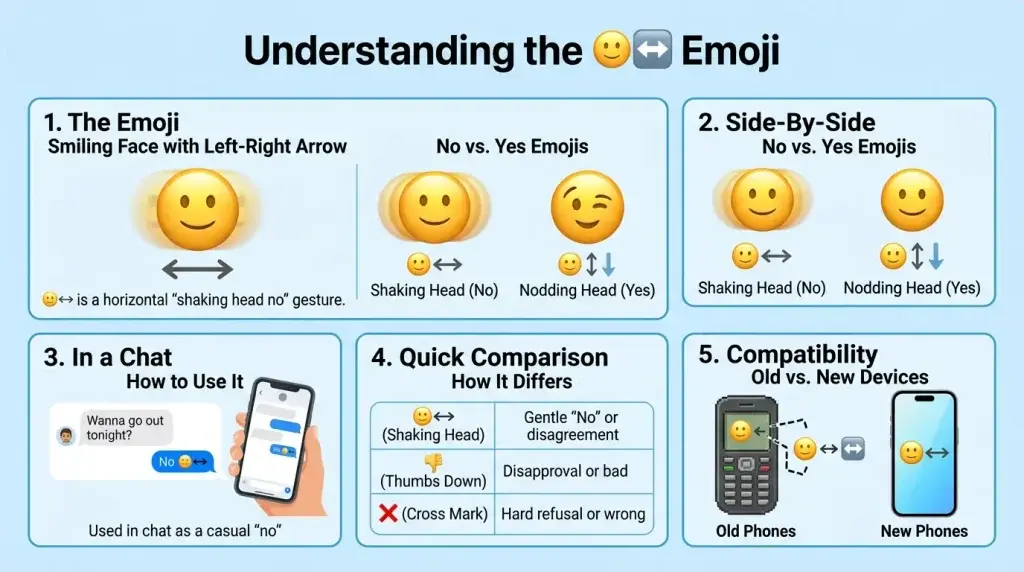
The 🙂↔️ emoji means “no,” “nope,” or “I disagree,” said with a calm face. It can also mean “I can’t believe it” or “that’s not right.” The smile keeps the mood light, even when the message is a refusal.
Its official name is “head shaking horizontally.” Think of a person gently moving their head from left to right. That is the same move we make when we say no without using words.
The Full Meaning of 🙂↔️
Let’s look closer at what this little face says. Most emoji show a feeling, like joy or anger. This one shows an action. The action is a head shake, and a head shake can carry a few different messages.
The first message is “no.” If a friend asks, “Want to go out in the rain?” you can reply with 🙂↔️ and they will understand right away. It is short, clear, and polite.
The second message is “I disagree.” If someone says something you do not agree with, the emoji works like a soft “I don’t think so.” It is gentler than a flat “wrong.”
The third message is “I can’t believe it.” Sometimes we shake our heads when something is silly, shocking, or too funny. The emoji fits those moments well. A friend might send a story about a pet doing something goofy, and you reply with 🙂↔️ and “Unreal.”
The fourth message is “that’s a shame” or “oh well.” Here, the head shake shows mild disappointment. The smile says, “It’s fine, but not great.”
What makes this emoji special is the mix of a smile and a head shake. A frowning face with a head shake would sound upset. A smiling face with a head shake sounds calm, playful, or kind.
How the Emoji Is Built
This emoji is a bit unusual. It is made from two pieces joined together. The first piece is the slightly smiling face 🙂. The second is a left-right arrow ↔️. Between them sits a hidden joiner, called a zero width joiner, which tells your phone to combine the two into one picture.
Emoji makers use this trick often. For example, many family and job emoji are made by joining smaller emoji. It lets a small set of symbols build many new ones.
Your phone does the work for you. You just pick the emoji from the keyboard, and it appears as one smiling face with little motion lines. You do not need to type the pieces by hand.
| Part | What It Looks Like | Job in the Emoji |
| Slightly smiling face | 🙂 | Shows the calm, friendly face |
| Hidden joiner | (not visible) | Links the face and the arrow |
| Left-right arrow | ↔️ | Shows side-to-side movement |
Where the Emoji Came From
The head shaking emoji is fairly new. It was approved in 2023 as part of Emoji 15.1, which is a set of new emoji released by the Unicode Consortium. This group is the nonprofit that decides which emoji exist and how they are named.
Phones do not get new emoji right away. After Unicode approves a set, companies like Apple, Google, and Samsung must draw their own versions and add them in software updates. That is why some people saw the emoji in 2024, while others got it later. Exact dates change from one brand to the next, so it is best to check your own device.
Before this emoji existed, people had to use other faces to say “no.” They might send a frowning face, a shrug, or a thumbs down. None of these showed the head shake itself. The new emoji filled that gap.
Its Twin: The Head Nodding Emoji
The head shaking emoji has a partner. It is called “head shaking vertically,” and it looks like 🙂↕️. Instead of a side-to-side arrow, it has an up-and-down arrow. It shows a nod, which means “yes.”
Together, the two emoji make a pair. One says no, and the other says yes. Both use the same calm smiling face, so they feel like they belong together.
This pair helps with quick replies. A friend asks, “Are you coming?” You can answer with a nod or a shake and nothing else. It keeps chats fast and friendly.
Real Life Examples of 🙂↔️ in Messages
The best way to understand an emoji is to see it in action. Here are some common ways people use it.
| Message | What It Means | Mood |
| “Did you finish your homework? 🙂↔️” | No, I did not | Funny, a little guilty |
| “He said pineapple is the best pizza 🙂↔️” | I disagree with that | Playful |
| “Can you lend me $50? 🙂↔️” | No, sorry | Polite but firm |
| “She forgot her keys again 🙂↔️” | Can you believe it? | Amused |
| “Is the test easy? 🙂↔️” | No, it is hard | Honest |
| “Missed the bus by one minute 🙂↔️” | What bad luck | Tired but calm |
Here is a short chat to show how it might look.
Lena writes, “Did you wake up early today?”
Marcus replies with 🙂↔️ and adds, “I slept until ten.”
Lena answers, “Ha! Me too.”
In this chat, the emoji says “no,” and the smile tells Lena that Marcus is not upset. It is a small joke about sleeping in.
How to Read the Tone
An emoji can sound different from one person to the next. So how do you know what the sender means?
Start with the words around it. If the message has kind or funny words, the emoji is likely friendly. If the message has hard words, the emoji may sound sharp or sarcastic.
Next, think about who sent it. A close friend or family member often uses it in a joking way. A stranger or a coworker may use it to be polite but clear.
Then look at the topic. Light topics, like food, games, or small mistakes, call for a playful reading. Serious topics, like money or a real problem, can make the emoji feel cold or dismissive.
Finally, notice the smile. Some people use a smiling face to hide strong feelings. A smile mixed with a head shake can sometimes mean “I’m annoyed, but I’m staying calm.” This works best between people who know each other well, since a stranger may not catch the hint.
If you are not sure, you can always ask. A quick “Do you mean no?” clears things up fast.
🙂↔️ vs. Other “No” Emoji
You have many ways to say no in emoji. Each has its own feel, so it helps to know the difference.
| Emoji | Name | Feel |
| 🙂↔️ | Head shaking horizontally | Calm, friendly, soft no |
| 👎 | Thumbs down | Clear dislike or disapproval |
| 🙅 | Person gesturing no | Strong, direct refusal |
| ❌ | Cross mark | Wrong, not allowed, or canceled |
| 🤷 | Person shrugging | Not sure, don’t know |
| 😑 | Expressionless face | Bored, unimpressed |
The head shaking emoji is the gentlest of these. It says no without sounding angry. The thumbs down feels harsher, and the cross mark feels like a rule or a final answer.
Pick the emoji that fits your mood. If you want to be kind, the head shake is a great choice. If you need to be very clear, the person gesturing no may work better.
What If You See Two Symbols Instead of One?
Sometimes, the emoji does not show up as one picture. Instead, you may see a smiling face followed by a small arrow, like 🙂 ↔️. This happens when a phone or app is too old to know the new emoji.
Since the emoji is made of two parts, an older device shows each part by itself. It cannot join them. The meaning gets lost, and the message can look strange.
There is an easy fix. Update your phone’s software, and the emoji should appear correctly. Also, keep in mind that the person you text may have an older phone. If they send you a message with a smiley and an arrow, they might have meant the head shake.
This is also why you should not rely on this emoji alone for something important. If the message matters, add a few words so nobody is confused.
Common Mistakes People Make
Even a tiny emoji can cause trouble. Here are the mistakes you will see most often.
The first mistake is thinking it means “I’m confused.” It does not. A confused face usually has a tilted head or a question mark. The head shake means “no” or “I disagree.”
The second mistake is mixing it up with the nodding emoji. The side-to-side arrow means no. The up-and-down arrow means yes. Looking closely at the arrow can save you from a mix-up.
The third mistake is using it in serious moments. If someone shares sad news, a smiling face with a head shake can look like you do not care. Words are better in those cases.
The fourth mistake is using it for formal messages. For work emails or school notes, plain writing is safer. A calm “I disagree” is clearer than any emoji.
The fifth mistake is sending it alone and hoping people will guess. A short note like “Nope, can’t make it” makes your message easy to read.
Current Usage and Trends
Since the emoji is still new, people are still working out how to use it. Right now, you will see it most often in friendly chats, comments, and short videos.
Many people use it to joke about small problems. A person might post a picture of a messy room with 🙂↔️ to say, “Not great, but we move on.” Others use it to answer a question without typing, such as “Did the cat stay off the couch?”
It is also popular as a reaction. Under a funny or silly post, a head shake can mean “I can’t believe this,” in a good way. In that case, it works like a laugh.
Because it is so new, its meaning may grow over time. Emoji often take on fresh uses as more people send them. For now, “no,” “I disagree,” and “can’t believe it” are the main ideas, and these are safe to use.
Tips for Using 🙂↔️ the Right Way
A few simple habits will help you use this emoji well.
Think about your reader first. With close friends, a head shake feels natural. With a boss or a teacher, you may want to use words instead.
Pair the emoji with a short message. A line like “Not today 🙂↔️” is much clearer than the emoji alone.
Match the mood. The smile makes it gentle, so use it for light topics. For serious ones, write your thoughts in full sentences.
Do not overuse it. One head shake in a message is plenty. Too many emoji can make a message hard to read.
Last, be ready to explain. Since the emoji is new, a friend may not know it yet. A quick, kind answer helps everyone stay on the same page.
FAQs About the 🙂↔️ Meaning
What does the 🙂↔️ emoji mean?
It means “no,” “I disagree,” or “I can’t believe it.” It shows a smiling face shaking its head from side to side, so the message feels calm and friendly.
What is the official name of the 🙂↔️ emoji?
Its official name is “head shaking horizontally.” It was approved in 2023 as part of Emoji 15.1 by the Unicode Consortium.
Is the 🙂↔️ emoji rude?
Usually not. The smile makes it soft and polite. Still, it can sound sarcastic or cold if you send it during a serious talk, so use it with care.
What is the difference between 🙂↔️ and 🙂↕️?
The side-to-side arrow shows a head shake, which means “no.” The up-and-down arrow shows a nod, which means “yes.”
Why does 🙂↔️ look like two emoji on my phone?
Your device may be too old to join the two parts. It shows the smiling face and the arrow separately. Updating your phone’s software usually fixes this.
Can I use 🙂↔️ at work?
It depends on your workplace. In a casual team chat, it may be fine. In formal emails or notes to a boss, clear words are a safer choice.
Conclusion
So, what is the 🙂↔️ meaning? It is a smiling face shaking its head, and it usually says “no,” “I disagree,” or “I can’t believe it.” The smile keeps the message soft, which is why people like it for small refusals and playful reactions.
You now know how the emoji is built, where it came from, and how it differs from similar ones. You also know that older phones may show it as two symbols, and that it pairs with the nodding emoji, which means “yes.”
The best advice is simple. Use the head shake with friends and light topics. Add a few words when your message matters. And when the subject is serious, choose kind, clear sentences over any emoji.

Hi, I’m Elias Monroe. I enjoy writing meaningful prayer content that helps people feel calm, hopeful, and spiritually strong. My goal is to share words that bring comfort during both joyful and difficult times.