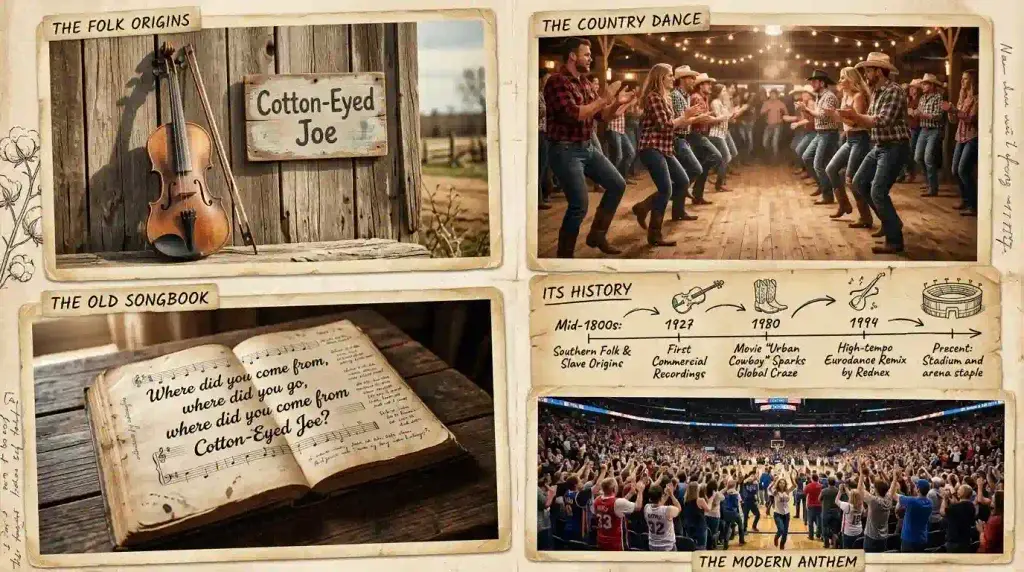
You are at a wedding, a ball game, or a country dance hall. The fiddle kicks in, and suddenly everyone is stomping and clapping. But if someone asked what it actually means, could you answer? The cotton eyed joe meaning is a real puzzle.
The song tells of a mysterious man who comes between a singer and their sweetheart. In this guide, you will learn the story, the main theories, the song’s history, and the famous dance. You will also find easy tables and clear answers.
Cotton Eyed Joe Meaning: The Quick Answer
“Cotton Eyed Joe” is an old American folk song about a mysterious man named Joe. In most versions, he is the reason the singer never got to marry their love. Nobody knows for sure who he was.
The words “cotton-eyed” have no proven meaning. Popular ideas include eyes turned milky white, eyes with a very pale color, or someone drunk on cheap liquor. There is no evidence for the urban legend that the song is about a sexually transmitted disease.
So the safest answer is this: the song is a story about a rival, and “cotton-eyed” is a mystery that history has not solved.
What Is the Story of the Song?
Let’s start with the plot, because it is simpler than the title. The story is a classic tale of love and loss.
In most versions, a heartbroken narrator loses their sweetheart to a mysterious charmer, and says that without Joe, they would have been married long ago. That is the heart of it. A person is hurt, and they blame Joe.
The song then asks Joe a question, over and over. Where did you come from? Where did you go? It sounds half angry and half curious. The narrator seems to want answers from a man who turned up, changed everything, and vanished.
One summary calls Joe a charmer who had the singer under his spell. That fits the feel of the tune. It is bouncy, but the story underneath is a little sad.
This mix of a happy beat and a sad story is common in folk music. Many old songs hide troubles inside lively tunes. It made them easy to dance to, and easy to remember.
What Does “Cotton-Eyed” Mean?
This is the question that brings most people to this topic. The honest answer is that no one knows for sure. Several theories exist, and each has fans. This table lists the most common ones.
| Theory | What It Says | How Strong Is the Evidence? |
| Drunk on moonshine | “Cotton-eyed” describes someone who drank too much illegal liquor | A popular idea, not proven |
| Blinded by bad alcohol | Wood alcohol (methanol) can turn eyes cloudy white and cause blindness | Popular idea, not proven |
| Very pale eyes | A person with unusually light-colored eyes | Possible, not proven |
| Eye illness | A disease that makes eyes look cloudy or white | Possible, not proven |
| A sexually transmitted disease | The name is a hidden code for an illness | Little evidence |
Many of the leading ideas involve drunkenness, including being drunk on moonshine, or going blind from wood alcohol that turns the eyes a milky white. The cotton comparison fits, because cotton is white and soft, and a cloudy eye can look that way.
Another idea is that the name may have first described a Black man with unusually light-colored eyes, which fits the song’s likely beginnings on plantations. Because the history is so old, it is hard to prove which theory is true.
One more theory deserves a clear answer, because it spreads online. Some people say the song is secretly about a disease. Experts note that there is little evidence to support this theory. It is best treated as an urban legend.
The main lesson is that “cotton-eyed” is a puzzle. It is fine to enjoy the song without choosing one answer.
Where Does Cotton Eyed Joe Come From?
The history of this song is long, and it is mostly hidden. It began as a folk song that spread through the American South in the 1800s, and the person who first wrote or played it is unknown.
Folk songs often work this way. They pass from person to person, change a little each time, and may never have one single author. By the time anyone wrote them down, the tune had already traveled for years.
The song spread across the southern states, especially among enslaved people, as music to sing and dance to. This history is important. It means the song grew out of hard times, and that it carries stories shaped by the lives of people who were enslaved.
Writers who collected old songs helped save versions of it. Texas-born collector Dorothy Scarborough included a version in her 1925 book, and Thomas Talley, the son of formerly enslaved people from Mississippi, shared another version in his book Negro Folk Rhymes.
In Talley’s version, Joe is both a person and a dance. One line suggests the narrator might have died years ago if not for dancing the Cotton Eyed Joe, and the song ends with Joe having been sold down south, which hints that he was enslaved. That detail adds a serious layer to a song most people know as fun.
Because the history is murky, be careful with websites that claim an exact date or a single inventor. The honest summary is that the song grew over time in the American South, and many people shaped it.
A Timeline of the Song’s Journey
This table gives a simple look at how the song traveled from old folk tune to worldwide hit. Dates are included only where sources support them.
| Time | What Happened | Notes |
| 1800s | Song circulates in the American South | Origins unknown |
| Early 1900s | Versions are collected and written down | Collectors helped save them |
| 1922 | Talley publishes a version in a folk rhyme book | Joe appears as a person and a dance |
| 1925 | Scarborough includes a version in her book | Features the jilted narrator |
| 1967 | Al Dean records an instrumental version | Linked to a popular polka dance |
| 1994 | Rednex releases a dance version | Becomes a huge hit |
By the early 1900s, as recorded music grew, it was already a widely known folk song. That shows how deeply it had spread before pop music came along.
There have been an estimated 130 or more recorded versions since 1950. That is a lot of covers for one old tune.
The Rednex Version and the 1990s Hit
For many younger people, the first time they heard the song was through the 1990s dance version. A Swedish group called Rednex released its cover on August 12, 1994, and it brought the song back to massive popularity.
It may seem strange. A Swedish dance act singing an old American folk tune? But the mix worked. The fast fiddle sounds and the pounding beat made it perfect for clubs, parties, and sports crowds.
The marketing was also unusual. The producers named their group Rednex and hired five performers to play the band in interviews. In other words, the band image was part of the show.
This version changed how many people hear the song. The fun, fast energy took center stage. For some listeners, the older story about a lost love faded into the background. That is a normal thing that happens when folk songs become pop hits. The tune lives on, but the original context can get lost.
The Cotton Eyed Joe Dance
Many people know “Cotton Eyed Joe” as a dance, not just a song. It is popular at country dance halls, school events, weddings, and parties.
The dance is usually lively and social. People dance in lines or pairs, kick, stomp, and spin to the beat. Because the steps are easy to learn, even beginners can join. That is a big reason the song stays popular.
Al Dean’s 1967 instrumental recording is said to have inspired a polka dance. Over time, different groups developed their own styles, so the steps may vary from place to place.
| Setting | How the Dance Is Used |
| Country dance halls | A fast partner or line dance |
| Weddings | A fun group dance for all ages |
| School events | An easy dance to teach together |
| Sports games | A song to get crowds moving |
| Parties | A famous party song with a simple beat |
If you want to try the dance, start with the basic rhythm, then follow the crowd. Most people at a party are happy to help a newcomer.
The dance side of the song shows how folk music can keep changing. A story about heartbreak became a way for people to laugh, move, and share a joyful moment.
The Fiddler Legend
Some old tales add another twist. In one story collected by Thomas Talley, called “Cotton-Eyed Joe, or the Origin of the Weeping Willow,” Joe is a fiddler whose violin was made from his dead son’s coffin.
That story is much darker than the party song. It shows how folk legends can be very different from each other. One version has a rival in love. Another has a sad, strange fiddler.
This variety is one reason historians say the song has no single, correct version. Each community told its own story. The common thread is a man named Joe who is mysterious, memorable, and a little bit magical.
When you hear the song at a party, it is fun to remember that the old stories were not always cheerful. Folk traditions often mix humor, sadness, and mystery.
Cotton Eyed Joe in Everyday Language
Sometimes people use “Cotton Eyed Joe” as more than a song title. The name can show up in a few ways.
| Use | Example | Meaning |
| Song title | “They played Cotton Eyed Joe.” | The song itself |
| Dance name | “Let’s do the Cotton Eyed Joe.” | The line or partner dance |
| Nickname | “He’s a real Cotton Eyed Joe.” | Jokingly, a mysterious or odd character |
| Pop culture joke | “Where did you come from?” | A playful nod to the chorus |
The nickname use is casual and rare. If someone calls a person “Cotton Eyed Joe,” it is usually a joke. Be careful, though. Because “cotton-eyed” may relate to eyes or illness in some theories, using it to tease a real person could be unkind. It is best to keep it for the song.
Common Mistakes and Myths
Because the song is so old, many myths float around. Here are the most common ones.
The first myth is that the song is definitely about a disease. As we saw, there is little evidence for this. It is best to say that it is an urban legend.
The second myth is that “cotton-eyed” has one proven meaning. It does not. Several theories exist, and none is confirmed.
The third myth is that the song began with the 1990s dance hit. In reality, it is a much older folk song from the 1800s. The 1990s version was a cover.
The fourth myth is that one person wrote it. Like many folk songs, it has no known author.
The fifth mistake is ignoring the history. The song’s early life among enslaved people in the South is an important part of its story. It deserves respect, not just party fun.
Last, avoid trusting every website. Many pages repeat guesses as facts, and some use made-up details. Trusted sources, like music history sites and folklore books, are better.
Why Does the Song Stay So Popular?
A song that is nearly two hundred years old, or even older, is rare. So why does this one last?
First, it is easy to sing. The chorus is simple and repeats, so people pick it up fast.
Second, it is fun to dance to. The beat practically pulls you onto the floor.
Third, it has a good mystery. Who was Joe? What does “cotton-eyed” mean? People love a puzzle, and the song never gives a final answer.
Fourth, it adapts. Folk, country, polka, and dance versions all work. Each new style gives the song another life.
Fifth, it brings people together. Whether it is a school dance or a stadium crowd, the song invites everyone to join in.
These traits explain why the tune has survived so many changes in music and culture.
Tips for Learning More About the Song
If this topic caught your interest, here are some easy ways to dig deeper.
Listen to different versions. Compare a slow folk recording, a country fiddle version, and the dance hit. You will notice how much the feel changes.
Read about folk song collectors. People like Dorothy Scarborough and Thomas Talley saved many songs that might have been lost. Their books show older versions.
Check trusted sources. Library collections, university folklore archives, and music history sites are more reliable than random web pages.
Learn the dance. Watching a beginner video can be a fun way to connect with the tradition.
Ask older relatives. Some people have family memories of the song at community dances.
Remember the history. Enjoy the music, and also take a moment to think about the people who first sang it.
FAQs
What is the simple cotton eyed joe meaning?
It is an old American folk song about a mysterious man named Joe, who is blamed for ruining the singer’s chance to marry. What “cotton-eyed” means is not known for sure.
What does “cotton-eyed” mean?
There is no proven answer. Popular theories include being drunk on moonshine, having milky white eyes from bad alcohol or illness, or having very pale eyes.
Is Cotton Eyed Joe about a disease?
There is little evidence for that. Experts treat it as an urban legend. The song is better understood as a story about a rival and lost love.
Where did Cotton Eyed Joe come from?
It began as a folk song in the American South in the 1800s, especially among enslaved people. Its first author is unknown.
Who made the famous 1990s version?
A Swedish group called Rednex released a dance cover in 1994. It became a huge hit and introduced the song to a new generation.
Is Cotton Eyed Joe also a dance?
Yes. Many people know it as a lively line or partner dance, popular at country dance halls, weddings, and parties.
Conclusion:
The cotton eyed joe meaning is a story wrapped in a mystery. The song tells of a man named Joe who comes between a singer and their love, and it asks where he came from and where he went. The words “cotton-eyed” may point to drunkenness, cloudy eyes, or pale eyes, but no one has proven which one is right. The idea that it is secretly about a disease has little support.
We also learned that the song is a very old American folk tune with roots in the 1800s South, that it was saved by folk collectors, and that it became a worldwide hit in 1994. Its history deserves both joy and respect. The best part of the mystery is that it keeps people curious.

Hello, I’m Clara Whitmore. I write daily prayers, devotionals, and faith-based reflections for readers seeking peace and encouragement. I believe prayer has the power to heal hearts and renew faith.