Your cat flops onto the rug, stretches out with paws in the air, and starts snoring. A few hours later, she is tucked into a tight ball on the couch. Is she telling you something? The cat sleeping positions meaning is easier to read than you might think: a cat’s pose often shows how safe, warm, and relaxed she feels.
Curled-up cats are usually keeping cozy, while stretched-out cats feel very secure. Many owners search for this topic because they want to understand their pets better. In this guide, you will learn what the most common poses may mean, what clues to look for, and when a change in sleep may be worth a vet visit.
Cat Sleeping Positions Meaning: The Quick Answer
A cat’s sleeping position gives clues about comfort, trust, temperature, and how deeply she is sleeping. Tight, curled poses often mean warmth or light rest. Open, sprawled poses usually mean deep relaxation and trust.
Here is the most important thing to remember: these are clues, not rules. Every cat is different. One cat may sleep on her back every day, while another never does, even though both feel safe.
The best method is to look at the full picture. Check the pose, the place, the temperature, and your cat’s normal habits. That will tell you far more than any single position.
Why Do Cats Sleep So Much?
Before we look at the poses, it helps to know why cats nap all day. Most adult cats sleep about 12 to 16 hours daily. Kittens and older cats may sleep even more.
Cats are natural hunters, and hunting takes a lot of energy. Long rests help them save that energy for short bursts of action, like pouncing on a toy. Cats are also most active around dawn and dusk, which explains the sudden zoomies at sunrise.
Much of a cat’s rest is light dozing, often called a cat nap. During a nap, a cat can wake up in a second if she hears a strange sound. Deep sleep comes in shorter stretches.
This matters for reading poses. A cat in light sleep often stays in a ready position, with her paws tucked under her. A cat in deep sleep may stretch out fully. So the same cat can use many different poses in one day.
Quick Guide to Common Cat Sleeping Positions
Here is a simple table to use as a cheat sheet. The details come in the sections after it.
| Position | What It Looks Like | What It May Mean |
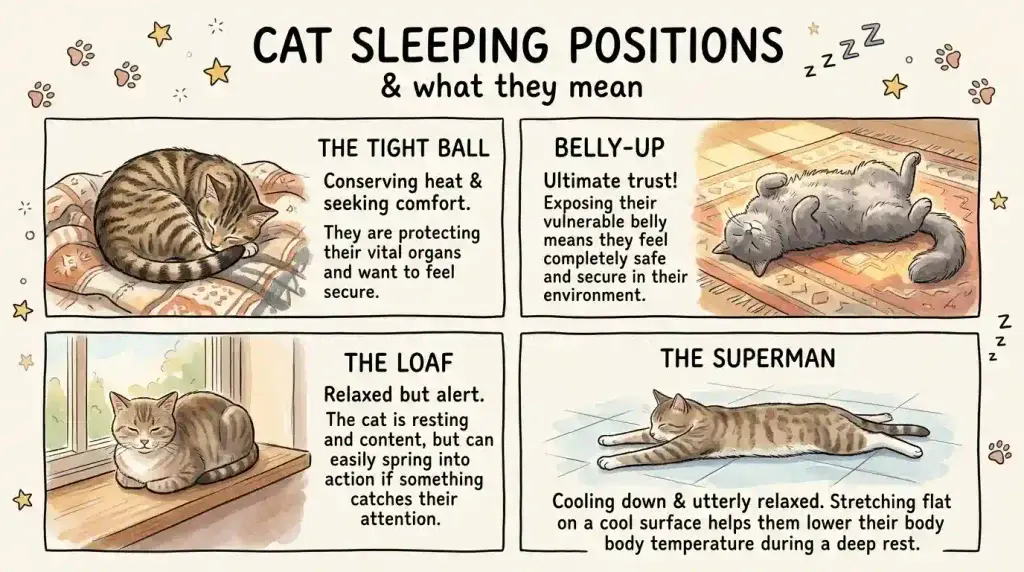
| Curled ball | Body tucked in a circle, nose near tail | Keeping warm, feeling cozy or a bit guarded |
| Loaf | Paws tucked under, head up | Relaxed but still alert |
| Side sprawl | Lying on one side, legs out | Deeply relaxed and comfortable |
| Belly-up | On the back, belly showing | High trust and feeling very safe |
| Superman | Belly down, legs stretched front and back | Resting but ready to jump up |
| Face covered | Paws or tail over the face | Blocking light, staying warm |
| Sitting nap | Sitting upright, head drooping | Light dozing, still watching |
| Hugging a toy | Wrapped around a toy or blanket | Comfort, play habits, or kitten memories |
The Curled Ball
This is the classic cat pose. The cat curls into a tight circle, with her nose near her tail. Some people call it the donut.
The most common reason is warmth. Curling up keeps body heat close and protects the belly. You may see more of this pose in cool rooms or on chilly nights.
The pose can also feel safe. A curled cat is small, tucked in, and hard to disturb. Some cats choose this shape when they are in a new home or feel a little unsure.
At the same time, many cats simply love it. If your cat curls up in her favorite bed every night and looks calm, it likely just means she is cozy. Look at her face and body. A soft face and slow breathing say “relaxed.” A tight, tense body says “worried.”
The Loaf
In the loaf position, the cat sits or lies with her front paws tucked under her chest, so she looks like a loaf of bread. Her head is usually up, and her eyes may be half closed.
This pose often shows a cat who is relaxed but not fully off duty. With her paws under her, she can stand up quickly. You may see it when she is watching birds, waiting for dinner, or resting in a place that is still fairly new.
Warmth can be part of the story too. Tucking the paws under keeps them from the cold floor. So a loaf on a chilly day may be mostly about comfort.
A loaf is a normal, healthy pose. It usually means calm attention rather than worry.
The Side Sprawl
When a cat lies on her side with her legs stretched out, she is usually very relaxed. Her body looks loose, and her breathing is slow and steady.
This pose often appears during deep sleep. A cat will not stretch out like this if she feels in danger, because it makes it harder to jump up fast. Choosing this pose suggests she feels secure in her space.
You may also see small signs of dreaming here. Whiskers may twitch, paws may paddle, and the tail may flick. These are normal and usually mean the cat is in a dream stage of sleep. It is best to let her rest.
The Belly-Up Pose
Few sights are as sweet as a cat sleeping on her back, belly showing. The belly is one of the most protected parts of a cat’s body. When she shows it, she is often telling the world that she feels very safe.
Many cat experts see this as a sign of deep trust. The cat does not expect any danger in this spot.
But there is a catch. A belly-up cat is not always asking for a belly rub. Many cats dislike having their bellies touched, even when they sleep that way. Trust and touch are two different things. If you reach in, she may grab your hand with her claws. That is usually a reflex, not meanness.
Belly-up can also be about heat. On a warm day, a cat may lie on her back to cool off, because the fur on her belly is thinner.
The Superman Pose
In the Superman pose, the cat lies flat on her belly with her front legs stretched out ahead and her back legs stretched behind. She looks like a tiny flying hero.
This pose is often seen on cool floors, like tile or hardwood. It helps a cat spread out and cool down by touching a chilly surface with her belly.
It can also show a cat who is resting but still wants to stay ready. Her legs are under her body, so she can leap up fast. It is a middle point between a light nap and deep sleep.
If your cat lies like this on a hot day, give her a cool spot, such as a tile area, and a fresh bowl of water.
Sleeping With the Face Covered
Sometimes a cat covers her face with her paws or tucks her nose under her tail. This is very common and usually harmless.
There are a few easy reasons. A covered face blocks bright light, which can help her sleep better. It also keeps her nose warm. A cat’s nose is sensitive, and tucking it in may feel good.
Some cats may also do it to feel hidden and safe, like a person pulling a blanket over their head. If it happens in a quiet, comfy spot, it is likely just her favorite style.
If she hides her face often and also acts different, such as eating less or avoiding people, pay closer attention. That could be a sign of stress or illness.
Sleeping While Sitting Up
Some cats doze while sitting upright, with their heads slowly drooping. It looks funny, but it makes sense. A sitting cat can wake up quickly and keep an eye on her surroundings.
This pose often shows a cat who is very relaxed but not ready to let her guard down fully. You might see it near a window, by a door, or in a busy room.
Older cats may also sit up while resting if lying down feels uncomfortable. If your cat sits up to sleep in a way that seems new, and she seems stiff or restless, it is worth mentioning to your vet.
What Other Body Clues Tell You
The pose is only part of the message. Other body signals help you read it correctly. This table shows some common clues.
| Body Clue | What You See | What It May Mean |
| Tail | Wrapped around the body | Warmth and comfort |
| Tail | Twitching while asleep | Dreaming |
| Ears | Flicking at sounds | Light sleep, still listening |
| Eyes | Half open | Light dozing |
| Whiskers | Twitching | Dreaming or a light sleep stage |
| Breathing | Slow and steady | Calm and comfortable |
| Paws | Kneading in sleep | Comfort, like kitten memories |
| Purring | Soft, steady | Content and relaxed |
Notice how ears and tails can change the meaning. A curled cat with twitching ears may be in a light sleep. A curled cat with a still tail and slow breathing may be deeply asleep.
Half-open eyes are also normal. Cats may nap with their eyes partly open, and you might see a thin white film at the corner. That is a third eyelid, and it is common in sleepy cats. If it stays visible when she is awake, though, mention it to your vet.
Where Your Cat Sleeps Matters Too
Where your cat chooses to rest says as much as how she lies. Here is a simple guide.
| Sleeping Spot | What It May Mean |
| On your bed or lap | Trust, bonding, and a love of your warmth |
| High on a shelf | A wish for a safe view of the room |
| In a box or small space | Feeling snug and protected |
| In a sunny window | Seeking warmth |
| On cool tile | Cooling down |
| Under furniture | Feeling shy, stressed, or wanting quiet |
| On your clothes | Comfort from your scent |
If your cat sleeps on you, it is often a compliment. Cats choose sleeping partners they trust. Your scent, warmth, and heartbeat can feel very soothing.
High places make cats feel in control, since they can watch everything below. Boxes and baskets give a hugging, safe feeling.
If a cat suddenly hides under the bed or in a closet more than usual, think about what has changed. A new pet, loud guests, or a move may be causing stress.
Do Sleeping Positions Show Personality?
You may have read that a cat’s pose reveals her personality. It is a fun idea, but there is no strong scientific proof that one pose matches one personality type.
What we can say is that cats often have favorite poses. A confident, relaxed cat may sprawl or sleep belly-up more often. A shy cat may curl up in hidden places. Over time, you will learn your own cat’s habits.
That knowledge is more helpful than any chart. If you know how your cat usually sleeps, you will notice quickly when something changes. A change in routine is often the first clue that a cat needs help.
Do Kittens and Senior Cats Sleep Differently?
Yes, age can change how a cat sleeps.
Kittens sleep a lot, often up to about 20 hours a day, because they are growing fast. They may fall asleep in odd places, like half in a bowl or on top of you. They also tend to sleep in piles with littermates or soft toys, which gives comfort and warmth.
Adult cats settle into their own patterns, usually with a mix of light naps and deeper sleeps.
Senior cats often sleep more, and they may need softer, lower beds. Sore joints can make some poses uncomfortable. If an older cat seems to avoid her usual spots or struggles to lie down, a vet check can help rule out pain, such as arthritis.
Whatever the age, a warm, quiet spot with easy access helps cats sleep well.
When a Sleeping Position May Signal a Problem
Most sleeping poses are perfectly normal. But sometimes a change can be a clue. Watch for these signs:
- Your cat cannot seem to get comfortable and keeps changing position.
- She sleeps in a stiff, hunched pose with a tight body.
- She breathes fast or with effort while resting. As a rough guide, many vets say more than about 30 breaths per minute while calm and asleep is worth a call.
- She avoids her favorite spots or struggles to jump up.
- She sleeps much more or much less than usual.
- She hides in odd places and seems to want to be alone.
These signs can point to pain, stress, or illness. They are not a diagnosis. Only a vet can tell what is going on.
This article gives general information and is not a substitute for veterinary advice. If you are worried, call your vet. It is always better to ask early.
Tips to Help Your Cat Sleep Better
A well-rested cat is usually a happy cat. Here are simple ways to help.
Offer several cozy spots. A soft bed, a blanket, and a covered cat cave let her choose.
Provide warm and cool options. A sunny perch is great for warmth, and a cool floor helps in summer.
Add a high place. A cat tree or sturdy shelf gives her a safe lookout.
Keep the area calm. Loud noise and heavy foot traffic can make resting hard.
Respect her naps. Avoid waking her often. Cats need uninterrupted rest to stay healthy.
Make beds easy to reach. Older cats do best with low, soft beds.
Watch the room temperature. A drafty room can make a cat curl up tightly, while a hot room can make her stretch out on the floor.
FAQs
What does the simple cat sleeping position mean?
A cat’s pose shows how safe and relaxed she feels. Curled poses often mean warmth or light rest, and stretched-out poses usually mean deep comfort.
Why does my cat sleep curled in a ball?
Most often it is to stay warm and feel secure. Curling up keeps body heat close and protects the belly. Many cats also just find it comfortable.
Does a cat sleeping on its back mean it trusts me?
Often, yes. Showing the belly is usually a sign of feeling very safe. But it does not always mean she wants a belly rub, so be gentle.
Why does my cat sleep on my bed or lap?
It usually means she trusts you and enjoys your warmth and scent. Cats choose safe, cozy places, and being near you is often one of them.
How many hours do cats sleep?
Most adult cats sleep about 12 to 16 hours a day. Kittens and older cats may sleep more. A sudden change from your cat’s normal habits is worth mentioning to your vet.
Can a sleeping position tell me if my cat is sick?
Sometimes a change can be a clue, such as a stiff, hunched pose or fast breathing at rest. But a pose alone cannot diagnose a problem. If you are worried, call your vet.
Conclusion:
The cat’s sleeping position’s meaning comes down to comfort and trust. Curled poses often show warmth or a bit of caution. Loaf and sitting poses suggest a cat who is resting but still alert. Side sprawls, belly-up poses, and the Superman stretch usually show a cat who feels safe and relaxed.
We also learned that body clues, like the tail, ears, and breathing, add meaning to every pose, that the sleeping spot matters, and that a sudden change in habits can be a sign to check in with your vet.
So here is some practical advice. Learn your own cat’s usual poses and favorite spots, and give her warm, quiet places to rest. Never wake her just for a cuddle. And when you see her sprawled out and snoring softly, take it as a compliment. It means she feels right at home with you.
Hi, I’m Rida, the writer behind this site about word meanings.
I explain words in simple English with clear definitions, synonyms, and real examples.
My goal is to help learners and curious readers pick the right word with confidence.
Every article is checked against trusted dictionaries so you can learn with trust.