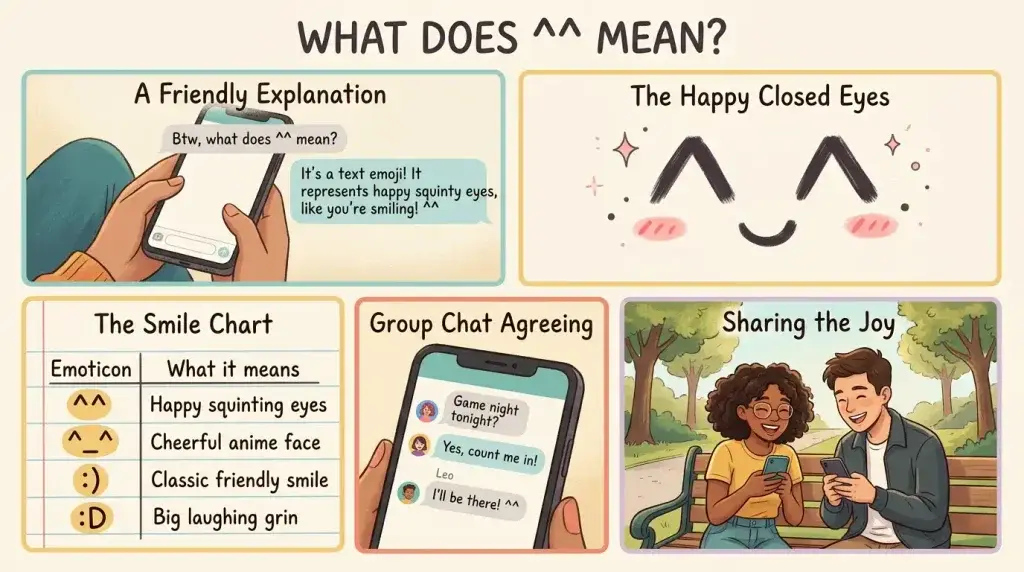
You get a message from a friend that ends with two little arrows pointing up: “Thanks for helping me today ^^”. You stop and wonder what they mean. Is it a code? A typo? The ^^ meaning in text is friendly and simple: it is a smiling face made from two caret symbols, which look like happy closed eyes. It tells the reader, “I’m smiling, and I mean this kindly.”
Many people search for it because it looks odd at first. It also has a second use in some chats. In this guide, you will learn both meanings, how to use them, where the style came from, and which mistakes to avoid. You will also find easy examples, tables, and clear answers.
^^ Meaning in Text: The Quick Answer
^^ means a happy, smiling face. The two caret symbols look like eyes that curve upward when someone smiles. People add it to the end of a message to show warmth, joy, or a friendly tone.
For example, “See you tomorrow ^^” means “See you tomorrow, and I’m happy about it.”
There is also a second meaning in some online chats. A single ^ or a double ^^ can point up to a message above and say, “I agree with that.” This use is less common, and the setting usually makes it clear.
What Does ^^ Really Mean?
Let’s look at the symbol closely. The character ^ is called a caret. On most keyboards, you type it by pressing Shift and the number 6. When you place two carets next to each other, they form a shape like two small hills. Now imagine those hills as closed eyes on a happy face. That is exactly the picture.
This is why people read ^^ as a smile. When someone is truly happy, their eyes curve upward and crinkle. The carets copy that shape. You do not need to add a mouth. The eyes alone say it.
The symbol also carries a gentle, polite feeling. It is softer than a big laughing emoji. Many people use it to keep a message from sounding too sharp. A sentence like “Please send the file ^^” sounds kinder than “Please send the file.”
It can show different moods, too. Depending on the sentence, ^^ may mean happiness, thanks, shyness, friendliness, or a small laugh. The words around it set the mood.
In short, ^^ does three jobs. It shows a smile, softens a message, and adds warmth.
The Two Meanings of ^^
This symbol has two main uses. This table shows how they differ.
| Meaning | What It Looks Like | What It Says | Where You See It |
| Happy face | “Thank you ^^” | I’m smiling and being friendly | Texts, chats, comments |
| Pointing up | “^^” alone under a message | I agree with the message above | Group chats, forums, gaming chats |
The first meaning is by far the most common. If the symbol comes at the end of a sentence, it is almost always a smile.
The second meaning shows up when someone types ^ or ^^ on its own line under another person’s message. The arrows point up, as if to say, “This one.” It is a quick way to agree without typing more words. Some chat groups and online games use it a lot.
A helpful tip is to look at the position. If it sits at the end of a sentence, think smile. If it sits alone below someone else’s message, think “I agree with the above.”
How to Use ^^ in a Text
Using ^^ is easy. You usually place it at the end of a sentence, just like you would place a smiley. Here is a table of common patterns.
| Pattern | Example | What It Means |
| sentence + ^^ | “Good morning ^^” | A warm hello |
| thanks + ^^ | “Thanks so much ^^” | A kind thank you |
| request + ^^ | “Can you help me ^^” | A polite, soft ask |
| compliment + ^^ | “Your drawing is so cute ^^” | A sweet compliment |
| reply + ^^ | “Sure, no problem ^^” | Friendly agreement |
A few simple tips can help. First, keep it light. ^^ works best with kind or cheerful messages. Second, use it once per message. Repeating it too much can look odd. Third, add a space before it, like “Okay ^^.” Many people do this because it makes the symbol easier to see.
You can also add small changes to the face. People write ^_^ to add a mouth, or ^.^ to add a tiny nose. These versions all share the same happy idea.
Real Life Examples of ^^
Examples make a symbol easier to learn. Here are some common moments where people use ^^.
| Situation | Example Text | Hidden Message |
| Greeting a friend | “Hi! Hope your day is great ^^” | I’m being warm and kind |
| Saying thanks | “Thank you for the gift ^^” | I truly appreciate it |
| Making a polite request | “Could you check this when you can ^^” | I’m asking nicely |
| Feeling shy | “I kind of like this song ^^” | A small, gentle confession |
| Agreeing in a group chat | “^^” under a message | I agree with the above |
Now let’s look at a few short stories.
Mia sent a message to a new classmate: “Want to study together tomorrow ^^”. The classmate replied right away with a happy answer. The ^^ made the invitation feel friendly and not pushy.
Daniel was talking with his cousin about a video game. After a long message, his cousin wrote, “That was awesome, you’re so good ^^”. Daniel smiled, because the symbol made the compliment feel warm.
In a gaming chat, one player wrote, “We should save before the boss fight.” Another player typed “^^” on the next line. Everyone understood that he agreed.
These stories show that the symbol is flexible. It can be sweet, shy, polite, or quick and practical.
Where Does ^^ Come From?
The honest answer is that nobody knows who first typed ^^. Slang and symbols like this grow in everyday online talk, so it is hard to trace them to one person or one date.
What we can say is this. Emoticons that read straight across, like ^_^, are often called “Eastern-style” emoticons. They became popular in online chats in countries like Japan and Korea, where people liked faces that could be read without turning your head. Western-style emoticons, like :-), need you to tilt your head sideways. Eastern-style faces stay upright, and the eyes do most of the work.
The ^^ face is a short, simple version of that style. It spread around the world as online communities, anime and comic fans, and gamers shared it in chats and forums.
It is also worth saying that some websites claim a specific date or a named inventor for the symbol. Be careful with claims like that. A safer way to put it is that ^^ grew naturally out of early online chat culture and spread as more people used it.
For deeper research, trusted sources like Merriam-Webster, Dictionary.com, and Cambridge Dictionary can show how emoticons are defined and used.
^^ vs. Other Smiley Faces
^^ has many cousins. They all show happiness, but each has its own feel. This table shows how they compare.
| Symbol | Name or Style | Common Feel |
| ^^ | Happy closed eyes | Soft, polite, cheerful |
| ^_^ | Happy face with a mouth | Cheerful, a bit more playful |
| 🙂 | Classic smiley | Simple, friendly, very common |
| 😀 | Big grin | Excited, laughing |
| XD | Laughing face | Very funny |
| 😊 | Smiling emoji | Warm and sweet |
| 🙂 | Slight smile emoji | Calm, sometimes polite or neutral |
The main difference is mood. ^^ is gentle and polite. 😀 is loud and excited. XD means something was really funny. 🙂 is a plain, all-purpose smile.
Some people like ^^ because it feels shy and sweet. It does not shout. It simply says, “I’m happy.”
If you want to sound a bit warmer than a plain period at the end of a sentence, ^^ is a handy choice. It adds friendliness without being too much.
Is ^^ Rude, Childish, or Polite?
This is a common question, and the answer is that ^^ is usually polite and kind. It is a small way to show warmth, so most people take it as friendly.
Some readers may see it as young or playful, because it is often used in casual chats and online fan spaces. That does not make it rude. It only means the tone is relaxed.
Tone still matters. If you write something unkind and add ^^, the mix can feel odd or even sarcastic. For example, “That idea is bad ^^” might look like a hidden insult. The smile does not erase the words. It is best to use ^^ with kind or neutral messages.
Also, think about who you are talking to. With friends, classmates, and online groups, it feels natural. With a boss, a teacher, or someone you do not know well, it may feel too casual. In those cases, a plain sentence or a simple smile like 🙂 may be safer.
Common Mistakes to Avoid
Even tiny symbols can trip people up. Here are the mistakes that show up most often.
The first mistake is thinking it is a typo. The ^^ is not a mistake. It is a purposeful face. If you see it in a message, it is almost always a smile.
The second mistake is using it in formal writing. In a work email, a school paper, or a business letter, ^^ looks out of place. Use plain words there.
The third mistake is mixing it up with the math symbol. In math and computer code, the caret often means “to the power of.” For example, 2^3 means two to the power of three. In a chat, though, ^^ is a face, not math.
The fourth mistake is overusing it. If every sentence ends with ^^, it can feel like too much. Save it for moments when you want to add warmth.
The fifth mistake is using it to soften harsh words. A smile does not cancel an unkind message. Be honest and kind in the words themselves.
Last, avoid using it with people who may not know the symbol. Older relatives or new internet users may need a quick explanation. A short note like “That’s a smiley face” can help.
How People Use ^^ Today
Today, ^^ appears in many places. Knowing where can help you spot it and use it well.
In text messages, it is a quick way to add friendliness. People use it to say thanks, hello, or good night.
In chat apps, you may see it in direct messages and group chats. It often shows up in polite replies and friendly check-ins.
In online communities and fan groups, it is very common. Fans of anime, comics, music groups, and games often use faces like ^^ in comments and posts.
In gaming chats, it can also work as the “pointing up” symbol. Players use it to agree with a teammate’s message without typing more.
In social media comments, ^^ is a gentle way to show that you enjoyed a post. It feels softer than a loud reaction.
One small trend is worth noting. Many people now use emoji more than text faces, so ^^ may look a bit old-school to some. But it remains popular with people who like its simple, soft style. For many, it has a charm that standard emoji do not quite match.
Tips for Using ^^ Naturally
If you want to use ^^ like a pro, a few easy habits will help.
Place it at the end. A smile works best after your words, like a friendly final touch.
Use it for kind messages. Thanks, greetings, compliments, and polite requests all fit well.
Add a space before it. Writing “Okay ^^” is easier to read than “Okay^^”.
Do not overuse it. Using it once in a while keeps it special.
Match your reader. If you are texting someone who may not know the symbol, you can try a plain smile like 🙂 first.
Keep it out of formal writing. Save it for chats with friends, classmates, and online groups.
Finally, read your message before you send it. If it sounds like something a friendly person would say out loud with a smile, you are probably using it well.
FAQs
What is the simple ^^ meaning in text?
It means a happy, smiling face. The two carets look like closed, smiling eyes. People add it to the end of messages to show warmth and friendliness.
What does ^^ mean in a group chat?
It can mean “I agree with the message above.” When someone types ^ or ^^ on its own line, the arrows point up to the earlier message.
Is ^^ the same as ^_^?
They are close. Both show a happy face. ^_^ has a mouth, so it can feel a bit more playful. ^^ is simpler and often feels softer.
Can I use ^^ in a work email?
It is better to avoid it in formal or work emails. Use plain words or a simple smile. With close coworkers in a casual chat, it may be fine.
Is ^^ a girl or boy symbol?
It is for everyone. Anyone can use ^^ to show a smile. It does not belong to one group.
How do I type the ^ symbol?
On most keyboards, press Shift and the number 6. On phones, you may need to switch to the symbols keyboard and look for the caret.
Conclusion:
The ^^ meaning in text is easy to remember: it is a happy, smiling face made from two carets. People use it to show warmth, add kindness to a request, and make a message feel friendly. In some chats, it can also point up and mean “I agree with the message above.”
We also learned that ^^ comes from the Eastern style of emoticons, that its exact first use is hard to trace, and that it works best in casual chats with kind words. It is smart to keep it out of formal writing and not to use it to cover up unkind messages.
So here is some practical advice. Use ^^ when you want to sound gentle and cheerful. Keep it simple, use it once, and let your words do the main work. Try it in your next message to a friend, and see how a tiny smile can brighten the chat.

Hello, I’m Clara Whitmore. I write daily prayers, devotionals, and faith-based reflections for readers seeking peace and encouragement. I believe prayer has the power to heal hearts and renew faith.