John 3:16 meaning, in one line: God loves everyone so much that he gave his Son, and anyone who trusts him receives life that never ends. That is the heart of the most famous verse in the Bible. You may have seen it on a sign at a ball game, a coffee cup, or a church wall. But what does it really mean?
Many people know the words by heart and still have questions. Who is the “world”? What does “believe” mean? Is “everlasting life” only about heaven? This guide walks through the verse slowly, in plain English. You will see the story behind it, what each key word means, and how people use it today. No hard words. No church background needed. Just a clear look at one short sentence that has shaped millions of lives.
John 3:16 Meaning in Simple Words
Here is the verse in the old King James wording: “For God so loved the world, that he gave his only begotten Son, that whosoever believeth in him should not perish, but have everlasting life.”
Now here it is in everyday speech. God loved people so deeply that he gave his own Son to save them. Anyone who puts their trust in that Son will not be lost forever. Instead, they will share in life that has no end.
That is the quick answer. The verse has three big ideas. First, God’s love is the reason for everything. Second, God did something about that love by giving his Son. Third, people can receive the gift by trusting him.
Notice the order. Love comes first, and the gift follows. Trust is the response. The verse does not start with rules or fear. It starts with love. That is one reason so many people hold on to it in hard times.
The Verse Word for Word
Bible translators have worked for centuries to say John 3:16 clearly in English. The meaning stays the same, but the wording changes a little. Seeing a few versions side by side can help you catch details you might miss in just one.
| Translation | Key Wording |
| King James Version (KJV) | “his only begotten Son” and “whosoever believeth” |
| New International Version (NIV) | “his one and only Son” and “whoever believes” |
| English Standard Version (ESV) | “his only Son” and “whoever believes” |
| New Living Translation (NLT) | “his one and only Son” and “everyone who believes” |
The biggest difference is how each version handles the Greek word monogenes. The King James says “only begotten.” Many newer versions say “one and only.” Both point to the same idea. This Son is special and has no equal. The other change is “whosoever” becoming “whoever.” It is the same word in modern dress. It means anyone at all.
The Story Behind the Verse
Verses mean more when you know where they sit. John 3:16 is not a random line. It is part of a late-night talk.
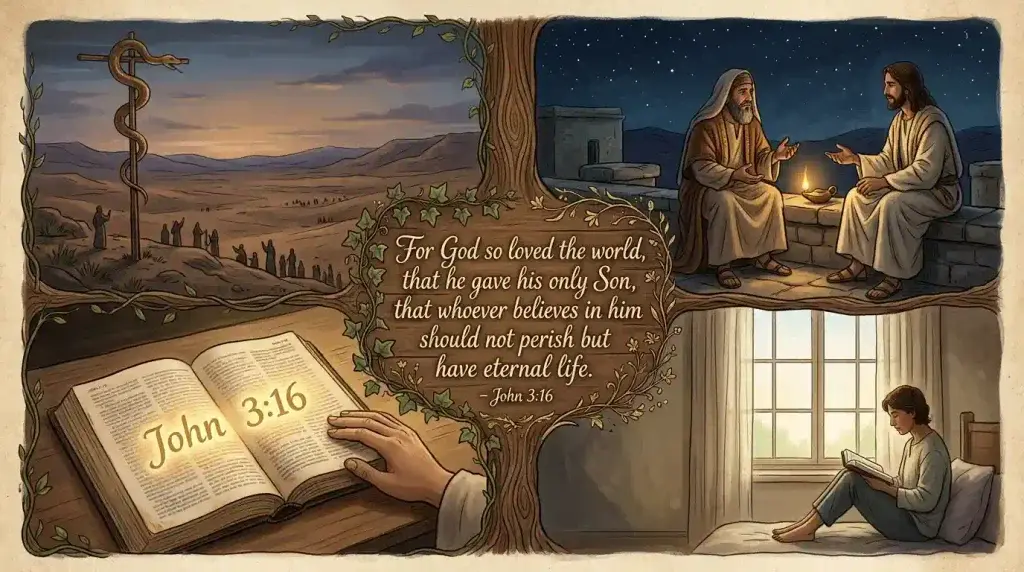
The chapter opens with a man named Nicodemus.Jesus answered with something surprising. He said a person must be “born again” to see God’s kingdom. Nicodemus was confused. How can a grown man be born a second time? Jesus explained that he meant a new birth from God, a fresh start from the inside.
Then Jesus pointed back to an old story. In the book of Numbers, the people of Israel were bitten by snakes in the desert. God told Moses to lift up a bronze snake on a pole. Anyone who looked at it was healed. Jesus said the Son of Man would be lifted up in a similar way, so that anyone who believes in him may have eternal life.
Verse 16 comes right after that. It explains why. Everything happens because God loved the world. Some Bible versions close the quote marks before verse 16, treating it as the writer’s comment. Others keep it as the words of Jesus. Either way, the message is the same.
The Gospel of John itself says why it was written. Near the end, the author says these things are recorded so that readers may believe and have life. Church tradition names John the apostle as the author, and most scholars place the writing in the late first century.
John 3:16 Meaning Phrase by Phrase
The best way to understand a famous verse is to take it in small bites. Each phrase carries its own weight.
| Phrase | What It Means |
| “God so loved” | God’s love is deep, real, and the starting point |
| “the world” | All people, not just one nation or group |
| “gave his only Son” | A costly gift, not just a kind thought |
| “whoever believes” | Anyone can receive it by trusting |
| “should not perish” | They will not be lost or destroyed forever |
| “everlasting life” | Life with God that never ends |
Take the first phrase. The word “so” does a lot of work. It does not just say God loved a little. It points to how much he loved, enough to give the most precious thing he had. Think of a parent who gives up everything for a child. The verse says God’s love goes even further than that.
Next, look at “gave.” Love in this verse is not only a feeling. It acts. In the Greek, the word for love is agape, a word the New Testament uses for self-giving love. God did not just care from far away. He stepped in.
Then there is “perish.” This word is serious. It tells us that without God’s gift, something real is at risk. The verse does not hide that. But it never stops on the bad news. It moves right to “but have everlasting life.” The warning is short. The hope is long.
What “Everlasting Life” Really Means
Many people hear “everlasting life” and think only of heaven after death. That is part of it. But the Gospel of John often uses the idea in a wider way.
The Greek word is aionios, and it carries two ideas at once. One is length. This life does not end. The other is kind. It is a new quality of life, one that knows God. Later in John, Jesus describes eternal life as knowing the only true God and the one he sent.
So everlasting life begins now, not only later. Think of it like moving into a new home before the moving boxes are all unpacked. You already live there. You are just still settling in. People who hold this view often say their daily lives have changed. They feel hope, peace, and a sense of being known.
At the same time, the verse does promise a future. Death is not the end of the story. Life with God continues past the grave. That is why this verse is read so often at funerals. It gives comfort that reaches beyond what we can see.
What It Means to “Believe”
The word “believe” is easy to misread. In daily speech, we say we believe in things like ghosts or good weather. That kind of belief is just agreeing that something might be true.
The Greek word here is pisteuo, and it means more than that. It leans toward trust, like sitting down in a chair without checking if it will hold you. You do not just think the chair exists. You put your weight on it.
So believing in Jesus means more than saying, “Yes, he lived.” It means trusting him with your life, your past, and your future. It means leaning on him for rescue instead of on your own good deeds.
This fits with other parts of the New Testament. Ephesians 2:8-9 says salvation is by grace through faith, a gift and not something earned. That matches John 3:16 well. The gift is God’s. The part we play is receiving it.
Who Is Included in “the World”?
Back in Jesus’ day, many people thought God’s favor belonged mainly to one nation. Then Jesus says God loved “the world.” The Greek word is kosmos, which can mean the whole human race.
That is a big, open door. It means no one is too far gone, too ordinary, or too different. Rich or poor, young or old, from any country, any language, any background. The word “whoever” backs this up. It leaves no one out.
This is also why the verse feels personal. Some readers like to swap in their own name. “God so loved me that he gave his Son.” That is not twisting the verse. It is simply taking “whoever” seriously.
At the same time, the verse reminds us that God’s love is not small. It does not stop at the edges of one church or one country. It reaches wide, and it invites everyone in.
What Verses 17 to 21 Add
John 3:16 should not be read alone. The next verses fill out the picture and clear up common worries.
Verse 17 says God did not send his Son to condemn the world, but to save it through him. This matters because some people picture God as eager to punish. The text says the opposite. The mission was rescue, not judgment.
Verses 18 through 21 then talk about light and darkness. Jesus says the light has come into the world, but some people prefer the dark because they do not want their actions exposed. Those who live by the truth come into the light.
This shows that the choice is real. The gift is offered to all, yet each person must answer it. Nobody is forced. But nobody is shut out, either.
Reading the whole passage together gives a balanced view. God loves deeply. God acts to save. And people are invited to respond.
Common Mistakes When Reading John 3:16
Because the verse is so short and so famous, people sometimes read it in ways the text does not support. Here are a few of the most common slips, and what the verse actually says.
| Common Mistake | A Better Reading |
| It is only about going to heaven | It also speaks of a new life that begins now |
| “Believe” just means agreeing with facts | It means trusting and relying on Jesus |
| God is angry and Jesus calms him down | Love is the reason God gave his Son |
| It is only for certain people | “Whoever” and “the world” include everyone |
| It is a lucky charm | It is a message of love and rescue, not magic words |
The last mistake is worth a closer look. Because the verse shows up on signs, shirts, and stickers, some people treat it like a good-luck phrase. But its power is in what it says, not in the numbers. Reading it, thinking about it, and answering it is very different from just displaying it.
Another slip is pulling the verse out of the Bible and leaving the rest behind. It works best as a doorway. It opens into the whole Gospel of John and the rest of Scripture.
Real Life Examples
Verses become clearer when we see them at work. Here are a few simple pictures.
Imagine a boy who is lost in a huge mall. His father searches every floor until he finds him. The father did not wait for the boy to find his own way out. He went looking. That is a small picture of a God who “gave” and came near.
Or think of a nurse who sits with a dying patient, scared and alone. She reads John 3:16 softly. The patient is not asking for a debate. He wants to know that death is not the end and that he is loved. For many families, this verse has become that kind of comfort.
Here is another one. A young man feels he has made too many mistakes to be forgiven. Then he reads “whoever believes.” The word does not say “whoever is good enough.” It says “whoever believes.” For him, that small word opens a door he thought was locked.
Stories like these show why the verse lasts. It speaks to ordinary people in their hardest moments, and it does so in plain words.
Why John 3:16 Is So Famous Today
This verse is everywhere. It is often called the Gospel in a nutshell, because it packs the main message of the Christian faith into a single sentence. Children memorize it in Sunday school. Preachers quote it around the world.
It has also shown up in public life. In the 1970s and 1980s, a man known as “Rainbow Man” held up John 3:16 signs at sporting events so cameras would catch them. In the 2009 college football national championship game, quarterback Tim Tebow wore it on his eye black, and searches for the verse jumped sharply that night.
Today people still print it on shirts, tattoos, and billboards. Online, millions look up the John 3:16 meaning every year, often because they saw it somewhere and got curious. That curiosity is a good thing. It leads people to read the passage for themselves.
Tips for Reading and Using John 3:16
If you want to get more out of this verse, a few simple habits can help.
First, read the whole chapter. Start at John 3:1 and read through verse 21. Seeing the talk with Nicodemus makes the verse feel alive instead of like a slogan.
Second, try a few translations. Free sites let you compare versions in seconds. Noticing small differences in wording can deepen your understanding.
Third, slow down on each phrase. Pick one, such as “so loved,” and think about it for a minute. Ask what it says about God and about you.
Fourth, if you are new to the Bible, read the rest of the Gospel of John next. It is a good place to start, and it explains why the writer wanted people to believe.
Finally, talk with someone you trust, like a pastor, a teacher, or a friend who reads the Bible. Questions are welcome. Nobody has to figure out a verse like this one alone.
FAQs
What is the simple meaning of John 3:16?
It means God loves all people so much that he gave his Son, Jesus. Anyone who trusts in Jesus will not be lost forever and will have life that never ends.
Why is John 3:16 so popular?
This sums up the Christian message in one sentence. It is short, easy to memorize, and full of hope. It names God’s love, his gift, and the way anyone can receive it.
Who said John 3:16?
The words appear in the Gospel of John. Depending on the Bible version, they are either spoken by Jesus to Nicodemus or written by John as a comment on that talk. Church tradition says John the apostle wrote the Gospel.
What does “only begotten Son” mean?
It translates the Greek word monogenes. It points to Jesus as the one-of-a-kind Son of God. Many modern Bibles say “one and only Son” to make that idea clearer.
Does John 3:16 mean everyone is saved?
The verse offers life to everyone, but it ties that life to believing. It says “whoever believes.” So the gift is for all, and each person is invited to trust and receive it.
What does “perish” mean in John 3:16?
It means to be lost or destroyed. In this verse it stands in contrast to everlasting life. The verse says that those who believe in Jesus will not perish but will have life with God.
Conclusion
The John 3:16 meaning comes down to this: God loves the world, God gave his Son, and anyone who trusts him receives life that lasts forever. Few verses say so much in so few words.
Along the way, we saw that love is where the story starts. We saw that “the world” includes everyone, that “believe” means real trust, and that “everlasting life” begins now and goes on beyond death. We also saw how the quiet night talk with Nicodemus gives the verse its setting.
If you take one thing away, let it be this. The verse is not a slogan to hang on a wall. It is an invitation. So read the whole chapter, ask honest questions, and think about what the verse says to you. Sometimes the simplest words are the ones worth coming back to again and again.

Hi, I’m Elias Monroe. I enjoy writing meaningful prayer content that helps people feel calm, hopeful, and spiritually strong. My goal is to share words that bring comfort during both joyful and difficult times.