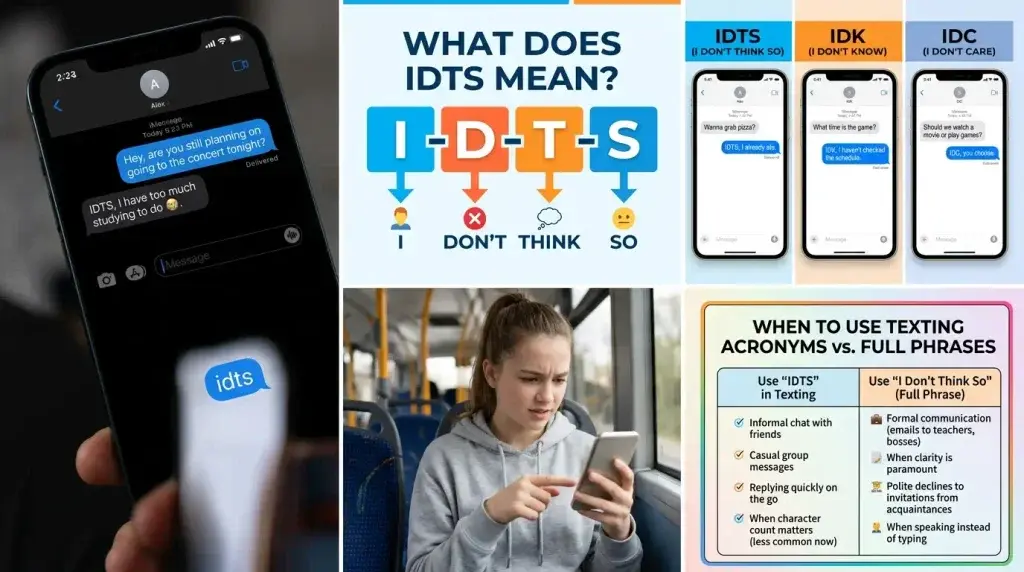
You are chatting with a friend, and a message pops up with just four letters: IDTS. Your brain stops for a second. Is it a code? A typo? A name? Don’t worry. The idts meaning in text is simple: it stands for “I don’t think so.” People use it as a quick, casual way to say no or to show doubt.
Many people search for this term because slang changes fast. Nobody wants to guess wrong and look silly. In this guide, you will learn what IDTS means, how to use it, and how tone changes the message. You will also see real examples, common mistakes, and similar slang terms. It takes less than five minutes. By the end, you will read and send IDTS like a pro.
Quick Answer: IDTS Meaning in Text
IDTS means “I don’t think so.” It is a short way to disagree, say no, or show that you doubt something. You will see it in text messages, social media comments, and group chats.
Here is a simple example:
- Friend: “Do you think it will rain today?”
- You: “IDTS. The sky looks clear.”
Notice that IDTS is softer than a flat “no.” It says, “I doubt it,” instead of “Absolutely not.” That small difference is why people like using it. It lets you disagree without sounding too harsh.
What Does IDTS Stand For?
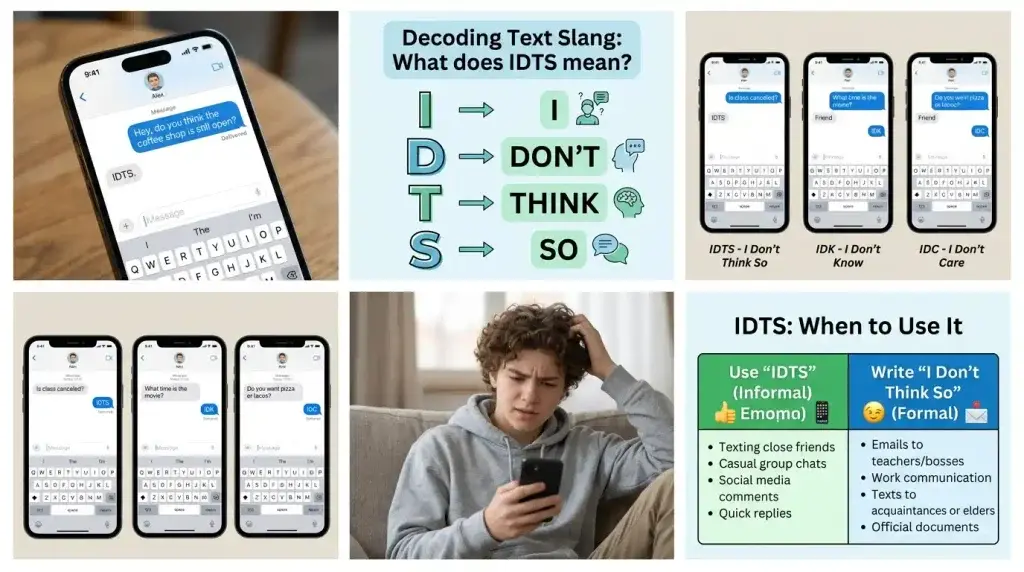
IDTS is an initialism. That means each letter stands for one word, and you say the letters one at a time, “I-D-T-S.” It is different from an acronym like “NASA,” which people say as one word.
Here is how the letters break down:
| Letter | Stands For | Example in the Phrase |
| I | I | “I” |
| D | Don’t | “don’t” |
| T | Think | “think” |
| S | So | “so” |
Put them together, and you get “I don’t think so.” The apostrophe in “don’t” is dropped, as it usually is in texting. Notice that the “N” in “don’t” is also skipped. People write “IDTS” instead of “IDNTS” because it is shorter and easier to type. Most text slang works this way. Writers keep the letters that matter most and drop the rest.
How People Use IDTS in Real Chats
IDTS shows up in lots of places. You might see it in a text from a friend, a reply under a TikTok video, or a comment on an Instagram post. People use it any time they want to answer fast.
Here are a few common ways people use it.
Answering a question. Someone asks, “Is he coming to the party?” You reply, “IDTS. He said he was busy.”
Doubting a claim. A friend says, “This team is going to win the title.” You reply, “IDTS, they lost three games in a row.”
Turning down an offer. A classmate asks, “Want to study at 9 p.m.?” You reply, “IDTS, I will be asleep by then.”
Making a joke. A friend says, “I am the best cook in our family.” You reply, “IDTS 😂.” The laughing emoji tells your friend you are teasing.
Adding a reason. Many people follow IDTS with a comma and a short reason. For example, “IDTS, I was home all day.” This makes the message clearer and kinder.
In all of these cases, the message stays short. That is the whole point of slang like this. It saves time, and it keeps the chat moving.
Tone: Is IDTS Polite, Playful, or Rude?
Text messages have a problem. You cannot hear a voice or see a face. So the same three words can feel friendly to one person and cold to another. IDTS is no different.
Punctuation and emojis change the feeling a lot. A period at the end can make a message sound serious. An emoji can make it sound light and playful. Look at these two replies:
- “IDTS.” This can sound firm, flat, or even a little annoyed.
- “IDTS 😅” This sounds relaxed, as if you are smiling while you say it.
Capital letters matter too. “idts” in all lowercase feels casual and easygoing. “IDTS” in all capitals can feel louder, as if you are stressing your point.
The words around IDTS also help. If you write, “IDTS, but thanks for asking,” you sound polite. If you write only “IDTS” in response to a big, serious question, you might sound cold. When in doubt, add a few kind words. A little extra effort goes a long way in a text.
IDTS vs. Similar Texting Slang
IDTS is not the only short way to say no or show doubt. Here is how it compares to other common terms.
| Slang | Full Meaning | How Strong Is It? | Example |
| IDTS | I don’t think so | Soft to medium | “IDTS, it’s too far.” |
| IDK | I don’t know | Very soft, unsure | “IDK, maybe later.” |
| IDC | I don’t care | Can sound rude | “IDC, you pick.” |
| NVM | Never mind | Neutral | “NVM, I found it.” |
| IMO | In my opinion | Soft, gives a view | “IMO, it’s too pricey.” |
| NAH | No (casual) | Medium | “Nah, I’m good.” |
The big difference is certainty. With IDK, you are saying you are not sure at all. With IDTS, you lean toward no, but you leave a little room for being wrong. That makes IDTS a good choice when you want to disagree without starting an argument.
Be careful not to mix these up. Sending “IDC” when you mean “IDTS” could upset someone, because “I don’t care” sounds much ruder than “I don’t think so.”
Grammar and Correct Usage
Slang does not follow strict grammar rules, but a few habits make your message easier to read.
First, IDTS works like a full sentence. You can use it alone, because “I don’t think so” is a complete reply. You do not need to add a subject or a verb.
Second, IDTS usually answers something. It works best as a reply to a question or a statement. If you send it out of nowhere, the reader will be confused.
Third, you can add extra words after it. For example, “IDTS, because I have to work” is clear and natural. The comma helps separate the short slang from your reason.
Fourth, capital letters are optional. Most people type “idts” or “IDTS,” and both are fine. Just stay consistent in one chat, so your messages look neat.
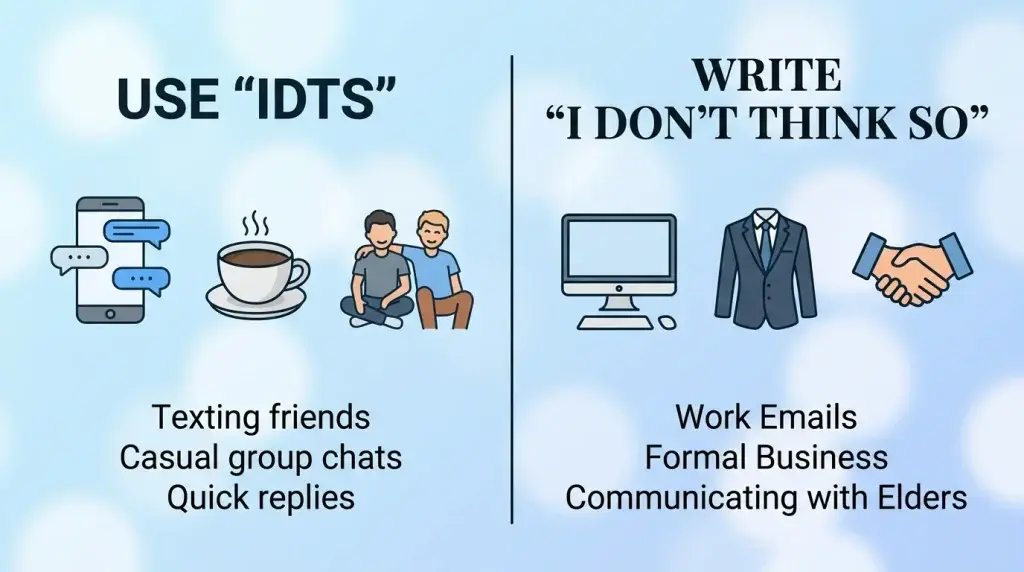
Finally, remember that IDTS is informal. In school essays, work emails, and business messages, it is better to write out “I don’t think so.” That keeps your writing clear and professional.
Where IDTS Fits and Where It Does Not
Knowing the right place to use slang is just as important as knowing the meaning. Here is a simple guide.
| Situation | Is IDTS Okay? | Better Choice |
| Texting a friend | Yes | IDTS |
| Group chat with peers | Yes | IDTS |
| Social media comments | Yes | IDTS |
| Email to a teacher or boss | No | “I don’t think so.” |
| Job application or resume | No | Full, formal sentences |
| Message to an older relative | Maybe not | Write it out in full |
The pattern is easy to see. IDTS fits when you are chatting with people your age or people you know well. It does not fit when you need to look careful and professional.
Also think about your reader. Not everyone knows internet slang. If you send IDTS to someone who does not text much, they might not understand it. A quick “I don’t think so” is always safe.
Common Mistakes to Avoid
Even simple slang can trip people up. Here are the most common mistakes.
Using it in formal writing. Slang in a work email can make you look careless. Save IDTS for casual chats.
Reading it as a harsh “no.” IDTS is usually softer than “no.” If you read it as angry, you may misjudge your friend. Look at the emoji and the other words before you decide how they feel.
Mixing it up with other slang. IDTS, IDK, and IDC all start with “ID,” so they look alike. But their meanings are very different. Double-check before you hit send.
Sending it with no context. If someone asks a long question and you only reply “IDTS,” it can feel rude. A short reason helps a lot.
Forgetting about tone. A single period can change how the message feels. If you want to sound friendly, add an emoji or a kind word.
Overusing it. If every reply is IDTS, your chats may start to sound flat. Mix in other words so your messages feel more like you.
Is There Another Meaning? A Note on Origin
You may find websites that list more than one meaning for IDTS. A few abbreviation lists show niche meanings from specialized fields, such as medicine. But in texting and social media, the meaning is almost always “I don’t think so.” If you see it in a chat, that is the safe guess.
What about its history? Some websites claim IDTS began in the early 2000s, but those pages do not give strong proof. There is no clear record of who first used it or exactly when. So it is best to be honest: the exact origin is unknown. What we do know is that it grew from the same habit that created many text abbreviations. People wanted to type less and reply faster, first on early cell phones with small keys and later on apps.
Slang also changes with time and place. A term that is popular this year may fade next year. If a friend uses IDTS in a way that does not match what you read here, ask them. A quick question is better than a wrong guess.
How to Reply When Someone Sends You IDTS
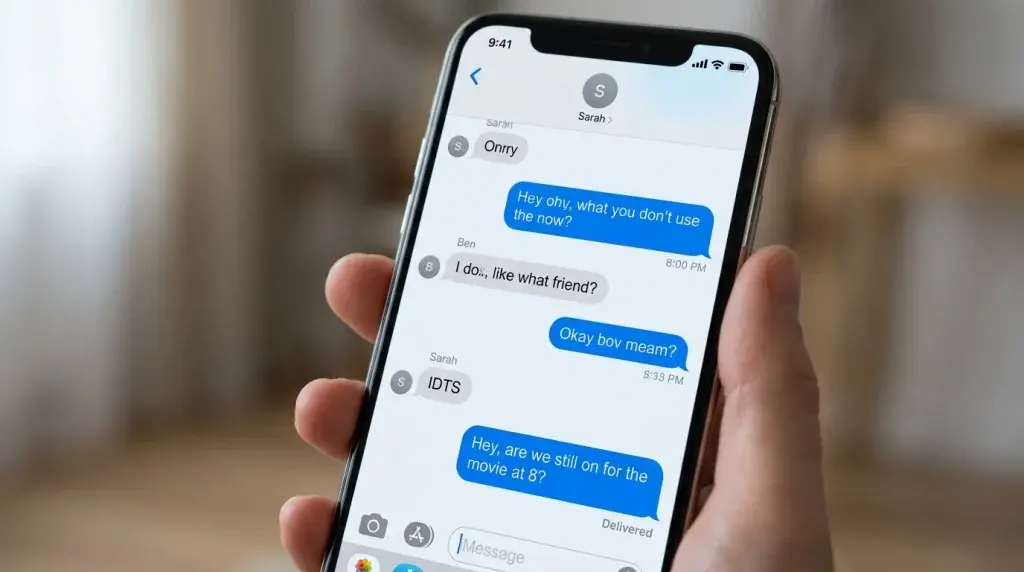
Sometimes you are the one receiving the message. What should you say back? It depends on what you asked.
If you asked a yes-or-no question, IDTS is your answer. You can simply say, “Okay, thanks!” or “Got it.”
If you want to know why, ask a gentle follow-up. For example, “Why not?” or “What makes you say that?” This keeps the chat friendly and helps you learn their reason.
If you disagree, you can say so kindly. Try, “Really? I thought it would work.” Then share your view.
If the message seems cold, do not jump to anger. Remember that text hides tone. A quick, “Everything okay?” can clear up a lot.
Tips for Using IDTS Well
Here are some easy habits that help you use IDTS in a smart, friendly way.
Add a reason when it matters. “IDTS, I have a test tomorrow” is clearer and kinder than IDTS alone.
Use emojis to set the mood. A smile or laugh can make your message feel light.
Match your friend’s style. If they write in full sentences, you might do the same. If they love short slang, go ahead and use IDTS.
Keep it out of serious talks. If someone shares bad news or a big problem, a quick IDTS can feel cold. Choose warm, full sentences instead.
Teach it when needed. If a parent or grandparent asks what it means, explain it simply. Sharing slang helps everyone feel included.
Check your audience. When you are not sure the reader knows it, write out the full phrase.
FAQs
1. What does IDTS mean in a text message?
IDTS means “I don’t think so.” People use it to say no or show doubt in a short, casual way.
2. Is IDTS the same as saying no?
Not exactly. It is softer than “no.” It says you doubt something, but it leaves a little room for being wrong.
3. Is IDTS rude?
Usually not. But a short IDTS with a period and no other words can sound cold. Adding a reason or an emoji makes it friendlier.
4. Can I use IDTS in an email to my boss or teacher?
It is better not to. IDTS is casual slang. In formal messages, write “I don’t think so” in full.
5. How is IDTS different from IDK?
IDK means “I don’t know,” so you are unsure. IDTS means “I don’t think so,” so you lean toward no. They are not the same.
6. Do I need to use capital letters with IDTS?
No. Both “IDTS” and “idts” are fine. Capitals can feel a bit louder, and lowercase can feel more relaxed.
Conclusion
Now you know the idts meaning in text: it stands for “I don’t think so.” It is a quick, casual way to say no or show doubt, and you will mostly see it in texts, comments, and chats with friends. Remember that it is softer than a plain “no,” but tone still matters. A period, a capital letter, or an emoji can change how it feels.
Use IDTS with friends and in relaxed chats. Skip it in school work, job messages, and any place that calls for careful writing. When you are unsure, add a short reason or write out the full phrase. And if you ever see a slang term you do not know, do not guess. Look it up or ask. That small habit will keep your messages clear and your chats friendly.

Hi, I’m Rebecca Hayes. I write faith-filled articles, healing prayers, and daily devotionals to encourage people in every season of life. My passion is helping readers find peace, hope, and strength through prayer.