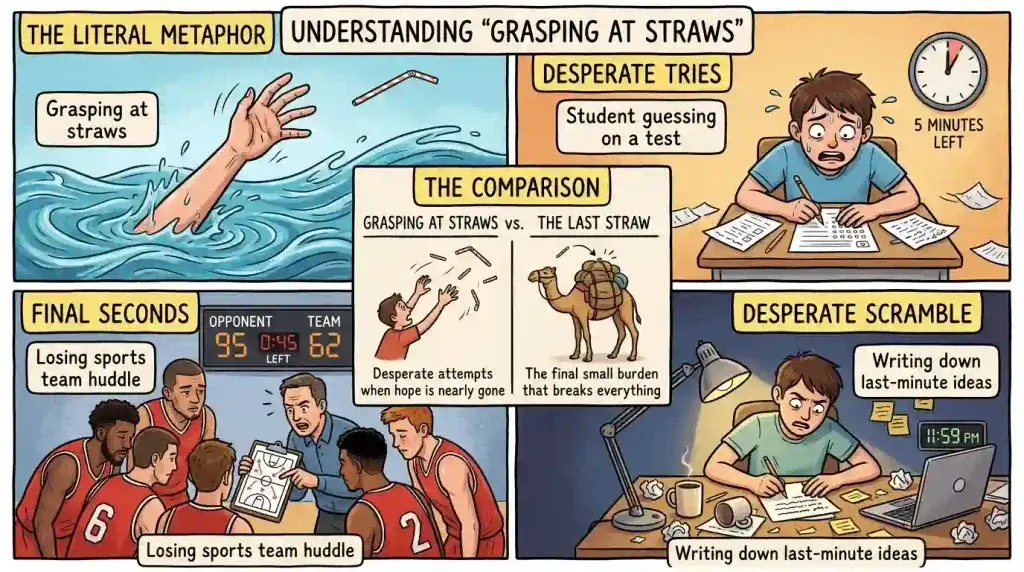
The grasping at straws meaning is simple: it describes someone who is trying any weak or unlikely idea because they feel desperate. The person has run out of good options, so they reach for anything that might help, even if it probably won’t.
You have likely heard this phrase on the news, in a movie, or from a friend. Maybe a coach said it about a team down by twenty points. Maybe a coworker said it about a last-minute plan. It sounds a little funny, but the feeling behind it is very real.
In this guide, you will learn what the phrase means, where it comes from, and how to use it. You will also see real examples, similar idioms, common mistakes, and answers to popular questions.
Quick Answer: What Does Grasping at Straws Mean?
“Grasping at straws” means trying a weak, unlikely, or hopeless idea when you are desperate. The person usually knows, deep down, that the idea is a long shot. But with nothing better available, they try it anyway.
Here are the key facts in short form:
- It shows desperation. The person feels stuck or out of time.
- The idea is weak. The chance of success is very low.
- It is an idiom. The words are not about real straws.
- It is often critical. People sometimes use it to say someone’s argument is flimsy.
For example: “After losing every case, the lawyer was grasping at straws.”
The Meaning Behind the Phrase
Let’s break the idiom into parts. That makes the whole idea easier to picture.
Imagine a person who has fallen into a river. They are being pulled away by the water. They look around, and the only thing within reach is a thin, dry straw floating by. They grab for it. But a straw is far too light to hold a person up.
That is the picture. The straw is a symbol for any hope that is too weak to help. The person grabbing it is a symbol for someone who is so desperate that they will try anything.
The phrase is an idiom, which means the words together carry a meaning that is different from each word alone. You are not talking about farm straw or drinking straws. You are talking about a last, weak hope.
It is also worth noting that the phrase can describe more than actions. It can describe arguments, theories, excuses, and plans. If someone offers a weak reason because they have no strong one, you might say they are grasping at straws.
Where Does the Phrase Come From?
Many people like to know how a saying began. This one has a long history, and it comes from an old proverb.
Many language sources say the idiom grew from the saying “a drowning man will clutch at a straw.” This idea appeared in English writing several hundred years ago. Some writers connect an early form of it to the 1500s, and many dictionaries trace it to Thomas More, an English writer of that era, though sources differ on the exact wording and date.
Over time, the long proverb got shorter. People dropped the drowning man and kept the heart of it, which is reaching for a weak hope. Today, we say “grasping at straws” or, in some places, “clutching at straws.”
I could not confirm every step of how the wording changed over the centuries, so I will keep this simple. What is clear is that the image of a person in water reaching for a straw is the root of the phrase, and it has stuck around because the picture is so strong.
Grasping at Straws vs. Clutching at Straws
You may hear two versions of this idiom, and many people wonder if one is wrong. The truth is that both are correct.
“Grasping at straws” is the more common version in American English. “Clutching at straws” is common in British English. Both mean the same thing, and both come from the same old image.
The small difference is in the verb. “Grasp” and “clutch” both mean to take hold of something. “Clutch” can feel a little tighter or more desperate, as if the person is holding on with all their strength. But in daily use, most people treat the two as the same.
| Version | Common In | Meaning |
| Grasping at straws | American English | Trying weak ideas out of desperation |
| Clutching at straws | British English | The same meaning |
| Grabbing at straws | Casual speech | The same meaning, less common |
If you are writing for a US audience, “grasping at straws” is the safest and most natural choice.
How to Use Grasping at Straws in a Sentence
The phrase is flexible, and it follows a simple pattern. Most often, you use it after a form of “to be,” such as “is,” “are,” or “was.” It works like a verb phrase that describes what someone is doing.
Here are common patterns:
- “[Person] is grasping at straws.” Example: “He is grasping at straws.”
- “[Person] was grasping at straws when…” Example: “She was grasping at straws when she blamed the weather.”
- “You’re grasping at straws.” Example: “I think you’re grasping at straws.”
- “It feels like grasping at straws.” Example: “Trying to fix it now feels like grasping at straws.”
More examples:
- “The team was grasping at straws in the final minutes.”
- “I know I’m grasping at straws, but let’s try one more thing.”
- “The company is grasping at straws to save the product.”
- “His excuse sounded like grasping at straws.”
A simple test helps. Ask yourself, “Is this person trying a weak idea because they are desperate?” If the answer is yes, the phrase fits.
Real Life Examples of Grasping at Straws
Examples make the idiom feel real. Here are everyday moments where it fits.
At school. A student who did not study tries every trick during a test, hoping to guess the answers. He is grasping at straws.
At work. A manager whose project is failing keeps changing the plan every day. Her coworkers say she is grasping at straws.
In sports. A losing team tries wild, last-second plays. Reporters write that the team was grasping at straws.
In law and politics. A lawyer uses a weak argument because the strong ones have run out. A commentator might say the lawyer is grasping at straws.
With health. A person tries many unproven treatments after losing hope. It is a sensitive area, so it is wise to be kind here. Real medical help should always come from a doctor.
At home. A parent tries ten different tricks to get a baby to sleep, one after another. “I’m just grasping at straws at this point,” the parent says.
In each case, the person has few good options. The phrase points to that gap between what is needed and what is available.
Is Grasping at Straws Always Negative?
This is a fair question, and the answer is: not always.
Often, the phrase is a gentle criticism. If someone says you are “grasping at straws,” they may mean your idea is weak or silly. In an argument, it can sound like an insult.
But the phrase can also be kind. When you say it about yourself, it can be a humble, honest way to admit you are in a tough spot. “I know I’m grasping at straws, but I’m willing to try” sounds brave and open.
Sometimes it even carries a little hope. History has many stories of people who tried a long shot and succeeded. So while the phrase suggests a low chance, it does not mean the result is impossible.
The key is tone. Said with a sneer, it can hurt. Said with a smile or a sigh, it can feel warm and human. Think about your audience before you use it about someone else.
Pie in the Sky Meaning
Pie in the sky means a pleasant but unrealistic hope or plan that is very unlikely to happen. People use the idiom to describe a dream or promise that sounds good but has little chance of coming true.
Pie in the Sky Synonym
Common synonyms for pie in the sky include pipe dream, fantasy, and wishful thinking. Each of these words describes an idea that is hopeful and appealing but not based on a realistic plan.
Pie in the Sky Origin
The phrase pie in the sky comes from a 1911 song by Joe Hill, which mocked promises of a reward in the afterlife. Over time, it became a common idiom for any unrealistic hope, especially one used to distract people from present problems.
Grasping at Straws vs. Similar Phrases
English has many ways to describe a desperate try. Some are close to this phrase, and some are a little different. This table shows how they compare.
| Phrase | Meaning | Tone |
| Grasping at straws | Trying weak ideas out of desperation | Neutral to critical |
| Hail Mary | A last, risky attempt, often with a small chance | Sports, dramatic |
| Long shot | An attempt with low odds | Neutral |
| Last-ditch effort | A final try before giving up | Serious |
| Shot in the dark | A guess with no clear information | Casual |
| Clutching at straws | Same as grasping at straws | British flavor |
| Barking up the wrong tree | Looking in the wrong place | Casual |
The main difference is focus. “Long shot” is about the odds. “Shot in the dark” is about guessing without information. “Last-ditch effort” is about timing. “Grasping at straws” is about the feeling of desperation and the weakness of the idea.
If you want to stress the desperate feeling, “grasping at straws” is a great choice.
Is the Phrase Formal or Informal?
The phrase sits in the middle. It is not slang, and it is not stiff. You can use it in school essays, news stories, work meetings, and chats with friends.
Because it is an idiom, very strict writing, like legal papers or science reports, may avoid it. In those cases, plain words like “relying on weak arguments” may sound more serious.
In a friendly message or a speech, though, the phrase adds color. It paints a picture, and pictures help people remember what you say. Just remember that it can sound critical when pointed at others, so use it with care.
Common Mistakes When Using Grasping at Straws
Even simple idioms can trip people up. Here are the most common mistakes.
Changing the words. Some people say “grasping for straws” or “grabbing straws.” Many speakers use “grasping for straws” too, and it is understood, but “grasping at straws” is the standard form.
Using it for a good plan. The phrase is for weak ideas. If a plan is solid, the phrase does not fit.
Using it without desperation. A person who simply tries something new is not grasping at straws. The feeling of being stuck is important.
Forgetting the plural. It is “straws,” not “straw.” The plural fits the idea of reaching for one weak hope after another.
Taking it literally. Remember that no real straws are involved. It is a picture, not a fact.
Using it in a harsh way. Telling someone who is hurting that they are “grasping at straws” can feel cruel. Choose your words with kindness.
Mixing it with other idioms. “Grasping at straws” and “the last straw” are different. The last straw means the final problem that makes someone give up. We will cover that next.
Grasping at Straws vs. The Last Straw
These two phrases both use the word “straw,” so they are easy to mix up. But their meanings are not the same.
“The last straw” comes from the saying “the straw that broke the camel’s back.” It means the final small problem that makes a person lose patience or give up. For example: “When he forgot my birthday again, that was the last straw.”
“Grasping at straws” is about trying a weak hope when desperate. For example: “She was grasping at straws to save the deal.”
| Phrase | Meaning | Example |
| Grasping at straws | Trying weak ideas out of desperation | “He was grasping at straws to win the argument.” |
| The last straw | The final problem that causes a breaking point | “Being late again was the last straw.” |
| Draw the short straw | Be picked to do an unwanted task | “I drew the short straw and had to clean up.” |
A quick memory trick: in “grasping at straws,” you are reaching for help. In “the last straw,” you are reaching your limit.
British vs. American English
The idiom is used and understood in both American and British English. The meaning is the same in both places.
The main difference is the verb. Americans tend to say “grasping at straws,” while many British speakers say “clutching at straws.” Both are correct, and both are easy to understand.
I could not find reliable data on exactly how often each version is used, so I will not give numbers. But if you are writing for a US audience, “grasping at straws” is the natural pick. If you are writing for a UK audience, “clutching at straws” will sound just right.
Tips for Using the Phrase Well
Here are some friendly tips to help you use it with confidence.
Use it for real desperation. The phrase shines when someone has run out of good options.
Try the swap test. Replace it with “trying a long shot.” If the meaning stays the same, you are on the right track.
Be kind when pointing it at others. Calling someone’s idea “grasping at straws” can sting. Soften it when you can.
Use it on yourself with humor. “I’m grasping at straws here” is a warm, honest way to admit you are stuck.
Do not overuse it. One use per piece of writing is plenty.
Pair it with context. A short explanation helps the reader see why the idea is weak.
Know your audience. For English learners or young readers, a plainer phrase like “trying a long shot” may be easier to understand.
Current Usage and Trends
Today, the phrase is still very common in speech and writing. You will hear it in news reports about politics, business, and sports. You will also see it in online comments, memes, and everyday chats.
I do not have reliable public numbers on how often people use it, so I will not make any claims. But it is easy to spot in headlines and captions.
One trend is that people often use it in a playful way. A friend might say, “I’m just grasping at straws, but maybe the keys are in the fridge.” That lightens the mood and shows humor in a tense moment.
Another trend is that the phrase shows up in talk about money, jobs, and big life changes. When times are hard, people often feel they are reaching for any answer, and the idiom fits that feeling well.
FAQs
1. What is the meaning of grasping at straws?
It means trying a weak or unlikely idea because you are desperate. The person has few good choices left.
2. Where does grasping at straws come from?
It comes from the old saying that a drowning person will clutch at a straw. A straw cannot hold anyone up, so it stands for a hopeless hope. Sources differ on the exact first use.
3. Is it grasping at straws or clutching at straws?
Both are correct. “Grasping at straws” is more common in American English, and “clutching at straws” is more common in British English.
4. Is grasping at straws an insult?
Sometimes. When pointed at someone else, it can sound critical. When used about yourself, it can sound honest and humble.
5. What is another way to say grasping at straws?
You can say “trying a long shot,” “making a last-ditch effort,” “taking a shot in the dark,” or “clutching at straws.”
6. What is the difference between grasping at straws and the last straw?
“Grasping at straws” means trying weak ideas when desperate. “The last straw” means the final problem that makes someone give up.
Conclusion
The grasping at straws meaning comes down to one clear picture: a person reaching for a weak hope because they feel they have no other choice. It describes desperate tries, flimsy arguments, and long-shot plans. It has old roots in the saying about a drowning person and a straw, and it is still popular today.
Now you know how to use the phrase, how it differs from similar idioms like “the last straw,” and which mistakes to avoid. You also know that tone matters, since the phrase can sound harsh or warm.
The best advice is to use it with care. Save it for moments of real desperation, be kind when pointing it at others, and feel free to use it with humor about yourself. When in doubt, a plain phrase always works.

Hello, I’m Clara Whitmore. I write daily prayers, devotionals, and faith-based reflections for readers seeking peace and encouragement. I believe prayer has the power to heal hearts and renew faith.