You have probably heard “take it easy” a hundred times. A friend says it when you look tired, and a coach says it after an injury. Coworkers toss it out on Friday afternoons as they head for the door. The words stay the same, yet the message shifts each time.
So what does “take it easy” mean? In simple terms, it means to relax, stay calm, or avoid overdoing things. Depending on situation, it can also mean to treat someone gently, to move slowly, or to say a casual goodbye.
That flexibility trips up many English learners. It also explains why the phrase can sound caring in one moment and irritating in the next. This guide covers the meaning, grammar, tone, origin, synonyms, and real examples, so you will know exactly when to use it and when to choose something else.
Quick Definition and Pronunciation
Take it easy (idiom): to relax, stay calm, or avoid putting too much effort or stress into something.
As a verb phrase, it most often appears as a command (“Take it easy!”). It also changes with the subject and tense, as in “I’m taking it easy today” or “She took it easy after the race.”
The pronunciation is /teɪk ɪt ˈiːzi/, with the main stress on the “ea” in “easy.” In fast speech, “take it” blends into something like “tay-kit.” When the phrase works as a goodbye, the rhythm loosens and the pitch drops on the last syllable.
Its register is informal to neutral. Friends, text messages, and most workplaces accept it without trouble. Formal writing usually calls for alternatives such as “please remain calm” or “please rest.”
Breaking Down the Phrase
Taken literally, the three words make little sense. “Take” suggests grabbing something, “it” points to an object, and “easy” means simple. Nobody is handing you a thing called “easy,” which is exactly why the phrase counts as an idiom.
The word “it” works as a placeholder for the general situation, your pace, or your level of effort. Idioms such as “call it a day” and “give it a rest” use “it” in the same way. Depending on context, the phrase can mean handling a situation calmly, handling your schedule lightly, or handling your body gently.
“Easy” behaves oddly here too. Standard grammar calls for an adverb ending in “-ly,” yet this fixed phrase keeps the short form, much like “drive slow” or “go easy.” Dictionary.com notes that careful speakers use “easy” as an adverb mainly in set phrases, including “take it easy” and “easy does it.”
Over time, the meaning stretched from pace (go slowly) to emotion (stay calm) to social use (a friendly goodbye). Each new use kept the same core idea of lightness and low pressure.
All the Meanings of “Take It Easy”
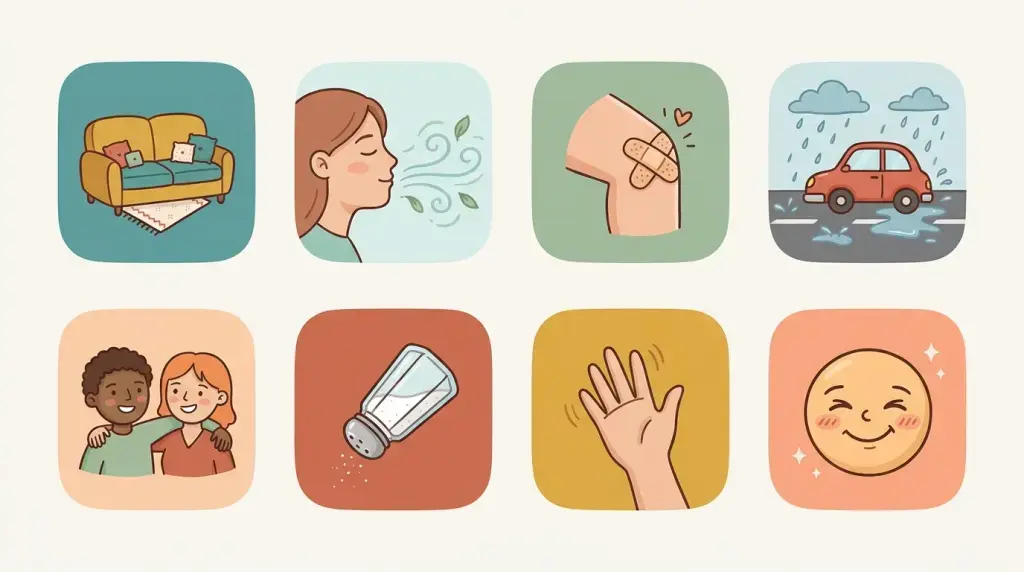
The right meaning depends on who is speaking, what is happening, and the tone of voice. Here are the eight main uses.
1. Relax and rest
This sense means spending time in a restful, low-effort way, especially after work or stress. It is the most common and friendliest use.
- “You’ve worked hard all week, so take it easy this weekend.”
- “I’m just taking it easy at home today.”
2. Calm down
Here the phrase asks someone to stop being upset, angry, or panicked. Delivery matters a great deal, because the same words can soothe or provoke.
- “Take it easy, everything is under control.”
- “Hey, take it easy. It was an accident.”
3. Don’t overdo it
Doctors, coaches, and family members use this meaning to limit physical or mental effort, often for health reasons.
- “Take it easy at the gym while your knee heals.”
- “The doctor told him to take it easy for two weeks.”
4. Go slowly or lightly
This one works as a gentle safety reminder about speed or force.
- “Take it easy on the corners, the road is wet.”
- “Take it easy going down the hill.”
5. Be gentle or lenient with someone
With “on” added, the phrase asks for kindness toward a person, including yourself.
- “Take it easy on her, it’s her first day.”
- “Take it easy on yourself. Everyone makes mistakes.”
6. Use sparingly
When the target is a thing, the phrase means to use or consume less of it.
- “Take it easy on the salt, your blood pressure is high.”
- “Take it easy on the hot sauce, it’s very strong.”
7. Casual goodbye
As a farewell, it works like “see you later” or “take care.” Speakers of American, Canadian, and Australian English use it especially often.
- “Great seeing you. Take it easy, man.”
- “Alright, I’m heading out. Take it easy!”
8. Don’t worry or stress
This meaning reassures someone that things will turn out fine.
- “Take it easy, you’ll do great in the interview.”
- “Take it easy, there’s no rush.”
Quick summary
| Meaning | Short example | Tone |
| Relax and rest | “Take it easy this weekend.” | Warm |
| Calm down | “Take it easy, it’s fine.” | Soothing or dismissive |
| Don’t overdo it | “Take it easy at the gym.” | Caring |
| Go slowly | “Take it easy on the corners.” | Neutral |
| Be gentle with someone | “Take it easy on her.” | Sympathetic |
| Use sparingly | “Take it easy on the salt.” | Practical |
| Casual goodbye | “See you, take it easy!” | Friendly |
| Don’t worry | “Take it easy, you’ll do fine.” | Reassuring |
All eight share one idea: less effort, less force, less stress.
“Take It Easy” vs. “Take It Easy On”
Grammar is where many learners stumble, so this section shows how the phrase behaves inside a sentence.
Standalone use
On its own, the phrase describes your pace, effort, or attitude. No object is needed.
- “I’m going to take it easy this afternoon.”
- “The doctor said to take it easy.”
Adding “on”
Adding “on” shifts attention to whoever or whatever receives your gentleness or restraint.
| Pattern | Meaning | Example |
| take it easy on + person | Be gentle with them | “Take it easy on your brother, he’s tired.” |
| take it easy on + yourself | Don’t be too hard on yourself | “Take it easy on yourself after that loss.” |
| take it easy on + thing | Use less of it | “Take it easy on the coffee.” |
| take it easy on + body part | Avoid strain | “Take it easy on your knee.” |
A quick test helps here. If you describe how you act or feel, use “take it easy.” If you describe who or what receives your gentleness, add “on.”
Tenses and forms
Only the verb “take” changes. The words “it easy” stay fixed.
| Form | Example |
| Simple present | “I take it easy on Sundays.” |
| Present continuous | “She’s taking it easy this week.” |
| Simple past | “He took it easy after the race.” |
| Present perfect | “I’ve been taking it easy lately.” |
| Future | “We’ll take it easy tomorrow.” |
| Infinitive | “The doctor told me to take it easy.” |
Easy, easier, and “make it easy”
Three similar-looking expressions carry different meanings. “Take it easy” means to relax. “Take it easier” is the comparative, meaning to relax more than before. “Make it easy” means to arrange things so something becomes simple, as in “This app makes it easy to book tickets.”
The negative form “don’t take it easy” is rare. When it appears, it warns someone not to be lazy or careless.
Tone, Context, and Social Nuance
The same three words can comfort one person and annoy another. Tone of voice, the relationship, and the timing decide which reaction you get.
When it sounds caring
The phrase works best when someone is tired, recovering, or overworking, and you are clearly on their side. Said to an exhausted friend or a patient on the mend, it signals concern and gives permission to slow down.
When it sounds dismissive
Trouble starts when the listener is already upset. Telling an angry customer or a frustrated partner to “take it easy” can suggest that their feelings are an overreaction. Acknowledging the emotion first usually works far better, with lines such as “I understand why you’re frustrated, so let’s sort this out” or “That sounds really stressful.”
Setting by setting
| Setting | Appropriate? | Notes |
| Friends and family | Yes | Natural, though repeated use can feel nagging |
| Coworkers | Yes | Fine for casual chats and farewells |
| Boss or client | Use with care | “Take care” is safer |
| Upset customers | Avoid | Offer help instead |
| Formal writing | Rarely | Choose “please rest” or “please remain calm” |
| Medical advice | Yes | Doctors use it to mean “limit your activity” |
Regional habits differ a little. Americans and Canadians use it freely as a sign-off, and Australians often pair it with “mate.” British speakers understand it everywhere but more often say “take care” or “cheers” when parting. These are tendencies, not strict rules.
In text messages, the missing voice makes things trickier. A friendly word or emoji, as in “Take it easy! 😊”, keeps the message from sounding curt.
No Pasa Nada Meaning in English
“No pasa nada” means “nothing is happening” in literal Spanish, but people use it to say “it’s nothing,” “don’t worry,” or “no problem.”
It is a calm, reassuring reply used when something small goes wrong, much like saying “take it easy” in English.
Origin and History
Pinning the phrase to one exact moment is impossible, but dictionaries give a useful timeline.
The root word is much older than the idiom. According to Dictionary.com, “easy” was first recorded between 1150 and 1200, borrowed into Middle English from Anglo-French and Old French. The idea of relief and comfort was built into the word from the start.
Etymonline reports that “take it easy” in the sense of “relax” dates to 1804, while the similar “be easy” appeared in that sense as early as 1746. The related “easy does it” was recorded by 1835. One idiom website credits an 1835 novel with the first printed use of “take it easy,” but that conflicts with the earlier date. For a safe summary, say the phrase has been in use since the early 1800s.
From there, the pattern is easy to trace. “Be easy” came first, then “take it easy,” and later “easy does it” spread as a close cousin. During the twentieth century, the phrase grew into a casual goodbye and a staple of popular music.
“Take It Easy” in Pop Culture
Few idioms have moved from everyday speech into music as smoothly as this one. The Eagles gave it a soundtrack in 1972.
Released on May 1, 1972, “Take It Easy” was the band’s debut single, written by Jackson Browne and Glenn Frey, who also sang lead. It peaked at No. 12 on the US charts.
The song’s story is a favorite among music fans. Browne began writing it in 1971 for his own debut album but struggled to finish it. Frey, his neighbor in Echo Park, Los Angeles, remembered the unfinished song and asked about it. According to Frey, his contribution was finishing the second verse, after which Browne agreed that they had co-written it.
A real place sits behind one famous scene. Frey said the second verse refers to a day when Browne’s car broke down in Winslow, Arizona. Decades later, the town added a tribute statue of Frey in Standin’ on the Corner Park.
The track also appears on the Rock and Roll Hall of Fame’s list of 500 Songs that Shaped Rock and Roll. Browne released his own version a year after the Eagles, though it did not perform as well.
Beyond that one song, the phrase shows up in album titles, hotel names, spa slogans, and everyday greetings. Its staying power comes from a short, rhythmic sound and a wish almost everyone shares: permission to slow down.
Synonyms and Alternatives
The right synonym depends on the mood and the setting. Here are common choices, grouped by meaning.
| Meaning | Phrases | Tone |
| Relax and rest | relax, unwind, kick back, put your feet up | Warm to casual |
| Calm down | calm down, settle down, keep your cool | Direct, sometimes bossy |
| Go gently | go easy, ease up, slow down, easy does it | Friendly |
| Don’t worry | no worries, don’t sweat it, don’t stress | Casual |
| Goodbye | take care, see you later, have a good one, cheers | Warm to casual |
| Formal | please rest, please remain calm, proceed with care | Polite |
One way to picture the tone is a ladder from softest to strongest: no worries, take it easy, relax, calm down, settle down. The further you climb, the more the phrase sounds like an order.
Antonyms and Opposites
Because “take it easy” has several meanings, it has several opposites too.
- Opposite of resting: work hard, push yourself, go all out, hustle
- Opposite of calming down: freak out, stress out, lose your cool
- Opposite of being gentle: be hard on, come down hard on, crack down
- Opposite of using sparingly: overdo it, pile on, go overboard
Sometimes the opposite advice is better. Deadlines, emergencies, and training for a big race all call for extra effort. Procrastination is another case, since someone avoiding a task needs a nudge, not permission to relax. Good advice often blends both sides: work hard, then rest, and push yourself without overdoing it.
“Take It Easy” Around the World
Every language has ways to say “relax” or “slow down,” yet few offer a perfect twin for this phrase. Translators usually pick different expressions for rest, calm, and goodbye.
| Language | Expression | Literal sense |
| Spanish | Tómatelo con calma | “Take it with calm” |
| Dutch | Doe rustig aan | “Do calmly on” |
| German | Relaxen (informal) | “To relax” |
| French | Du calme / Prends ton temps | “Calm” / “Take your time” |
Editor’s note: please confirm these with native speakers before publishing, since tone varies by region.
Word-for-word translations often fail for three reasons. Each language builds the idea from different images, one English phrase covers several meanings, and direct equivalents can sound more formal or more commanding than the original. Learners do best when they think in situations, not words, and when they memorize “take it easy” as a single chunk.
Common Mistakes and Misunderstandings
Learners and native speakers both slip up now and then. Here are the most frequent errors, with fixes.
- Reading it literally. The phrase is about how you act, never about choosing an easy option.
- Saying “take it easily.” The correct form is “take it easy.”
- Confusing it with “make it easy.” The second one means to simplify something.
- Forgetting “on.” Say “take it easy on your brother,” not “take it easy your brother.”
- Using it on upset people. Acknowledge their feelings first, then offer calm.
- Closing formal emails with it. “Best regards” or “Take care” fits better.
- Overusing it as comfort. Repeating it can feel like you are not listening.
- Saying it sharply. A pushing hand gesture or hard tone turns “relax” into “back off.”
Real-Life Scenarios
Seeing the phrase in action makes its shades of meaning clearer. These short exchanges show five common settings.
At work
Sam: “I’ll stay another hour and finish the report.” Priya: “You’ve been here since seven. Take it easy, it can wait until tomorrow.”
Priya shows concern and gives Sam permission to stop.
After an injury
Doctor: “Your ankle is healing well, but take it easy for two weeks. Take it easy on the stairs, too.”
The doctor uses both forms, one for general rest and one for a specific activity.
At home with kids
Dad: “Whoa, take it easy! The floor is slippery.”
Here the phrase works as a quick safety reminder.
Between friends
Alex: “This was great. I should get going.” Jordan: “Same here. Take it easy, man.”
This is the casual goodbye at its friendliest.
In customer service
An agent who tells a shouting customer, “Sir, take it easy,” will likely make things worse. A better reply is, “I’m sorry about the repeated calls. Let me fix this right now.” Acknowledging the frustration and offering action calms people more than the phrase ever could.
The Psychology and Lifestyle Angle

For many people, “take it easy” is advice they badly need and rarely follow. Busy work cultures treat constant activity as a badge of honor, which makes rest feel like laziness. Research on workplace habits supports this picture: rest breaks reduce stress and fatigue, yet they are often skipped under high workload and time pressure.
Burnout is a related but more specific idea. The World Health Organization describes it in the ICD-11 in terms of exhaustion, mental distance or cynicism toward one’s job, and reduced professional efficacy. The WHO treats it as an occupational phenomenon, not a medical condition.
Rest does help. A study of hospital physicians in Vienna found that fatigue was lower in the half hour after a break than in the hour before it. Breaks are not a complete cure, though. Recovery guides note that a vacation into an unchanged workload buys relief, not recovery, and lasting improvement usually means changing the conditions that caused the exhaustion.
That is why “take it easy” works best alongside real support. If tiredness lasts for weeks or comes with hopelessness, speaking with a doctor or therapist is a wise step.
For everyday life, a few habits make the advice practical:
- Take short breaks away from your screen several times a day.
- Try a rhythm such as 25 minutes of focus followed by 5 minutes of rest.
- Switch off devices at the end of the workday.
- Protect your sleep, since it is the most basic form of rest.
- Set boundaries around extra tasks.
- Spend time with people who do not drain you.
- Be kind to yourself, which is “take it easy on yourself” in practice.
Quick Quiz: Test Your Skills
Read each sentence and pick the meaning: relax, calm down, don’t overdo it, go slowly, be gentle, use sparingly, goodbye, or don’t worry.
- “Thanks for coming! Take it easy, see you next week.”
- “The doctor said I should take it easy for ten days.”
- “Take it easy on the pepper, it’s really strong.”
- “It’s your first week. Take it easy on yourself.”
- “The road is icy, so take it easy on the turns.”
For the grammar check, choose the correct word: “You should take it (easy / easily) after a long week,” and “Please take it easy (on / for) your little brother.”
Answers: 1 is a goodbye. 2 means don’t overdo it. 3 means use sparingly. 4 means be gentle with someone. 5 means go slowly. The grammar answers are “easy” and “on.”
FAQS
What does “take it easy” mean in simple words?
It means to relax, stay calm, or avoid pushing too hard. It can also mean to be gentle with someone or to say a casual goodbye.
Is “take it easy” rude?
Not in most situations. The risk lies in tone and timing, since a sharp delivery or an upset listener can make it sound dismissive.
What does “take it easy on someone” mean?
It means to treat them gently and avoid being too harsh. For example, “Take it easy on the new intern, it’s her first week.”
Can you say “take it easy” as goodbye?
Yes, it is a common casual farewell, similar to “take care.” For formal settings, “have a good day” is safer.
What is the difference between “take it easy” and “calm down”?
“Calm down” is a direct instruction that can sound bossy. “Take it easy” is softer and covers more uses, including rest, reassurance, and goodbye.
Is it “take it easy” or “take it easily”?
The correct form is “take it easy.” In this fixed phrase, “easy” works as an adverb.
Where does “take it easy” come from?
Etymonline dates the sense of “relax” to 1804, building on the older “be easy” from 1746. The word “easy” itself goes back to Middle English and Old French.
Who sang “Take It Easy”?
The best-known version is by the Eagles, released in 1972 and written by Jackson Browne and Glenn Frey.
Conclusion
Three small words carry a lot of weight. “Take it easy“ can offer rest, calm a worry, ask for gentleness, warn of a slippery road, or close a conversation warmly. Every use rests on the same idea of easing up and lowering the pressure.
The key lesson is that context and tone decide the meaning. Said gently to a tired friend, the phrase is a gift. Said sharply to an upset customer, it can backfire.
So which way do you use it most, as a goodbye, as advice, or as a reminder to yourself? Share your answer in the comments, and send this guide to a friend who is learning English (or to one who needs a break).

Hi, I’m Rida, the writer behind this site about word meanings.
I explain words in simple English with clear definitions, synonyms, and real examples.
My goal is to help learners and curious readers pick the right word with confidence.
Every article is checked against trusted dictionaries so you can learn with trust.