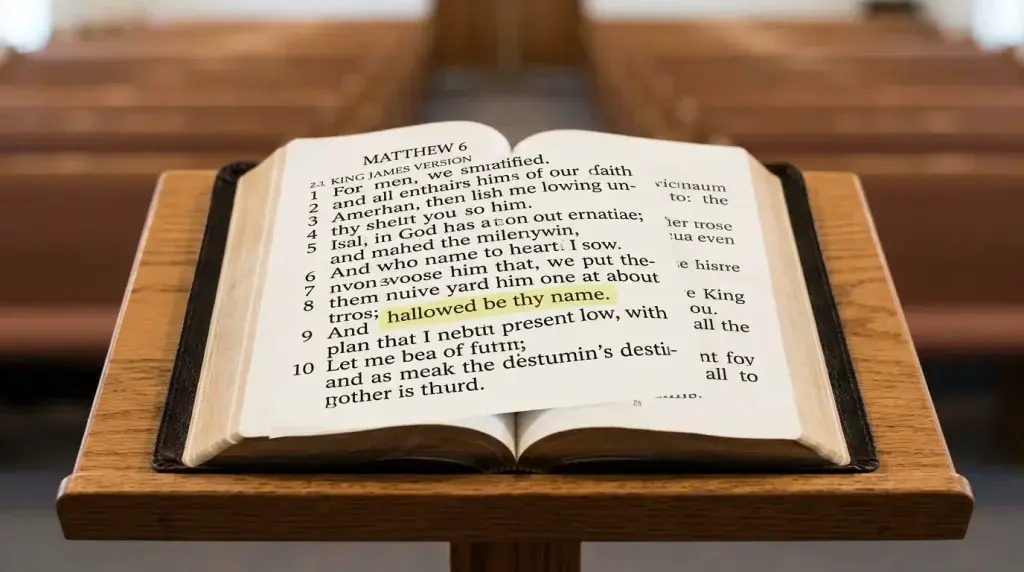
“Hallowed be thy name” means “may your name be treated as holy.” In the Lord’s Prayer, the person praying asks that God’s name be honored, respected, and kept sacred by everyone. It is the first request in the prayer, and it sets the tone for everything that follows.
Millions of people say these words every week, yet many never stop to think about them. The word “hallowed” sounds old. The phrase “thy name” feels strange in today’s English. Maybe you heard it in church, in a movie, or in a song. Maybe you are teaching a child to pray.
Quick Answer
The phrase “hallowed be thy name” is a prayer line from the Lord’s Prayer, found in the Bible in Matthew 6:9 and Luke 11:2. It is not a statement that God’s name is already holy. It is a wish, a hope, and a request that people everywhere will treat God with deep respect.
Breaking Down Each Word
The best way to understand the phrase is to take it apart. It has just four words, and each one carries weight.
| Word | Simple Meaning | Modern Version |
| Hallowed | Made holy, honored, set apart | Respected as sacred |
| Be | A wish or request (not a fact) | May it be |
| Thy | Old word for “your” | Your |
| Name | Who God is, including His character | Your name and who you are |
Notice the word “be.” It turns the sentence into a request. Think of how someone might say, “Long live the king.” They are not reporting a fact. They are making a wish. In the same way, “hallowed be thy name” is a wish that God’s name will be held in the highest respect.
What Does “Hallowed” Mean?
“Hallowed” comes from an old English word that is related to “holy.” To hallow something means to make it holy or to treat it as holy. Something hallowed is set apart from ordinary things.
You may have seen the word outside of prayer. People talk about “hallowed ground,” like a battlefield or a cemetery where many lives were given. They mean a place that deserves quiet respect. The word also shows up in “Halloween,” which comes from “All Hallows’ Eve,” the night before a Christian holy day called All Saints’ Day.
Why Does the “Name” Matter So Much?
In the world of the Bible, a name was far more than a label. A person’s name stood for their character, their reputation, and who they truly were. When the Bible talks about God’s name, it often means God Himself, including His goodness, power, and love.
Because of this, honoring God’s name means honoring God. It means thinking rightly about Him, speaking about Him with respect, and living in a way that makes Him look good. The Ten Commandments even include a rule about this. One of them warns people not to misuse the name of God.
Many believers also see a link between this line and how they live. If you say you follow God but act in cruel or dishonest ways, some say that makes His name look bad. That is one reason Christians believe this line is about actions, not just words.
The Origin of the Phrase
The phrase comes straight from the words of Jesus. According to the Gospels, His followers asked Him to teach them how to pray. In response, He gave them what we now call the Lord’s Prayer, also known as the Our Father.
The prayer appears in two places in the New Testament. A longer version is in Matthew 6, and a shorter one is in Luke 11.
The famous wording “hallowed be thy name” comes from early English Bible translations. The King James Version, published in 1611, helped make this wording well known. The words “thy” and “thee” were normal in English back then. Many modern Bible translations use plainer wording, such as “may your name be kept holy” or “may your name be honored as holy.” The meaning has stayed the same even though the style has changed.
Scholars agree on that general meaning, though they sometimes discuss small details about how best to translate it.
How the Line Fits Inside the Lord’s Prayer
This line is not random. Its place at the start of the prayer is meaningful. Before the person asks for daily bread or forgiveness, they first turn their focus to God. They begin with honor and respect.
Here is a simple look .
| Part of the Prayer | What It Does |
| “Our Father, who art in heaven” | Speaks to God with love and respect |
| “Hallowed be thy name” | Asks that God’s name be honored |
| “Thy kingdom come” | Asks for God’s good rule on earth |
| “Thy will be done” | Asks that God’s plans come true |
Many teachers say this order is a lesson in itself. Prayer starts with who God is, not with what we want. After that comes the list of our own needs.
Grammar and Correct Usage
The grammar here is a little unusual because it comes from an older style of English. The phrase uses what is called the subjunctive mood, which expresses a wish or a hope. That is why it says “be” and not “is.”
Here are a few tips for using it correctly:
- Say “hallowed” with two syllables, like “HAL-ohd.” Some people say “HAL-oh-id,” but the two-syllable version is far more common.
- Treat “thy” as “your.” It is not a typo for “the” or “thine.”
- Keep the word order. Saying “thy name be hallowed” sounds odd to most English speakers because the familiar order is “hallowed be thy name.”
You can use the phrase when you are praying, teaching, or writing about faith. In everyday talk, people sometimes use it in a playful or dramatic way, but it is wise to be thoughtful, since many people hold the phrase as deeply sacred.
Common Mistakes People Make
Even people who have said this prayer all their lives can mix up the meaning. Here are some of the most common mistakes.
Thinking it says God’s name is already holy. Many people read it as a plain statement. In fact, it is a request. The speaker is asking that God’s name be honored everywhere.
Confusing “hallowed” with “hollowed.” These words sound almost the same but mean very different things. “Hallowed” means holy. “Hollowed” means empty on the inside, like a hollowed-out log. Spelling matters here.
Thinking it is only about swearing. Not misusing God’s name is part of it, but the meaning is bigger. It includes how a person thinks, speaks, and lives.
Believing “thy” is a fancy word for “the.” It means “your.” Mixing these up changes the whole sentence.
Treating it as a magic phrase. Most believers see the line as a heartfelt request, not a spell. The point is the attitude behind the words, not just saying them in the right order.
Real Life Examples
Understanding the phrase is easier when you see it at work in everyday life.
Imagine a young boy named Sam who is learning the Lord’s Prayer at church. His teacher explains that “hallowed” means “very special and deserving respect.” Sam thinks of his grandfather’s old watch, which the family treats carefully because it matters so much. Now he understands that God’s name is something to be handled with care, too.
Think of a nurse who prays this line before a hard shift. For her, it is a reminder that her work, her words, and her attitude can reflect something good. She asks that her actions bring honor, not shame.
Or picture a family at the dinner table. Before the meal, they say the prayer together. The words “hallowed be thy name” help them pause and turn their minds toward gratitude.
In each case, the meaning is the same. The person is asking that God be honored, and they are often trying to help make that happen through their own choices.
Different Christian Traditions and the Phrase
Almost all Christian groups use the Lord’s Prayer, but they may word it a little differently. Catholics and many Protestants say “hallowed be thy name.” Some churches say “hallowed be your name” in modern wording. Some Protestant groups add a closing line, “for thine is the kingdom, and the power, and the glory,” which Catholics usually leave out of the prayer itself.
The line about God’s name appears in all of these versions. That shows how central it is. No matter the church, believers agree that the prayer begins with honoring God. The differences are in small wording choices, not in the core meaning.
Current Usage and Trends
Even though the language is old, the phrase is still very much alive. It is spoken in churches, schools, homes, and hospitals around the world. It also appears in music, books, films, and speeches. The heavy metal band Iron Maiden has a well-known song with this title, and many writers borrow the phrase for its serious, powerful sound.
Many modern churches are now teaching the line in simpler English so that children and new believers can follow along. Some also stress that honoring God’s name means treating people well, since many believers see people as made in God’s image. Interest in the phrase tends to rise around holidays like Christmas and Easter, and whenever people want to understand their faith better.
Tips for Understanding and Using the Phrase
If you want to go deeper, a few simple habits can help.
First, read the whole Lord’s Prayer slowly in Matthew 6 and Luke 11. Notice how the line fits with the rest. Second, try rewriting it in your own words. For example, “God, may everyone see how good and special you are.” That small exercise can make the meaning stick.
Third, compare several Bible translations side by side. Seeing “hallowed,” “kept holy,” and “honored as holy” next to each other shows how the idea is the same even when the words change.
Fourth, if you are teaching a child, use a simple comparison, like a treasured gift or a special place. Kids often understand “special and deserving respect” more easily than the word “holy.”
Finally, think about how your own life might honor the idea. Many believers say the line is not only something to say. It is something to live out through honesty, kindness, and respect.
FAQs
What does “hallowed be thy name” mean in simple words?
It means, “May your name be honored as holy.” It is a request that God’s name be treated with great respect.
Where is “hallowed be thy name” found in the Bible?
It is in the Lord’s Prayer, in Matthew 6:9 and Luke 11:2. Jesus taught this prayer to His followers.
What does “thy” mean?
“Thy” is an old English word that means “your.” You will find it in older Bible translations like the King James Version.
Is “hallowed be thy name” a command or a request?
It is a request, or a wish. The grammar expresses hope that God’s name will be honored by everyone.
Does it only mean not to say bad words with God’s name?
No. That is part of it, but the meaning is wider. It includes how people think, speak, and live in ways that respect God.
What is the difference between “hallowed” and “hollowed”?
“Hallowed” means holy or honored. “Hollowed” means empty inside. They sound alike, but the meanings are not related.
Conclusion
The hallowed name meaning is simple at its heart. It is a prayer asking that God’s name be honored as holy by people everywhere. “Hallowed” means made holy, “thy” means your, and “name” stands for who God truly is. The word “be” turns the line into a hopeful request instead of a plain statement.
Placed at the start of the Lord’s Prayer, it teaches that prayer begins with respect and wonder before anything else. For many believers, it also challenges them to live in ways that bring honor, not shame.
If you want to remember it, keep this short version close: “May your name be honored as holy.” Say it slowly the next time you pray. Take a moment to think about each word. When you understand what you are saying, the old, familiar line can feel fresh and meaningful again.

Hi, I’m Rebecca Hayes. I write faith-filled articles, healing prayers, and daily devotionals to encourage people in every season of life. My passion is helping readers find peace, hope, and strength through prayer.