You are carrying too many bags, and a friend steps up and says, “I got you.” Your shoulders relax. You instantly know that help has arrived. The i got you meaning is simple: it tells someone, “I will help you,” “I understand you,” or “I’ll take care of it.” It can also mean “I tricked you” in a playful way, as in “Ha! I got you!” Many readers search for this phrase because the same three words can carry very different feelings.
In this guide, you will learn each meaning, how to use it, where it may have come from, and which mistakes to avoid. You will also find easy examples, helpful tables, and clear answers to common questions.
I Got You Meaning: The Quick Answer
“I got you” means “I will help you,” “I will take care of it,” or “I understand.” People say it to offer support, promise help, or show they are on your side.
For example, “Need a ride? I got you” means “I’ll give you a ride.” And “I got you” after a long explanation can mean “I understand what you are saying.”
There is also a playful meaning. If someone jumps out and scares you, they might laugh and say, “I got you!” In that case, it means “I tricked you” or “I caught you.”
The tone and the setting tell you which meaning fits.
What Does “I Got You” Really Mean?
Let’s look at the phrase closely. The word “got” is a casual form of “have” or “take.” When you say “I got you,” you are saying “I have you,” as if you are holding someone steady. It paints a picture of someone who is there to catch or support another person.
That is why the phrase feels warm. It says, “You are safe with me.” It is short, quick, and easy to say, which makes it perfect for friendly talk.
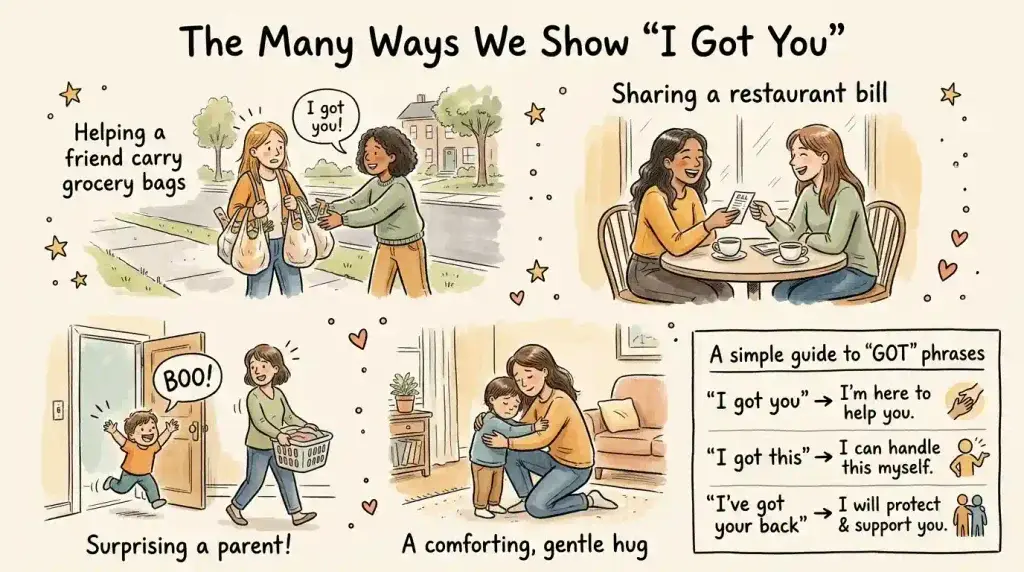
The phrase can carry four main meanings. The first is support, as in “Don’t worry, I got you.” The second is understanding, as in “Okay, I got you.” The third is payment, as in “Lunch is on me, I got you.” The fourth is playful surprise, as in “Gotcha! I got you!”
Each meaning shares one thread: someone is taking charge of a moment. They may be offering help, showing they follow your point, covering a cost, or winning a little joke.
Because the phrase is so flexible, it pays to listen to the situation. Who is talking? What just happened? Is the mood serious or silly? Those clues will usually tell you what the speaker means.
The Four Main Meanings of “I Got You”
This table gives a quick view of each meaning.
| Meaning | Example | What It Says |
| Support or help | “Don’t stress, I got you.” | I will help you |
| Understanding | “Okay, I got you.” | I understand what you mean |
| Paying or covering | “Dinner’s on me, I got you.” | I will pay |
| Playful trick | “Ha! I got you!” | I fooled or caught you |
The first meaning is the most common. When someone says “I got you” in a kind voice, they almost always mean they will help or protect you.
The second meaning shows up in talks and instructions. Imagine your coworker explains a plan, and you say, “I got you.” You are saying, “I follow you.”
The third meaning is very common in friend groups. When the check comes, someone may say, “I got you,” which means “I’ll pay.”
The fourth meaning is for fun. It is often said with a laugh after a joke or a prank.
I Got You as Support and Loyalty
This is the heart of the phrase for many people. When you say “I got you” to a friend who is struggling, you are promising to stand by them.
Think of a friend who is nervous about a big test. You say, “Relax. I got you. We’ll study together.” That sentence does more than offer help. It tells your friend, “You are not alone.”
The phrase is also used in families. A parent might say it to a child who feels scared: “It’s okay. I got you.” The words offer comfort and safety.
In sports and teamwork, it means “I have your back.” If a teammate misses a shot, another player may say, “I got you on defense.” That means “I will cover your spot.”
Because the phrase promises help, it is wise to use it honestly. If you say “I got you,” try to follow through. Words feel strong when actions match them.
I Got You as “I Understand”
Sometimes the phrase simply means “I understand” or “I follow you.” This meaning is very common in work chats, school talks, and everyday instructions.
For example, a manager says, “Please send the file by noon.” You reply, “Got it. I got you.” Here you are saying, “I understand, and I’ll do it.”
You may also hear people say it during a story. A friend explains a tricky situation, and you say, “Oh, I got you.” It means, “Now I see what you mean.”
This meaning is close to the short phrase “gotcha” or “got it.” All three can be used in nearly the same way, though “I got you” often feels a bit warmer and more personal.
A small tip can help. If someone says “I got you” right after you explain something, they most likely mean “I understand.” If they say it right after you ask for help, they most likely mean “I’ll help you.”
I Got You as Paying or Covering
In many friend groups, “I got you” means “I’ll pay.” It is a casual, kind way to offer to cover a cost.
For instance, at a restaurant, someone might say, “Put your wallet away. I got you.” Or a friend might say, “I got you for coffee today.”
This use carries a gentle message of care. It is a way to say, “Let me treat you.” Often, it comes with a smile and no strings attached.
It can also work as a promise for the future. “Next time is on you, but today, I got you” is a friendly way to share costs over time.
It is nice to say thank you when someone offers this kind of kindness. A simple “Thanks, I owe you one” keeps the friendship warm and fair.
I Got You as a Playful Trick
The phrase can also be playful. When someone sneaks up on you, plays a joke, or wins a small game, they may say, “I got you!”
For example, a child hides behind a door and jumps out. “Boo! I got you!” The meaning is “I scared you” or “I fooled you.”
In games like tag or hide and seek, it means “I caught you.” In a joke, it means “You believed me, but it was a trick.”
The tone is key here. It is usually bright, quick, and laughing. If the words are said in a harsh voice, they could sound like a warning or a threat.
If you are not sure which meaning someone intends, look at their face and voice. A smile and a laugh almost always mean it is playful.
How to Use “I Got You” in a Sentence
This phrase is easy to use. It usually stands alone as a short statement, or it comes after a small setup.
Here is a table of common patterns.
| Pattern | Example Sentence | What It Means |
| I got you. | “Need help? I got you.” | I will help |
| Don’t worry, I got you. | “Don’t worry, I got you.” | You are safe with me |
| I got you on + thing | “I got you on dinner.” | I’ll pay for dinner |
| Okay, I got you. | “Okay, I got you.” | I understand |
| Got you! | “Got you! You jumped!” | I tricked you |
| I got you, [name] | “I got you, Sam.” | A friendly personal promise |
A few simple notes can help. First, “I got you” is informal. It fits friends, family, teammates, and casual work chats. Second, you can shorten it to “got you” or “gotcha” in fast talk. Third, you can make it stronger with words like “always” or “no matter what,” as in “I’ll always got you.” Actually, the correct form is “I’ve always got you” or “I’ll always have you,” but in casual speech people often say, “I always got you.”
In very formal writing, plain words like “I will assist you” or “I understand” work better.
Real Life Examples of “I Got You”
Examples make a phrase easier to remember. Here are some common situations.
| Situation | Example | Hidden Message |
| A friend needs a ride | “I got you. I’ll pick you up.” | I’ll help |
| Group dinner | “Relax, I got you tonight.” | I’ll pay |
| Hearing directions | “Turn left, then right.” “I got you.” | I understand |
| Playing a prank | “Ha! I got you!” | I fooled you |
| Comforting someone | “It’s okay. I got you.” | You’re safe with me |
Now let’s look at a few short stories.
Marcus was moving to a new apartment and could not find enough helpers. His coworker Dee heard about it and said, “I got you. I’ll bring my truck on Saturday.” Marcus felt a huge wave of relief.
Ella was scared before her first piano show. Her older sister whispered, “You’ll be great. I got you.” Ella took a deep breath and walked onto the stage.
A boy named Theo crept up behind his dad in the kitchen and tapped his shoulder. His dad jumped. “Got you!” Theo yelled, laughing so hard he could barely stand.
These stories show how flexible the phrase is. It can be calming, helpful, or silly. The mood is always shaped by the situation.
Where Does “I Got You” Come From?
The history of this phrase is a bit fuzzy, so let’s be careful. Many websites share neat stories with exact dates and names, but those claims are often hard to prove.
What we can say is that “I got you” is made of very old, basic English words. “Got” has been used for a long time to mean “have,” “take,” or “understand.” The idea of “getting” someone, as in catching, understanding, or helping them, appears in many everyday phrases like “I get it” and “I’ve got your back.”
The phrase also became widely known through its use in speech, songs, movies, and shows. Because it is short and warm, it spread easily in casual talk.
What we do not know for sure is who first used it in each meaning. If a source gives one exact person and date, treat it with care. A safer way to say it is that the phrase grew naturally out of everyday speech and has been shaped by different uses over time.
For deeper research, trusted sources like Merriam-Webster, Dictionary.com, and Cambridge Dictionary can show how the phrase is defined.
“I Got You” vs. Similar Phrases
Many phrases sound close to “I got you.” Each has its own flavor. This table shows how they compare.
| Phrase | Meaning | Common Feel |
| I got you | I’ll help, I understand, or I’ll pay | Warm and flexible |
| I’ve got your back | I will support and protect you | Loyal and strong |
| I got this | I can handle it myself | Confident |
| Got it | I understand | Short and neutral |
| Gotcha | I understand, or I caught you | Casual and quick |
| I’m here for you | I will support you emotionally | Caring and gentle |
| Count on me | You can depend on me | Serious promise |
A key difference is “I got you” versus “I got this.” The first is about helping another person. The second is about handling something yourself. If a friend says, “I got you,” they are helping you. If they say, “I got this,” they are taking care of a task on their own.
“I’ve got your back” is a close cousin. It is a bit stronger and often used when someone is protecting you, like in a tough situation.
Using a mix of these phrases can keep your talk fresh. Still, “I got you” has a friendly, easygoing charm that is hard to match.
Is “I Got You” Grammatically Correct?
Many learners ask this question. The answer is yes, in casual English. “I got you” is a normal, spoken form that native speakers use every day.
Some people feel that “I have got you” or “I will help you” is more formal. But in daily talk, “I got you” is perfectly fine and very common.
You may also hear “I gotcha,” which is a spoken short form of “I got you.” It is even more casual and is usually written in chats and stories.
If you are writing a formal paper or a business letter, you might choose different words. For example, “I will assist you” or “I understand your request” would sound more polished.
For American English, the phrase is especially common in everyday talk. It is also understood in other English-speaking places like the United Kingdom, Canada, and Australia, though the exact wording may change a bit.
Common Mistakes to Avoid
Even simple phrases can trip people up. Here are the mistakes that show up most often.
The first mistake is mixing up the meanings. “I got you” can mean help, understanding, paying, or a trick. If the context is not clear, add a few extra words.
The second mistake is using it in formal writing. In a business report or a school paper, the phrase may look too casual. Use plain, formal words instead.
The third mistake is making a promise you cannot keep. Saying “I got you” is kind, but it works best when you really can help.
The fourth mistake is confusing it with “I got this.” One is about helping others, and the other is about handling things yourself.
The fifth mistake is using the playful meaning at the wrong time. A joke like “I got you!” may not be funny to someone who is scared or upset.
Last, avoid saying it in a harsh voice. Tone can turn “I got you” from a kind promise into something that sounds like a threat. A calm, warm voice keeps the meaning friendly.
How People Use “I Got You” Today
Today, the phrase shows up in many places. Knowing these uses can help you spot it and use it well.
In friendships, it is a common way to offer help, rides, snacks, or a listening ear. It feels easy and warm.
In text messages and social media, people use it to show support. “I got you, we’ll figure it out” is a typical message to a friend who feels stressed.
At work, coworkers say it to show they understand a task or plan to help. “I got you on that report” is a quick way to say, “I’ll handle it.”
In music and movies, it appears in many songs, lines, and scenes. Because the phrase is short and powerful, writers like it for friendship, love, and loyalty.
In parenting, it is a gentle, calming phrase. Parents say it to comfort little ones, whether during a fall, a bad dream, or a scary moment.
One small trend is worth noting. As people look for simple, honest ways to show care, short phrases like “I got you” have grown more popular. They feel real, quick, and kind, without sounding formal or stiff.
Tips for Using “I Got You” Naturally
If you want to use this phrase like a pro, a few easy habits will help.
Say it warmly. A calm, friendly tone makes the phrase feel safe and kind.
Follow through. If you say “I got you,” try to match your words with actions.
Add a little detail. “I got you, I’ll bring snacks” is clearer than a plain “I got you.”
Match it to the moment. Use the playful meaning for fun, and the supportive meaning for real needs.
Do not overuse it. Using it once in a while keeps it meaningful.
Match your reader. If you are talking to English learners, add a short note, such as “That means I will help you.”
Finally, say it out loud. If it sounds like something a caring friend would say, you are probably using it well.
FAQs
What is the simple i got you meaning?
It means “I will help you,” “I understand,” or “I’ll take care of it.” In a playful setting, it can also mean “I tricked you.”
What does “I got you” mean in a text?
Most often, it means “I will help you” or “I understand.” In a joking chat, it may mean “I fooled you.” The tone and the conversation show which one fits.
Is “I got you” the same as “I’ve got your back”?
They are close. Both show support. “I’ve got your back” is stronger and often means protecting someone. “I got you” is more flexible and can also mean understanding or paying.
What does it mean when someone says “I got you” about money?
It means they will pay or cover the cost. For example, “Dinner is on me, I got you” means “I’ll pay for dinner.”
Is “I got you” formal or informal?
It is informal. It fits friends, family, and casual chats. For formal writing, use plain words like “I will help you” or “I understand.”
What is a good reply to “I got you”?
You can say “Thanks, I appreciate it” or “Thank you so much.” If it was a favor, you can add, “I owe you one.”
Conclusion:
The i got you meaning is easy to remember. It can mean “I will help you,” “I understand,” “I will pay,” or, in a playful way, “I tricked you.” All of these meanings share one idea: someone is stepping up to take care of a moment. That is why the phrase feels so warm and friendly.
We also learned that it is informal, that its exact origin is hard to prove, and that tone and context decide which meaning fits. It is smart to use it honestly and to keep it out of formal writing.
So here is some practical advice. When a friend needs help, say it with a calm voice and then follow through. When someone says it to you, say thank you and pass the kindness along. Try it in your next chat, and notice how a simple phrase can make someone feel safe and supported.

Hi, I’m Rebecca Hayes. I write faith-filled articles, healing prayers, and daily devotionals to encourage people in every season of life. My passion is helping readers find peace, hope, and strength through prayer.