You may have heard “third-degree murder” in a news story or a crime show and wondered what it really means. You are not alone. Most people know “first-degree” and “second-degree,” but the third level is much less common. The third degree murders meaning is this: it is a killing done with extreme disregard for human life, but without a plan or a clear intent to kill. Here is a surprise.
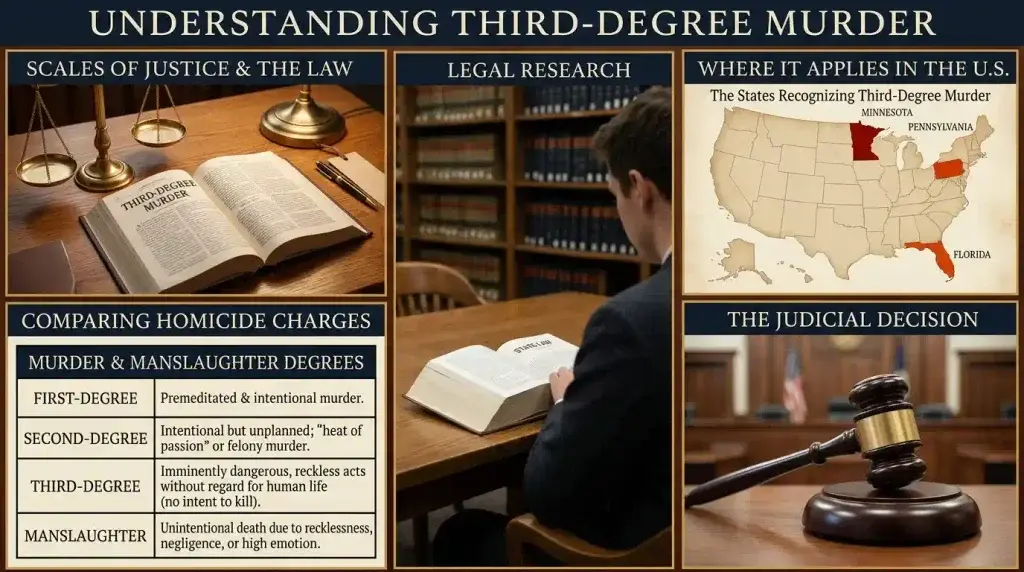
Only three states use this charge: Florida, Minnesota, and Pennsylvania. In this guide, you will learn what it means, how each state defines it, and how it differs from other charges. You will also find easy tables, clear examples, and answers to common questions.
Third Degree Murders Meaning: The Quick Answer
Third-degree murder is a type of criminal homicide. It usually means someone caused a death with a reckless, dangerous attitude, but did not plan the killing or mean to kill. It is generally treated as the lowest level of murder, but it is still a very serious crime.
The exact meaning depends on the state. Each of the three states that use the charge defines it differently.
Please note that this article is general information, not legal advice. For help with a real case, a licensed attorney is the right person to ask.
What Does “Third Degree Murder” Really Mean?
Let’s start with the big picture. The law splits murder into levels, called degrees. The degree depends on what the person was thinking and what they did. Higher degrees usually mean more planning or more intent. Lower degrees usually mean less.
In many states, first-degree murder means a planned killing. Second-degree murder often means an intentional killing that was not planned, or a killing during certain crimes. Third-degree murder sits below those. It is not about planning. It is about a dangerous act, done with a deep lack of care for whether someone lives or dies.
A key word here is “malice.” In law, malice does not always mean hate. It can mean a mindset of extreme disregard for human life. A person acts in a way that is so dangerous that death is a very likely result, and they do not care.
Another word you may hear is “depraved mind” or “depraved heart.” These old-fashioned phrases describe someone who acts with shocking disregard for others. They are used in some third-degree murder laws.
So, in simple words, third-degree murder is a killing that comes from a very dangerous, uncaring act rather than a plan or a wish to kill.
Which States Have Third-Degree Murder?
This is one of the most important facts about the topic. Most states do not use the term at all. Only Minnesota, Florida, and Pennsylvania have third-degree murder laws.
Other states may punish the same kind of act in a different way. For example, a dangerous killing without intent might be called second-degree murder, or manslaughter, depending on the state.
| State | Has Third-Degree Murder? | Where the Same Act May Go in Other States |
| Florida | Yes | Often manslaughter or felony murder |
| Minnesota | Yes | Often second-degree murder or manslaughter |
| Pennsylvania | Yes | Often second-degree murder or manslaughter |
| Most other states | No | Second-degree murder or manslaughter |
There is also no federal third-degree murder charge. Federal law has no charge by that name. Because of this, the same event could be charged very differently depending on where it happens.
If you live in a state without this charge, do not worry. It simply means your state sorts these crimes in another way.
Third-Degree Murder in Florida
Florida uses the charge in a particular way. According to legal summaries, Florida applies it to unintentional killings that happen during a felony that is not on the state’s list of serious felonies, such as robbery, arson, kidnapping, or sexual battery.
In plain words, the person did not mean to kill anyone. But a death happened while they were committing a certain kind of crime. If that crime is on Florida’s list of the most serious felonies, the charge can be first-degree murder. If it is not on the list, the charge may be third-degree murder.
The punishment is lower than for higher degrees. Florida treats it as a second-degree felony with a maximum of up to 15 years in prison. Sentencing guidelines and a person’s record can change the real outcome.
Here is a simple, made-up example. Imagine a person commits a felony that is not on the serious list. During the crime, a bystander dies by accident. The person had no plan to hurt anyone. In Florida, that situation could lead to a third-degree murder charge.
Third-Degree Murder in Minnesota
Minnesota has two main paths to this charge.
The first path is about dangerous acts. A person does something extremely dangerous to others, shows a “depraved mind,” and a death results. The person did not mean to kill anyone. But the act showed no regard for human life. Minnesota and Pennsylvania both classify depraved indifference murder as third degree.
The second path is about drugs. In Minnesota, killing someone by directly or indirectly giving them drugs can be third-degree murder. This part of the law is often used in overdose cases.
The penalty is serious. The maximum sentence in Minnesota is 25 years, and drug-related cases can also carry a fine of up to $40,000. The actual sentence often follows guidelines, and those guidelines suggest about 12.5 years for a first offense involving a depraved mind.
Here is a made-up example. Imagine a person fires a gun down a crowded street “just to scare people.” They do not aim at anyone. But a person is hit and dies. The act was so dangerous that it could fit the “depraved mind” idea.
Many people first heard the term in news coverage of high-profile Minnesota cases, which is one reason so many searches begin there.
Third-Degree Murder in Pennsylvania
Pennsylvania’s rule is the broadest. The state defines third-degree murder as any murder that is not first or second degree. In this setup, first-degree murder is an intentional killing, and second-degree murder is a death during another serious crime. Third-degree murder covers the rest.
In practice, that usually means a killing with malice but without a plan to kill, and without a qualifying felony. Pennsylvania is one of only three states with this charge.
Because the definition is wide, it can cover many different situations. A fight that goes too far, an extremely reckless act, or a killing done with a dangerous attitude may all be charged this way, depending on the facts.
On punishment, you will see different numbers in different places. One law firm blog reports a range of 10 to 20 years, but sentencing rules can change over time. For the most current limits, check the state’s official statutes or ask a Pennsylvania attorney.
Third Degree vs. Other Charges
Many people mix up the different homicide charges. This table gives a simple view. Remember that the details change from state to state.
| Charge | What It Usually Means | Intent or Mindset | Typical Seriousness |
| First-degree murder | A planned, deliberate killing | Premeditated intent to kill | Most serious |
| Second-degree murder | An intentional killing without planning, or a killing during certain crimes | Intent to kill or harm | Very serious |
| Third-degree murder | A killing from an extremely dangerous act | Malice, but no plan or intent to kill | Serious |
| Voluntary manslaughter | A killing in the “heat of the moment” | Sudden anger or strong provocation | Less serious |
| Involuntary manslaughter | An accidental death from careless acts | Carelessness, no malice | Least serious |
The big dividing line is malice. Murder, including third-degree murder, requires some form of malice, while manslaughter does not.
Here is an easy way to remember it. First-degree is “planned.” Second-degree is “meant to.” Third-degree is “didn’t care.” Manslaughter is “didn’t mean to, but should have been more careful, or lost control.”
Third-Degree Murder vs. Manslaughter
This is one of the most common questions. Both involve a death without a plan to kill. So what is the difference?
The key idea is the mindset. Manslaughter usually involves carelessness or sudden strong emotion. Third-degree murder involves a deeper level of disregard for human life.
Imagine two drivers. The first driver looks at a phone for a moment and causes a crash that kills someone. That is a tragedy, and it is usually seen as carelessness. It may be charged as manslaughter or a similar offense. The second driver races at high speed through a crowded school zone on purpose, ignoring everyone. A court may see that as a much more extreme disregard for life.
Still, each state draws the line in its own way, and judges and juries look at all the facts. That is why the same type of event can lead to different charges in different places.
Real Life Examples of the Ideas Behind Third-Degree Murder
Examples help make a hard topic easier to understand. These are made-up situations that show the ideas, not real cases.
| Situation | Why It May Fit | Why It May Not |
| A person fires a gun into a crowded area to scare people, and someone dies | Extremely dangerous act, no plan to kill | If the person aimed at someone, it could be higher |
| A person gives dangerous drugs to someone and the person dies (Minnesota) | Drug-related death rule | Facts and proof matter a lot |
| A death during a non-listed felony in Florida | Unplanned killing during a felony | If the felony is on the serious list, the charge may be higher |
| A fight with a weapon that ends in death | Malice without a plan, in a state like Pennsylvania | If it was a sudden fight with strong provocation, it might be manslaughter |
Please remember that prosecutors, judges, and juries decide real cases. Many details, such as the person’s thoughts, their actions, and the law of that state, shape the final charge.
What Must Be Proven in a Third-Degree Murder Case?
In a criminal case, the government must prove each part of the charge beyond a reasonable doubt. That is a high standard.
In a third-degree murder case, the main points often include the following. First, a person died. Second, the defendant caused the death. Third, the defendant acted with the required mindset, such as malice or a depraved mind, or committed the needed act under that state’s law.
Proof of the mindset is often the hardest part. Nobody can read a person’s mind, so lawyers use facts. They may look at what the person did, what they said, how dangerous the act was, and what a reasonable person would have known.
Defenses vary. Some states, including Florida, have Stand Your Ground laws, and others have castle doctrine laws. A person may also argue that they did not cause the death, that it was an accident, or that they acted in self-defense. Every case is different, which is why legal advice matters.
How Is Third-Degree Murder Punished?
Third-degree murder is usually punished less harshly than first or second degree. But it is still a serious crime with long prison terms.
| State | Reported Maximum | Notes |
| Florida | Up to 15 years | Treated as a second-degree felony |
| Minnesota | Up to 25 years | Drug cases may add fines |
| Pennsylvania | Varies; check current law | Sources report different ranges |
Sentences can change because of a person’s past record, the facts of the case, and the state’s guidelines. Courts may also consider whether there were special factors, such as harm to a vulnerable victim.
Because laws change, anyone who needs exact numbers should read the current state law or speak with a lawyer. A news story or blog post, including this one, may be out of date.
Where Does the Idea of Degrees of Murder Come From?
The idea of splitting murder into degrees has a long history. Many legal writers credit Pennsylvania as an early leader, with a law from the 1790s that separated murder into levels. The goal was to save the harshest punishments for the most serious killings and to treat less serious cases differently.
Over time, other states adopted their own versions. Many used two degrees, and a few used three. Today, the result is a patchwork. States use different words and different lines.
What we cannot say for sure is every detail of how each state’s law developed. Legal history is complex and often debated. For deeper study, trusted sources like state legislature websites, the Legal Information Institute at Cornell Law School, and law school libraries can help.
Common Mistakes and Myths
Because the topic is serious and confusing, a few myths pop up often.
The first myth is that every state has third-degree murder. As we saw, only three do. Do not assume your state uses it.
The second myth is that third-degree murder is “not really murder.” It is still murder. It simply means a lower level than the others, and it carries long prison terms.
The third myth is that it always means an accident. It does not. It involves malice or a dangerous attitude, which is different from a pure accident.
The fourth myth is that crime shows show it correctly. TV often uses legal words loosely. Real cases follow detailed state rules.
The fifth mistake is mixing up “third degree” in other settings. You may also hear “third-degree burn,” or the phrase “giving someone the third degree,” which means asking tough questions. Those have nothing to do with the legal charge.
Last, avoid treating any online article as legal advice. Laws change, and facts matter.
FAQs
What is the simple third degree murders meaning?
It means a killing caused by an extremely dangerous, uncaring act, without a plan or intent to kill. It is the lowest level of murder in the states that use it.
Which states have third-degree murder?
Only Florida, Minnesota, and Pennsylvania have this charge. Other states handle similar cases as second-degree murder or manslaughter.
Is third-degree murder the same as manslaughter?
No. Third-degree murder involves malice or a depraved mind. Manslaughter usually involves carelessness or sudden strong emotion, not malice.
What is the penalty for third-degree murder?
It depends on the state. Florida’s maximum is up to 15 years, and Minnesota’s is up to 25 years. Pennsylvania’s numbers vary by source, so check current law.
Is there a federal charge of third-degree murder?
No. Federal law has no charge by that name. The charge exists only in the three states listed above.
Can I get legal advice from this article?
No. This article gives general information only. For help with a real situation, contact a licensed attorney in your state.
Conclusion:
The third degree murders meaning comes down to one clear idea: a killing that happens because of an extremely dangerous, uncaring act, not because of a plan or a wish to kill. It is the lowest level of murder, but it is still a very serious crime with long prison terms.
We also learned that only Florida, Minnesota, and Pennsylvania use the charge, that each state defines it differently, and that it is different from manslaughter because it involves malice or a depraved mind. Laws change, and every case depends on its facts.
So here is some practical advice. If you want to understand a news story, check which state it happened in, because the meaning depends on local law. If you need help with a real situation, speak with a licensed attorney. Knowing the basics can make the news, and the law, a little less confusing.

Hi, I’m Elias Monroe. I enjoy writing meaningful prayer content that helps people feel calm, hopeful, and spiritually strong. My goal is to share words that bring comfort during both joyful and difficult times.