
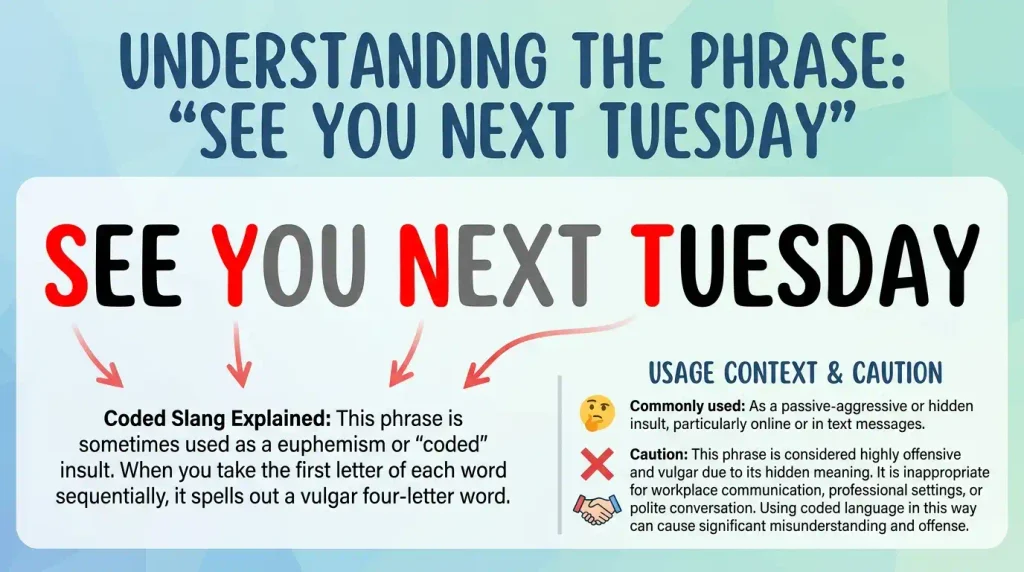
You have probably seen “see you next Tuesday” written in a text, a comment and something about it felt off. That’s because this phrase is not really about making weekend plans.
It is a sneaky way to spell out a rude word using the first letters of each word. People use it to insult someone without typing the actual swear word.
In this article, you will learn exactly what “see you next Tuesday” means why it can still upset people .
Quick Answer
“See you next Tuesday” is a hidden way of saying a vulgar insult. If you look at the first letter of each word, you get C-U-N-T, which spells out a curse word.
People use the phrase “see you next Tuesday” as a joke so they can insult someone in public.
Meaning or Definition
At its core, “see you next Tuesday” is an acronym-style insult. It takes a common, everyday phrase and uses it as a stand-in for a much harsher word.
But when you spell out the first letter of each word, “see,” “you,” “next,” and “Tuesday,” you get a word that is widely seen.It lets people say something rude while keeping a straight face, since the words themselves are completely normal.
Because of this double meaning, the phrase pops up a lot in comedy, sarcasm, and casual insults between friends who both understand the joke.
Origin or History
The exact start of this phrase is hard to pin down, since slang like this usually spreads through spoken conversation.
However, language experts generally agree it grew out of a common habit in English slang: taking offensive words and hiding them inside normal-sounding phrases so they can slip past censors, workplace rules, or polite company.
This kind of wordplay became especially popular once text messages, early internet chatrooms, and social media made written communication a huge part of daily life.
“See you next Tuesday” fits perfectly into this pattern because “Tuesday” starts with an unusual letter that most people would not expect at the end of a curse-word acronym, which is part of what makes it work so well as a disguise.
That film helped push the phrase further into mainstream pop culture, even though many viewers did not immediately catch the hidden meaning behind the title.
Grammar or Correct Usage
Grammatically, “see you next Tuesday” works exactly like a normal goodbye phrase. It can stand alone as a complete sentence, and it follows regular English sentence structure with a subject understood (“I will”) followed by “see you next Tuesday.” Because it looks so ordinary on paper, that is exactly why it works as a hidden insult.
People rarely explain the hidden meaning out loud when they say it, since the whole point is that only some listeners will understand the real message. Here is a quick breakdown of how the phrase compares to its hidden meaning.
| Phrase Part | Letter | Hidden Word Connection |
| See | C | First letter of the hidden word |
| You | U | Second letter of the hidden word |
| Next | N | Third letter of the hidden word |
| Tuesday | T | Fourth letter of the hidden word |
This table shows exactly why the phrase spells out what it does using words that otherwise sound completely innocent.
Common Mistakes
A lot of people make mistakes when they first come across this phrase, mostly because it looks so harmless. Here are a few common misunderstandings.
One mistake is thinking the phrase is always meant as a joke. While it is often used playfully between friends who know the reference .The tone and situation matter a lot here.
Another mistake is not realizing how offensive the hidden word actually is. Using the phrase carelessly, especially at work, school, or in professional writing, can lead to serious consequences.
Some people also confuse this phrase with genuinely innocent uses of “see you next Tuesday,” such as when someone is scheduling an actual meeting for the following Tuesday. Context is everything. If two coworkers are planning a real appointment, the phrase is not an insult at all.
Real-Life Examples
Understanding this phrase gets easier with a few real examples of how it shows up in everyday life.
That mismatch is often a signal the phrase is being used as a hidden jab rather than a real scheduling note.
On social media, you might see it used in a comment section under a post about someone unpopular, where a user writes “see you next Tuesday” as a way to insult that person publicly while avoiding automatic word filters that block actual curse words.
In casual conversation between close friends, someone might jokingly say “see you next Tuesday” as a lighthearted, teasing insult, similar to calling a friend a goofball or a jerk in an exaggerated way.
Current Usage or Trends
Today, “see you next Tuesday” continues to show up across social media platforms, comment sections, group chats, and even in some song lyrics or movie dialogue. It remains popular specifically because it lets people bypass automatic content filters that many platforms use to catch and block offensive language.
Some apps and websites have caught on and now flag the full phrase “see you next Tuesday” the same way they would flag the actual curse word, especially on platforms aimed at younger audiences or professional communication. This shows that platform moderators are aware of the hidden meaning and are actively working to prevent people from using it as a loophole.
Despite this, the phrase still spreads because slang constantly evolves, and new versions or spins on the same trick keep appearing. Understanding phrases like this can help you read tone more accurately in texts, comments, and online conversations, especially when something feels a little too sarcastic or oddly specific for no clear reason.
Tips or Best Practices
If you come across this phrase and are not sure how to respond, here are a few simple tips that can help.
| Situation | Recommended Response |
| A friend says it as a joke | Laugh it off if you’re comfortable, or ask directly what they mean |
| A stranger says it online | Ignore or report it if it feels targeted or hostile |
| It’s used in a professional setting | Address it directly, since it can count as inappropriate language at work |
| You’re unsure of someone’s intent | Ask for clarification before assuming it’s an insult |
FAQs
What does “see you next Tuesday” really mean?
It is a hidden way of spelling out a vulgar insult using the first letter of each word, which together spell a curse word.
Is “see you next Tuesday” always an insult?
No. If used to talk about an actual future meeting on a Tuesday, it is completely innocent. It only becomes an insult when someone uses it with that hidden meaning in mind.
Where did the phrase come from?
Its exact origin is unclear, but it grew out of a common slang habit of hiding offensive words inside normal-sounding phrases, and it became more widely known after a 2011 film used it as a title.
Is it appropriate to use at work?
No. Even though it looks harmless, using it with the hidden meaning in mind can be seen as inappropriate or offensive language in a professional setting.
Do social media platforms block this phrase?
Some platforms do flag or filter it, especially ones aimed at younger users, since moderators are aware of its hidden meaning.
How can I tell if someone means it as an insult?
Pay attention to context and tone. Tense conversation before hand are all clues it might be used as a hidden job.
Conclusion
“See you next Tuesday” might look like an ordinary, friendly phrase at first glance, but it actually hides one of the most offensive words in the English language behind its first letters. If it shows up in a joke between friends, a sarcastic online comment, or an old movie title, the meaning behind it stays the same.
Now that you understand where it comes from and how people use it, you can spot it more easily in conversations, texts, and comment sections. When in doubt, always pay attention to context, tone, and intention before deciding how to respond to it.

Hi, I’m Rebecca Hayes. I write faith-filled articles, healing prayers, and daily devotionals to encourage people in every season of life. My passion is helping readers find peace, hope, and strength through prayer.





1 thought on “See You Next Tuesday Meaning: What This Phrase Really Means<p class="post-updated-date">🕓 <span class="updated-label">Last updated on</span> <time datetime="2026-09-29T05:47:39+00:00">September 29, 2026</time></p><script type="application/ld+json"> { "@context": "https://schema.org", "@type": "BlogPosting", "mainEntityOfPage": { "@type": "WebPage", "@id": "https://prayyeralert.com/see-you-next-tuesday-meaning/" }, "datePublished": "2026-09-27T01:19:14+00:00", "dateModified": "2026-09-29T05:47:39+00:00" } </script>”