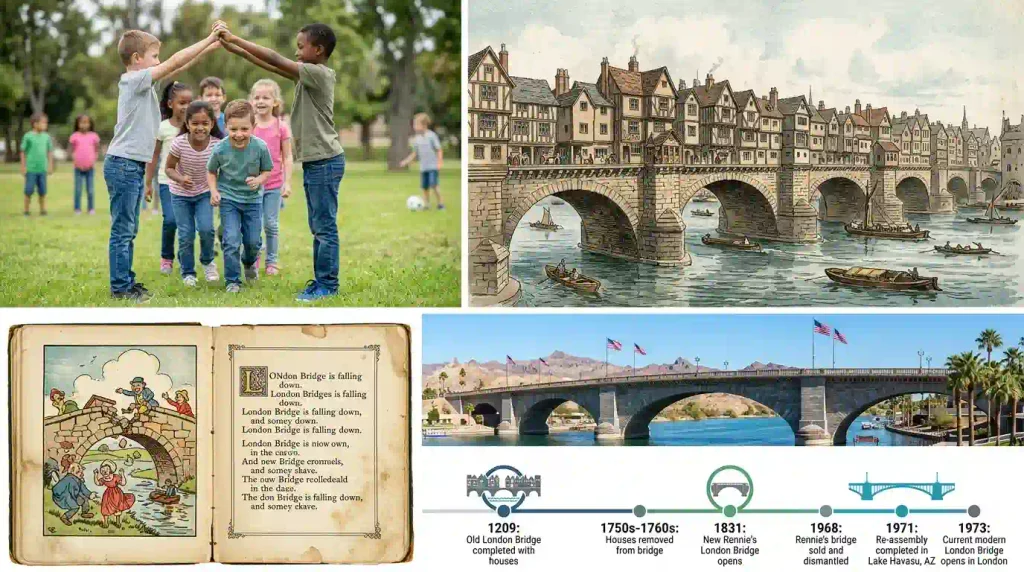
You probably learned this song when you were very small. You held hands with a friend, made an arch, and giggled as the “bridge” came down. But have you ever stopped to ask what it all means? Many parents, teachers, and curious adults search for the London Bridge falling down every day. The song sounds happy, yet the words talk about a broken bridge, a lost lady, and a guard who stays up all night. That is a strange mix for a nursery rhyme.
“In this article, you will learn what the words mean, where the song may have come from, and which stories are true and which are only guesses. You will also see how the real bridge changed over 800 years.“
Grab a snack and let’s cross this bridge together.
Quick Answer: What Does the London Bridge Falling Down Meaning?
The London Bridge is falling down meaning it is simple on the surface. The rhyme is about a bridge that keeps breaking, and people who keep trying to fix it with stronger materials. Nobody knows for sure what it was first about. Popular guesses include a Viking attack, real repairs, and o
ld fears about bridges. The song may be all of these, or none of them.
That is the honest answer. Many websites claim they have solved the mystery. They have not. Experts who study folk songs say the true beginning is lost. What we do have is a paper trail that starts in the 1700s and a lot of history about the real bridge that makes the guesses easier to test.
What the Rhyme Actually Says
Let’s start with the words. Nursery rhymes change from place to place, so you may know a slightly different version. Most versions follow the same plot, though. First, the bridge is falling down. Then someone says, “Build it up with wood and clay,” but the wood and clay wash away. Next comes a new plan. Builders try bricks and mortar, but those do not last either. After that, they try iron and steel, and bend and bow. The final plan is silver and gold, and then a guard is set to watch over the bridge all night.
In many versions, the song also mentions a “fair lady.” She seems to be the person the song is speaking to, or the person who is affected by the broken bridge.
Here is a quick table that shows how each part of the story might be read.
| Part of the Rhyme | Plain Meaning | Possible Deeper Reading |
| Bridge is falling down | The bridge is broken | Real damage from floods, ice, fire, or war |
| Wood and clay | The first, cheap repair | Early bridges were often made of timber |
| Bricks and mortar | A stronger try | Stone and brick came later |
| Iron and steel | An even stronger try | Modern building materials |
| Silver and gold | A very costly try | Money problems, or a wish for something perfect |
| Man to watch all night | A guard for safety | Fear of thieves, or old sacrifice tales |
Notice something. The rhyme reads like a list of failed repairs. Each fix is stronger than the last, and each still fails. That pattern is one reason the song has stuck around. It is easy to remember, and it makes a small story kids can follow.
The Oldest Written Version
Here is what we know for sure. The first printed version we can point to appeared in 1744. It was in a book called Tommy Thumb’s Pretty Song Book, printed in London. That does not mean the rhyme was born in 1744. It only means that it is the earliest copy that has survived.
Folk songs usually live by word of mouth for many years before someone writes them down. So the rhyme could be much older. Some experts think it has been sung for several hundred years, maybe more. But we cannot prove a date earlier than the 1700s. This is why any writer who says “this rhyme is exactly 1,000 years old” is guessing.
In the 1800s and 1900s, collectors gathered many versions from all over Britain and the United States. Modern folk song researchers gave the rhyme an index number, 502, in the Roud Folk Song Index. That number helps scholars track its many versions across time.
Theory One: The Viking Attack of 1014
This is the most famous story about the London Bridge falling down. It says the song is about a Viking attack in the year 1014.
The tale comes from an old Norse book written in the 1200s. It says that a Norse leader named Olaf tied ropes to the bridge’s posts during a battle. His ships rowed away with the ropes, and the bridge came crashing down. This helped his side take the city.
It is a great story, and it sounds like it fits the song. But there is a big problem. The Norse book was written about 200 years after the event, and it tells the story in the style of a saga. That is closer to a legend than a news report. Also, there is no clear link between that tale and the nursery rhyme. Nobody has found a bridge of songs stretching from 1014 to 1744.
So is the Viking theory false? Not necessarily. It is just unproven. Historians usually call it a fun possibility, not a fact.
Theory Two: Real Repairs and Real Trouble
The second theory is much more down to earth. It says the rhyme is about the real bridge, which really did have many problems.
Old London Bridge was finished in 1209. Builders used stone, and it stood for more than 600 years. That is a long time, but it was never in perfect shape. Ice damaged it in 1281, and part of it fell. Fires burned on and near it. A big fire in 1212 trapped many people on the bridge. The river ran fast through narrow gaps between the piers, and the water wore at the stone all the time.
The bridge also cost a lot to keep up. Money for repairs was meant to come from special funds and tolls. Some historians say that in the 1200s, part of this money was sent to a queen, Eleanor of Provence, and the bridge went without care. If that is true, the “fair lady” in the song might be her. That idea is popular, but it is still a theory.
What makes this theory attractive is that it does not need a secret code. A bridge that breaks a lot and needs constant fixing is a very good reason for a song about a bridge that breaks a lot and needs constant fixing.
Theory Three: The Dark Sacrifice Story
Now for the spooky one. Some people say the rhyme hints at an old, gruesome custom. In this tale, builders long ago buried a person inside a bridge or wall to keep it strong. The “man to watch all night” is then said to be a guard, or even a ghost.
This idea is very popular online because it sounds shocking. But be careful. Stories about people being buried in walls show up in folk tales across Europe. Yet historians have not found any real proof that this happened at London Bridge. No bones were found in its stones. No records mention it.
So it is best to treat this one as a legend. It tells us more about how people feel about scary old stories than about how the rhyme began. It is fine to mention it, but it is not fair to call it the answer.
The Theories Side by Side
It helps to see all three ideas together. This table shows what each one says, what supports it, and what is missing.
| Theory | Main Idea | What Supports It | What Is Missing |
| Viking attack, 1014 | Song is about Olaf pulling down the bridge | An old Norse saga tells the story | Written 200 years later, no link to the rhyme |
| Real bridge trouble | Song is about repairs and damage | Ice, fire, and cost problems are well documented | No proof of exactly when the song began |
| Sacrifice legend | Song hints at a buried person | Similar tales exist in many countries | No physical or written proof for London Bridge |
If you had to bet, the second theory has the strongest ground, because the bridge’s problems are so well recorded. But a careful writer will always say the same thing: the true origin is unknown.
Who Is the “My Fair Lady”?
This line puzzles many readers. Who is she?
There are a few ideas. One says she is Queen Eleanor, as mentioned above. Another says she is Queen Matilda, a queen who is linked in some stories to building bridges around London. A third idea says she is simply a made-up figure. The phrase “fair lady” was a common way to address a woman in old songs, so she may not be a real person at all.
Here is a small tip for anyone teaching this song. You can tell children that no one knows who she is, and that is part of the fun. It lets them make up their own story. That is a healthy way to enjoy a folk rhyme, and it is also honest.
What the Building Materials Mean
The list of materials is where the song gets interesting. Wood and clay would be quick and cheap. Bricks and mortar are stronger. Iron and steel are stronger still. Silver and gold are the most costly, and they are not even good for building.
Why would the song end with silver and gold? A few readers think it shows a person losing hope. If nothing strong enough works, why not try the most precious things? Others think it is just a fun way to make the song more exciting, like a child saying, “Well, what if we made it out of diamonds?”
There is also a practical reading. Old London Bridge was expensive to fix, and money was always a worry. So a song that ends with silver and gold could be a joke about high costs. Again, no proof. But it makes sense.
Why a Guard Watches All Night
The final part says a man is set to watch the bridge. This might sound odd, but there is a simple reason it feels right. Bridges have always been important places. They carried trade and travelers, and they had to be protected from thieves and enemies.
Old London Bridge even had gates and towers at its ends. Guards did stand watch. So the “man to watch all night” fits real life. For kids, the line just adds a bit of suspense. Someone is keeping the bridge safe while everyone sleeps.
The Game Behind the Song
The song is also a game, and for many people that is the real meaning. Two players face each other and lift their hands to make an arch. Everyone else walks through in a line while singing. When the song ends, the arch drops and catches whoever is under it.
Some versions have the caught player pick a side, and then the game becomes a tug-of-war. Other versions just let the caught player become part of the arch. It is silly, fast, and easy to learn. That is why the game has lasted for so many years.
Many folk experts point out that games and songs often travel together. The song gives the beat, and the game gives the fun. Even if the words were once about something serious, children mostly care about the running and the catch.
Similar Rhymes Around the World
Here is a fact that surprises many people. London is not the only city with a “falling bridge” rhyme. Similar songs and games exist in several European languages. In some, the city is different. In others, the bridge has a different name. The pattern of an arch game with a bridge song shows up again and again.
This tells us something important. The rhyme may not be about London at all. It may come from a shared idea that many cultures had, and London may have adopted it or added its own name. That would explain why no single event can be matched to the song.
It also shows how nursery rhymes work. They travel, change, and pick up new meanings along the way. A song can start in one place and end up somewhere very different.
The Real London Bridge Through Time
Now let’s look at the actual bridge. The story of London Bridge is even more interesting than the guesses. This table gives a quick timeline.
| Year | What Happened |
| Around 1014 | Legend says a Viking attack brought down a bridge |
| 1209 | Old stone London Bridge is finished |
| 1212 | A big fire causes a terrible disaster on the bridge |
| 1281 | Ice damages the bridge and parts fall |
| 1831 | A new bridge opens after the old one is taken down |
| 1968 | The 1831 bridge is sold to an American businessman |
| 1971 | The rebuilt bridge opens in Lake Havasu City, Arizona |
| 1973 | A newer London Bridge opens in London |
The old bridge was not just a road. It was a busy street over the river. People built houses and shops right on it. Some buildings were several floors tall. It was crowded, noisy, and full of life. For centuries, it was the only bridge across the river in central London.
The Bridge That Moved to Arizona
This part of the story is real, and it is a favorite. When the 1831 bridge became too weak for modern traffic, London sold it. In 1968, an American businessman named Robert McCulloch bought it for a little over two million dollars. Workers numbered the stones, took the bridge apart, and shipped the pieces across the ocean. They put it back together in Lake Havasu City, Arizona, where it opened in 1971.
You may have heard that he thought he was buying Tower Bridge. That is a popular joke, but he and others have denied it. It is better to call it a myth.
So if you ever visit Arizona, you can walk over a piece of the London Bridge from the 1800s. It is the same bridge that gave the old rhyme a brand-new life in America.
Common Mistakes and Myths
Because this topic is so popular, a lot of half-true claims float around. Here are the ones to watch for.
The first myth is that the rhyme is definitely about the Vikings. It might be, but no one can prove it. The second myth is that the rhyme is about the Great Fire of London in 1666. That fire did damage buildings near the bridge, but it did not destroy the bridge, and the rhyme was not written down until later. The third myth is that someone was buried alive under the bridge. There is no proof. The fourth is that the “London Bridge” in Arizona is the one from the rhyme. It is the bridge from 1831, not the medieval one.
There is also a mix-up with Tower Bridge. Many visitors see the two towers and the blue-and-white bridge and think, “That must be London Bridge.” It is actually Tower Bridge, a different bridge nearby. London Bridge is plainer and quite simple to look at.
Why the Rhyme Still Matters Today
So why do we still sing it? There are a few good reasons. First, the tune is easy. Even very young children can remember it after a few tries. Second, the story is simple to follow. Something breaks, people try to fix it, and things keep going wrong. Kids understand that.
Third, the game is fun. It gets people moving and laughing. And finally, the rhyme has a touch of mystery. When you tell a child that no one knows where the song came from, their eyes light up.
Teachers also use the rhyme to talk about materials, problem-solving, and history. You can ask, “Which material do you think would work best?” or “Why would silver and gold be a poor choice?” That turns a simple song into a small science lesson.
Tips for Sharing the Song With Kids
If you want to explain the song to a child, keep it short and honest. Tell them the song is about a bridge that keeps breaking. Say that people tried different ways to fix it. Then add that nobody knows for sure where the song came from, and that is what makes it a mystery.
You can also make it a game with a history twist. After playing, show them a picture of the real bridge. Point out the old houses that once stood on it. Ask them what they would build a bridge from.
If the child asks about the darker theories, you do not need to share every scary detail. It is fine to say, “Some old stories are spooky, but no one has proof.” That is honest and gentle.
FAQs
What is the meaning of the London Bridge falling down meaning in simple words?
It is a song about a bridge that keeps breaking and needs repairs. Nobody knows the exact reason it was first sung. It could be about real bridge trouble, an old battle, or just a fun game.
Is the rhyme about a real event?
It may be, but there is no proof of which event. The bridge really did suffer from ice, fire, and lack of money. But the song has never been tied to one clear day or story.
Who is the fair lady in the song?
No one knows. Some say she is a queen, such as Eleanor of Provence, while others say she is only a made-up figure. “Fair lady” was a common phrase in old songs.
When was the rhyme first written down?
The earliest known printed version appears in a London book from 1744. The song may be older than that, but that is the earliest copy we can point to.
Is the song really about a person buried in the bridge?
That is only a legend. Similar stories exist across Europe, but historians have found no proof that it happened at London Bridge.
Conclusion
The London Bridge is falling down meaning there is not one neat answer. On the surface, it is a song about a broken bridge and a list of repairs. Underneath, it may be about Vikings, queens, real floods, or nothing at all. What we know for certain is that the rhyme was printed in 1744, that the real bridge had many troubles, and that a version of the bridge now stands in Arizona.
The best way to enjoy the song is to hold both ideas at once. It is a simple game for little hands, and it is also a puzzle from the past. Next time you sing it, try sharing one true fact with the kids around you. Tell them that no one has solved the mystery yet. Who knows? Maybe one of them will grow up to find the answer.

Hi, I’m Elias Monroe. I enjoy writing meaningful prayer content that helps people feel calm, hopeful, and spiritually strong. My goal is to share words that bring comfort during both joyful and difficult times.