A variable in math is a letter or symbol that stands for a number. That number might be unknown, or it might change. This is the simple variable meaning in math, and it is the key to algebra.
Maybe you looked at a worksheet and wondered why letters showed up in a number class. You are not alone. Many students feel confused the first time they see an x or a y. The good news is that variables are easier than they look. They are just labels, like name tags for numbers.
In this guide, you will learn what variables are, why we use them, and which letters are popular. You will also see real examples, common mistakes, and easy tips. By the end, those mystery letters will feel friendly.
Variable Meaning in Math: The Quick Answer
A variable is a symbol, usually a letter, that holds the place of a number. The number can be unknown, like the answer you are trying to find. Or it can change, like the temperature outside during the day.
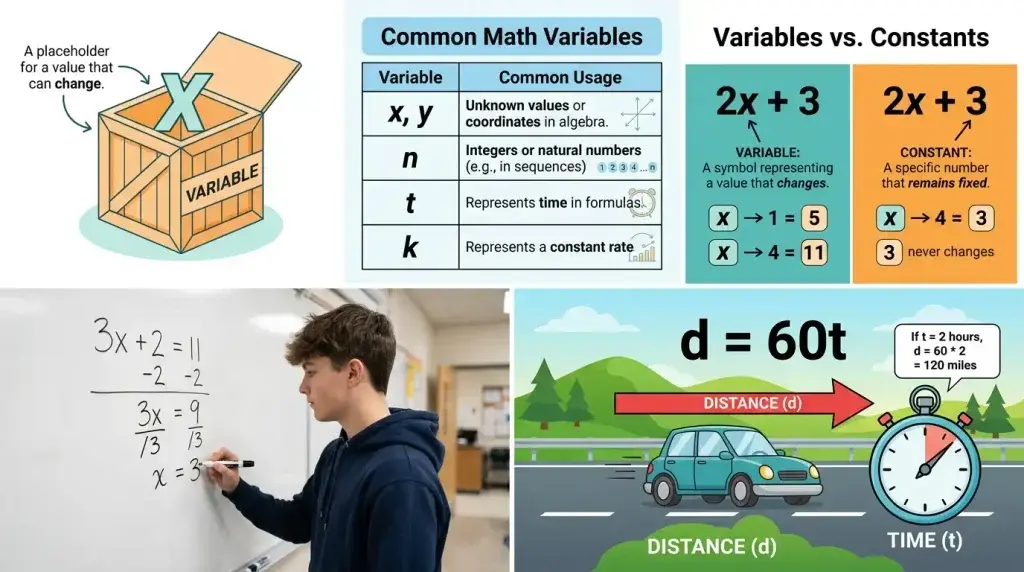
Think of a variable as an empty box with a label on it. The label might say x. Today the box might hold a 5. Tomorrow it might hold a 12. The box stays the same, but what is inside can change.
Here is a tiny example. Look at this sentence: x + 3 = 7. The letter x is a variable. It is hiding a number. To find it, ask yourself, “What plus 3 makes 7?” The answer is 4, so x = 4. You just solved for a variable.
That is the heart of it. A variable lets us talk about numbers without naming them yet. This helps us write rules, solve puzzles, and describe the world in a short, clean way.
Why Do We Use Letters Instead of Numbers?
You might ask, “Why not just use numbers?” Fair question. The answer is that letters give us power that single numbers cannot.
Imagine you want to find the area of a rectangle. You could say, “A rectangle that is 4 feet long and 3 feet wide has an area of 12 square feet.” That works for one rectangle. But what about a rectangle that is 10 feet by 6 feet? You would need a whole new sentence.
With variables, you write one rule that works for every rectangle: A = l × w. Here, A stands for area, l stands for length, and w stands for width. Now you can plug in any numbers you like. One short rule replaces thousands of long sentences.
Variables also help when we do not know a number yet. Say a store sells pencils at the same price each. You buy some pencils and spend $6. How much did each cost? You can write the problem with a variable and then solve it. Without a variable, it is hard to even start thinking about the problem in an organized way.
So letters are not there to scare you. They are there to save time, show patterns, and make hard problems easier to handle.
Common Letters Used as Variables
Any letter can be a variable. In practice, though, some letters show up again and again. Over many years, math writers have built habits, and these habits help everyone read math more quickly.
The letters x, y, and z are the most famous. People often use x for the number they want to find. The letter y often goes along with x when two numbers are connected. The letter n is a favorite for counting numbers, like 1, 2, 3, and so on. Letters such as a, b, and c often stand for numbers that are fixed for a problem, like in the rule y = ax + b.
Many letters are chosen because they remind us of a word. Using the first letter of a word makes it easier to remember. The table below shows some popular choices.
| Letter | What It Often Stands For | Example |
| x | An unknown number | x + 5 = 9 |
| y | A second number that depends on x | y = 2x |
| n | Any counting number | n + 1 is the next number |
| t | Time | d = 50t |
| d | Distance | d = rt |
| r | Rate or speed | d = rt |
| l | Length | A = l × w |
| w | Width | A = l × w |
| A | Area | A = l × w |
| s | Side of a square | P = 4s |
These are habits, not strict laws. If a problem says “let b be the number of books,” then b means books in that problem. Always read the problem to see what each letter means.
Variables vs. Constants
To fully understand variables, it helps to meet their opposite. A constant is a value that never changes. The number 7 is always 7. The number 100 is always 100.
Some constants are written as letters or symbols, which can be a bit tricky. The best example is pi, written as π. Pi is always about 3.14159, no matter what problem you are working on. So even though π looks like a letter, it is a constant, not a variable.
Here is a simple way to tell them apart. Ask yourself, “Can this change or be different?” If yes, it is likely a variable. If no, it is a constant.
| Feature | Variable | Constant |
| Value | Can change or be unknown | Always stays the same |
| Looks like | Usually a letter, like x | A number, or a special symbol like π |
| Example | The number of students in a class | The number of days in a week |
| In an equation | The “x” in 2x + 3 = 11 | The “3” and “11” in 2x + 3 = 11 |
Look at the expression 2x + 3. The 2 and the 3 are constants. The x is the variable. Most math sentences are a mix of both.
Types of Variables You Will Meet
As you learn more math, you will notice that variables play different roles. You do not need to memorize fancy names. Just see how each one behaves.
The first kind is the unknown variable. This is a number you are trying to find. In the equation x − 2 = 8, the letter x is unknown. Your job is to figure out that it equals 10.
The second kind is the changing variable. Here, the value really does change. Think about your age, the price of gas, or the height of a plant. These things are different from day to day. A letter can stand for any of those values.
The third kind shows up when two quantities are linked. Mathematicians call these the independent variable and the dependent variable. The independent variable is the one you choose or change. The dependent variable is the one that reacts. Suppose you earn $10 for every hour you work. The hours you work are the independent variable. The money you earn depends on the hours, so it is the dependent variable. We can write this as m = 10h.
Knowing these roles helps you read word problems with confidence. When you see a problem, ask, “What am I trying to find? What can change? What depends on what?” Those questions point you toward the right variables.
How Variables Work in Expressions and Equations
Now let’s see variables in action. There are two main places you will find them: expressions and equations.
An expression is a math phrase with no equals sign. For example, 4n + 1 is an expression. It does not say anything is equal to anything. It just describes a calculation. If n is 3, then 4n + 1 becomes 4 × 3 + 1, which is 13. If n is 5, it becomes 21. The same expression gives different answers when the variable changes.
An equation is a math sentence with an equals sign. It says two things have the same value. For example, 3x + 2 = 11 is an equation. To solve it, you want to find what x must be. First, take away 2 from both sides, which gives 3x = 9. Then divide both sides by 3. You get x = 3. You can check your answer by putting 3 back in: 3 × 3 + 2 is 11. It works.
One more tip is worth knowing. When a number sits right next to a letter, like 3x, it means multiply. So 3x means 3 times x. Also, when two letters sit together, like xy, it means x times y. This saves space, and you will get used to it fast.
A variable can also be used in a formula. A formula is a rule that works every time. The rule for the perimeter of a square is P = 4s. If one side is 5 inches, then P = 4 × 5 = 20 inches. If one side is 9 inches, then P = 36 inches. The variable s lets one formula fit every square.
Real Life Examples of Variables
Variables are not just for classrooms. You use the idea all the time, even if you do not write letters.
Think about a road trip. If you drive 60 miles each hour, the distance depends on how long you drive. You can write d = 60t, where d is distance and t is time in hours. After 3 hours, d = 60 × 3 = 180 miles. After 5 hours, you have gone 300 miles. The time changes, and the distance changes with it.
Now think about shopping. Say apples cost $2 each. The total cost depends on how many apples you buy. If a stands for the number of apples, the cost is 2a dollars. Buy 4 apples and you pay $8. Buy 10 and you pay $20.
Weather gives us another example. To change a temperature from Celsius to Fahrenheit, you can use F = (C × 9/5) + 32. If it is 20 degrees Celsius, you get F = 36 + 32 = 68 degrees Fahrenheit. The letter C can be any temperature, so the rule works anywhere.
Even cooking uses the idea. If a recipe needs 2 cups of flour for every batch, then flour = 2b, where b is the number of batches. Planning for 3 batches means you need 6 cups.
Each of these examples shows the same thing. A variable is a flexible spot in a rule. You fill it in when you know the facts.
A Short Look at the History of Variables
People did math long before they used letters for unknown numbers. Early math problems were written out in full sentences. That made them long and hard to follow.
Over time, thinkers began using symbols to make things shorter. The French mathematician François Viète is often credited with helping make letters standard in algebra in the late 1500s. He used letters to stand for numbers in a general way, which let him write rules instead of single cases.
Later, René Descartes helped set the habit that many of us still follow today. In his work from 1637, he used letters near the end of the alphabet, like x, y, and z, for unknown numbers. He used letters near the start, like a, b, and c, for known ones. That is why x became the famous “mystery number” letter.
Historians do not agree on every detail about who did what first, and symbols changed slowly over many years. But the big picture is clear. Using letters made math faster to write and easier to share.
Variables in Different Parts of Math
The word “variable” shows up in many math subjects. The basic idea stays the same, but the setting changes. Here is a quick tour.
| Math Area | How Variables Are Used | Simple Example |
| Arithmetic | Fill in a missing number | 5 + ? = 9 becomes 5 + x = 9 |
| Algebra | Solve equations and build rules | 2x + 1 = 7, so x = 3 |
| Geometry | Stand for lengths, angles, and areas | Area of a circle: A = πr² |
| Statistics | Stand for things we measure | Let h be the height of a student |
| Calculus | Show how one quantity changes with another | Speed changes as time passes |
| Computer coding | Store a value so a program can use it | score = 10 |
Computer coding is an interesting case. In programming, a variable is like a labeled container in the computer’s memory. It holds a value, such as a score in a game. The score can go up or down while you play. This is very close to the math idea of a changing quantity.
Statistics uses the word a bit differently. There, a variable is something you can measure or record about people or things, like age, height, or favorite color. The core idea is still that it can take different values.
Common Mistakes Students Make With Variables
Everyone makes mistakes when learning something new. Knowing the usual trouble spots can help you dodge them.
One big mistake is thinking a letter always means the same number. In reality, x can be 2 in one problem and 50 in another. Inside a single problem, though, the same letter usually keeps the same value. So if x is 4 at the start, it is 4 all the way through that problem.
Another mistake is mixing up 3x and 3 + x. These look alike but are very different. If x is 5, then 3x means 3 × 5, which is 15. But 3 + x means 3 + 5, which is 8. Watch for the missing plus sign.
Students also confuse 2x with x². The first means 2 times x. The second means x times x. If x is 4, then 2x is 8, but x² is 16.
A fourth mistake is dropping the variable too soon. When you work on x + 6 = 10, you might write “4” without saying what it belongs to. Always finish with x = 4 so your answer is clear.
Last, some learners forget that capital and small letters can mean different things. In many problems, n and N are not the same. Read each problem closely to see how it uses each letter.
Tips for Learning Variables With Ease
You can get better at variables with a few simple habits. None of them are hard, and they add up quickly.
Start by saying the math out loud in plain words. When you see 3x + 2 = 11, say, “Three times some number, plus two, equals eleven.” Turning symbols into a sentence makes them feel less strange.
Next, try swapping in numbers. If you are not sure what an expression does, test it. Pick a number for x and work it out. Seeing the result gives you a feel for how the variable behaves.
It also helps to draw a picture. For a word problem, sketch a box, a bar, or a simple diagram. If x is the number of cookies in a bag, draw the bag and label it x. Pictures make the abstract idea real.
Practice with real life, too. Look around and ask, “What changes here? What stays the same?” Prices, time, and speed are great places to start.
Finally, check every answer. Put your solution back into the original equation. If both sides match, you got it right. This habit builds trust in your own work and catches small slips early.
FAQs
What is a variable in math in simple words?
A variable is a letter or symbol that stands for a number. The number may be unknown, or it may change. It works like a labeled box that can hold different values.
Is x always the variable in math?
No. The letter x is very popular, but any letter can be a variable. You might see n, t, a, or even a Greek letter. The problem tells you what each letter means.
What is the difference between a variable and a constant?
A variable can change or be unknown, while a constant always stays the same. In 2x + 3, the letter x is the variable. The numbers 2 and 3 are constants.
Can a variable have more than one value?
Yes. In an equation like x + x = 10, the variable has one answer, which is 5. But in a rule like y = 2x, the variable x can be many different numbers, and y changes with it.
Why do we use variables in math?
Variables help us write general rules, solve for unknown numbers, and describe changing things. One rule with a variable can replace many separate examples, which saves time and shows patterns.
Is pi a variable?
No. Pi (π) is a constant. Its value is about 3.14159, and it does not change. It looks like a letter, but it always means the same number.
Conclusion
Now you know the variable meaning in math. A variable is a letter or symbol that stands for a number that is unknown or can change. It works like a labeled box, ready to hold whatever number fits the situation.
Along the way, you saw why letters beat single numbers, how variables differ from constants, and how they show up in equations, formulas, and daily life. You also learned a bit of history and spotted the mistakes that trip up many students.
The best way to get comfortable is to practice. Say each problem in plain words, try numbers in place of letters, and always check your answer. Start with small problems and build up. Soon, x and y will feel like old friends instead of strangers. Every strong math skill begins with understanding what a variable really means, and you are well on your way.

Hello, I’m Clara Whitmore. I write daily prayers, devotionals, and faith-based reflections for readers seeking peace and encouragement. I believe prayer has the power to heal hearts and renew faith.