Have you ever wondered how one small choice could change your whole day, or even your whole life? That is the idea behind a famous phrase people love to talk about. The butterfly effect meaning is simple: a very small change in the beginning can lead to a very large result later on. People search for this phrase after watching a movie, reading a book, or hearing it in a science class. Some want the plain definition.
Others want to know where it came from and whether it is really true. In this guide, you will learn what the idea means, how scientists came up with it, how it shows up in daily life, and which common myths to avoid. Let’s dive in.
The Butterfly Effect Meaning: The Quick Answer
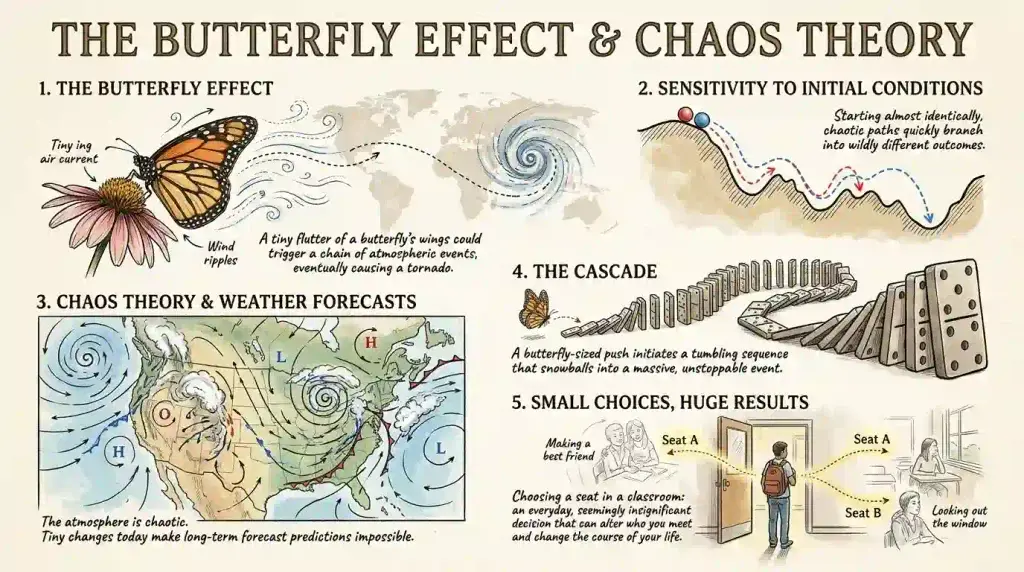
The butterfly effect is the idea that a tiny change in a starting condition can cause huge differences in the final outcome. In other words, small things can have big results over time.
The name comes from a poetic picture. Imagine a butterfly flapping its wings in one part of the world. Could that tiny movement help start a storm far away? The question is not meant to be answered with a simple yes. It is a way to show how sensitive some systems can be.
Today, people use the phrase in two ways. Scientists use it to describe how some systems, like the weather, are hard to predict. Everyday speakers use it to say that small choices can shape our lives in surprising ways.
What Does the Butterfly Effect Really Mean?
Let’s slow down and look at the idea more closely. At its heart, the butterfly effect is about sensitivity. In some systems, tiny differences at the start grow bigger and bigger as time passes. By the end, the results can look nothing alike.
Think about rolling a ball down a hill with many bumps. If you start the ball one inch to the left, it may bump into different rocks and end up in a totally different valley. The change at the start was small. The change at the end was large.
Scientists call this “sensitive dependence on initial conditions.” That is a long phrase, but the meaning is not hard. “Initial conditions” means the starting point. “Sensitive dependence” means the result depends a lot on even the smallest details of that start.
It helps to know what the butterfly effect does not say. It does not say that every small thing causes a big thing. Most small actions fade away and change very little. The idea is about certain kinds of systems, where small differences can grow over time. It also does not say that a butterfly directly causes a tornado. We will talk more about that myth later.
Where Does the Butterfly Effect Come From?
The idea has a clear and well-known story. It comes from the work of Edward Lorenz, an American mathematician and meteorologist who studied weather at the Massachusetts Institute of Technology (MIT).
In the early 1960s, Lorenz was running a computer model that simulated weather patterns. One day, he wanted to repeat a run of his model. To save time, he restarted it from the middle and typed in numbers that were rounded slightly. The numbers were very close to the original ones. He expected nearly the same weather pattern to appear.
That is not what happened. Over time, the new run drifted far away from the first one. The tiny rounding difference had grown into a big change. Lorenz realized something important: long-term weather forecasts are very hard because tiny errors can grow quickly.
He shared his findings in a scientific paper in 1963. Later, in 1972, he gave a talk with a title that asked whether the flap of a butterfly’s wings in Brazil could set off a tornado in Texas. That poetic title helped the phrase spread. It is often said that the butterfly image was also inspired by the shape of a graph from his work, which looked a bit like butterfly wings. People disagree about how much that shape played a role, so it is safest to say the name caught on because it was so easy to picture.
The Science Behind It:
The butterfly effect is closely tied to a field called chaos theory. That name can sound scary, but the basic idea is friendly.
In everyday language, “chaos” means total mess. In science, chaos has a more careful meaning. A chaotic system follows clear rules, yet it is still hard to predict over a long time. The rules are not random. The trouble is that tiny differences in the starting point grow so fast that long-term predictions become unreliable.
Weather is the best-known example. Meteorologists use powerful computers and lots of data. They can give a good forecast for the next few days. But the further ahead they look, the less certain things become. Small measurement errors, such as a slightly wrong temperature reading, can grow into larger errors.
Here is a table that shows how a chaotic system differs from a simple one.
| Feature | Simple System | Chaotic System |
| Starting change | Small change gives a small result | Small change can give a large result |
| Predictability | Easy to predict far ahead | Hard to predict far ahead |
| Example | A swinging pendulum in a clock | Weather patterns |
| Rules | Clear and steady | Clear but very sensitive |
| Long-term results | Stay close together | Drift far apart |
Chaos theory also shows up in other areas. Scientists have used it to study how populations of animals rise and fall, how fluids move, and how some heart rhythms behave. In each case, the main lesson is the same: some systems are very sensitive to small changes.
The Butterfly Effect in Everyday Life
You do not need a science lab to see this idea at work. Most of us have lived through small moments that turned into big ones.
Imagine a student who decides to sit in a different seat on the first day of school. She ends up next to a boy who loves music. They become friends, start a band, and years later, one of them becomes a professional musician. A simple seat choice shaped a whole path.
Or think about a man who misses his bus by ten seconds. He walks instead and meets an old friend on the street. That friend offers him a job. The missed bus turned out to be the start of a new career.
These stories are not scientific proof, and we should be honest about that. They are simple examples that show the spirit of the idea. In real life, many causes mix together, so it is hard to say that one small event alone created a big change. Still, the stories help us understand why the phrase feels so true.
Here is a table of everyday examples and what they show.
| Small Action | Possible Big Result | Lesson |
| Saying hello to a new neighbor | A lifelong friendship | Kindness can grow over time |
| Saving a few dollars each week | A large savings fund after years | Small habits add up |
| Reading ten pages a day | Dozens of finished books in a year | Steady effort matters |
| Skipping one important meeting | A missed chance at a promotion | Small choices can have costs |
| Planting one tree | Shade and fruit for a whole community | Small acts can help many people |
The table shows both the bright side and the risky side. A small good habit can grow into something wonderful. A small careless choice can sometimes lead to trouble, too.
The Butterfly Effect in Movies, Books, and Pop Culture
The idea has captured the imagination of storytellers for decades. It fits perfectly into stories about time travel, second chances, and the “what if” questions we all ask.
One of the best-known examples is the 2004 film titled The Butterfly Effect. In the movie, a young man discovers a way to go back in time and change events from his past. Each change that he makes leads to new and often unexpected results. The film uses the phrase to show that even well-meant changes can have a long chain of effects.
Time travel stories in general love this idea. A classic theme is that a traveler goes back in time, makes a tiny change, and returns to a very different present. Science fiction writers have used this plot for many years, and some stories even came before the phrase was popular. For instance, Ray Bradbury’s short story “A Sound of Thunder,” published in 1952, imagines a time traveler who steps on a butterfly in the past and changes the future.
Video games also use the idea. Many story-based games let players make choices that shape later events. A small decision in the first hour might change which characters live or which ending you see. Game makers use this to make players feel that their choices matter.
Pop culture often stretches the idea beyond what scientists mean. In movies, a tiny change can rewrite the whole world. In real science, the effect is more about unpredictability than about neat, clear chains of cause and effect. It is fine to enjoy the stories, as long as we remember that they are for fun.
Common Myths and Mistakes About the Butterfly Effect
Because the phrase is so popular, many people misunderstand it. Here are the most common mistakes.
The first myth is that a butterfly really causes tornadoes. This is not what the idea says. Lorenz used the butterfly as a way to show how sensitive the weather system is. He was not claiming that one butterfly could directly cause a storm. Billions of small things affect the weather, and no one can trace a storm back to a single wing flap.
The second myth is that every small action has a huge effect. In truth, most small actions fade away. The idea only applies to systems that are very sensitive. Being nice to a stranger is a good thing to do, but we cannot promise that it will change the world.
The third myth is that the butterfly effect means we can control the future. It actually points the other way. It tells us that the future can be hard to predict, because tiny changes can grow in surprising ways.
The fourth mistake is using the phrase as a simple word for “cause and effect.” A normal cause and effect is a clear link, like dropping a glass and watching it break. The butterfly effect is about small changes in complex systems leading to big, unpredictable outcomes.
The fifth mistake is thinking that it is only about bad outcomes. Small changes can lead to wonderful results, too. The idea is neutral. It does not say that results are good or bad.
Butterfly Effect vs. Similar Ideas
Many people mix this idea with other phrases. Here is a quick table to show the differences.
| Idea | Meaning | How It Differs |
| Butterfly effect | Small starting changes can cause large, hard-to-predict results | Focuses on sensitivity and unpredictability |
| Domino effect | One event triggers a chain of similar events | Each step directly pushes the next one |
| Snowball effect | Something grows bigger as it moves along | Focuses on growth, not unpredictability |
| Ripple effect | An action spreads outward and touches others | Effects usually get weaker with distance |
| Cause and effect | One thing leads to another | A general idea, not tied to sensitivity |
The domino effect is perhaps the closest cousin. When one domino falls, it knocks over the next one, and the next. The result is easy to see and fairly easy to predict. With the butterfly effect, the path is much harder to follow. You cannot easily say which small change led to which big result.
The snowball effect is about growth. A small snowball rolling down a hill picks up more snow and becomes huge. The ripple effect is like tossing a pebble in a pond. The waves spread out and slowly faded.
Knowing these differences helps you choose the right phrase. If you want to talk about a chain of events, the domino effect may fit. If you want to talk about surprising, hard-to-predict changes from tiny starting points, the butterfly effect is the better choice.
How to Use the Phrase in a Sentence
You can use this phrase in both serious and casual talk. It usually works as a noun, as in “the butterfly effect,” and it often appears with words like “show,” “explain,” or “illustrate.”
Here are some sample sentences:
- “The butterfly effect explains why weather forecasts become less accurate over time.”
- “Looking back, missing that train was a real butterfly effect in my life.”
- “The teacher talked about the butterfly effect in her science class.”
- “In the movie, one small change creates a butterfly effect that changes everything.”
A few small tips can help. If you are speaking about science, mention that it is about sensitive systems. If you are speaking about daily life, it is fine to use it in a looser, more playful way. Just avoid claiming that it proves a specific cause for a specific event. Phrases like “might have,” “could have,” and “may have led to” keep your words honest and careful.
Why the Butterfly Effect Matters Today
You might wonder if this idea is only a fun fact. In truth, it has real value in many areas.
In weather forecasting, it explains why scientists run many versions of a forecast with slightly different starting numbers. This method, often called ensemble forecasting, helps show a range of possible outcomes instead of just one. It is a smart way to deal with uncertainty.
In business and planning, the idea reminds leaders that small decisions, such as a tiny change to a product or a policy, can sometimes grow into large effects. That is one reason many teams test small changes before rolling them out widely.
In personal life, it can be a gentle reminder to value small habits. Drinking a little more water, taking a short walk, or learning a few new words each day may seem tiny. Over months and years, these small steps can add up to something meaningful. Keep in mind that this is more about steady habits than true chaos, but the spirit of the lesson is similar.
The idea also teaches humility. Since we cannot predict every result, we can stay open to surprises. We can plan carefully, but we should also be ready to adjust when things change.
Tips for Understanding and Using the Butterfly Effect
If you want to explain this idea to a friend or a child, a few simple tips can help.
Start with a picture. Describe a butterfly, a ball rolling down a bumpy hill, or a tiny shift in a river’s path. Pictures stick in the mind better than long definitions.
Use one clear example. Choose a single story, like the missed bus or the first-day seat, and walk through it step by step. Too many examples can blur the point.
Be honest about what is science and what is storytelling. It is fine to enjoy movies and stories, but it helps to say, “This is the real science, and this part is for fun.”
Remember the key word, which is “sensitive.” The butterfly effect is about systems that react strongly to small changes. If a system is not sensitive, the idea does not apply.
Finally, connect it to something the person already knows, like the weather. Almost everyone has seen a forecast change from one day to the next, so it is an easy way in.
FAQs
What is the simple butterfly effect meaning?
It means that a very small change at the start can cause a very big change later. The result can be hard to predict because small differences grow over time.
Who came up with the butterfly effect?
Edward Lorenz, an American mathematician and meteorologist, is credited with the idea. He found it while studying weather models on a computer in the early 1960s.
Does a butterfly really cause a tornado?
No. The butterfly is only a picture to show how sensitive weather can be. It does not mean one butterfly directly causes a storm.
Is the butterfly effect the same as the domino effect?
Not quite. In the domino effect, one event pushes the next in a clear chain. In the butterfly effect, tiny changes lead to large and hard-to-predict results.
Is the butterfly effect a real scientific idea?
Yes. It is a well-known part of chaos theory. It describes how some systems, like the weather, are very sensitive to their starting conditions.
Can I use the butterfly effect to describe my own life?
Yes, in a casual way. Many people use it to describe how a small choice led to a big change. Just remember that real life has many causes, so it is a helpful comparison, not a scientific proof.
Conclusion:
The butterfly effect meaning comes down to one clear idea: tiny changes at the start can lead to very large results later. The phrase began with Edward Lorenz and his weather research. It grew into a famous symbol of chaos theory and a favorite theme in movies, books, and games.
We also learned some important points. The idea is about sensitive systems, not about every small action. It does not claim that a butterfly causes a tornado. And it reminds us that the future can be hard to predict, which is a good reason to stay thoughtful and flexible.
So here is some practical advice. Pay attention to your small daily choices, because habits and kindness can add up over time. At the same time, do not worry about every tiny decision. Make good choices, stay curious, and enjoy the surprises along the way.

Hello, I’m Clara Whitmore. I write daily prayers, devotionals, and faith-based reflections for readers seeking peace and encouragement. I believe prayer has the power to heal hearts and renew faith.