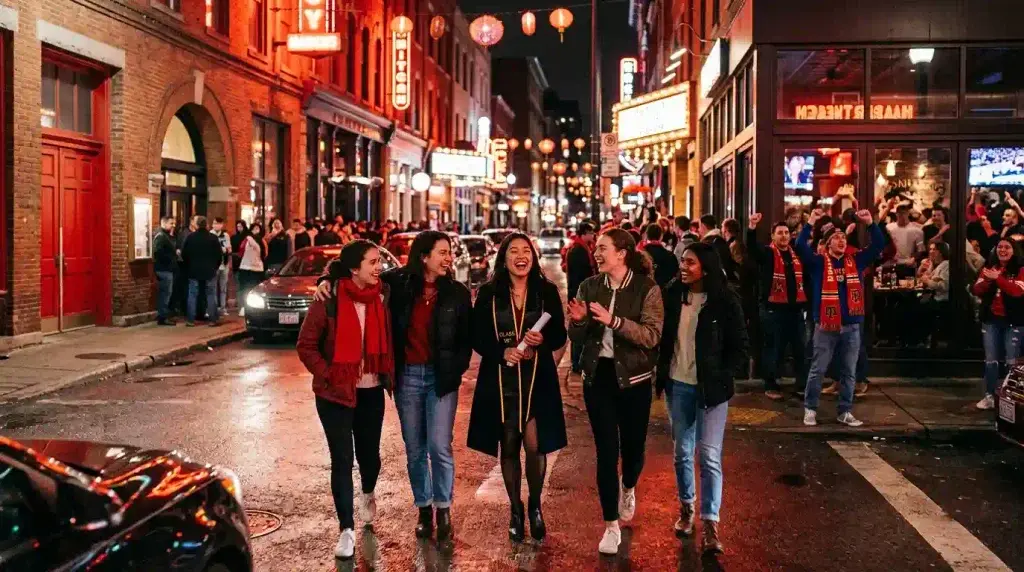
The paint the town red meaning is simple: it means to go out and have a loud, lively, fun time, usually at night with friends. Nobody grabs a paintbrush. It is just a colorful way to say “let’s celebrate in a big way.”
You may have heard it in a movie, a song, or from a friend on a Friday afternoon. Maybe you wondered, why red? And why a whole town? Lots of people search for this phrase because it sounds strange when you read it word for word. In this guide, you will learn what it means, how to use it, and where it may have started. You will also see real examples, common mistakes, and phrases that mean almost the same thing. By the end, you can use it with confidence in your writing and your talk.
Quick Answer: Paint the Town Red Meaning
To paint the town red means to go out and enjoy a wild, happy night. People use it for parties, big dinners, dancing, and other fun outings. It is an idiom, which means the words do not mean what they say. The phrase is casual and cheerful. You would say it to friends, but you would probably not put it in a serious business report.
A short example helps. “We passed our exams, so tonight we are going to paint the town red.” That sentence means the group plans to celebrate in a big way.
What Paint the Town Red Means in Everyday Life
When someone says they want to paint the town red, they usually mean they want to let loose. Think of a group of friends after a long week, a team after a big win, or a family after good news. They are not planning a quiet night on the couch. They want music, food, laughter, and maybe a few stops along the way.
The phrase often hints at staying out late. It also suggests moving from place to place, such as dinner first, then a show, then dessert, then a dance floor. That is part of the picture. You are not just visiting one spot. You are making the whole town part of your celebration.
Some people think the phrase only means drinking. That is not true. Many dictionaries describe it as going out to celebrate in a lively way, and drinking is only one way people do that. A group of teenagers eating pizza and bowling until midnight can paint the town red too. The key ideas are fun, energy, and a bit of wildness.
Why red? The color red is tied to fire, heat, and strong feelings. It is a bold color that grabs your eyes. So “red” fits a night that feels bold and exciting. We will look at other ideas about the color later, but the simple answer is that red matches the mood.
How to Use Paint the Town Red in a Sentence
This idiom works like any other action phrase in English. The verb is “paint,” and the rest of the phrase stays the same. You change only the verb to match the time of your sentence. You can say “to paint the town red,” “painted the town red,” or “painting the town red.” The words “the town red” do not change.
Here is a quick table to show how the phrase changes with time.
| Form | Example sentence |
| Base form | They want to paint the town red this weekend. |
| Past tense | We painted the town red after the wedding. |
| Ongoing form | Are you painting the town red tonight? |
| Future | She will paint the town red when she gets her bonus. |
| With “let’s” | Let’s paint the town red for your birthday! |
Keep the word order the same. You say “paint the town red,” not “paint red the town.” Some people shorten the phrase to “paint the town,” and you may see that in casual talk. But the full phrase is the safer choice, especially in writing.
The phrase also fits well with time words. You will often hear “tonight,” “this weekend,” or “after the game.” These small words help the listener picture when the fun will happen. Because the idiom is informal, it fits best in friendly messages, stories, and relaxed talk.
Origin and History: What We Know for Sure
Here is the honest answer: no one knows for certain where this phrase came from. Word experts have studied it for a long time, and they still disagree. That is common with idioms. Many of them grew out of everyday talk long before anyone wrote them down.
What we do know is that the phrase became popular in the late 1800s. Most major dictionaries point to that time, and early printed uses appear in American writing. Over the next hundred years it spread across the English-speaking world. It has stayed popular ever since, which tells us people love its bright, playful picture.
If you read a website that says the origin is “proven,” be careful. Most claims about this phrase are stories, and some of them are fun to tell, but they are not solid facts. The best approach is to treat each story as a possible clue rather than a final answer.
The Main Theories Behind the Phrase
There are a few popular ideas about how the phrase began. The most famous one is the story of the Marquis of Waterford. In April 1837, this wealthy and rowdy British nobleman is said to have visited the English town of Melton Mowbray with a group of friends. After a night of partying, they supposedly painted parts of the town red, including a toll gate, some doors, and a statue. The story is colorful, and many books repeat it.
There is one big problem, though. The phrase does not seem to show up in print until decades later. That gap makes some experts doubt that the Marquis story is the true source. It may be a case where a good story was attached to a phrase after the fact.
Another idea points to the Old West in America. Cowboys would ride into town after weeks or months on the trail, ready to celebrate. Their wild nights could get loud and rough, and “red” might have hinted at the danger. This fits the time period well, but no clear proof ties the phrase to cowboys.
A third idea links the color to red-light districts, where red lamps marked places of nightlife. A fourth idea is simpler. Red is just the color of excitement, so the phrase may have grown naturally from that.
| Theory | Basic idea | How strong is the evidence? |
| Marquis of Waterford, 1837 | A rowdy nobleman and friends painted an English town red | Famous story, but the phrase appears in print much later |
| Old West cowboys | Cowboys celebrated hard after long trips | Fits the time, but no firm proof |
| Red-light districts | Red lamps marked nightlife areas | Possible link to the color, not proven |
| Color of excitement | Red stands for fire and strong feelings | Makes sense, but cannot be proven |
In the end, the real origin is still a bit of a mystery. That is part of the fun.
British vs American English
The good news is that you do not need to worry about big differences here. People in the United States, the United Kingdom, Canada, and Australia all understand this idiom. It means the same thing in each place. Spelling is not an issue either, since the phrase has no words that change between American and British spelling.
What does change is the choice of nearby phrases. In the United States, people often say “hit the town” or “party hard.” In Britain, you might hear “have a night out” or “go out on the town.” Some British speakers also use slang like “on the lash,” which usually points to drinking. These are all close cousins, but “paint the town red” is the one that travels best across countries.
Real Life Examples
Seeing the phrase in real situations makes it easier to remember. Here are some everyday ways people use it.
After graduation, a student might say, “Our whole class is going to paint the town red tonight.” That tells you the group plans a big celebration.
After a sports win, a news writer might say that fans painted the town red until sunrise. This paints a picture of crowds, cheering, and happy noise in the streets.
On a trip, a traveler could write, “It was our last night in Rome, so we painted the town red.” That means they packed in as much fun as they could before leaving.
At work, a coworker might joke, “When this project ends, I am going to paint the town red.” Here the phrase shows relief and a wish to celebrate after hard work.
You can also use it with a smile when the plan is small. A mom might say, “We got our grades up, so let’s paint the town red with ice cream.” The phrase becomes a joke because the fun is gentle and sweet. That kind of playful use is very common.
Common Mistakes to Avoid
The biggest mistake is taking the phrase word for word. If a new English learner hears “paint the town red,” they may think someone is using a paintbrush. Always remind them it is an idiom. The meaning lives in the whole phrase, not in each word.
Another mistake is using it for quiet events. You would not say you painted the town red by reading a book at home. The phrase needs energy, noise, or excitement. It also works best for going out, not staying in.
People also change the words by accident. You might hear “paint the town in red” or “paint the city red.” These are not wrong in everyday talk, but the standard version is “paint the town red.” Sticking to it keeps your writing clear.
A fourth mistake is using it in very formal writing. A legal letter or a school report is not the place for it. Save it for stories, blogs, social posts, and casual talk.
Finally, some people mix it up with other phrases that use the color red. That is easy to do, so the table below shows how they differ.
Similar Phrases and Look-Alikes
Some phrases mean almost the same thing as this idiom. Others only look similar because they use the word “red.” Here is a quick guide.
| Phrase | Meaning | Example |
| Hit the town | Go out for fun | Let’s hit the town after work. |
| Live it up | Enjoy yourself in a big way | He lived it up on his birthday. |
| Kick up your heels | Relax and have fun | They kicked up their heels at the party. |
| See red | Become very angry | I saw red when he broke my phone. |
| In the red | Owe money or lose money | The shop has been in the red all year. |
| Red-letter day | A special, happy day | Our wedding day was a red-letter day. |
Notice that only the first three share the same happy spirit. The last three use “red” in totally different ways. If you remember that red can mean excitement, anger, or money trouble depending on the phrase, you will avoid most mix-ups.
Tips for Using the Phrase Well
Use it when the mood is light. This idiom shines in cheerful moments, such as birthdays, wins, and trips. If the situation is sad or serious, pick another phrase.
Match the tone of your audience. With friends, it sounds natural and warm. With a boss or a stranger, you may want a plainer phrase like “go out and celebrate.”
Do not use it too often. Idioms are like spices. A little adds flavor, but too much makes the writing feel tired. One well-placed use in an article or a message is plenty.
If you are teaching the phrase to a child or a new English learner, use a picture. Ask them to imagine bright red paint splashing across a city full of lights. Then explain that the paint stands for fun. That image sticks in the mind and makes the meaning easier to remember.
Finally, pair it with a clear time or reason. “We are going to paint the town red tonight because we won the game” is easy to follow. It gives the listener the who, the when, and the why.
Current Usage and Trends
The phrase is still alive and well today. You will find it in news headlines, travel blogs, song lyrics, and social media posts. People like it because it is short, bright, and easy to picture. Sports writers use it when fans celebrate a championship. Travel writers use it when they describe a city’s nightlife.
There is one modern twist. In politics, red is a team color in some places, including the United States. A headline like “Voters paint the town red” could be a clever play on words, meaning both a big celebration and a strong show of support for one party. When you read a headline like that, check the context to see which meaning the writer wants.
We do not have exact numbers on how often the phrase is used, and it is hard to measure. But dictionaries still list it as a common idiom, and it keeps showing up in everyday English. That is a good sign that it will stay around.
FAQs
What is the meaning of painting the town red? It means to go out and have a lively, exciting time, often at night and often with friends. It is another way of saying “celebrate in a big way.”
Is painting the town red an idiom? Yes. An idiom is a phrase whose meaning is different from the meaning of its separate words. Nobody is truly painting a town. The phrase just describes a wild, happy outing.
Does it always mean drinking? No. Drinking is one way people celebrate, but the phrase is about having fun and making noise. Dancing, eating, and visiting many places can all count.
Who first said paint the town red? Nobody knows for sure. A famous story points to the Marquis of Waterford in 1837, but the phrase appears in print much later. Other ideas include cowboys and red-light districts, and none of them is proven.
Is it formal or informal? It is informal. It fits well in friendly talk, blogs, and social posts. In formal writing, a plain phrase like “celebrate” is usually better.
What can I say instead of paint the town red? You could say “hit the town,” “live it up,” “go out and celebrate,” or “have a night out.” Each one has a similar happy feeling, though “paint the town red” sounds a bit more dramatic.
Conclusion
Now you know to paint the town red meaning from top to bottom. It means to go out and celebrate in a bold, lively way, usually with friends and often late into the night. It is an idiom, so you should never read it word for word. The exact origin is still unclear, and stories about the Marquis of Waterford, cowboys, and red lights are fun but unproven.
The best way to learn a phrase like this is to use it. Try it in a message to a friend the next time something good happens. Keep it casual, match it to a cheerful moment, and avoid using it too often. If you do, it will sound natural and add a little color to your English, just like the phrase itself.

Hi, I’m Rebecca Hayes. I write faith-filled articles, healing prayers, and daily devotionals to encourage people in every season of life. My passion is helping readers find peace, hope, and strength through prayer.