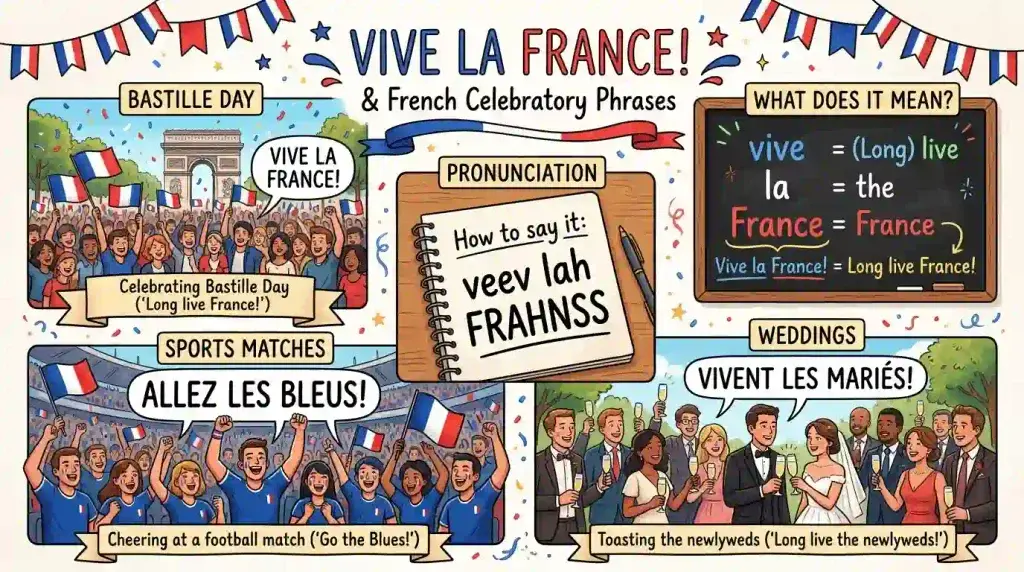
The Vive la France meaning is simple: it means “Long live France.” It is a loud, proud cheer that shows love for the country of France. French people shout it at parades, sports games, and national holidays. You may have heard it in a movie, a song, or a history class and wondered what the words really say. Is it just a fancy way to say “Go France”? Is it only for people born in France? Can you use it too?
Readers search for this phrase because it sounds so strong and so full of feeling. In this guide, you will learn the meaning, the grammar, and the sound of the phrase. You will also see where it comes from, how people use it today, and which mistakes to avoid. Let’s start with the quick answer.
Quick Answer: Vive la France Meaning in Plain English
“Vive la France” is French for “Long live France.” People say it to show love, pride, and support for their country. It works like a cheer. You can think of it as “Hooray for France!” or “May France live on and do well.” It is short, loud, and full of feeling.
The phrase is not a question, and it is not a normal chat line. It is an exclamation, so it usually ends with an exclamation mark. When French speakers type it, they often add a small space before the mark, like this: Vive la France !
Here is an easy way to remember it. If you can say “Long live…” in English, you can say “Vive…” in French. The idea is the same, and so is the energy.
Word-by-Word Breakdown of the Phrase
The phrase has only three words, but each one does a job. Looking at them one by one makes the meaning much clearer.
| French Word | Simple Meaning | Quick Note |
| Vive | May it live / long live | A form of the verb vivre, which means “to live” |
| la | the | The word for “the” before a feminine noun |
| France | France | The country’s name, treated as feminine in French |
Why “la” and not “le”? In French, every noun is either masculine or feminine. Most country names that end in the letter e, such as France, Italie, and Espagne, are feminine. So French speakers say “la France.” Saying “le France” sounds wrong to them.
If you translate the words exactly, you get something like “Live the France.” That sounds odd in English, which is why people use “Long live France” instead. The meaning matters more than the word order.
How to Pronounce Vive la France
The sound is often written as “veev lah FRAHNSS.” Let’s break it into small steps.
Start with “vive.” It rhymes with the English word “leave,” not with “five.” The final e is silent. So you say “veev.” Next comes “la,” which sounds like “lah,” the same sound you hear in “la la la.”
The last word is “France.” Here the “an” is a nasal sound. That means some of the air flows through your nose, and you do not make a hard “n” sound. The French r is also made in the back of the throat. If that feels hard, do not worry. English speakers who say “frahnss” are still understood.
French does not stress words the way English does. Each part is fairly even, with a slight lift on the last syllable. A good way to practice is to say it slowly three times, then speed up. Listening to a native speaker on a French news clip or a Bastille Day speech will help your ear a lot.
Why the Grammar Looks a Little Strange
Many learners ask why the phrase uses “vive” and not “vit.” Both come from the verb vivre. The word “vit” is used to state a fact, as in “La France vit,” which means “France lives.” The word “vive” is used to make a wish.
This wish form is called the subjunctive. The full sentence behind the cheer is “Que la France vive,” which means “May France live.” Over time, people dropped the first part. That left the short, punchy “Vive la France.”
The next point is a favorite for teachers. The verb must match the thing being cheered for. France is one thing, so the verb is singular: “vive.” If you cheer for more than one thing, the verb becomes “vivent.” For example, children shout “Vivent les vacances !” which means “Hooray for vacation!” Even so, many French speakers say “Vive les vacances” in casual talk. You will hear both, but the plural form is the one grammar books prefer.
Where the Phrase Comes From
The “Vive…” pattern is very old in French. For centuries, crowds cheered for their leaders with it. The best-known example is “Vive le roi !” which means “Long live the king.” You may also know the royal saying “Le roi est mort, vive le roi !” It means “The king is dead, long live the king,” and it shows that a new ruler takes over right away.
Things changed during the French Revolution of 1789. People began cheering for ideas and the country instead of one ruler. History books often tell how French soldiers cried “Vive la Nation !” at the Battle of Valmy in 1792. Later, soldiers under Napoleon shouted “Vive l’Empereur !” for their emperor.
Over the 1800s and 1900s, cheers for the country itself grew common. Leaders have ended speeches with “Vive la France !” many times, and Charles de Gaulle is one famous example. Here is an honest note, though. I could not find a reliable source that names the first person to say “Vive la France,” or the exact date. It grew out of a long habit, not one single moment, so it is better not to trust any story that claims a clear starting point.
When French People Use “Vive la France”
The phrase belongs to big, emotional moments. It is not something most people say on an ordinary Tuesday morning. Here are the times you are most likely to hear it.
The biggest day is Bastille Day on July 14. It is France’s national holiday, and it remembers the storming of the Bastille in 1789 and the celebration of unity in 1790. There are parades, fireworks, music, and flags. Cheers like “Vive la France !” fit right in.
You may also hear it on Armistice Day on November 11, at sports events, and at political speeches. Fans sometimes use it when a French team wins. Even so, the more common chant at a football match is “Allez les Bleus !” which means “Go, the Blues.” That is the nickname of the French national team, taken from its blue shirts.
French people living in other countries also use the phrase. At a party abroad, someone might raise a glass and say it with a smile. In that setting, it feels warm and a little playful, like a toast.
Real Life Examples and Related Phrases
Once you know the “Vive…” pattern, you will notice it everywhere. The table below shows common phrases, what they mean, and where people use them.
| Phrase | Meaning in English | Where You Hear It |
| Vive la France ! | Long live France | Holidays, speeches, national pride |
| Vive la République ! | Long live the Republic | Political events and national days |
| Vive le roi ! | Long live the king | Royal events and history lessons |
| Vivent les vacances ! | Hooray for vacation | Everyday fun, school breaks |
| Vivent les mariés ! | Long live the bride and groom | Weddings |
| Vive la différence ! | Celebrate the difference | Used in English, too |
| Allez les Bleus ! | Go, France’s national team | Football matches |
Here are a few short examples to show the phrase in real life. At a parade, a father lifts his daughter and she waves a small flag, shouting, “Vive la France !” At a wedding dinner, guests clink glasses and say, “Vivent les mariés !” Before a big match, two friends wearing blue shirts shout, “Allez les Bleus !”
Notice how each example matches the mood. Joyful moments get a cheerful cheer. Serious moments, like a memorial service, usually call for quiet words instead.
Tone and Feelings: Is It Political?
Mostly, “Vive la France” is warm and patriotic. It is like an American waving a flag on the Fourth of July or chanting “USA!” at the Olympics. Most of the time it simply says, “I love my country.”
Still, words about the nation can carry extra meaning. Like any patriotic slogan, it can be used by a political group to send a message. The same words may feel friendly at a parade and heated at a protest. The crowd, the speaker, and the setting all shape how the phrase is heard.
For visitors and learners, the safe path is easy. Use it in friendly moments, such as a holiday, a toast, or a sports game. Avoid using it to tease anyone or in the middle of a heated political talk. When in doubt, listen first and see how people around you use it.
How English Speakers Use the Phrase
English speakers know the phrase from books, movies, and history. The United States and France also share a long friendship, which is one reason Americans know it. France gave the Statue of Liberty to the United States, and it was dedicated in 1886. French and American stories often meet in classrooms, so the cheer pops up in that setting.
People in the USA might say it when cheering for a French friend, a French athlete, or a French restaurant they love. They may also use it as a playful toast after a good meal. That kind of use is usually friendly, as long as the tone is kind.
You may also see its cousin, “Vive la différence,” in English writing. People use it to celebrate the ways people or things are different. The meaning of “vive” stays the same: long live it.
Common Mistakes to Avoid
A few small slips come up again and again. The good news is that each one is easy to fix.
The first mistake is writing “le France.” France is feminine, so the correct form is “la France.” The second is saying “vive” like the English number “five.” The sound is “veev,” with a long “ee.” The third is mixing up the verb forms. Use “vive” with one thing and “vivent” with many things, at least in careful speech and writing.
Some learners think the phrase means “live in France” or “the life of France.” It does not. To say “to live in France,” you would say “vivre en France.” Another slip is writing “Viva la France.” “Viva” is Spanish and Italian. The French word is “vive.”
Last, do not use it as a hello or goodbye. It is a cheer, not a greeting. If you say it to a shop owner when you walk in, you may get a surprised smile.
Tips for Using Vive la France the Right Way
Start by thinking about the moment. A happy, public, or festive setting is best. A quiet or sad setting is not the place for a cheer.
Next, say it with a smile and a clear voice. Because the phrase is short, tone does most of the work. Practice the sound so you feel relaxed saying it, since a shy mumble can make it lose its power.
When writing, put the phrase in italics if you can, and finish it with an exclamation mark. If you are writing in French, add the small space before the mark. Also, learn two or three related phrases, such as “Vivent les mariés” and “Allez les Bleus.” They help you sound natural in more situations.
Finally, check a trusted French dictionary if you are unsure about a word form. Good sources are made by French language experts and are updated over time. A few minutes of checking can save you from a silly mistake.
FAQs
What does Vive la France mean in English?
It means “Long live France.” It is a cheer that shows pride and love for the country. You can also think of it as “Hooray for France.”
Is Vive la France only said on Bastille Day?
No. Bastille Day is the biggest moment for it, but people also say it at sports games, speeches, and other national events. It is less common in daily life.
How do you say Vive la France correctly?
Say “veev lah FRAHNSS.” The first word rhymes with “leave,” the final e is silent, and the “an” in France is a soft nasal sound. English speakers who say it a bit differently are still understood.
Can people who are not French say it?
Yes, in friendly settings. Many people use it to cheer for a French friend, join a toast, or enjoy a holiday. Just keep the tone kind and avoid using it to mock anyone.
What is the opposite of Vive la France?
There is no fixed opposite phrase. The French pattern for “Down with…” is “À bas…” but people rarely use it for a whole country. It is better to skip it.
Why is it vive and not vit?
“Vit” states a fact, as in “France lives.” “Vive” makes a wish, as in “May France live.” That wish form is called the subjunctive, and it is why the cheer uses “vive.”
Conclusion
Now you know the Vive la France meaning: it is a proud cheer that says “Long live France.” You learned that “vive” comes from the verb for “to live,” that “la” goes before the feminine word France, and that the phrase is said as “veev lah FRAHNSS.” You also saw how the “Vive…” pattern grew from royal cheers to cheers for the nation, and why no one can name the exact first speaker. The phrase shines at parades, holidays, and games, and it works best with a smile. To use it well, match the mood, say it clearly, and avoid common slips like “le France” or “Viva la France.” Keep a few related phrases handy for weddings and sports. With a little practice, you can use this famous French cheer with confidence and respect.

Hi, I’m Elias Monroe. I enjoy writing meaningful prayer content that helps people feel calm, hopeful, and spiritually strong. My goal is to share words that bring comfort during both joyful and difficult times.