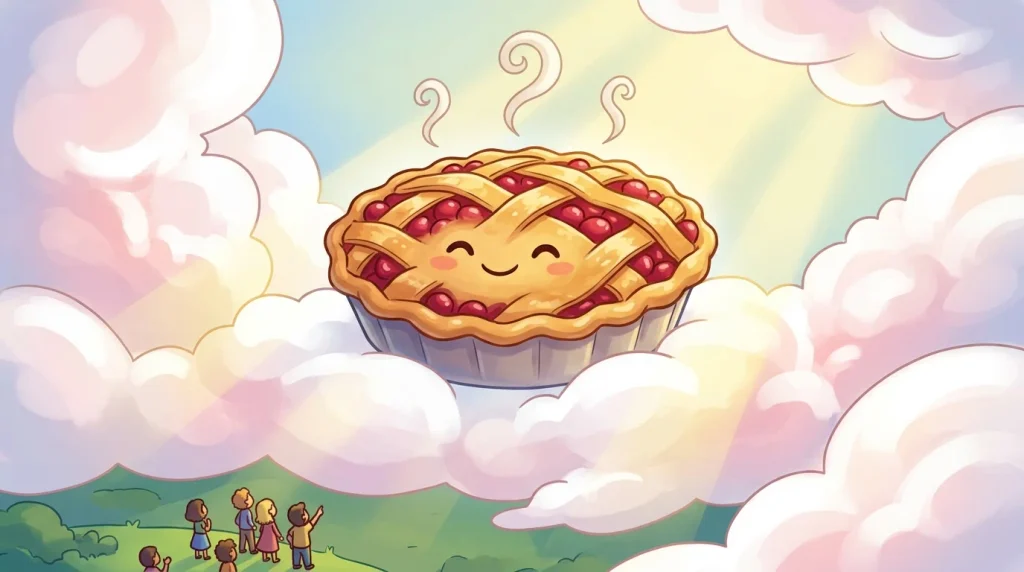
The pie in the sky meaning is simple. It describes a hope, plan, or promise that sounds wonderful but is very unlikely to happen. Think of a friend who says he will be a millionaire by next month, with no plan to get there. That is pie in the sky.
People search for this phrase because they hear it in movies, news stories, and meetings, and it can feel confusing. Pie has nothing to do with dessert here, and the sky is not really involved either.
In this guide, you will learn what the phrase means, where it came from, and how to use it in your own sentences. You will also see real examples, common mistakes, and easy tips. By the end, you will use it with confidence.
Quick Answer: What Does Pie in the Sky Mean?
Pie in the sky means a dream or promise that is too good to be true. It is something people talk about but rarely get. The speaker usually thinks the idea is unrealistic, silly, or far away.
Here is a quick example. Imagine a small town where a leader promises free ice cream for everyone, every day, forever. It sounds fun, but no one can explain how to pay for it. A neighbor might say, “That’s pie in the sky.”
The phrase is an idiom, which is a group of words that means something different from the words alone. If you read it word by word, you would picture a pie floating in the clouds. The real meaning is about a reward that is out of reach. Idioms like this are common in American English, and this one is used often in everyday talk, business, and politics.
The Simple Definition in Plain Words
Dictionaries describe pie in the sky as an idea or hope that will probably never happen. Another way to say it is this: it is a nice thought with no real path to get there.
Two parts make the phrase work. The first is the “pie.” Pie is a treat. It is sweet, and people want it. The second part is the “sky.” The sky is far away, and nobody can climb up and grab something from it. Put them together, and you have a treat that you can see in your mind but never eat.
That picture explains why the phrase feels a little sad and a little funny at the same time. The dream is pleasant, but it sits out of reach.
Speakers often use the phrase when they doubt something. If you say, “His plan is pie in the sky,” you are saying you do not believe it will work. You are not always being mean. Sometimes you are just being honest. Still, the words can sting, so it helps to know how strong they sound before you use them with a person who is excited about a goal.
Where Did the Phrase Pie in the Sky Come From?
The phrase is widely linked to a labor activist named Joe Hill. Hill was born in Sweden and moved to the United States. He wrote songs for a workers’ group called the Industrial Workers of the World, often shortened to the IWW. In 1911, he wrote a song called “The Preacher and the Slave.”
The song was a joke with a serious point. Hill borrowed the tune of a well-known church hymn and changed the words. His version made fun of preachers who told poor, hungry workers to be patient and wait for a happy reward in heaven. Hill felt that this advice ignored real problems, like low pay and long hours. In the song, the reward after death is called pie in the sky. Workers needed food and fair treatment now, not promises for later.
The song appeared in the IWW’s songbook and spread quickly among workers. Over time, people used the phrase outside of the song. It lost its link to church and became a general way to describe any big promise that seems empty.
Hill later became famous for another reason. He was convicted of murder in Utah and was executed in 1915. His supporters have long argued that the trial was unfair. That story helped keep his songs alive, and the phrase traveled with them.
Some word experts note that ideas like this one may have existed before Hill. Still, his song is the moment most people point to when they explain the start of the phrase.
How to Use Pie in the Sky in a Sentence
Pie in the sky works in two main ways. You can use it as a noun phrase, or you can use it before another word to describe something.
As a noun phrase, it stands alone. Here are two examples. “Winning the lottery is pie in the sky for most of us.” “The coach’s promise of a perfect season was just pie in the sky.”
As a describing phrase, it goes in front of a noun, and you add hyphens. For example: “She had a pie-in-the-sky plan to build a school on the moon.” Or: “The team laughed at his pie-in-the-sky idea.” Notice the hyphens tie the words together so they act like one adjective.
You do not need an article like “a” or “the” in front of the phrase. It sounds natural to say, “That’s pie in the sky,” rather than “That’s a pie in the sky.”
The phrase also fits well with a few common verbs. You can say something “is” pie in the sky, or you can say it “sounds like” pie in the sky. You might also hear that someone “is chasing” pie in the sky, which means they are spending time on a dream that will not come true.
Because it is an idiom, keep the wording the same. Changing it to “cake in the sky” or “pie in the clouds” will confuse most listeners, unless you are making a joke on purpose.
Is Pie in the Sky Positive or Negative?
Most of the time, the phrase is negative or at least doubtful. When someone calls your plan pie in the sky, they usually mean it will not work. It can sound like a gentle warning or a sharp criticism, depending on the voice and the moment.
That said, the tone can change. Sometimes people use it in a warm, playful way. A group of friends might joke, “Let’s dream big, some pie in the sky!” while planning a fantasy trip. In that case, the phrase means a fun dream, and no one feels hurt.
Here is a helpful way to think about it. The phrase does not say the dream is bad. It says the dream has no clear road to real life. A dream can be beautiful and still be pie in the sky. The word is about how likely something is, not about how good it is.
Also, remember that some big dreams that once sounded impossible did come true. People once laughed at ideas like flying machines and phones you could carry in your pocket. So the phrase should be used with care. Calling an idea pie in the sky can shut down a person who might have a real chance if they work hard and plan well.
| Situation | Tone of the Phrase | Example |
| Serious doubt | Negative | “His promise to double sales in one week is pie in the sky.” |
| Friendly joke | Playful | “A private island for our family? That’s pie in the sky, but I love it.” |
| Warning to a friend | Caring but firm | “Quitting your job to become a movie star tomorrow is pie in the sky.” |
| Talking about politics | Critical | “Critics said the plan was pie in the sky.” |
Pie in the Sky vs. Similar Phrases
English has many idioms for dreams that seem out of reach. Some are close to pie in the sky, and some are not. Knowing the small differences helps you choose the best one.
A “pipe dream” is very close in meaning. It is a hope that cannot come true. A “castle in the air” also means a dream with no base, like a building with no ground under it. “Wishful thinking” is when you believe something will happen just because you want it to. “When pigs fly” is a joking way to say something will never happen. “Too good to be true” is a warning that an offer seems unreal.
A “moonshot” is different. It is a very bold goal that people chase seriously, often with plans, money, and hard work behind it. So a moonshot can succeed, while pie in the sky almost never does.
| Phrase | Simple Meaning | How It Differs from Pie in the Sky |
| Pipe dream | A hope that cannot come true | Almost the same, but often about personal wishes |
| Castle in the air | A dream with no base | Focuses on a plan with no support |
| Wishful thinking | Believing because you want to | Describes the thinker more than the plan |
| When pigs fly | Something that will never happen | More joking and stronger |
| Too good to be true | An offer that seems fake | Often used for deals and ads |
| Moonshot | A huge but serious goal | Has a real plan, so it can work |
Real Life Examples of Pie in the Sky
Examples make the meaning stick, so here are some from different parts of life. You will see the phrase in school, work, money talk, and the news.
In school, a student might say he will get straight A’s without opening a book. A teacher could smile and say that sounds like pie in the sky. At work, a manager might set a goal that no team could reach with the time and people they have. Workers might quietly call that goal pie in the sky.
In money matters, a get-rich-quick offer is a classic case. If an ad says you can earn thousands of dollars a week by clicking a button, be careful. That claim is often pie in the sky, and sometimes it is a scam.
In politics and news, writers often describe big promises as pie in the sky when they doubt the plan can be paid for or finished. You may see this in headlines or hear it in debates. Since different people disagree about which plans are realistic, the phrase often shows up when opinions clash.
| Area of Life | Pie in the Sky Example | Why It Fits |
| School | “I’ll learn all of Spanish in one weekend.” | The time is far too short |
| Work | “Let’s triple our profit by Friday.” | No steps or tools are named |
| Money | “Earn $5,000 a day from your couch!” | Too good to be true |
| Sports | “Our tiny team will beat the champions by 50 points.” | Very unlikely with no proof |
| Home | “We’ll build a mansion on our small budget.” | The money does not match the goal |
Current Usage and Trends
The phrase is still alive today, and you will hear it in many places. It is common in business meetings, where leaders use it to describe goals that feel too big. Startup founders sometimes use the phrase about their own ideas, half joking, to show they know a plan is risky.
You will also see it in online writing. Bloggers and news writers use it in headlines because it is short and easy to picture. It appears in talk about technology, space travel, health, and energy, where some ideas sound unreal until science catches up.
One interesting trend is how the phrase is now often used for plans rather than for the afterlife. Its first meaning, about heaven and hard times, is less common in daily speech. Most people today use it as a general way to say “unrealistic.” They may not even know about Joe Hill.
The phrase is mainly American in its start, but people in the United Kingdom, Canada, and Australia know it well too. There is no big difference in spelling or meaning between American and British English for this idiom, so you can use it safely in both.
Common Mistakes to Avoid
Even a simple idiom can trip people up. Here are the mistakes that show up most often, along with easy ways to fix them.
The first mistake is changing the words. Some writers say “pie in the clouds” or “cake in the sky.” These versions do not carry the same meaning, and listeners may be puzzled. Stick to the standard wording.
The second mistake is forgetting the hyphens when the phrase describes a noun. Write “a pie-in-the-sky plan,” not “a pie in the sky plan.” The hyphens help readers see that the words work together.
The third mistake is using the phrase for something that is only hard. Pie in the sky means very unlikely, not just difficult. Running a marathon is hard, but many people finish one. It would be wrong to call it pie in the sky. However, running a marathon in ten minutes would fit.
The fourth mistake is being too blunt. Telling a friend that his dream is pie in the sky might hurt. Try a softer phrase first, like “That might be a stretch,” or ask how he plans to do it.
The last mistake is taking the phrase literally in writing. If you are writing about actual pie, do not use this idiom, or your readers may be confused.
Tips for Using Pie in the Sky Well
A few small habits will help you use the phrase in a smart and kind way.
First, think about your audience. In a casual talk with friends, the phrase is fine. In a formal report, you may want a clearer word such as “unrealistic” or “unlikely,” or you can use the idiom once with a short explanation.
Second, pair the phrase with a reason. Saying “That plan is pie in the sky because there is no money for it” is stronger and fairer than saying it alone. People listen better when they hear why.
Third, keep your tone in check. A smile or a light voice can make the phrase feel friendly. A flat, cold voice can make it feel harsh.
Fourth, try using humor about yourself. Saying, “My plan to clean the whole house in ten minutes is pie in the sky,” shows that you know your limits and makes people laugh.
Finally, remember to leave room for hope. If a goal is big, you can say, “It sounds like pie in the sky now, but let’s find a small first step.” That way, you respect the dream and still stay honest.
Frequently Asked Questions
What is the meaning of pie in the sky in simple words?
It means a hope or promise that sounds great but is not likely to come true. The idea is nice, but there is no real way to get it.
Who first used the phrase pie in the sky?
The phrase is widely linked to Joe Hill and his 1911 song “The Preacher and the Slave.” The song made fun of promises of a heavenly reward for people who were suffering now.
Is pie in the sky an idiom?
Yes. An idiom is a group of words with a meaning that is different from the words alone. Pie in the sky has nothing to do with real pie or the actual sky.
Is it rude to say something is pie in the sky?
It can be, depending on how you say it. The phrase often shows doubt, so it may upset someone who is proud of their plan. A soft tone and a clear reason can make it more polite.
Should I write pie in the sky with hyphens?
Use hyphens when the phrase comes before a noun, as in “a pie-in-the-sky idea.” When it stands alone after a verb, such as “That is pie in the sky,” you do not need hyphens.
What is a good synonym for pie in the sky?
Good choices include pipe dream, wishful thinking, castle in the air, and unrealistic hope. Each one has a slightly different feel, so pick the one that fits your sentence best.
Conclusion
The pie in the sky meaning comes down to one clear idea: a wonderful promise or dream that is unlikely to come true. The phrase grew out of a 1911 labor song that mocked empty promises of a reward after death. Today, people use it for any plan that sounds sweet but has no real path.
Remember a few simple rules. Keep the wording the same, add hyphens when it comes before a noun, and use it only for things that are truly unlikely, not just hard. Also think about your tone, since the phrase can sound sharp.When you hear it next time, you will know just what the speaker means.
And when you use it yourself, add a short reason to make your point fair and clear. A big dream is not always pie in the sky, but a dream with a plan has a much better chance.

Hello, I’m Clara Whitmore. I write daily prayers, devotionals, and faith-based reflections for readers seeking peace and encouragement. I believe prayer has the power to heal hearts and renew faith.