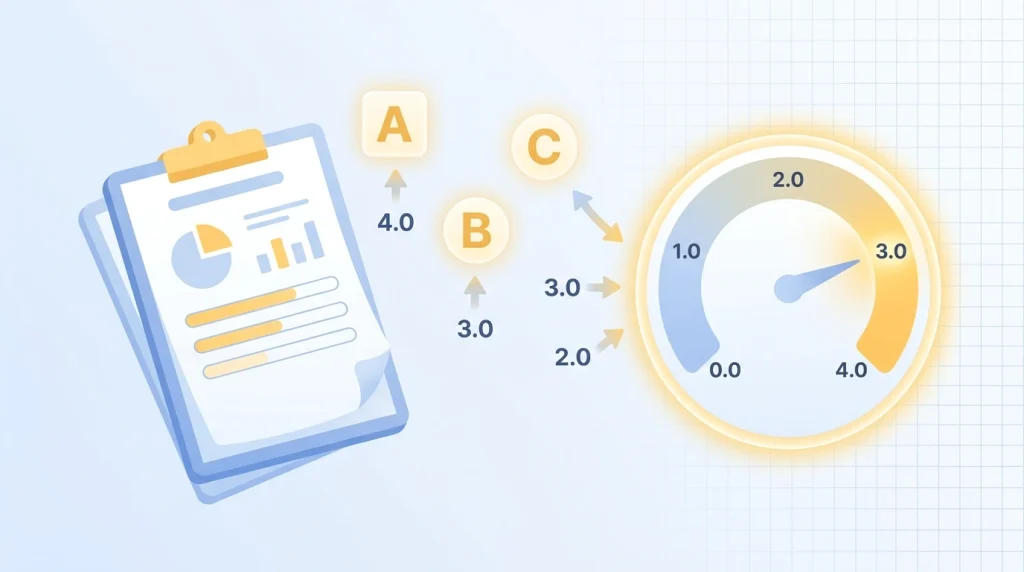
Have you ever looked at your report card and wondered what your GPA scale actually means? You are not alone. The GPA scale reporting meaning refers to how schools convert your letter grades into a number system, usually from 0.0 to 4.0, so colleges and employers can quickly understand how well you did. In short, it’s a simple way to turn all your grades into one clear number.
Many students see their GPA on a transcript and feel confused. Is a 3.5 good? Does a weighted GPA count differently? Why do some schools use a 5.0 scale instead of 4.0? These are common questions, and this guide will answer all of them in plain, simple language.
By the end of this article, you will understand exactly what GPA scale reporting means, how it works, why it matters, and how to read your own GPA with confidence. Let’s break it down step by step.
Quick Answer
GPA scale reporting means turning your class grades (like A, B, C) into numbers, then averaging those numbers to create one score called your Grade Point Average, or GPA. Most schools in the United States use a 4.0 scale, where an A equals 4.0 points, a B equals 3.0 points, and so on. This number tells colleges, scholarship boards, and employers how strong your grades are, all in one simple glance.
Meaning or Definition
GPA stands for Grade Point Average. It is a number that represents the average value of all the grades a student earns during a certain time period, such as a semester, a year, or an entire school career.
Here’s how it works in simple terms. Every letter grade you earn gets turned into a point value. Then, all those point values get averaged together. That average is your GPA.
“GPA scale reporting” simply describes the method a school uses to convert grades into numbers and then share that information on report cards, transcripts, and college applications. Different schools may use different scales, but the goal is always the same: to give a clear, easy-to-compare snapshot of academic performance.
Think of it like a scoreboard. Instead of listing every single grade you ever earned, your GPA sums up your overall performance into one tidy number. This makes it faster for colleges to compare thousands of applicants at once.
How the GPA Scale Works
The most common GPA scale in American schools is the 4.0 scale. Here is a simple breakdown of how letter grades typically convert into GPA points.
| Letter Grade | Percentage Range | GPA Points |
| A | 90–100% | 4.0 |
| B | 80–89% | 3.0 |
| C | 70–79% | 2.0 |
| D | 60–69% | 1.0 |
| F | Below 60% | 0.0 |
Some schools use a more detailed version with pluses and minuses, like A-, B+, or C-. In that case, the points shift slightly, often by 0.3 points up or down. For example, an A- might equal 3.7, while a B+ might equal 3.3.
Once every class grade is converted into points, the school adds up all the points and divides by the number of classes. That final number is your GPA. It usually falls somewhere between 0.0 and 4.0, though some scales go higher.
Weighted vs Unweighted GPA
This is one of the most misunderstood parts of GPA scale reporting, so let’s make it clear.
An unweighted GPA treats every class the same. If you take a regular class or a harder Advanced Placement (AP) class, an A is still worth 4.0 points. This scale usually tops out at 4.0.
A weighted GPA gives extra credit for harder classes. An A in an AP or honors class might be worth 5.0 points instead of 4.0, because the class is more challenging. This is why some students report a GPA above 4.0, like 4.3 or 4.6. It does not mean they got extra credit for nothing. It means they took harder classes and earned strong grades in them.
Colleges usually understand both types of GPA reporting, but it helps to know which one your school uses, since it affects how your GPA looks compared to other schools.
Different GPA Scales Used in the USA
Not every school uses the exact same GPA scale. Here is a comparison of common scales you might come across.
| GPA Scale Type | Typical Range | Common Use |
| Standard 4.0 Scale | 0.0 to 4.0 | Most U.S. high schools and colleges |
| Weighted 5.0 Scale | 0.0 to 5.0 | Schools offering AP, IB, or honors classes |
| Percentage Scale | 0% to 100% | Some schools before converting to GPA |
| 100-Point Scale | 0 to 100 | A few colleges and international programs |
Because scales differ, colleges often recalculate GPA using their own standard formula when reviewing applications. This helps them compare students fairly, even if their high schools used different reporting systems.
Common Mistakes Students Make
Many students misunderstand GPA scale reporting in a few common ways. Let’s clear up the confusion.
One mistake is assuming a GPA above 4.0 is impossible. As explained earlier, this can happen with weighted scales, so it is not an error or a mistake on the transcript.
Another mistake is comparing GPAs from two different schools as if they mean the same thing. A 3.8 unweighted GPA might actually reflect harder coursework than a 4.2 weighted GPA from a school with easier grading standards. Numbers alone don’t always tell the full story.
Some students also forget that GPA can be calculated over different time periods. A “cumulative GPA” covers your entire academic record, while a “semester GPA” only reflects one term. Mixing these up can lead to confusion when filling out applications.
Finally, students sometimes think a low grade in one class will completely ruin their GPA. In reality, GPA is an average, so one weak grade has a smaller effect when balanced against many strong grades over time.
Real Life Examples
Let’s look at a simple example to make this clearer.
Imagine a student took four classes in one semester and earned the following grades: A, B, A, and C. Using the standard 4.0 scale, these grades convert to 4.0, 3.0, 4.0, and 2.0 points. Adding them together gives 13.0 points. Dividing by four classes gives a GPA of 3.25 for that semester.
Now imagine a second student took the same four classes, but two were AP classes using a weighted 5.0 scale. Their A grades in AP classes might convert to 5.0 points instead of 4.0. That means their total could be higher, even with the exact same letter grades. This example shows exactly why GPA scale reporting can look different depending on the method a school uses.
Why GPA Scale Reporting Matters
GPA is one of the most important numbers in a student’s academic life. Colleges use it to decide admissions. Scholarship programs use it to award financial aid. Some employers even ask for GPA when hiring recent graduates.
Because GPA plays such a big role, understanding how the scale works helps students set realistic goals. If a student knows that a B pulls their average down more than they expected, they can adjust their study habits early instead of being surprised later.
Parents and teachers also rely on GPA scale reporting to track a student’s progress over time. It offers a consistent way to measure improvement, semester after semester, without needing to review every single assignment or test.
Tips for Understanding and Improving Your GPA
If you want to keep a strong GPA, a few simple habits can help. First, always know which scale your school uses, If it is weighted or unweighted, so you can set accurate goals.
Second, pay close attention to classes where you are struggling early in the semester. Since GPA is an average, catching a low grade early gives you time to raise it before it affects your overall score.
Third, if your school offers weighted classes, consider If taking a harder class might help your long-term GPA, as long as you can still perform well in it. A strong grade in a challenging class often carries more weight.
Finally, always double-check your transcript for accuracy. Mistakes in grade entry do happen, and catching them early can prevent GPA reporting errors from affecting college applications.
FAQs
What is a good GPA on a 4.0 scale?
Generally, a GPA of 3.0 or higher is considered good, since it reflects mostly B grades or better. A GPA of 3.5 or above is considered strong, and anything close to 4.0 is excellent.
Can a GPA be higher than 4.0?
Yes. This usually happens with weighted GPA scales, where harder classes like AP or honors courses earn extra points for strong grades.
What is the difference between weighted and unweighted GPA?
An unweighted GPA treats all classes equally, with a maximum of 4.0. A weighted GPA gives more points for harder classes, allowing scores above 4.0.
Do colleges look at weighted or unweighted GPA?
Many colleges consider both, but they often recalculate GPA using their own formula to compare students fairly across different high schools.
How is cumulative GPA different from semester GPA?
Semester GPA reflects grades from one term only, while cumulative GPA averages grades across a student’s entire academic record up to that point.
Does one bad grade ruin your GPA?
Not usually. Since GPA is an average across many classes, one low grade has a smaller impact when balanced against several stronger grades over time.
Conclusion
Understanding GPA scale reporting helps students, parents, and even employers make sense of academic performance in a simple, standardized way. At its core, GPA converts letter grades into numbers, then averages them to create one score that reflects overall achievement. If a school uses a 4.0 scale or a weighted 5.0 scale, the purpose stays the same: to offer a clear, comparable measure of academic success.
Now that you understand how GPA scales work, you can read your own transcript with more confidence. Keep track of your grades each semester, understand which scale your school uses, and remember that GPA is simply one part of your overall academic story.
With this knowledge, you’re better prepared to set goals and make informed decisions about your education.
Discover More Article

Hi, I’m Elias Monroe. I enjoy writing meaningful prayer content that helps people feel calm, hopeful, and spiritually strong. My goal is to share words that bring comfort during both joyful and difficult times.