Say la vie meaning is simple. It is a common way to write the French phrase “c’est la vie,” which means “that’s life.” People use it when something goes wrong and they can’t fix it. It’s a calm shrug in words.
Maybe you heard it in a song, in a movie, or from a friend. You typed what you heard into a search bar, and now you’re here. That happens a lot, because the phrase sounds like “say la vee,” so many people spell it that way.This guide clears it all up. You will learn what the phrase means, how to spell it, and how to say it out loud.
You will also see real examples, common mistakes, and similar phrases. By the end, you will know how to use it well, and when to leave it out.
Quick Answer: Say La Vie Meaning in Plain English
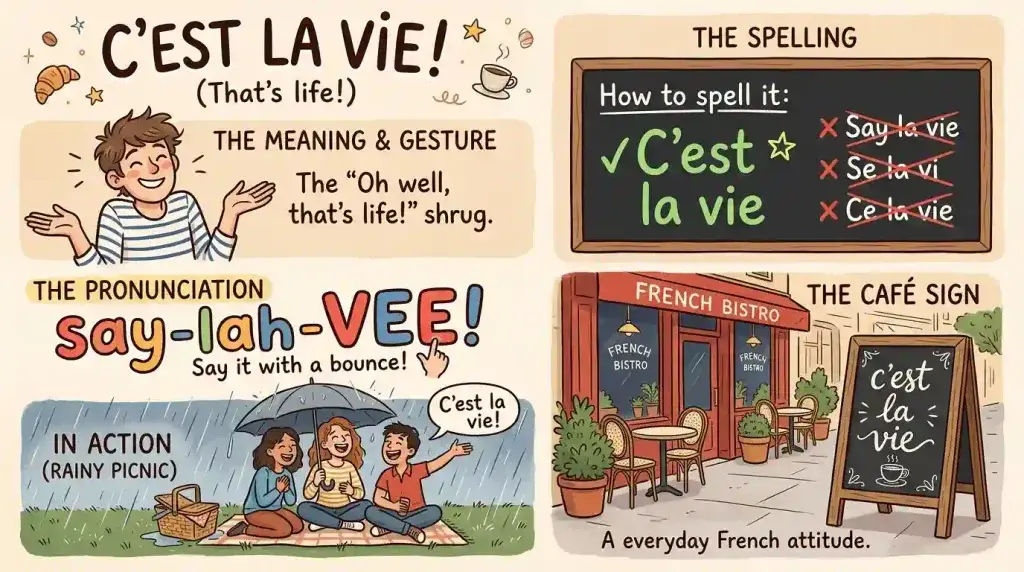
“Say la vie” is not a real French phrase. It is a spelling of what people hear when someone says “c’est la vie.” The correct French spelling is c-apostrophe-e-s-t, then “la,” then “vie.” The meaning is “that’s life” or “such is life.”
Think of it as a polite way to accept something you can’t change. You sigh, you smile a little, and you say, “C’est la vie.”
The phrase carries a gentle message. Bad things happen, good things happen, and life keeps moving. You don’t need to fight every problem. Sometimes the best answer is to accept it and move on.
Why People Write “Say La Vie” Instead of “C’est la Vie”
English speakers often learn this phrase by ear. They hear it before they ever see it written. So they spell it the way it sounds, and “say la vie” looks right to an English reader.
French spelling is tricky for a good reason. French has many silent letters. In “c’est,” the “t” at the end is silent, and the “c'” at the start sounds like an English “s.” The word “est” sounds like the English word “say.” So the whole word sounds like “say.”
Other spellings pop up too. You might see “sela vie,” “cest la vie,” “say la vee,” or “c’est la vi.” They all point to the same phrase. Search engines are smart enough to guess what you mean, which is why this article can help you even if you typed it wrong.
Here is a small table of the spellings you might run into.
| What You Might See | Is It Correct? | Notes |
| c’est la vie | Yes | The proper French spelling |
| cest la vie | Almost | The apostrophe is missing |
| say la vie | No | Spelled the way it sounds |
| say la vee | No | A fully phonetic spelling |
| sela vie | No | A common typing mistake |
If you are writing for school, work, or a website, use “c’est la vie.” If you are texting a friend, nobody will mind a quick typo.
Breaking Down the Words One by One
The phrase has only three parts, so it is easy to take apart. Looking at each piece helps you remember it.
| French Word | Sounds Like | English Meaning |
| c’est | say | it is, that is |
| la | lah | the |
| vie | vee | life |
Put them together, and you get “it is the life.” That sounds a bit odd in English, so we say “that’s life” instead. French and English don’t always match word for word. A good translation follows the feeling, not just the words.
The word “c’est” is a short form. It joins “ce,” which means “this” or “it,” with “est,” which means “is.” The little mark between the letters is called an apostrophe. It shows that a letter was dropped to make the words flow better. English does this too, like “it’s” for “it is.”
The word “la” tells you that “vie” is a feminine word in French. French gives every noun a gender, even things like tables and ideas. You don’t need to worry about that here. Just remember that the phrase always stays the same: c’est la vie.
How to Say C’est La Vie Out Loud
Saying it right is easier than it looks. Break it into three small sounds: “say,” “lah,” and “vee.” Now say them together without a pause. It should sound like “say-lah-VEE.”
The last sound gets a little more push. That “vee” is the heart of the phrase. Keep the “a” in “lah” soft and short, like the “a” in “father.”
Many English speakers say “say la vee” in a clear, simple way, and that works fine in everyday talk. If you want to sound more French, make the “v” soft and let the “ee” stay short and bright. Don’t stretch it into “veeee.”
Here are a few quick tips for practice. Say it slowly three times. Then say it a little faster. Try it with a shrug, because the body language helps the meaning come through. Listening to a native French speaker on a language app or video can also help your ear.
When to Use This Phrase
People use “c’est la vie” when they face a small bump in the road. It works best when the problem is real but not a disaster. The phrase says, “I’m not thrilled, but I accept it.”
Say your flight is delayed by two hours. You can’t make the plane fly faster. A calm “Oh well, c’est la vie” helps you let go of the stress. Or say you studied hard, but your test score was lower than you hoped. You can feel a little sad, then say it and move on.
It can also work for happy surprises. Say a friend gets a great new job, and you joke, “Hey, that’s life, c’est la vie. Good things happen.” That use is less common, but it does exist.
The phrase is also a nice way to comfort someone. If a friend spills coffee on a new shirt, you might say, “Ah, c’est la vie.” It tells them it’s okay, and it keeps the mood light.
Be careful with big, painful events. If someone lost a loved one or a home, “c’est la vie” can sound cold. It makes a deep loss feel small. In those moments, a kind and simple “I’m so sorry” is much better.
Real Life Examples You Can Copy
Seeing the phrase in action makes it stick. Here are some everyday moments, along with the feeling behind each one.
| Situation | Sample Sentence | Feeling |
| Missed the train | “We missed it by a minute. Oh well, c’est la vie.” | Mild disappointment |
| Rainy picnic day | “No picnic today. C’est la vie. Let’s watch a movie.” | Cheerful acceptance |
| Lost a game | “We lost, but that’s sports. C’est la vie.” | Calm and fair |
| Burnt dinner | “I burned the rice again. C’est la vie. Pizza night!” | Light and funny |
| Sold-out concert | “Tickets are gone. C’est la vie. Maybe next time.” | Gentle sigh |
Notice a pattern in these. The phrase often comes after the problem and before the next step. It acts like a small bridge. You admit what happened, and then you head toward a plan.
You can also use it alone, as a short reply. If a friend says, “My phone fell in the pool,” you might answer, “Ah, c’est la vie.” Your friend will understand you mean, “That’s life. It happens.”
Where the Phrase Came From
The phrase is French, and it has been part of French speech for a long time. French speakers have used it for years to mean that life brings good and bad. Exact first-use dates are hard to pin down, so it’s best not to claim a precise year.
What we can say is that English speakers have used it too, and records suggest it showed up in English writing in the 1800s. Like other French phrases such as “déjà vu” and “bon voyage,” it moved into English because it says something in a tidy way. English borrowed it, and now many people use it without thinking about where it came from.
The phrase also shows up in music and pop culture. Chuck Berry’s well-known song “You Never Can Tell” includes it, and other artists have used the phrase in titles and lyrics over the years. This kept it in the public ear for generations. I’m not going to quote any lyrics here, but you can look the songs up if you’re curious.
Because the phrase traveled by sound, it makes sense that the spelling got twisted. That is how “say la vie” was born. It’s a friendly reminder that language moves from mouth to mouth long before it moves to paper.
Tone: Is It Happy, Sad, or Sarcastic?
The meaning of “c’est la vie” can shift with the way you say it. The words are the same, but the mood changes. This is true for many phrases, and it’s one reason the phrase is so handy.
Said with a smile, it sounds relaxed and easygoing. You are telling the world that you won’t let a small problem ruin your day. Said with a sigh, it sounds a little tired or sad. You are saying, “I wish it were different, but it isn’t.”
Said with a flat voice and a roll of the eyes, it can be sarcastic. Imagine someone who is truly upset but pretends not to be. They say, “Oh, great. C’est la vie,” and everyone knows it means the opposite.
So how do you know which tone to pick? Think about your goal. In writing, the tone is harder to show. Adding a few words around the phrase helps. “Oh well, c’est la vie!” feels lighter than “C’est la vie.” with a period and nothing else.
Common Mistakes to Avoid
Even people who know the phrase slip up now and then. Here are the main errors, and how to fix each one.
The first mistake is the spelling. Writing “say la vie” or “sa la vie” in an essay or a business email can look careless. Use “c’est la vie,” with the apostrophe after the “c.” Keep it as three words with that little mark.
The second mistake is adding extra letters or accents. Some people write “c’est la vié” or “c’est là vie.” French does use accents in many words, but this phrase has none. Keep it plain.
The third mistake is using it for serious loss. As mentioned, it can sound cold when someone is deeply hurt. Save it for small and medium troubles.
The fourth mistake is using it too often. If every little thing earns a “c’est la vie,” the phrase loses its charm. People may think you don’t care. Use it now and then, so it stays fresh.
The fifth mistake is mixing it up with similar French phrases. For example, “c’est la guerre” means “that’s war,” and it is used for a tough, unfair situation. The two are cousins, but they are not twins.
Phrases That Mean Almost the Same Thing
English has many ways to say what “c’est la vie” says. Some are casual. Some are a bit old-fashioned. Knowing a few gives you choices.
| Phrase | Language | Best Used When |
| That’s life | English | Everyday talk, any mood |
| Such is life | English | Slightly formal or writerly |
| Oh well | English | Small, quick letdowns |
| It is what it is | English | You can’t change the facts |
| Que sera, sera | Spanish-style, used in English | Accepting the future |
| C’est comme ça | French | “That’s just how it is” |
Each phrase has its own flavor. “Oh well” is short and light. “It is what it is” feels a bit blunt. “Such is life” sounds like something from an old book. “C’est la vie” has a soft, stylish ring that many people enjoy.
The phrase “que sera, sera” is a bit different. It looks forward and means “whatever will be, will be.” That is more about the future, while “c’est la vie” is usually about something that already happened.
How People Use the Phrase Today
You will still hear “c’est la vie” in daily life. People use it in conversation, on social media, and in captions on photos. It often goes with a shrug emoji or a laughing face.
It also shows up on mugs, T-shirts, and wall art. Cafés and shops use it in their names, because it feels warm and a little French. You may even see it on a sign over a bakery.
In writing, the phrase often ends a short story or a post. A writer tells about a rough day, then closes with “C’est la vie.” It gives the piece a gentle finish. Bloggers and speakers like it for that reason.
Search trends also show that people look up the phrase by how it sounds. That is why spellings like “say la vie” still get searched. Many people hear a phrase long before they read it, and that’s perfectly normal.
Tips for Using It Well
A few small habits will help you use the phrase like a pro. First, match it to the moment. Light problems fit best. Second, say it with the right tone, since a smile or a sigh changes the whole meaning.
Third, spell it correctly in anything you plan to publish. Write “c’est la vie,” keep the apostrophe, and use lowercase after the first word unless it starts a sentence. Some writers put it in italics because it is a foreign phrase, but many English style guides now treat it as a common expression, so plain text is fine too.
Fourth, don’t overdo it. One well-placed “c’est la vie” works better than five scattered ones. Fifth, pair it with a next step. For example, “The picnic is off. C’est la vie. Let’s cook inside.” That turns acceptance into action, which feels both wise and kind.
Finally, if you aren’t sure, choose the plain English version. “That’s life” does the same job and never raises a question about spelling or tone.
FAQs
What does the say la vie meaning?
It is a common spelling of “c’est la vie,” a French phrase that means “that’s life.” People use it to accept something they can’t change.
Is “say la vie” a real phrase?
No. It is a spelling based on how “c’est la vie” sounds. The correct spelling is “c’est la vie.”
How do you pronounce c’est la vie?
Say it as “say-lah-VEE.” Keep the words smooth and let the last sound be a little stronger.
Is “c’est la vie” French or English?
It is French, but English speakers use it so often that many dictionaries list it as a phrase borrowed into English.
Can I use c’est la vie in a formal email?
You can, but do it carefully. It is a light, casual phrase. In a very formal letter, a plain sentence like “Unfortunately, this is how things turned out” may fit better.
Does c’est la vie always sound negative?
Not always. It often comes after bad news, but it can also sound cheerful, calm, or playful. Your tone and the situation decide the mood.
Conclusion
Now you know the say la vie meaning for sure. It is a spelling of the French phrase “c’est la vie,” and it means “that’s life.” It helps people accept a small setback and keep going.
You also learned how to spell it, how to say it, and when to use it. The correct form is “c’est la vie,” and the sound is “say-lah-VEE.” Use it for small troubles, match your tone to the moment, and skip it when someone is grieving.
Here is one last piece of practical advice. The next time something goes a little wrong, take a breath and try the phrase. Say it with a gentle smile. You may find that it lightens the load, and that’s a pretty nice gift from a three-word saying.

Hello, I’m Clara Whitmore. I write daily prayers, devotionals, and faith-based reflections for readers seeking peace and encouragement. I believe prayer has the power to heal hearts and renew faith.