Words of affirmation meaning are simple: it is a love language where a person feels loved when they hear kind, honest, and caring words. A short “I’m proud of you” can mean more to them than a gift or a fancy date. Maybe a friend told you this is your love language. Or maybe your partner keeps asking for more kind words, and you want to understand why.
Either way, you are in the right place. Below, you will learn where the idea came from, what it looks like in real life, and how to use it well. You will also see common mistakes and get plenty of examples you can use today.
Words of Affirmation Meaning: The Quick Answer
Words of affirmation are spoken or written messages that show love, thanks, support, or belief in someone.
The phrase “words of affirmation” is most often linked to the idea of love languages. In that idea, each person has a main way they like to give and receive love. For some people, that way is hearing kind words. They remember compliments for years. They also remember harsh words for just as long.
Here is the easy way to think about it. If actions are the heart’s hands, words are the heart’s voice. A person who speaks this language wants to hear the love, not only see it.
Where the Idea Comes From
The idea comes from Dr. Gary Chapman, an American author and marriage counselor. He wrote the book The 5 Love Languages, which came out in 1992. The book became very popular and has sold millions of copies. It helped many couples talk about their needs in a new way.
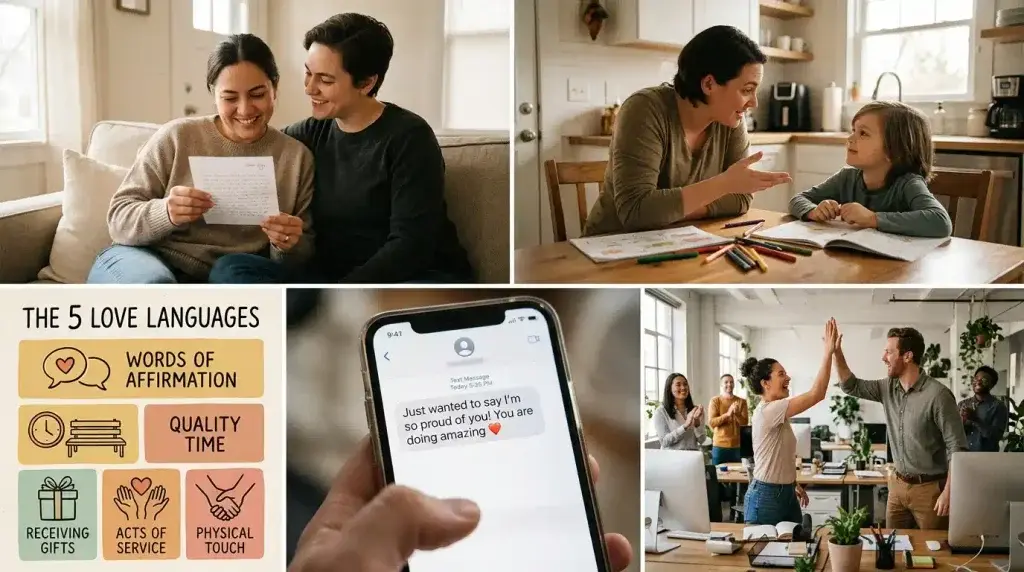
Chapman listed five love languages. They are words of affirmation, quality time, receiving gifts, acts of service, and physical touch. He believed people give love in the way they most want to receive it. So problems can start when two people speak different languages. One person says “I love you” all day long. The other person wants help with the dishes. Both feel unseen, even though both are trying.
The table below gives a quick look at all five.
| Love Language | What It Feels Like | Simple Example |
| Words of Affirmation | Feeling loved through kind words | “I really appreciate you.” |
| Quality Time | Feeling loved through full attention | A walk with no phones |
| Receiving Gifts | Feeling loved through thoughtful items | A small present “just because” |
| Acts of Service | Feeling loved through helpful actions | Cooking dinner after a hard day |
| Physical Touch | Feeling loved through closeness | A hug or holding hands |
One honest note: love languages are a popular tool, not a proven science. Some studies have found that the five-language model is not as exact as many people think. Still, many people find it useful for starting good talks. Use it as a guide, not a rule.
What Words of Affirmation Look Like in Real Life
Words of affirmation come in many shapes. They are not only “I love you.” In fact, the most powerful ones are often specific. Saying “You’re great” is nice. Saying “You stayed calm in that tough meeting, and I admired it” is better. It shows you were paying attention.
You can share these words out loud, in a note, in a text, or even in a card on the fridge. Timing matters too. A kind message on a normal Tuesday can feel more special than one on a birthday, because nobody expects it.
Here are some examples across different parts of life.
| Situation | Example of Words of Affirmation |
| Partner | “I love how you make me laugh when I’m stressed.” |
| Child | “I saw how hard you tried on that puzzle. I’m proud of you.” |
| Friend | “You’re the first person I call with good news. Thank you for being there.” |
| Coworker | “Your idea saved us a lot of time today. Great job.” |
| Yourself | “I did my best, and that is enough for today.” |
Notice that each example is clear and honest. None of them are too fancy. Good words of affirmation sound like you, not like a greeting card.
Signs Someone Speaks the Words of Affirmation Language
How can you tell if this is your love language, or your partner’s? There are a few clues. None of them prove it, but together they paint a picture.
First, think about how you feel after a kind message. If a compliment lifts your whole week, that is a clue. Second, think about how you feel after harsh words. People who value affirmation often feel hurt for a long time after criticism, even when it was meant as a joke.
Third, notice how you show love. Many people give love the same way they want to receive it.
Fourth, notice what you complain about. If you often wish someone would just say how they feel, that points to this language. A person might say, “I know you care, but I never hear it.” That is a classic sign.
You can also ask a simple question: “What kind of words make you feel loved?” People are often surprised by how clear their answers are once they stop and think.
Words of Affirmation in Romantic Relationships
In a couple, words of affirmation can be the glue that holds a bond together. Busy lives make it easy to forget small things. Work, bills, kids, and tired evenings can crowd out kindness. A person who needs affirmation may start to feel invisible during those times.
The good news is that this love language is free and quick. It takes only a few seconds to send a message that says, “I’m glad you’re mine.” Over weeks and months, those seconds add up.
Good words in a relationship include thanks, praise, and support. Words also matter during fights. Even when you disagree, you can choose a kind language. Saying “I’m upset, but I still love you” is very different from name-calling. For someone who values words, harsh talk in an argument can cut deeper than it would for others.
Words of Affirmation With Kids, Friends, and Coworkers
This love language is not only for couples. It works in every kind of bond.
With children, words shape how kids see themselves. A child who hears “You’re so smart” may feel good for a moment. But a child who hears “You worked hard on that, and it paid off” learns that effort matters. Many child experts suggest praising effort and choices rather than only talent. It helps kids feel brave about trying new things.
With friends, words can be a gentle way to stay close. A quick text like “I was just thinking about how much you helped me last year” can brighten a day. Friends often take each other for granted, so these small reminders matter.
At work, kind words can boost trust and teamwork. A manager who says “Thank you for staying late, I know it wasn’t easy” builds loyalty. Even a short note to a teammate can turn a bad day around. Just keep it honest and professional.
The Different Types of Words of Affirmation
Not all affirming words do the same job. Knowing the types helps you pick the right words for the moment.
| Type | What It Does | Example |
| Compliments | Praise something you notice | “That color looks great on you.” |
| Encouragement | Gives courage and hope | “You’ve got this. I’m cheering for you.” |
| Appreciation | Says thank you | “Thanks for picking up the kids today.” |
| Love and Care | Shares feelings directly | “I’m so happy you’re in my life.” |
| Comfort | Supports in hard times | “I’m here with you. You’re not alone.” |
A mix of all five works best. If you only give compliments, your words may feel shallow. If you only comfort, the bond may feel heavy. Balance keeps things warm and real.
How to Give Words of Affirmation the Right Way
Giving kind words sounds easy. But a few small habits make them land much better.
Be specific. “You’re amazing” is fine, but “You made everyone feel welcome at the party” is better. Specific praise shows you truly noticed.
Be honest. People can tell when words are fake. If you say something you do not mean, it can hurt trust. Find something real to say, even if it is small.
Be regular. A big speech once a year cannot replace small words used often. Think of it like watering a plant. A little each day is better than a flood once a month.
Use the person’s style. Some people love public praise. Others feel shy and would rather get a private note. Think about what would make this person feel good, not what would make you feel good.
Match your words with your actions. If you say “I appreciate you” but act cold, the words may feel empty. When words and actions agree, the message is strong.
Finally, try writing. A handwritten note can be saved and read again on hard days. Many people keep special notes for years.
Common Mistakes to Avoid
Even kind people slip up. Here are some common mistakes and easy fixes.
| Mistake | Why It Hurts | Better Choice |
| Praise mixed with a dig | “You looked nice, for once” feels like an insult | Give a clean compliment with no “but” |
| Only speaking up when asked | The person feels they must beg for kindness | Share kind words without being asked |
| Fake or too-much praise | It feels untrue and loses its power | Say fewer words, but mean them |
| Harsh words in anger | Cruel words are remembered for a long time | Take a break, then speak calmly |
| Comparing people | “Why can’t you be more like her?” hurts deeply | Focus only on the person in front of you |
Another mistake is assuming everyone wants words. If your partner does not respond much to compliments, that is not a sign they do not care. They may speak a different love language. The goal is to learn what works for them, not to force your own style.
What If Words Are Hard for You?
Some people find it hard to say kind things out loud. Maybe you grew up in a home where people did not share feelings. Maybe you simply feel shy. That is okay. This skill can be learned, like any other.
Start small. Try one kind sentence a day. It can be as short as “Thanks for today.” Then slowly add more detail. You can also use a note or a text if speaking feels too hard at first.
It can help to keep a “notice list.” Each day, write down one good thing you saw in someone else. Then share it. Over time, noticing good things becomes a habit, and the words come more easily.
You can also practice with yourself. Self-talk matters. If you often speak harshly to yourself, try changing a few phrases. Instead of “I’m so folish ,” try “I made a mistake, and I can learn from it.” Kind self-talk can make it easier to be kind to others too.
Words of Affirmation Examples You Can Use Today
Sometimes you know you want to say something nice but cannot find the words. Here are some ideas, grouped by feeling.
To show thanks, you might say, “I noticed how much you did today, and I’m grateful.” Or you might try, “Thank you for always listening to me.”
To show pride, you could say, “I’m so proud of how far you’ve come.” Or, “You handled that with so much grace.”
To show love, try, “You make my life better in so many ways.” Or, “I’m lucky to have you.”
To give courage, say, “I believe in you, even when you doubt yourself.” Or, “Whatever happens, I’m on your side.”
To comfort someone, you might say, “It’s okay to feel this way. I’m here.” Or, “You don’t have to go through this alone.”
Feel free to change these to fit your own voice. The best words are the ones that sound like you.
FAQs
What is the meaning of words of affirmation?
Words of affirmation means using kind, caring, and honest words to show love or support. It is one of the five love languages described by Gary Chapman.
What are examples of words of affirmation?
Examples include “I’m proud of you,” “Thank you for helping me,” “You look great today,” and “I believe in you.” Specific and honest words work best.
How do I know if words of affirmation is my love language?
Notice how you feel after hearing kind or harsh words. If compliments make you glow and criticism stays with you for days, this may be your main love language.
Is words of affirmation only for romantic partners?
No. It works with kids, friends, family, and coworkers too. Anyone can feel more valued when they hear sincere, kind words.
Can too many compliments be a bad thing?
Yes, if they feel fake or empty. A few real, specific words are better than many general ones. Quality matters more than quantity.
What if my partner does not speak this love language?
Talk openly about it. Ask what makes them feel loved, and share what makes you feel loved. You can learn each other’s languages and meet in the middle.
Conclusion
The words of affirmation meaning come down to this: kind, honest words can make people feel seen, valued, and loved. This love language, shared by Gary Chapman in The 5 Love Languages, reminds us that what we say really matters. Words can lift a person up, and words can also hurt. So choosing them with care is a gift.
Remember that love languages are a helpful guide, not a perfect science. Every person is different. The best plan is to pay attention, ask questions, and speak with kindness.
Here is one thing you can do today. Think of one person in your life and send them a specific, heartfelt message. Do not wait for a special day. Small words, said often and said honestly, can build strong and happy bonds over time.

Hi, I’m Rebecca Hayes. I write faith-filled articles, healing prayers, and daily devotionals to encourage people in every season of life. My passion is helping readers find peace, hope, and strength through prayer.