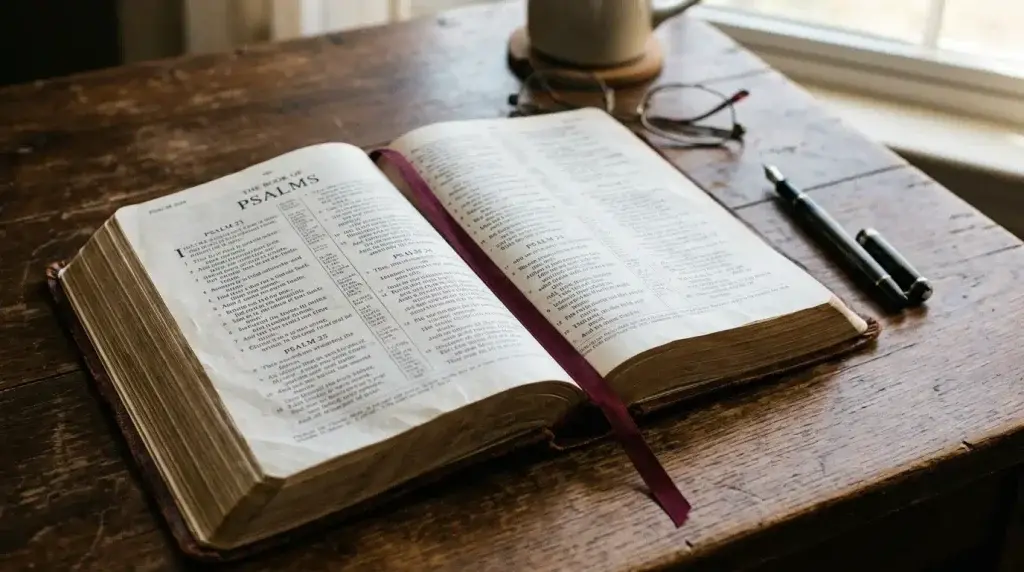
The selah meaning in the Bible is simple at its core: it is a short pause. Most scholars think it tells the reader or singer to stop, think, and let the words sink in. Still, no one knows for sure, and that is part of the fun.
If you have ever read the Psalms, you have likely seen this odd little word tucked inside a verse. You may have wondered what it means, how to say it, and why it shows up so often.
Many readers just skip right over it. In this guide, you will learn where selah appears, what the main ideas about it are, and how you can use it in your own prayer time.
Quick Answer
Selah is a Hebrew word found 71 times in the book of Psalms and three times in Habakkuk. Its exact meaning is not known. Most Bible teachers say it means “pause,” “stop and think,” or “lift up.” It was likely a note for music or worship. Readers today often treat it as a moment to pause and reflect.
That is the short version. Because the word is so old, the full story takes a little more room. The sections below walk through it step by step, so you can see why people still talk about it today.
What Selah Really Means in the Bible
Selah, pronounced SEE-luh or SAY-lah, comes from the Hebrew word selah. Hebrew is the language most of the Old Testament was first written in. The word shows up inside poems and songs, usually at the end of a line or a thought.
Here is the honest part. The Bible itself does not stop to explain the word. There is no verse that says, “Selah means this.” Because of that, readers and scholars have worked from clues. They look at where the word sits, what comes just before it, and how early translators handled it.
Think of it like a note in a song book. If you found an old hymn book with a strange mark between lines, you might guess it meant “rest here” or “sing louder.” You would base your guess on the music around it. That is how experts have studied selah for hundreds of years.
Most of the clues point to a pause. In many places, the verse before selah is deep, strong, or surprising. The word then gives the singer or listener a beat to take it in. That is why “pause and think” is the most common answer you will hear today.
Another idea is that selah means “lift up.” This comes from a Hebrew root word that can mean raising something high. If that is right, the word might have told singers to raise their voices or told musicians to play louder. Others think it called the crowd to lift their hearts toward God.
So when you ask about the selah meaning in the Bible, the best answer is a mix. It was a musical or worship note, and it most likely pointed to a pause, a lift, or both.
Where Selah Appears in the Bible
Selah is not spread across the whole Bible. It lives in just two books. The Psalms hold nearly all of the uses, and Habakkuk holds a few more. Habakkuk chapter 3 is a prayer written like a song, so it makes sense that the word shows up there.
The word is found in 39 of the 150 psalms. Some psalms use it once, while others use it several times. Psalm 3 is the first place you will meet it, and it appears again and again from there.
| Book | Number of Times | Notes |
| Psalms | 71 | Found in 39 different psalms |
| Habakkuk | 3 | All in chapter 3, a prayer set like a song |
| All other books | 0 | Selah does not appear anywhere else |
| Total | 74 | Across the whole Bible |
Many of the psalms with selah are marked as songs for a choir leader, or are linked to David and the sons of Korah. That fits the idea that selah was a note for the music. Most of the uses are packed into the first three-fifths of the book, and the last part of Psalms has very few.
One more fact is worth knowing. In the original Hebrew, selah is part of the text itself. It is not a footnote added later. That means the writers or early editors thought it was important enough to keep right in the poem.
The Origin and History of Selah
Where did the word come from? The honest answer is that we are not fully sure. The Hebrew root may be linked to words that mean “to lift up,” “to weigh,” or “to hang.” Each of these could connect to the idea of a pause or a raising of sound.
The oldest clue comes from the first Greek translation of the Old Testament, called the Septuagint. It was made a few hundred years before Jesus was born. The translators turned selah into a Greek word, diapsalma. That word is often understood to mean a break in the music, a kind of musical interlude.
That is a strong hint. People who lived much closer to the time of the Psalms understood the word as something to do with music. They did not treat it as a normal word with a plain meaning.
Other early Jewish writers had different ideas. Some old Aramaic translations rendered it as “forever.” Some later Jewish teachers read it as a word that stressed truth, like saying “always” or “so it is.” Over time, these ideas mixed together, and readers kept all of them in mind.
By the time the Bible was translated into Latin and later into English, translators had a choice. They could guess a meaning and swap in an English word, or they could leave selah alone. Most chose to leave it. That is why you still see the original word in most English Bibles today.
This long history shows something useful. Even the earliest readers were unsure about selah, and they kept it anyway. That tells us they respected it as part of the song.
Main Ideas About What Selah Means
Scholars have offered several ideas over the years. None has been proven, but each has a reason behind it. Here is a clear look at the top ones.
| Idea | What It Suggests | Why People Believe It |
| A musical pause | Stop singing and let the music rest | Early Greek translators used a word tied to music breaks |
| A time to reflect | Stop and think about what was just said | The line before selah is often deep or serious |
| Lift up | Raise your voice, music, or heart | The Hebrew root may mean “to lift” |
| Play louder | Instruments rise in a burst of sound | Fits the “lift up” idea in a worship setting |
| Forever or always | Stress that the truth lasts | Some old Aramaic translations used this sense |
As you can see, the ideas overlap. A pause and a lift are not opposites. Picture a choir that stops for a breath, then bursts back in stronger than before. One idea can hold both.
Some readers like to say selah means “think about that.” Others say it means “let that sink in.” These are friendly, modern ways to say the pause idea. They are not word-for-word translations, but they capture the feeling well.
It is also fair to say that selah may have meant different things in different places. A word in a song can change with the tune or the moment. That would explain why no single meaning fits every single verse perfectly.
How Selah Works Inside the Psalms
Seeing selah in real verses helps the idea come alive. Let’s walk through a few well-known spots.
In Psalm 3, David writes about being chased by enemies. He says many people are against him, and some say God will not help him. Right after that thought, the word selah appears. It is easy to imagine a pause there. The listener has just heard a scary and sad line, and they get a moment to feel it.
Psalm 46 is another great example. This psalm is about God as a safe place in times of trouble. It talks about earth shaking and mountains falling into the sea. Selah appears three times. Each time, it follows a strong statement about God’s power and care. The pause seems to say, “Did you hear that? Think about it.”
Psalm 24 is a joyful song about the King of glory coming in. The word appears near the end, as the psalm builds toward a high point. This fits the “lift up” idea nicely, since the whole song is about raising gates and welcoming a great king.
Then there is Psalm 32, where the writer shares how it felt to hide a wrong and then confess it. Selah comes in at moments of deep honesty. A pause there lets the heart catch up with the words.
Notice the pattern. Selah tends to land after something big: a hard problem, a powerful promise, a bold praise, or a heavy truth. It acts like a spotlight, drawing attention to what was just said.
How Different Bible Translations Handle Selah
If you read from more than one Bible version, you may notice that selah is handled in different ways. Most popular English Bibles, such as the King James Version, the New International Version, the English Standard Version, and the New American Standard Bible, keep the word as it is. They do not try to translate it.
Some Bibles add a short footnote. The note might say that the meaning is uncertain, or that it may be a musical term. This is a good example of honest translation. The editors are telling you that they are not sure either.
A few modern versions and paraphrases handle it in their own way. Some replace it with a word like “pause” or “interlude,” while others tuck a note in the margin. Because translation choices vary, it is a smart move to check your own Bible’s notes. They often explain how that version treats the word.
Keeping selah in the text has one clear benefit. It lets each reader think about it and decide how to use it. It also stays true to the original, which is a good rule for any careful Bible reader.
Common Mistakes People Make About Selah
Because the word is so mysterious, people sometimes say things about it that go too far. Here are a few mistakes worth avoiding.
The first mistake is saying that the meaning of selah is certain. You may hear a teacher say, “Selah definitely means ‘stop and listen.'” That sounds nice, but it goes beyond what we can prove. A better way to say it is that selah likely signals a pause.
The second mistake is thinking selah is a person’s name or a place. It is neither. It is a word used inside songs and poems, and it does not stand for a character or a city.
The third mistake is believing that selah is found all over the Bible. As the table showed, it only appears in Psalms and Habakkuk. You will not find it in Genesis, the Gospels, or the letters of Paul.
The fourth mistake is treating selah like a magic word. Some people say it at the end of prayers or posts as if it adds power. The word itself does not carry power. Its value comes from the habit it points to, which is slowing down and thinking about God.
The fifth mistake is skipping it. Many people read right past selah without a thought. But since the word was kept in the text for thousands of years, it deserves at least a moment of attention.
How to Practice Selah in Your Daily Life
You do not need to be a Bible expert to use the idea of selah. It is really about slowing down. In a busy world, a built-in pause can be a gift.
Start with your Bible reading. When you come to a selah in the Psalms, stop for a few seconds. Read the line before it one more time. Ask yourself a simple question: “What is this saying about God, or about me?” Then keep going.
You can also use selah in prayer. After you talk to God, stay quiet for a minute. You do not have to say anything. Just sit and listen, the way you might sit with a friend after a long talk.
Here are a few easy ways to build the habit:
Families can try it too. After reading a short passage together, everyone can be quiet for thirty seconds. Then each person can share one thing that stood out. Kids often enjoy this, and it teaches them that quiet time is not boring.
The point is not to follow a strict rule. It is to make space for your heart to catch up with the words you have read.
Selah in Music and Culture Today
Selah has not stayed only in old scrolls. Today you will find it in church songs, books, art, and even names. Many worship songs use the word as a quiet moment in the middle of a tune. Some Christian bands and groups even take it as their name.
Writers and speakers like it, too. You might see it at the end of a poem or a social media post, as a way to say, “Think about that.” In this way, a very old word has found a new home.
Some people also use selah as a first name, especially in the United States. It has a gentle sound, and many parents like the idea behind it. Because the Hebrew word is not a name in the Bible, this use is modern, but it shows how much people love the word.
In bookstores, you will find journals, devotionals, and prayer guides built around the idea of pausing. The word has become a small symbol of calm. In a world full of noise, that makes sense.
It is worth remembering, though, that the modern use does not always match the ancient one. The people who first sang the psalms were using it in a worship setting. Today it often carries a looser, more personal feel. Both can be meaningful, as long as we are clear about which is which.
FAQs
What does selah mean in the Bible?
Selah most likely means a pause, a time to think, or a call to lift up your voice or heart. Its exact meaning is not known. It was probably a note for music or worship in the Psalms.
How do you pronounce selah?
Most people say SEE-luh or SAY-lah. Both are common in English. The Hebrew sound is closer to SEH-lah. Any of these is fine for daily reading and talking.
How many times is selah in the Bible?
Selah appears 74 times in all. There are 71 uses in the book of Psalms and three in Habakkuk chapter 3. It is not found in any other book of the Bible.
Is selah only in the Psalms?
Almost. Nearly all of the uses are in Psalms, and the rest are in Habakkuk 3. Since both are written as songs or prayers, the word fits the musical setting of those books.
Why do Bible translators keep selah instead of translating it?
Because no one knows its full meaning. A wrong guess could change the sense of the verse. Keeping the original word is the safest and most honest choice, and many Bibles add a footnote.
Should Christians say selah today?
There is no rule about it. Many people use it as a friendly reminder to pause and think. If you use it, you can do so with respect and with a clear idea of what it likely meant.
Conclusion
The selah meaning in the Bible may not be fully solved, but it is still rich and helpful. It shows up 74 times, in only two books, and it most likely points to a pause, a lift, or both. Early translators, old scholars, and modern readers all agree that it matters, even if they do not agree on every detail.
The best part is that you do not need to know every answer to learn from it. When you see selah, treat it like a gentle sign on a quiet road. Slow down. Look at what you just read. Let it settle in your heart before moving on.
Try it this week. Pick one psalm, find the word, and pause. You may be surprised by how much one small breath can change your reading.
Discover More Article

Hi, I’m Elias Monroe. I enjoy writing meaningful prayer content that helps people feel calm, hopeful, and spiritually strong. My goal is to share words that bring comfort during both joyful and difficult times.