You may have seen it on a flag, a state seal, or in a history book: “sic semper tyrannis.” It looks strong and serious, and it is a little hard to read. The sic semper tyrannis meaning is “thus always to tyrants,” a Latin phrase that says tyrants will always meet this fate. It is the motto of the state of Virginia. It is also linked to one of the darkest moments in American history, the shooting of President Abraham Lincoln.
That mix of pride and pain is why so many people search for it. In this guide, you will learn what the words mean, where the phrase came from, how it is used, and why it can be so controversial. You will also find easy tables and clear answers.
Sic Semper Tyrannis Meaning: The Quick Answer
“Sic semper tyrannis” is Latin for “thus always to tyrants.” It is commonly translated that way. In plain English, it means that cruel rulers who seize too much power will always come to a bad end.
The phrase is best known today as the motto of Virginia. It appears on the state seal and flag. It is also known because of John Wilkes Booth, who shouted it after he shot President Lincoln in 1865.
So the phrase carries two stories. One is about standing against unfair power. The other is about a violent crime. Both are part of its history.
What Do the Three Words Mean?
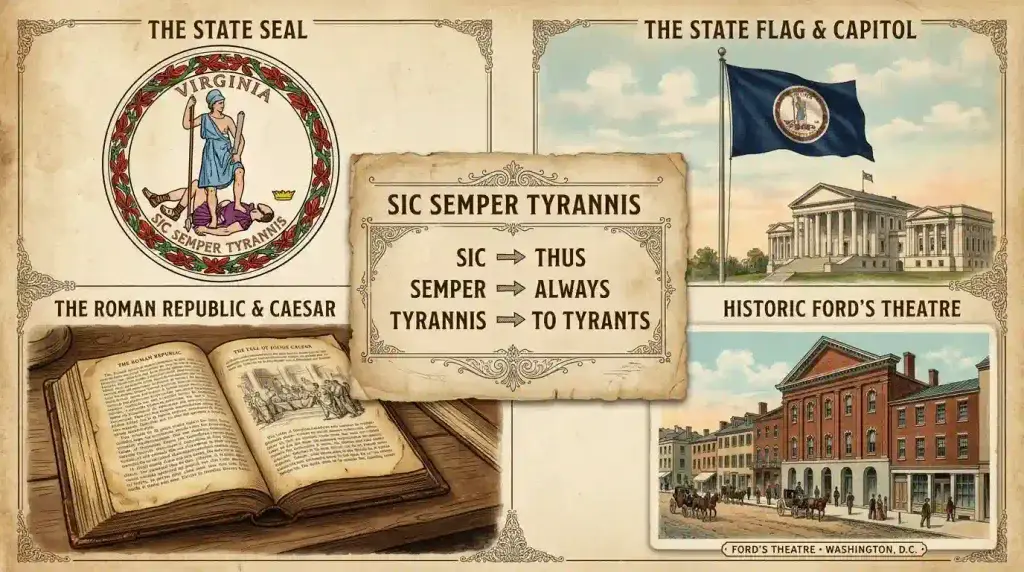
Latin can look scary, but this phrase has only three words. Here is a simple breakdown.
| Latin Word | Meaning in English | Notes |
| Sic | Thus, so, in this way | Points to something just shown or done |
| Semper | Always | Means every time, without fail |
| Tyrannis | To tyrants | A form of “tyrannus,” meaning tyrant or harsh ruler |
Put together, you get “thus always to tyrants,” ors
Notice that the phrase has no verb. Latin often skips verbs when the meaning is clear. A very close English match would be, “So it always goes for tyrants.” Another good match is, “That is what tyrants get.”
A tyrant is a ruler who uses power in a cruel or unfair way and does not listen to the people. The word comes from Greek and Latin. In the old world, it often meant someone who took power by force, not by fair rules.
For pronunciation, many English speakers say it like “sik SEM-per ti-RAN-is.” The exact sound can change depending on whether a person uses classical Latin or the English way of saying Latin words.
Where Does Sic Semper Tyrannis Come From?
The origin of the phrase is a bit of a mystery. It is often credited to Marcus Junius Brutus, one of the people who killed Julius Caesar in ancient Rome.
The story goes that Brutus and other Roman senators believed Caesar was becoming a tyrant. They killed him in 44 BC to protect the Roman Republic. Later tellings of the story say that Brutus used the words “sic semper tyrannis” at that moment.
But there is a big catch. Historians are not sure that Brutus ever said it. Writers note that the motives behind Caesar’s killing show the meaning of the phrase, whether or not the story is historically accurate. Ancient writers described the event, but the exact Latin phrase does not appear to come from them. It may have been attached to the story much later.
So the safest way to say it is this: the phrase is traditionally linked to Brutus, but we cannot prove that he said it. The idea behind it, that people may resist cruel rulers, is very old and shows up in many cultures.
Sic Semper Tyrannis and the Virginia Seal
Here is the most official and lasting use of the phrase. In 1776, the year the United States was founded, Virginia adopted it as part of its seal.
The seal is full of meaning. George Mason presented the idea to the Virginia Convention in 1776 as part of the state’s seal. A statesman named George Wythe is also credited with the design.
The picture on the seal tells a story. A woman stands for Virtus, the Roman figure of virtue and courage. She holds a spear and wears the clothing of a warrior. Under her foot lies a fallen figure with a crown rolling nearby. That figure is the tyrant. The scene says that virtue has beaten tyranny.
The date matters. In 1776, American colonies were breaking away from British rule, and many colonists felt that the king had become unfair and controlling. The seal showed Virginia’s side in that struggle. It said, in a sense, that Virginians stood against a king they saw as a tyrant.
Today the phrase is recognized as the official motto of the Commonwealth of Virginia. It still appears on the state’s flag and seal.
A Funny Joke About the Seal
The seal’s picture has inspired a famous joke. A joke dating back to the Civil War says that “sic semper tyrannis” really means “Get your foot off my neck.”
The joke makes sense when you look at the seal. Virtus stands with her foot on the tyrant’s body. A soldier looking at the picture might read the scene as one person pressing down on another, so the joke flips the point of view.
It is a light moment in a very serious history. People often use humor to make sense of strong images and strong words. Soldiers in the Civil War were said to have used this translation themselves, which shows how widely known the seal was.
John Wilkes Booth and Abraham Lincoln
This is the part of the story that makes many people uneasy. On April 14, 1865, John Wilkes Booth shot President Abraham Lincoln at Ford’s Theatre in Washington, D.C. Lincoln died the next day.
Booth wrote in his diary that he shouted “Sic semper tyrannis” after the shooting. He knew the phrase from Virginia’s seal and from the story of Brutus, and he wanted to cast himself as a hero fighting a tyrant.
That claim was false and wrong. Lincoln was an elected president, not a tyrant. Booth and other Confederate sympathizers viewed Lincoln’s treatment of the Southern states as cruel and unfair. But that view does not make murder a noble act. The killing was a crime that deeply harmed the country.
Because of Booth, the phrase now has a dark shadow. Many people cannot hear it without thinking of Lincoln’s death. Some writers say Booth’s use of the phrase twisted its original meaning.
It is important to say clearly: this article explains history. It does not praise violence. Using a famous phrase does not make an act right.
A Timeline of the Phrase
This table shows the key moments in the phrase’s story. Remember that the first one is a tradition, not a proven fact.
| Time | Event | Notes |
| 44 BC | Julius Caesar is killed in Rome | Phrase is traditionally linked to Brutus, but unproven |
| 1776 | Virginia adopts the phrase for its seal | Tied to George Mason and George Wythe |
| 1861 to 1865 | Civil War | Soldiers joke about the seal’s meaning |
| 1865 | John Wilkes Booth shouts it after shooting Lincoln | Recorded in his diary |
| Later years | The phrase appears in books, films, and debates | Meaning is often argued over |
The timeline shows how one phrase can change in meaning. It began as a symbol of resistance to bad rule. It later became linked to a terrible crime. Today, it is both a state motto and a controversial phrase.
Why Is the Phrase Controversial?
Few mottos are as debated as this one. Writers describe the phrase as polarizing. There are a few reasons.
First, the link to Lincoln’s assassination. Many people feel that a phrase tied to the killing of a president should not be a state motto.
Second, later users. In modern times, some people have used the phrase in anger or in support of violence. One article notes that Timothy McVeigh wore a shirt carrying the phrase, and suggests he may have felt a link to Booth’s motives. That connection adds to the feeling that the words can be misused.
Third, the question of who the “tyrant” is. People often use words like “tyrant” for leaders they dislike. Because one person’s tyrant may be another person’s elected leader, the phrase can be used to excuse harmful acts. That is one reason many historians urge careful use.
Some people have argued that its association with Booth makes it a poor choice for a state symbol. Others say its original meaning, from 1776, is about freedom and should be judged separately.
There is no single answer, and reasonable people disagree. The best approach is to know the full history and to speak about it with care.
Different Ways People Read the Phrase
The same words can be understood in different ways. This table shows several common views.
| View | How It Reads the Phrase | Main Idea |
| Historical | A motto from 1776 | Resistance to unfair rule |
| Classical | A phrase tied to Brutus and Caesar | A story from ancient Rome |
| Darker | Booth’s words at Ford’s Theatre | A crime and false claim |
| Symbolic | Virtue defeating tyranny | A hopeful message about justice |
| Warning | Misuse by angry people | A reminder to use strong words carefully |
Each view has a piece of truth. The phrase really has been used in all of these ways. That is why a quick answer about its meaning always leaves out part of the story.
For students, a good habit is to ask: Who is using the phrase? When? And what do they mean by “tyrant”? Those three questions can help you judge any use of it.
Other Places the Phrase Appears
Besides Virginia’s seal, you may see the phrase in other settings.
In books and films, writers use it to set a scene in history or to show a character’s strong views. It appears in stories about Rome, the American Revolution, and the Civil War.
In schools and museums, teachers use it to explain the history of Virginia and the events of 1865. Museum displays about Lincoln’s assassination often mention it.
On flags and clothing, some people display it. Because of its mixed history, it can send very different messages depending on who uses it and why.
In debates about symbols, the phrase comes up when people talk about state mottos, monuments, and how to remember the past.
If you see the phrase, take a moment to think about the setting. A school lesson about Virginia history is very different from a violent message.
Common Mistakes and Myths
Because the phrase is famous, a few mistakes spread often.
The first myth is that Booth invented the phrase. He did not. It was already the motto of Virginia and linked to older stories.
The second myth is that Brutus definitely said it. As we saw, this is a tradition, not a proven fact.
The third myth is that the phrase is only about Lincoln. Its history goes back much further, and it has been Virginia’s motto since 1776.
The fourth mistake is thinking it means “death to rulers.” The words say “thus always to tyrants,” which describes the fate of unjust rulers. It is not a rule that applies to any leader a person dislikes.
The fifth mistake is using the phrase lightly. Because of its link to a real killing, it can hurt or upset people. Think before you use it, especially in jokes.
Last, avoid trusting every website. Many pages repeat guesses as facts. Reliable sources include state government sites, history museums, and well-known encyclopedias.
Tips for Understanding and Using the Phrase
If you want to learn more or use the phrase in school or writing, here are some tips.
Learn the full story. Know the Roman tradition, the Virginia seal, and the Booth connection.
Use clear context. Explain who said it and when, so readers do not get the wrong idea.
Be careful with jokes. This phrase is tied to real harm, so humor can easily go wrong.
Check trusted sources. Look at Virginia’s official state pages, the Library of Congress, and respected history sites.
Think about the word “tyrant.” Ask whether it fits the situation, or whether it is being used as a label to justify anger.
Respect different feelings. Some people see pride in the motto, and others feel pain. Both can be true.
Keep history and violence separate. Understanding a phrase does not mean approving of what people did with it.
FAQs
What is the simple sic semper tyrannis meaning?
It is Latin for “thus always to tyrants.” It means that tyrants, or cruel rulers, will always meet a bad end.
Is sic semper tyrannis the Virginia state motto?
Yes. Virginia adopted it as part of its seal in 1776. It appears on the state’s seal and flag.
Who said sic semper tyrannis first?
Tradition links it to Marcus Junius Brutus at the killing of Julius Caesar, but historians cannot prove he said it. The exact first use is unknown.
Why did John Wilkes Booth say sic semper tyrannis?
Booth shouted it after shooting President Lincoln, calling Lincoln a tyrant. That claim was false, and the act was a crime. His diary says he used the phrase.
What does the Virginia seal show?
It shows Virtus, a figure of virtue, standing over a fallen tyrant with a crown beside him. She holds a spear. The picture shows virtue defeating tyranny.
Is sic semper tyrannis a violent phrase?
It describes a harsh fate for tyrants, and it has been used by violent people. But it was also chosen in 1776 as a symbol of resisting unfair rule. Its meaning depends on how and why it is used.
Conclusion:
The sic semper tyrannis meaning is “thus always to tyrants.” It is a Latin phrase that says unjust rulers will meet a bad end. It is tied by tradition to Brutus and the death of Julius Caesar, though that link cannot be proven. In 1776, Virginia adopted it for its seal, where it still stands as the state motto. In 1865, John Wilkes Booth shouted it after killing President Lincoln, which gave the phrase a dark shadow that remains today.
We also learned that the phrase is controversial, that people read it in different ways, and that it is wise to use it with care.
So here is some practical advice. Learn the whole story before you quote or share the phrase. Use trusted sources, think about the setting, and remember that history deserves both honesty and respect.

Hi, I’m Sarah Mitchell. I love writing faith-based content that brings peace, hope, and encouragement to everyday life. Through prayers and devotionals, my goal is to help readers feel closer to God and stronger in faith.