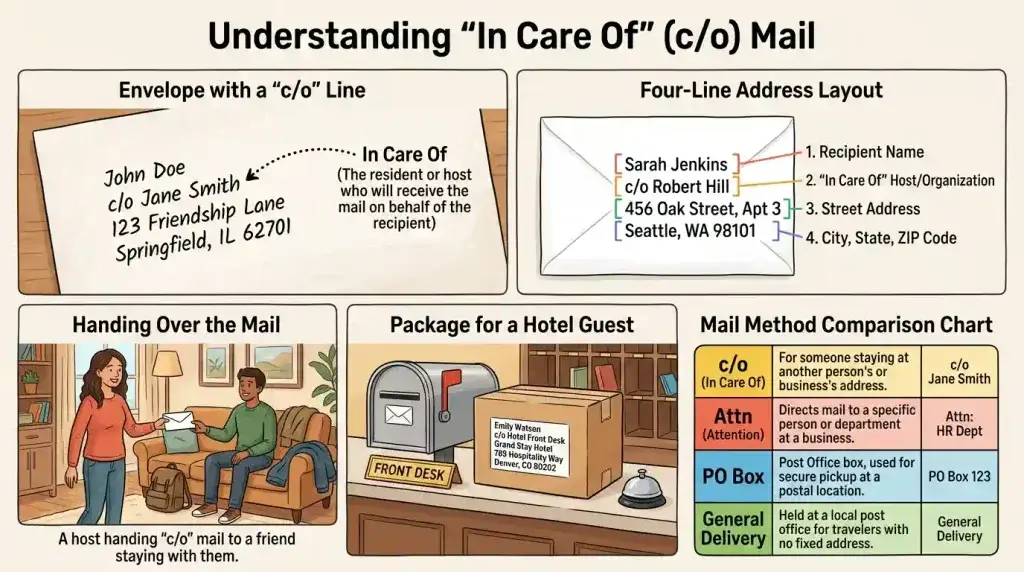
The care of name meaning is easy once you see it in action. “In care of,” often written c/o, means you are sending mail to a person at an address that belongs to someone else. The person named after “c/o” receives it and passes it along.
You have probably seen c/o on an envelope, a package label, or a form and wondered what to do with it. Maybe you are staying with a friend. Maybe you are between homes. Or maybe you need to mail something to a person who is staying at a hotel or working at an office.
In this guide, you will learn what the phrase means and how to write it on an address. You will also see how it differs from “attention,” plus real examples, common mistakes, and simple tips.
Quick Answer: In Care of Name Meaning
“In care of” tells the mail carrier, “This letter is for Person A, but deliver it to Person B’s address.” Person B is the one “taking care of” the mail until Person A gets it.
Here is a quick example. Maria is staying with her aunt for two months. A friend mails her a card addressed to Maria, c/o her aunt, at her aunt’s street address. The aunt receives the card and hands it to Maria.
Notice the key idea. The name after c/o is the person or place that holds the mail for someone else. It is not the final reader. It is the helper in the middle.
What Does C/O Stand For?
C/O is short for “care of.” You will see it written in a few ways: c/o, C/O, or the full words “in care of” or “care of.” They all mean the same thing. The slash is just a quick way to shorten the phrase.
The table below breaks the phrase into easy parts.
| Part | Simple Meaning | Role in the Address |
| In care of / c/o | “Through the help of” | Signals that mail is going through another person or place |
| First name on the address | The person the mail is really for | The final reader |
| Name after c/o | The person or business who holds the mail | The helper who receives it |
| Street address | Where the mail is actually delivered | The location of the helper |
When you look at it this way, the phrase is not hard. It is simply a way to say, “This mail has a middle stop.”
How to Write an Address With C/O
The address has a clear order. Start with the person the mail is for. On the next line, write c/o and the name of the person or business receiving it. Then add the street address, city, state, and ZIP code.
Here is how it looks, one line at a time.
| Line | What to Write | Example |
| Line 1 | Name of the real recipient | Maria Lopez |
| Line 2 | c/o and the name of the helper | c/o Rosa Diaz |
| Line 3 | Street address | 45 Maple Street |
| Line 4 | City, state, and ZIP code | Dayton, OH 45402 |
Written out in full, the address looks like this:
Maria Lopez
c/o Rosa Diaz
45 Maple Street
Dayton, OH 45402
This is the most common layout in the United States. Some people put the c/o on the same line as the first name, but the two-line format is cleaner and easier for mail workers to read.
I should add a small note. Postal rules can change, and the exact style the USPS prefers is best checked on usps.com. Their address tools can also help you confirm a full address.
Which Name Goes First?
This is where many people get mixed up. The person the mail is for always goes on top. The person the mail is going through goes after “c/o.”
Think of it this way. The first line answers, “Who needs this?” The second line answers, “Who will hand it over?”
If you flip the two names, the mail may still arrive, but it could be opened by the wrong person or returned. The helper’s name does not replace the real recipient. It only adds a safe stop along the way.
A simple memory trick can help. Read the address out loud with the word “through” in place of c/o. “Maria Lopez, through Rosa Diaz, at 45 Maple Street.” If it sounds right, you wrote it correctly.
When Should You Use C/O?
C/O is helpful in many everyday situations. It works whenever the person’s name is not tied to the address in a normal way.
The first and most common case is a temporary stay. If you are living with a friend, a relative, or a roommate for a short time, c/o helps mail find you. The second case is a move. When you are between homes, a family member can hold your mail.
Business and travel give more examples. A guest at a hotel may get mail addressed to them, c/o the hotel. A worker at a job site may use c/o with the company’s name. Students sometimes use c/o with a school office. And a person who is helping someone with money or paperwork may receive mail for that person, c/o a trusted adult or helper.
Some people also use it for legal or money matters, such as a lawyer or agent who handles mail for a client. In those cases, an office or professional can be the “care of” name.
Always ask first. Using someone’s address without their permission can cause confusion, and it is rude. The helper should know to expect your mail and to pass it on.
C/O vs. Attn and Other Address Terms
Many people mix up c/o with other address terms. They look alike, but they do different jobs. The table below shows the main ones.
| Term | What It Means | When to Use It |
| c/o (care of) | Mail goes through someone else at their address | The person does not live or work at that address regularly |
| Attn (attention) | Mail is for a certain person or department at an organization | The person works at the company or office |
| PO Box | A locked box at a post office | You rent the box and collect mail there |
| General Delivery | Mail held at a post office for pickup | You have no fixed address for a short time |
| Apt or Unit | A specific home inside a building | You live at that address |
The big difference is between c/o and Attn. Use “Attn” when you are writing to a company and want a certain person or desk to see it. The person usually works there. Use “c/o” when the recipient is a guest or temporary visitor, not a regular worker or resident.
You will sometimes see both in one business address, but that is rare. When in doubt, think about if the person belongs at the address or is only passing through.
Where Does the Phrase Come From?
The words are simple. “Care” here means looking after something, and “in care of” suggests that another person is looking after the mail. That makes the phrase easy to understand even if you have never heard it before.
As for the exact history, I could not find a firm date or a clear first use of “in care of” on mail. Language writers agree that the idea is old and tied to the growth of postal services, but they do not agree on exact dates. So it is safer not to claim a precise start.
You may also see an older style that used a percent sign, like “% Rosa Diaz,” in place of c/o. That form was used in some older addresses. It is not a good choice today, because modern mail systems and people are far more used to c/o. I am noting it only because you might spot it on old letters or labels.
Grammar and Usage: Writing C/O the Right Way
Using c/o in a sentence is different from using it on an envelope. Both are fine, but the style changes.
On an address, any style works: c/o, C/O, or c/o with capital letters. Many people use lowercase, but capitals are also common. Pick one and keep it the same throughout. The slash is the normal punctuation, with no spaces around it.
In a sentence, you can write “care of” in full or use c/o. Here are some easy examples:
- “Please send the package to Jon Smith, c/o the front desk.”
- “I’m staying with my uncle, so use his address and write c/o his name.”
- “The letter was addressed to her in care of her school.”
- “Mail for the guest should go c/o the hotel.”
In formal writing, “in care of” is usually clearer. In quick notes, forms, and labels, c/o saves space. The phrase works as a short phrase that links two names. It does not change in different tenses, and it does not have a plural form.
Common Mistakes People Make
A few slips happen again and again. Knowing them will help you avoid lost or delayed mail.
The first mistake is swapping the names. If the helper goes on the first line and the real recipient goes on the second, the mail can end up with the wrong person. The second mistake is leaving off the c/o entirely. Without it, a mail carrier may not know why a stranger’s name is on someone else’s house.
The third mistake is forgetting to ask permission. The helper may not know the mail is coming. The fourth mistake is using c/o when “Attn” is better. If a person works at a company, “Attn” is the standard choice.
Other common errors include leaving out the ZIP code, writing the helper’s name too small or in the wrong place, and using c/o for a long-term address. If you live at a place for years, it is better to update your address in the normal way and not rely on c/o.
A final mistake is thinking c/o fixes everything. It does not. Some places and offices have their own rules, and we will cover that next.
When C/O May Not Work
C/O is helpful, but it has limits. Some offices and services want a proper home address, and a c/o address may not be accepted for every purpose.
For example, certain government or bank forms may ask for proof that you live at an address. A c/o line alone may not count as proof. Rules differ by agency, by state, and by company, and I did not find one simple rule that covers all of them. So it is wise to check with the office or service in question.
Package carriers can also be picky. Some delivery services read the first line as the main name on the package. If the helper’s name is hard to find, the package may be left or returned. Using clear, simple labels can help.
If you need a longer-term fix, a PO Box or a mailbox rental may be better. These give you a stable address in your own name. For any legal, tax, or money matter, ask the office involved what they accept. I am not a legal or tax professional, so this is general information only.
Tips for Using C/O Without Problems
A few simple habits can help your mail arrive safely.
Ask the helper first, and tell them what to expect. A short text like “A card is coming for me, c/o you” can save a lot of worry. Spell all names the way they appear on the mailbox or door. Mismatched names can confuse carriers.
Keep the address clean and clear. Put each part on its own line. Write in print if you are using a pen, and use the full ZIP code. If you are ordering online, look for a line labeled “Address 2” or “Apt/Suite” and put the c/o there if the form has no better spot.
Tell senders to use the same format each time. And if your stay is short, tell the sender when to stop using the address. Finally, thank your helper. They are doing you a favor, and a small thank-you goes a long way.
British vs. American English
The phrase “care of” is used in both American and British English. In both places, c/o means the same thing: mail going through another person or place.
The main differences are in the rest of the address. US addresses put the ZIP code after the state, while UK addresses use a postcode, and the order of the lines can be a little different. The c/o line itself works the same way.
I did not find any strong rule that sets the two styles apart on c/o. If you are mailing something abroad, it is wise to check the postal rules of the country you are sending to.
Current Usage and Trends
Today, c/o is still used, though less often than it once was. Email and online accounts have changed how we send and get messages. Many people no longer rely on a friend’s address for important mail.
Still, the phrase has not gone away. Online shopping has kept it alive. People who live in shared housing, travel a lot, or move often still find it handy. Hotels, offices, and schools also use c/o in their daily mail.
I did not find exact numbers on how often c/o is used now, so I will not guess. What is clear is that the phrase is still a normal part of English and still helps in many mailing situations.
FAQs
What does “in care of” mean on mail?
It means the mail is for one person but delivered to another person’s address. The second person holds the mail and passes it on.
What does c/o stand for?
C/O stands for “care of.” You can also write it as “in care of” or “C/O.”
Which name goes first when using c/o?
The real recipient goes on the first line. The person or place that receives the mail goes after c/o on the second line.
Is c/o the same as attention?
No. “Attn” is used for a person or department at an organization where they work. C/O is used when the person is a guest or does not live or work at the address.
Can I use c/o for a long time?
You can, but it is better for short stays. For a long-term address, many people use a PO Box or update their address in the normal way.
Does every office accept c/o addresses?
Not always. Some banks and agencies want a proper home address, so it is best to ask first.
Conclusion
Now you know the meaning of the name. It tells mail carriers that a letter or package is for one person but should go to another person’s address. The helper receives the mail and passes it on.
We also covered how to write the address, which name goes first, and how c/o differs from “Attn.” We looked at common mistakes, from swapped names to missing permission. And we saw that some offices may not accept a c/o address for every purpose.
Here is a simple tip you can use today. Put the real recipient on the first line, add c/o and the helper’s name on the second line, then finish with the street address. Ask your helper first, and check the rules at usps.com for any special cases. A little care makes sure your mail lands in the right hands.

Hi, I’m Elias Monroe. I enjoy writing meaningful prayer content that helps people feel calm, hopeful, and spiritually strong. My goal is to share words that bring comfort during both joyful and difficult times.