Star crossed lovers are two people who deeply love each other but cannot be together because fate, family, or the world stands in the way. That is the star crossed lovers meaning in a nutshell. The phrase sounds poetic, and it is. You may have heard it in a classroom, a movie, or a song, and wondered what it really says.
People search for this phrase for many reasons. Some are students reading Romeo and Juliet. Others are writers who want to use it the right way. Some just heard it in a love story and got curious.
In this guide, you will learn what the phrase means, where it came from, and why people once blamed the stars. You will also see famous examples, common mistakes, and easy tips for using the phrase in your own writing.
Star Crossed Lovers Meaning in Simple Words
Think of a couple who love each other a lot. Now imagine that something bigger than them keeps them apart. It might be a family feud, a war, a rule, or plain bad luck. They try hard, but nothing works out. Those two people are star crossed lovers.
The key idea is that the problem is not a lack of love. The love is real and strong. The trouble comes from outside forces, and most of the time the couple cannot control them.
The phrase also carries a sad mood. When people say “star crossed,” they often expect a heartbreaking ending. Still, not every story ends in tragedy. Some star crossed couples find a way through, but the path is almost always painful.
Here is a quick way to remember it. If two people love each other but the world keeps pulling them apart, they are star crossed.
Breaking Down the Word “Star Crossed”
The word has two parts, and each one tells you something.
“Star” points to the sky. Long ago, many people believed the stars and planets shaped what happened in a person’s life. “Crossed” means blocked, stopped, or turned against. Put them together and you get “blocked by the stars.” In other words, the stars were working against you.
Today, most writers add a hyphen and write “star-crossed” when it comes before a noun. You will see both forms online. The hyphen is the more formal choice, but the meaning stays the same either way.
The word “crossed” also shows up in everyday speech. If you cross someone, you go against them or get in their way. If your plans get crossed, they fall apart. So “star-crossed” is about the sky getting in the way of love.
| Word Part | Plain Meaning | What It Adds |
| Star | The stars and planets in the sky | The idea of fate or destiny |
| Crossed | Blocked, opposed, or stopped | The idea of struggle |
| Lovers | Two people who love each other | The emotional center of the story |
| Star-crossed | Doomed by fate | A sad, romantic mood |
Where the Phrase Comes From
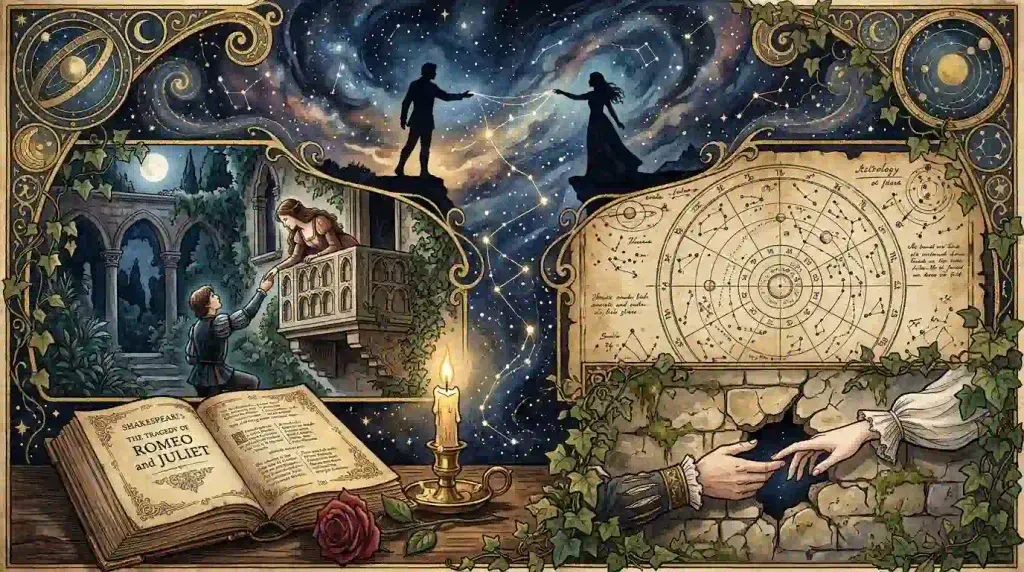
The phrase is best known from William Shakespeare’s play Romeo and Juliet. The play was written in the mid-1590s and first printed in 1597. In the opening speech, called the prologue, the narrator tells the audience how the story will end. One line says, “A pair of star-cross’d lovers take their life.”
That one line gave the English language a lasting phrase. Many language scholars point to this play as the earliest well-known use of “star-crossed” in English. If you are looking for the true first use, check a trusted dictionary such as the Oxford English Dictionary, because early records can be hard to confirm.
The story is simple. Romeo and Juliet live in the city of Verona. Their families, the Montagues and the Capulets, hate each other. The two young people fall in love anyway. They marry in secret, but a string of bad choices, bad timing, and bad news leads to tragedy. In the end, their deaths finally stop the feud between the families.
Shakespeare did not invent the idea of doomed lovers. Stories like this are older than his play. But his words turned the idea into a short, memorable phrase that people still use more than four hundred years later.
Why Did People Blame the Stars?
To understand this phrase, it helps to know how people thought in Shakespeare’s time. Astrology was a common belief. Many people thought the position of the stars and planets at your birth could shape your life. A good alignment brought good luck. A bad one brought trouble.
Because of this, people used the sky to explain sad events. If a baby was born sick, if a business failed, or if love went wrong, someone might say the stars were against them. It was a way to explain pain that seemed to have no cause.
Today, most people do not believe the stars control their love lives. Still, the phrase lives on because it is a beautiful way to describe bad luck. When we say “star-crossed,” we usually mean “fate was against them,” even if we do not believe in astrology.
There is another side to this idea that is worth knowing. In Shakespeare’s play, the lovers also make bad choices. They rush into marriage, they act in secret, and they do not ask for help. So some readers say the stars were not the only problem. People argue about this in classrooms to this day, and there is no single correct answer.
Famous Star Crossed Lovers From Stories and Legends
Many cultures have their own tales of doomed love. Here are some of the best known.
Romeo and Juliet are the most famous pair. Their families were enemies, and their love ended in tragedy.
Tristan and Isolde come from a medieval legend. Tristan is sent to bring Isolde to marry his uncle, the king, but the two fall in love along the way. Their love breaks the rules of loyalty and duty.
Pyramus and Thisbe come from an ancient Roman story told by the poet Ovid. Two neighbors in love are kept apart by their parents and talk through a crack in a wall. Many people believe this tale helped inspire Shakespeare’s famous play.
Layla and Majnun come from an old Arabic story that was retold by many poets, including the Persian writer Nizami in the twelfth century. Layla’s family refuses to let her marry the poet she loves. He is so lost in love that he is called Majnun, which means “mad.”
Heer and Ranjha are a beloved couple in Punjabi folk tradition. Their story was made famous in a poem by Waris Shah in the eighteenth century. Family pressure and social rules keep them apart.
Lancelot and Guinevere come from the legends of King Arthur. Guinevere is married to the king, and Lancelot is his loyal knight, so their love threatens the whole kingdom.
| Couple | Where the Story Comes From | What Keeps Them Apart |
| Romeo and Juliet | Shakespeare’s play | A family feud |
| Tristan and Isolde | Medieval European legend | Duty to a king |
| Pyramus and Thisbe | Ancient Roman poetry | Angry parents |
| Layla and Majnun | Arabic and Persian tradition | Family refusal |
| Heer and Ranjha | Punjabi folk tale | Family and social rules |
| Lancelot and Guinevere | King Arthur legends | Loyalty to the king |
Common Reasons Lovers Become Star Crossed
If you look at these stories, you will notice a pattern. The same few obstacles come up again and again. Writers like them because readers understand them right away.
Family fights are one of the most common. Two people fall in love, but their families are enemies. Social class is another. One person is rich and the other is poor, and the world will not allow the match. War and distance can also do it. Soldiers leave, borders close, and letters get lost.
Other stories use rules and duty. A person may already be promised to someone else, or may have a job or role that forbids love. Sickness and time can also play a part. In some stories, one person is ill, or the two meet at the wrong moment in their lives.
| Obstacle | How It Works in a Story | Example |
| Family feud | Two families hate each other | Romeo and Juliet |
| Social class | Wealth or rank divides the pair | Titanic |
| Duty or loyalty | A promise blocks the love | Tristan and Isolde |
| Distance or war | The lovers are far apart | Many wartime love stories |
| Illness | Health or time works against them | The Fault in Our Stars |
How to Use “Star Crossed Lovers” Correctly
Using the phrase well is easy once you know the rules.
First, use it for a couple, not a single person. The word “lovers” already tells us there are two. You would not call one lonely person star-crossed in the same way.
Second, use it when something outside the couple blocks them. If two people simply broke up because they stopped caring, they are not star-crossed. The phrase needs strong love plus an outside obstacle.
Third, you can use it in a few different ways. It works as a plain description, as in “They were star-crossed lovers.” It also works as a short label for a story, as in “It is a star-crossed love story.” You can use it for real people too, though it fits best when the couple truly faced something hard.
Here are some simple examples:
- “The two nurses were star-crossed lovers who met during the war.”
- “Their star-crossed romance ended when his family moved overseas.”
- “She loved stories about star-crossed couples, so she picked Romeo and Juliet.”
As for the hyphen, it is safest to write “star-crossed” with a hyphen in formal writing, such as school essays. In casual writing, you will often see it without one. Both are understood.
Common Mistakes to Avoid
Even people who love this phrase sometimes get it wrong. Here are the mistakes to watch for.
The biggest mistake is using it for any sad love story. A breakup caused by cheating or a simple fight is not star-crossed. Fate or the outside world has to play a part.
Another mistake is thinking it only means “tragic.” Many star-crossed stories do end sadly, but the phrase is about the obstacle, not the ending. A couple can be star-crossed and still find a way through in the end.
Some people also mix up “star-crossed” with “cross-eyed” or “crossed stars” in a silly way. Others forget that the phrase is old, so they use it in a joking way that feels out of place in serious writing. Be mindful of your tone.
Finally, be careful with the claim that Shakespeare invented the phrase. It is safer to say he made it famous. Language history is tricky, and early records can be hard to prove.
Star Crossed Lovers in Movies, Books, and Songs
The idea is everywhere in modern culture. Writers keep coming back to it because readers feel it deeply.
West Side Story, a famous musical from the 1950s, moves Romeo and Juliet to New York City. The rival groups there are street gangs instead of noble families. Titanic tells a story of love across social classes on a doomed ship. The popular novel The Fault in Our Stars by John Green is about two teenagers who meet and fall in love while facing serious illness.
That last title has a fun link to Shakespeare. It comes from a line in Julius Caesar: “The fault, dear Brutus, is not in our stars.” The line says that people are responsible for their own choices, not the stars. It is a nice contrast to the star-crossed idea, and John Green’s book plays with it.
Many songs and TV shows also use the idea. The phrase is often a short way to say “a romance with big problems.” When you see it in a movie description, expect strong feelings and a hard road for the couple.
Star Crossed vs. Forbidden Love vs. Soulmates
People often mix these three ideas, but they are not the same. Knowing the difference can make your writing sharper.
“Forbidden love” means the relationship is against a rule. It might be against family wishes, a law, or a job rule. The focus is on the ban.
“Soulmates” means two people who seem made for each other. The focus is on a perfect match, with no sad obstacle needed.
“Star-crossed” focuses on fate and bad luck. The couple is often a good match, and the world still gets in the way.
| Term | Main Idea | Is Fate Involved? | Typical Mood |
| Star-crossed lovers | Love blocked by fate or the world | Yes | Sad, romantic |
| Forbidden love | Love against a rule or ban | Not always | Tense, secret |
| Soulmates | A perfect, deep match | Often | Warm, hopeful |
A couple can fit more than one label. Romeo and Juliet are star-crossed, and their love is also forbidden. Many people would call them soulmates too.
Why We Love Star Crossed Love Stories
You might ask why sad love stories are so popular. There are a few good reasons.
First, they show how strong love can be. When two people risk everything, readers feel the size of their feelings. Second, the stories let us feel big emotions in a safe way. We can cry at a movie and then go on with our day. Third, almost everyone has felt blocked from something they wanted. Distance, timing, or family pressure are real problems, so these tales feel true.
There is also a lesson tucked inside many of these stories. They often show what happens when anger, pride, or fear wins. In Romeo and Juliet, the feud is the real villain. The families only learn their lesson after it is too late. That gives the story a deeper message about peace and listening.
Tips for Using the Phrase in Your Own Writing
If you want to use the phrase in an essay, a story, or a post, a few simple tips will help.
Be specific. Instead of just saying “star-crossed lovers,” tell the reader what keeps them apart. A short detail, such as “a feud between two towns,” makes the idea feel real.
Do not overuse it. A phrase this strong works best once or twice. If it shows up in every paragraph, it loses its power.
Match the mood. The phrase is serious and poetic, so it fits romance, drama, and school essays. It may sound odd in a funny or casual note unless you are joking on purpose.
Last, check your facts. If you mention Shakespeare, say that he wrote Romeo and Juliet in the 1590s. If you are not sure about a date or a claim, leave it out or look it up in a trusted source.
FAQs
What is the simple meaning of star crossed lovers?
It means two people who love each other but cannot be together because of fate, family, or other outside problems. The love is real, but the world gets in the way.
Who first used the term “star-crossed”?
The best-known early use is in Shakespeare’s Romeo and Juliet, written in the 1590s. Experts often credit this play with making the word famous, but you should check a trusted dictionary for the exact first record.
Do star crossed lovers always die?
No. The famous examples often end in tragedy, but the phrase is about the obstacle, not the ending. Some star-crossed couples find a way to be together.
Is it “star-crossed” or “star crossed”?
Both are used. The hyphenated form, “star-crossed,” is the more formal and common choice in print. The meaning does not change.
Are Romeo and Juliet the only star crossed lovers?
Not at all. Tristan and Isolde, Pyramus and Thisbe, Layla and Majnun, and Heer and Ranjha are other well-known pairs. Many modern books and movies use the same idea.
Can I use the phrase for real people?
Yes, if the couple faced real outside obstacles such as war, distance, or family pressure. Just avoid using it for a regular breakup, since the phrase needs strong love and a blocking force.
Conclusion
The star crossed lovers meaning is easy to hold on to once you break it down. It describes two people who truly love each other, yet fate, family, or the world keeps them apart. The phrase became famous through Shakespeare’s Romeo and Juliet, and it grew out of an old belief that the stars shape our lives.
Today, you do not have to believe in astrology to enjoy the phrase. It is a graceful way to talk about love that meets hard luck. Remember to use it for couples, not single people, and only when an outside force is the problem. Add a clear detail about what blocks the pair, and your writing will feel richer.
Whether you are studying a play, writing a story, or just curious, you now know what the phrase means and how to use it well. Pick one famous couple from this guide and read their story. You will see why it has lasted for so long.

Hi, I’m Elias Monroe. I enjoy writing meaningful prayer content that helps people feel calm, hopeful, and spiritually strong. My goal is to share words that bring comfort during both joyful and difficult times.